

Property management is one of the most misunderstood areas of Real Estate Professional Status (REPS).
Investors often ask two opposite questions:
- Can I qualify for REPS if I hire a property manager?
- If I manage other people’s properties, does that qualify me for REPS?
The answer to both is: it depends on the services you personally perform and whether you materially participate in your own rental activities.
Under guidance from the Internal Revenue Service in Publication 925, REPS requires:
- 750+ hours in real property trades or businesses
- More than 50% of your working time in those activities
- Material participation in your rental properties
Property management can help satisfy some of these requirements — but not always in the way people assume.
Scenario 1: Claiming REPS When You Have a Property Manager
Many investors believe that hiring a property manager automatically disqualifies them from REPS.
That’s not true.
The IRS does not prohibit using professional management. What matters is whether you are still actively involved in operating your rentals.
You simply cannot count the property manager’s hours — only your own.
Activities That May Still Count Toward REPS
Even with a property manager, investors often perform many operational tasks themselves.
Examples include:
- Selecting and hiring a property manager
- Setting rental strategy and pricing
- Approving tenant selections
- Reviewing lease terms
- Approving repairs and maintenance
- Overseeing renovations or capital improvements
- Evaluating property performance
- Meeting contractors for major work
- Visiting properties to inspect work
- Communicating regularly with the property manager about operational issues
These activities may count toward your REPS hours if they involve real operational decision-making.
When Using a Property Manager Makes REPS Harder
Problems arise when investors become completely passive.
Examples that generally carry little weight:
- Simply receiving monthly reports
- Skimming financial statements
- Letting the property manager make all decisions
- Rarely communicating about property operations
If the property manager performs nearly all services and you rarely intervene, demonstrating material participation becomes difficult.
Scenario 2: Claiming REPS as a Property Manager
Now let’s flip the situation.
Some property managers assume that because they spend hundreds of hours managing properties, they automatically qualify for REPS.
Not necessarily.
Managing properties for others may help you satisfy the 750-hour and 50% working-time tests, but that alone is not enough to unlock the tax benefits of REPS.
Why Managing Other People’s Properties Is Not Enough
REPS changes how your own rental activities are treated for tax purposes.
Even if you manage properties for clients all year, the IRS still requires that you materially participate in your own rental properties.
This is where many property managers get confused.
Your management work may help you qualify as a real estate professional — but you still need to demonstrate participation in the rentals where you are claiming losses.
Example
Imagine a property manager who:
- Works 1,600 hours managing properties for clients
- Owns two rental properties personally
They may satisfy the 750-hour REPS requirement easily.
But if their own rentals are handled entirely by someone else — and they perform little work on them — those activities may still be considered passive.
Material Participation Still Applies
Even after meeting the REPS thresholds, the IRS still evaluates whether you materially participate in your rental activities.
Material participation tests often include:
- 500 hours in the activity
- 100+ hours and more participation than anyone else
- Substantially all participation
If your own rentals are mostly handled by someone else, meeting these tests may be difficult.
The Two Layers of REPS
Understanding REPS becomes much easier when you separate the two layers.
Layer 1: Real Estate Professional Qualification
You must perform:
- 750+ hours in real property trades or businesses
- More than 50% of your working time in real estate
Property management work — including managing other people’s properties — can help satisfy this layer.
Layer 2: Material Participation in Your Rentals
You must still materially participate in the rental activities where you claim losses.
This requirement applies whether you are:
- A full-time investor
- A property manager
- A real estate agent
- A developer
Without material participation, rental losses remain passive even if you qualify as a real estate professional.
What the IRS Often Looks For
In REPS audits, the IRS commonly evaluates:
- Logs showing services performed
- Operational decisions you made
- Frequency of involvement in your rentals
- Evidence supporting your hours
Investors who maintain detailed records have a much stronger position.
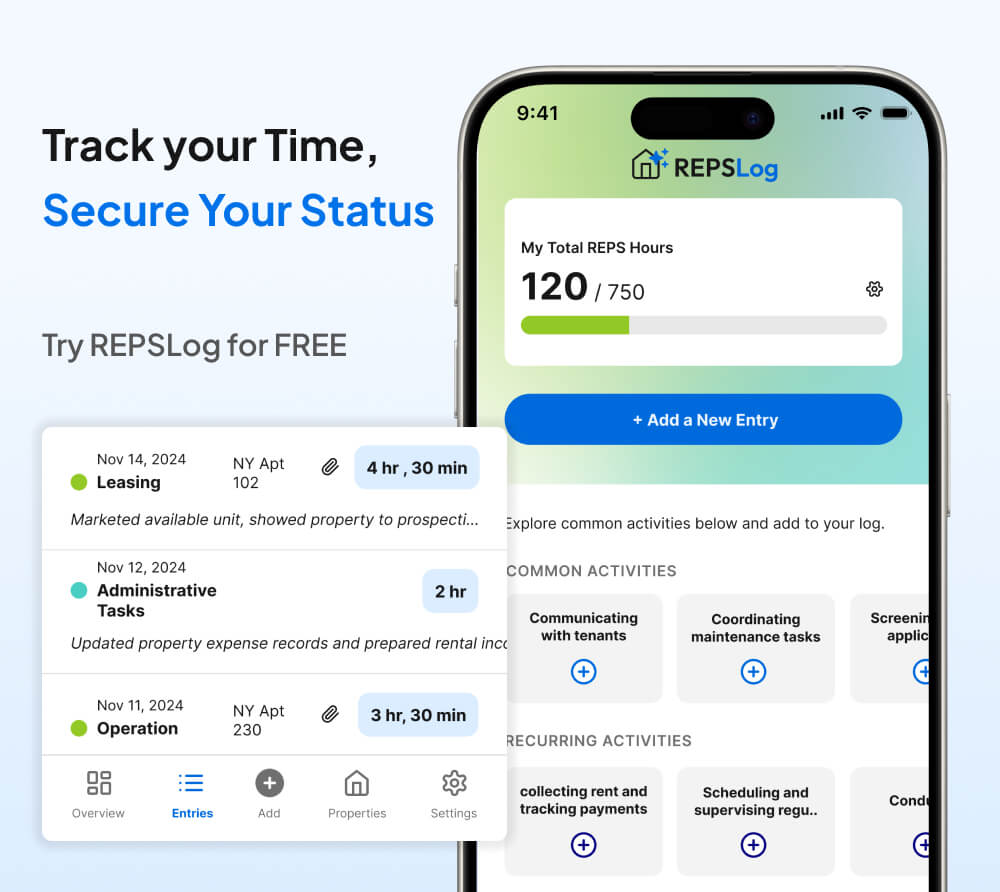
How REPSLog Helps Track Property Management Activities
Tracking hours across multiple properties — and distinguishing between your rentals and other activities — can quickly become complicated.
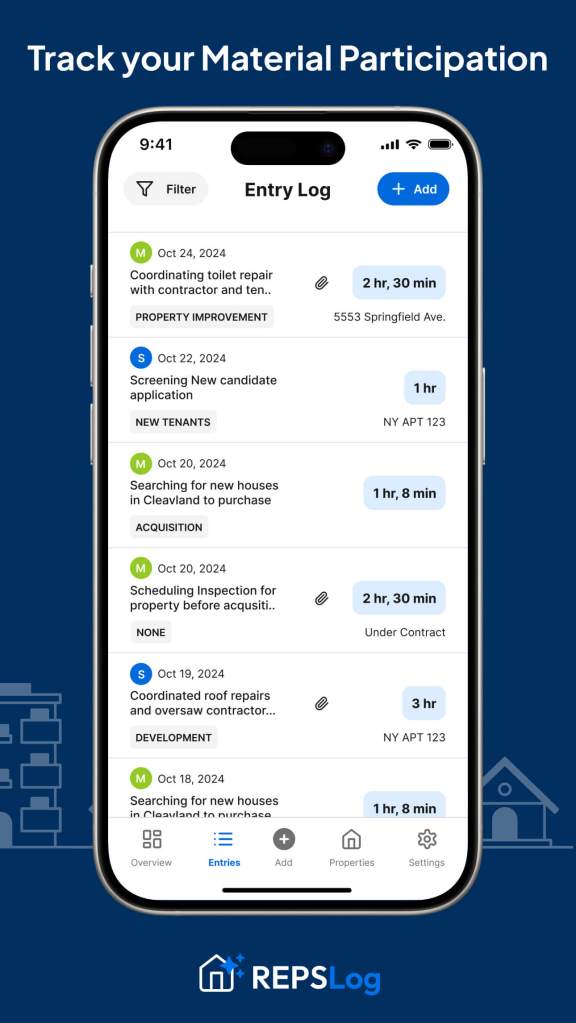
REPSLog helps by allowing investors and professionals to:
- Log activities as they happen
- Track hours across multiple properties
- Separate activities related to personal rentals from other real estate work
- Use timers for real-time tracking
- Upload supporting evidence such as invoices and approvals
- Track other participants to understand who performed the most services
When material participation depends on showing that you performed real operational work, clear documentation becomes critical.
The Bottom Line
Property management can support REPS — but only under the right conditions.
If you hire a property manager, you must remain actively involved in operating your rentals.
If you work as a property manager, your hours may help you qualify as a real estate professional — but you still need to materially participate in your own rental properties.
Understanding this distinction is key to correctly applying REPS rules.
Frequently Asked Questions
Can I qualify for REPS if I use a property manager?
Yes. You can still qualify if you personally perform enough real estate services and remain involved in managing your rentals.
Do property manager hours count toward REPS?
No. Only the hours you personally perform count toward your REPS calculation.
Can property managers qualify for REPS?
Yes, but they must still materially participate in their own rental properties to claim the tax benefits.
Does approving repairs count toward REPS?
Yes, when you are actively managing the decision and directing the work.
Does reviewing property manager reports count?
It may count if it leads to operational decisions, but passive review alone is generally weak support for REPS hours.
Please Note: REPSLog is NOT a lawyer or CPA, and this is not legal or financial advice. Please consult a qualified professional for guidance regarding IRS rules and regulations.




 REPSLog Blog