

Managing your first rental property feels simple.
You find a tenant, collect rent, handle a few issues, and it works. It even feels like passive income.
Then you add a second or third property, and something changes.
Messages come in at random times. Repairs turn into coordination. You’re juggling vendors, tenants, pricing, and small tasks that never fully go away.
At that point, the question becomes unavoidable:
Should you self-manage your rental property or hire a property manager?
Self-Managing vs Property Manager: What’s the Difference?
Self-managing means you handle everything yourself, including tenant communication, maintenance, leasing, and operations.
Hiring a property manager means outsourcing the day-to-day management of your rental property, typically for a fee of 8–12% of monthly rent.
Both approaches work. The real difference is what you are optimizing for.
What You’re Really Deciding
This decision is not just about convenience.
It comes down to priorities.
Self-managing tends to maximize control, profit, and involvement. Hiring a property manager shifts things toward time savings and simplicity.
There is no universal right answer. You are choosing a trade-off based on your situation.
Pros and Cons of Self-Managing Rental Property
Self-managing is often seen as the default, especially for newer investors. But it comes with both advantages and trade-offs.
On the upside, you keep more of your cash flow. Property management fees typically range between eight and twelve percent of rent, and over time that difference becomes significant, especially across multiple properties.
You also stay close to your business. You see what is happening in real time, understand tenant behavior, and make better decisions based on direct experience.
For investors pursuing strategies like Real Estate Professional Status (REPS) or short-term rental tax benefits, this level of involvement can be important. Being actively engaged helps you accumulate and demonstrate qualifying activity.
At the same time, self-managing requires consistent effort. You are responsible for communication, coordination, and ongoing decisions. While no single task is overwhelming, the accumulation creates constant pressure, which is where many investors start to feel burned out.
Pros and Cons of Hiring a Property Manager
Hiring a property manager shifts your role from operator to overseer.
The biggest benefit is time. You are no longer handling tenant communication, maintenance coordination, or day-to-day issues. This can significantly reduce mental load and make your real estate portfolio feel more passive.
It also makes it easier to manage properties that are not local. If you invest out of state or across multiple cities, having someone on the ground becomes much more practical.
The trade-off is cost and control. Property managers charge ongoing fees, and you rely on them to make decisions that directly impact your investment. You also lose some visibility into the details of how your properties are being run.
For investors focused on REPS or STR strategies, reduced involvement can also matter. If you are less engaged, it may become harder to meet participation requirements.
Do You Need a Property Manager for Rental Property?
You do not necessarily need a property manager, even with multiple properties.
Many investors successfully self-manage small and mid-sized portfolios. Others choose to hire managers early to reduce time commitment.
A property manager becomes more useful when:
- you have limited time
- your properties are not local
- you prefer a hands-off approach
If none of these apply, self-managing can still be a strong option.
A Practical Way to Decide
Instead of following a rule of thumb, it is better to look at your situation more closely.
The number of properties you own is one factor, but structure matters more. A few disorganized properties can feel overwhelming, while a larger portfolio with systems in place can remain manageable.
Your available time is critical. If you can consistently dedicate time each week, self-managing tends to work well. If you are constantly squeezing tasks into small gaps, issues tend to build up.
Your goals also play a role. If you are optimizing for higher returns or trying to qualify for tax benefits tied to your activity, staying involved is important. If your priority is reducing day-to-day involvement, hiring a manager may be the better fit.
Location is another consideration. Local properties are easier to manage directly. As distance increases, coordination becomes more difficult and the value of a manager increases.
The Hybrid Approach Most Investors Use
In practice, many investors do not fully choose one side.
They keep control of their properties but outsource specific tasks such as cleaning, maintenance, or inspections. This reduces workload while maintaining visibility and involvement.
This approach often provides the best balance between control, efficiency, and scalability.
The Part Most Investors Miss
Whether you self-manage or hire a property manager, one factor tends to matter more than the decision itself.
Organization.
Many investors struggle because their systems are inconsistent. Tasks are scattered, activities are not tracked clearly, and important details are easy to lose over time.
A structured approach makes everything easier. When activities are organized and tied to specific properties, the entire operation becomes more manageable.
Why This Matters for REPS and STR
If you are pursuing tax strategies like REPS or short-term rental benefits, your level of activity is only part of the equation.
You also need to be able to prove it.
This means keeping consistent, property-level records over time. Trying to reconstruct your activity later is difficult and often unreliable.
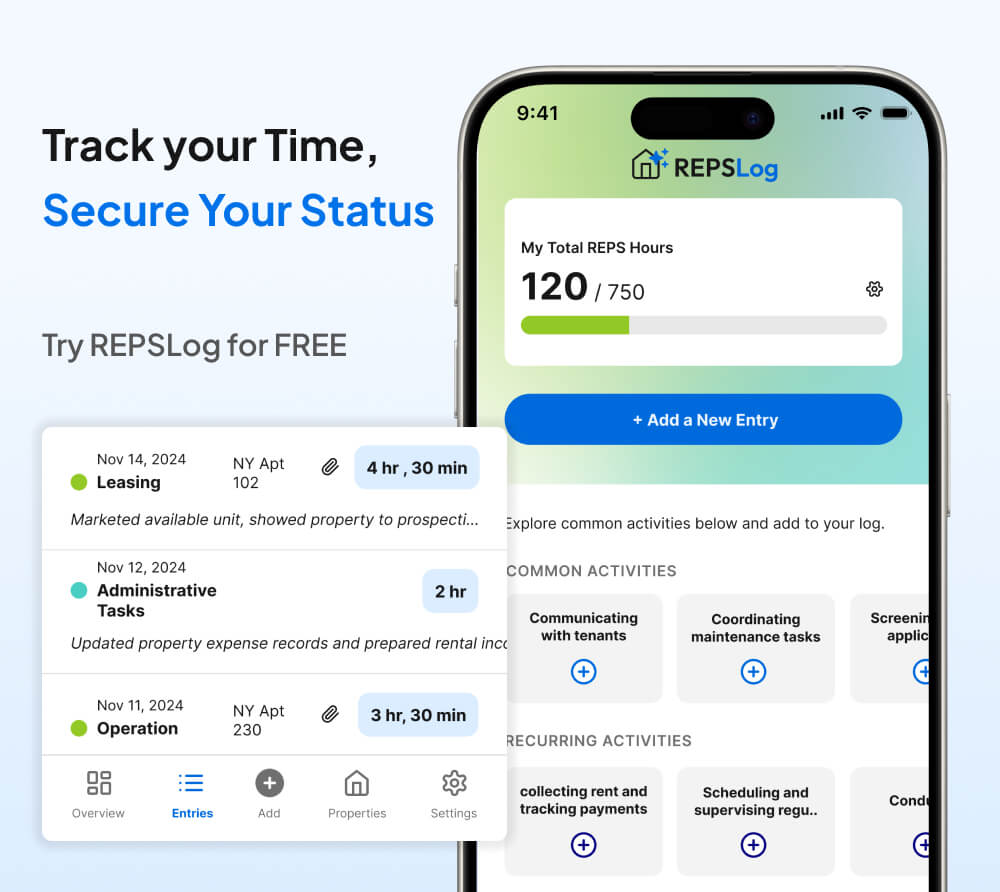
A better approach is to track activity as it happens. Some investors do this manually, while others use tools like REPSLog to log time per property, categorize tasks, and maintain organized records without adding extra complexity.

Final Takeaway
There is no single right answer to whether you should self-manage or hire a property manager.
If your goal is to maximize profit, stay involved, and support tax strategies, self-managing often makes sense.
If your goal is to reduce time commitment and simplify operations, hiring a property manager can be worth the cost.
For many investors, the most effective solution is somewhere in between.
The key is not choosing the “perfect” approach, but choosing one that aligns with your time, your goals, and how involved you want to be in your real estate business.
Please Note: REPSLog is NOT a lawyer or CPA, and this is not legal or financial advice. Please consult a qualified professional for guidance regarding IRS rules and regulations.





 REPSLog Blog