The 750-hour requirement is the single most concrete benchmark in qualifying for Real Estate Professional Status (REPS). Unlike the more-than-half test, which depends on your total work across all professions, the 750-hour rule is an absolute number. You either hit it or you do not. There is no sliding scale, no partial credit, and no workaround.
Yet despite its apparent simplicity, the 750-hour rule is where most REPS claims break down. Investors miscategorize activities, round up hours, fail to log consistently, or discover in April that they fell short the previous year. This guide provides a detailed breakdown of exactly what counts, what does not, and how to track your hours so that you never find yourself guessing.
Understanding the 750-Hour Threshold
The 750-hour requirement comes from IRC Section 469(c)(7)(B). To qualify as a real estate professional, you must perform more than 750 hours of personal services during the tax year in “real property trades or businesses” in which you materially participate.
A few critical points embedded in that sentence:
Personal services — This means work you perform yourself. Hours logged by your employees, contractors, or property managers do not count toward your 750 hours. You can hire people to handle work on your properties, but their time is their time, not yours.
Real property trades or businesses — The activities must fall within the 11 categories defined under IRC Section 469(c)(7)(C). We will cover these in detail below.
Material participation — You must materially participate in the real property trades or businesses where you are logging hours. If you are a silent investor in a real estate syndication, those hours do not count.
Per year — The 750-hour test resets every January 1. Hours from the prior year do not carry forward. Each tax year stands on its own.
The 11 Real Property Trades or Businesses
IRC Section 469(c)(7)(C) defines “real property trade or business” as any real property development, redevelopment, construction, reconstruction, acquisition, conversion, rental, operation, management, leasing, or brokerage trade or business. Let us examine each one and what activities fall under it.
1. Development
Entitling raw land, securing zoning changes, obtaining permits, conducting feasibility studies, working with engineers and architects on site plans, managing the entitlement process through municipal agencies. If you are taking land from raw to buildable, this is development.
2. Redevelopment
Repositioning an existing property for a higher or different use. Converting an office building to residential units, renovating a dated apartment complex to command higher rents, adapting a retail space for mixed-use occupancy. Redevelopment is distinct from routine maintenance — it involves a fundamental change in the property’s character or market position.
3. Construction
Building new structures. This includes managing general contractors, reviewing draw schedules, conducting site inspections during construction, coordinating with subcontractors, and overseeing punch lists. If you are an owner-builder on your own projects, virtually all of your construction-related hours qualify.
4. Reconstruction
Rebuilding or restoring properties that have been damaged or deteriorated. Insurance claim work following a fire or natural disaster, structural rebuilding, and restoration of historic properties all fall under reconstruction.
5. Acquisition
The full lifecycle of purchasing property. Sourcing deals, reviewing listings, driving neighborhoods, meeting with brokers, analyzing financials, performing due diligence, negotiating purchase agreements, coordinating inspections, working with lenders on financing, and closing transactions. Every hour spent acquiring properties for your portfolio counts.
This is a category many investors undercount. The research, analysis, and negotiation that goes into a single acquisition can represent dozens or hundreds of hours, and every one of them qualifies.
6. Conversion
Changing the use of a property. Converting a single-family home into a duplex, turning a long-term rental into a short-term vacation rental, or adapting commercial space for a different business type. The planning, permitting, and physical work involved in conversion all qualify.
7. Rental
Managing rental properties in all their dimensions. This is the broadest category for most investors and includes:
- Marketing vacant units and creating listings
- Showing properties to prospective tenants
- Screening applications (background checks, credit checks, income verification)
- Executing lease agreements
- Collecting rent and managing deposits
- Addressing maintenance requests and coordinating repairs
- Conducting property inspections (move-in, move-out, periodic)
- Handling evictions and legal proceedings
- Managing short-term rental operations (guest communications, turnover coordination, pricing strategy, review management)
- Coordinating cleaning and restocking between guests
- Dealing with HOA matters related to rental use
8. Operation
Day-to-day operational tasks for your properties. Paying property-related bills, managing insurance policies, handling utility setup and transfers, maintaining landscaping, overseeing snow removal, managing pest control, and ensuring properties meet code requirements. If it keeps the property running, it is an operational activity.
9. Management
Managing the business side of your real estate activities. This includes overseeing property managers (even if you have hired one, the time you spend directing and reviewing their work counts), managing your portfolio strategy, analyzing property performance, preparing budgets, reviewing financial reports, and making capital improvement decisions.
It also includes managing people who work on your properties — supervising contractors, coordinating with handymen, and directing cleaning crews.
10. Leasing
While there is overlap with rental activities, leasing specifically covers the process of finding and securing tenants. Lease negotiations, drafting lease terms, handling lease renewals, processing lease modifications, and managing lease compliance all fall under this category.
11. Brokerage
If you are a licensed real estate agent or broker, the hours you spend on brokerage activities count fully. Showing properties to buyers, listing homes for sellers, attending open houses, negotiating offers, managing transactions through closing, prospecting for clients, and completing continuing education required by your license all qualify.
This is why real estate agents who also invest often have the easiest path to REPS qualification — their day job already generates hundreds or thousands of qualifying hours.
Activities That Many Investors Miss
Beyond the obvious tasks, several legitimate activities are frequently overlooked:
Education and Research
Time spent on real estate education that directly relates to your trades or businesses counts. This includes attending investor meetups, taking courses on property management or analysis, watching educational content about real estate strategies relevant to your portfolio, reading books on landlord-tenant law in your state, and researching market conditions in areas where you invest.
The key qualifier is “directly related.” A general investing seminar that covers stocks, bonds, and real estate would only qualify for the portion specifically addressing real estate topics.
Travel Time
Driving to and between properties for management, inspection, or operational purposes is a qualifying activity. If you drive 45 minutes each way to inspect a property, coordinate a repair, or meet a contractor, that 90 minutes counts. Keep a mileage log alongside your time log — it corroborates your entries.
However, travel must be for a qualifying purpose. Driving past a property you might want to buy without stopping or taking any action is not the same as driving to a property to perform a physical inspection and due diligence assessment.
Administrative and Bookkeeping
Managing the financial side of your real estate activities is qualifying work. Categorizing expenses, reconciling accounts, preparing financial statements, managing payroll for property-related employees, and organizing documentation all count. So does time spent communicating with your CPA about property-specific tax matters.
Market Research for Acquisitions
Analyzing comparable sales, studying rental rate trends, evaluating neighborhoods, reviewing demographic data, and building financial models for potential acquisitions all qualify under the acquisition category. For active investors, this research can represent a significant time commitment that is often underlogged.
Technology and Systems
Setting up and managing property-related technology — smart locks, security cameras, noise monitoring devices, pricing software for STRs, property management software — counts as operational time. So does creating and maintaining property listings on various platforms.
Activities That Definitely Do Not Count
Investor Activities
Reading about real estate as a general interest, reviewing your net worth statements, monitoring your portfolio performance from a distance, and attending conferences as a passive spectator are investor activities, not operational ones. The distinction matters: an investor watches from the sidelines; a professional is on the field.
Work on Your Personal Residence
Mowing your own lawn, renovating your own kitchen, or maintaining your primary home does not count — even if you own it. REPS hours must be in trades or businesses, and your personal residence is not a trade or business.
Time as a Limited Partner
By statutory definition, limited partners do not materially participate. If your real estate involvement is through limited partnership interests, those hours are excluded.
Passive Monitoring
Checking your bank account to confirm rent was deposited, glancing at a security camera feed, or receiving an automated report from your property manager does not constitute active participation. The IRS looks for substantive involvement, not passive observation.
What a Typical Week Looks Like
Understanding how 750 hours translates to weekly effort helps with planning. Dividing 750 by 52 weeks yields approximately 14.4 hours per week. That is just over 2 hours per day, seven days a week — or about 3 hours per day on a 5-day schedule.
Here is an example of what a qualifying week might look like for an active investor managing a portfolio of rental properties:
Monday (3 hours)
- 1.5 hours: Reviewed three potential acquisition opportunities, ran initial financial analysis on two of them
- 0.5 hours: Called contractor to schedule bathroom repair at 456 Oak Ave
- 1.0 hour: Drove to 789 Pine St to inspect completed roof repair, documented condition with photos
Tuesday (2.5 hours)
- 1.0 hour: Showed vacant unit at 123 Main St to prospective tenant, discussed lease terms
- 0.5 hours: Processed tenant application — ran background and credit check
- 1.0 hour: Responded to maintenance requests from three tenants, coordinated repair schedules
Wednesday (3 hours)
- 2.0 hours: Attended real estate investor meetup, discussed market trends and STR regulations in my area
- 1.0 hour: Updated financial records for all properties, categorized recent expenses
Thursday (2 hours)
- 1.0 hour: Met with insurance agent to review and update property coverage
- 1.0 hour: Researched short-term rental regulations for potential conversion of long-term rental
Friday (2.5 hours)
- 1.5 hours: Drove to and inspected two properties for potential acquisition, took notes and photos
- 1.0 hour: Prepared and sent lease renewal to tenant at 321 Elm St
Saturday (1.5 hours)
- 1.0 hour: Coordinated turnover at STR property — confirmed cleaning crew, restocked supplies
- 0.5 hours: Responded to guest inquiry and managed booking for STR property
Weekly Total: 14.5 hours — on pace for approximately 754 hours annually.
Why Rounding and Estimating Destroys Your Claim
One of the most damaging practices is rounding up time entries. Logging “2 hours” for a task that took 80 minutes, or entering “1 hour” for a 30-minute phone call, introduces inaccuracies that compound over 52 weeks. If the IRS audits your claim and determines that even 15% of your logged hours are inflated, you could drop below 750 and lose your entire REPS deduction — not just the inflated portion.
Tax Court judges have explicitly addressed this issue. In multiple cases, courts have applied a percentage haircut to taxpayers’ claimed hours when the log appeared to contain systematic rounding or estimation. A log that shows entries exclusively in whole hours or half-hours raises a red flag. Real activities take 23 minutes or 1 hour and 40 minutes, not conveniently rounded numbers.
Be precise. If a task took 45 minutes, log 45 minutes. If it took 20 minutes, log 20 minutes. Precision signals authenticity.
Tracking Best Practices
Log in Real Time (or Close to It)
The gold standard is logging activities as you complete them or at the end of each day. Waiting until the end of the week invites memory errors. Waiting until the end of the month guarantees them. Waiting until tax season to reconstruct a full year of activities is a recipe for audit failure.
Be Specific in Your Descriptions
“Property management — 2 hours” will not survive IRS scrutiny. Compare that to:
- “Drove to 123 Main St to meet plumber for water heater replacement. Inspected old unit, discussed options, approved replacement. Waited on-site during installation and confirmed proper operation. 2 hours 15 minutes.”
The second entry tells a story. An auditor can verify it — there should be a plumber’s invoice dated the same day, a payment record, and perhaps a receipt for the new water heater.
Tie Entries to Properties
Every entry should be associated with a specific property or, at minimum, your real estate portfolio generally (for activities like market research or education that span multiple properties). If you have not made a Section 469 grouping election, property-level tracking is essential for proving material participation on each property individually.
Use a Dedicated Tracking System
Mixing your REPS log into a general calendar or catch-all spreadsheet creates retrieval problems and credibility concerns. A dedicated system — whether a purpose-built app or a separate, well-organized spreadsheet — demonstrates seriousness and intentionality.
Review Your Totals Monthly
Do not wait until December to discover you are behind. A monthly check-in takes five minutes and gives you the ability to course-correct. If you are averaging 10 hours per week in June, you know you need to increase your pace. Discovering this in January, after the tax year has closed, leaves you with no options.
Retain Supporting Evidence
Your time log is your primary documentation, but corroborating evidence strengthens it enormously. Keep receipts for property-related purchases, save emails and text messages with tenants and contractors, take photos during property visits, and maintain mileage records. You do not need to present all of this proactively, but having it available if questioned is invaluable.
Key Takeaways
- 750 hours is the absolute minimum — there is no rounding down, no partial credit, and no carryover from prior years
- Only personal services count — hours worked by employees, contractors, and property managers are excluded from your total
- The 11 qualifying categories are broad but have boundaries — investor-type activities, personal residence work, and passive monitoring are excluded
- Commonly missed activities include acquisition research, travel between properties, education, administrative work, and technology management
- Rounding and estimation are dangerous — precision in your log protects you; systematic rounding undermines your claim
- Contemporaneous logging is critical — real-time or same-day entries carry far more weight than reconstructed logs
- Monthly progress reviews ensure you stay on pace and can adjust before the year ends
Track Your 750 Hours With REPSLog
Reaching 750 hours is achievable for dedicated real estate investors. Proving it to the IRS is the hard part. Spreadsheets get abandoned, paper logs get lost, and mental estimates get rejected in Tax Court.
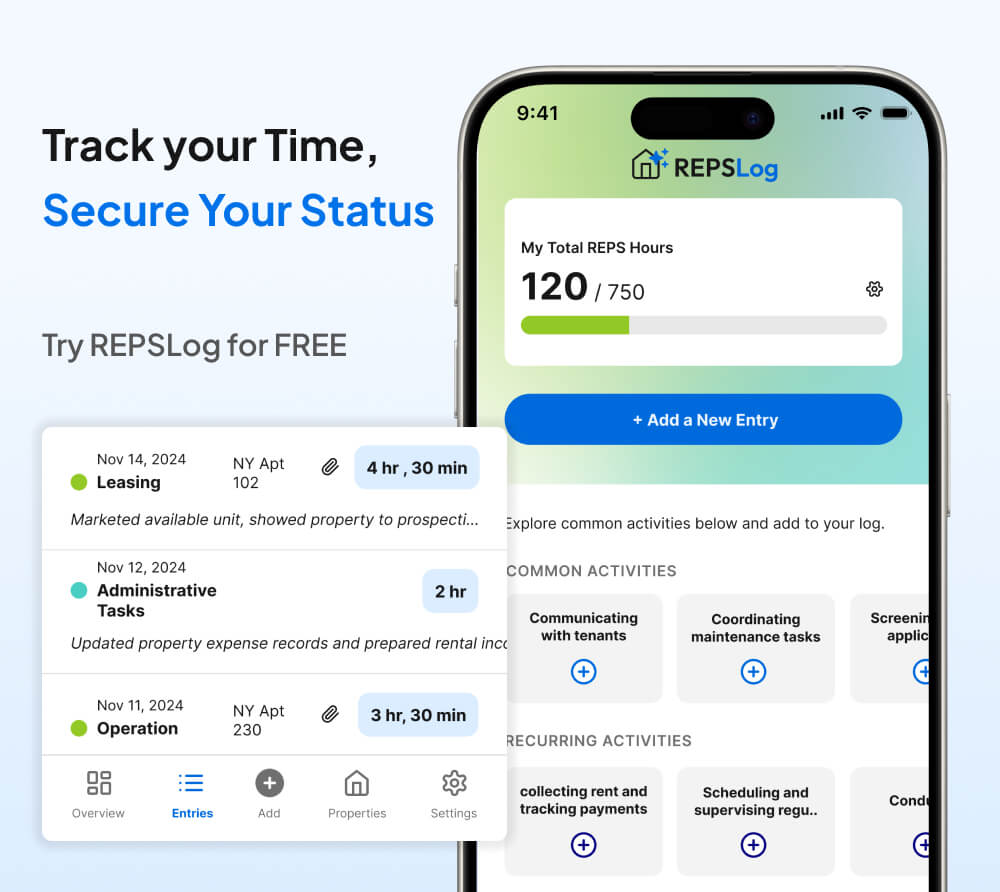
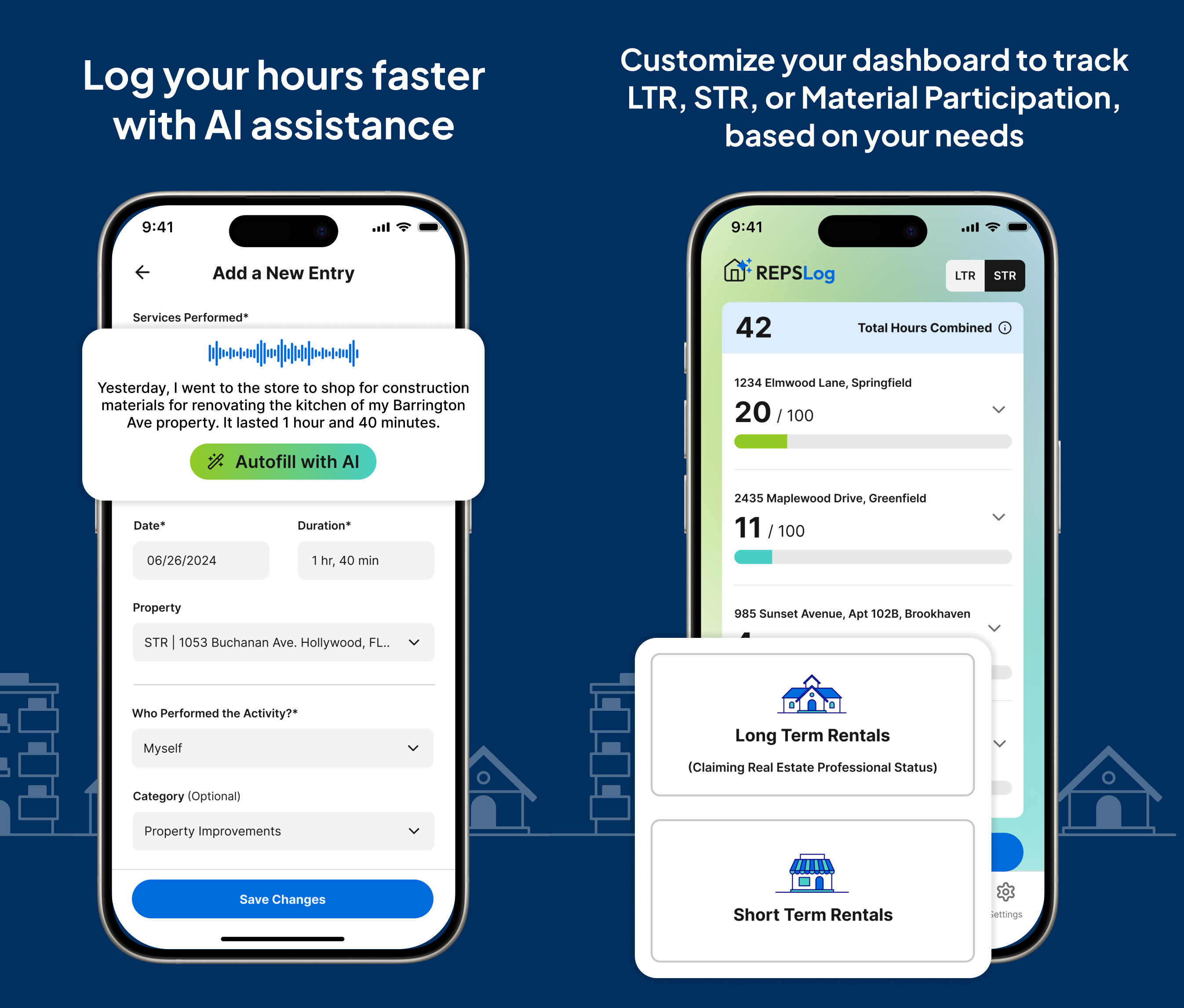
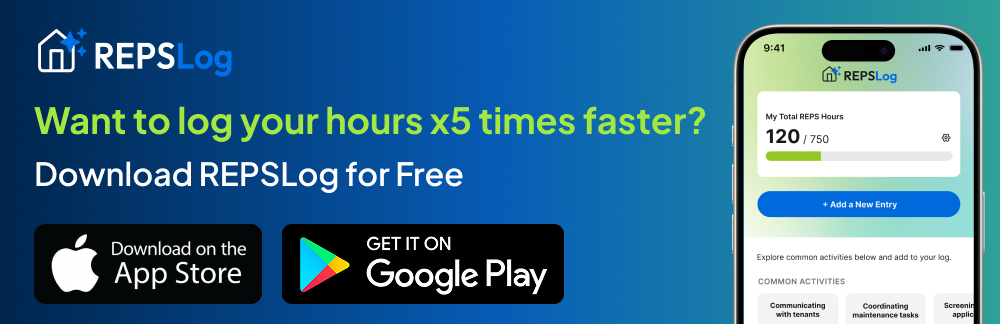
REPSLog is designed specifically for tracking REPS-qualifying hours. Log activities in seconds with descriptions, property assignments, and precise durations. See your running total at a glance so you always know exactly where you stand against the 750-hour threshold. When tax time arrives, export a clean, detailed report that your CPA can use directly.
Available on iOS and Android, or on the web at app.reps-log.com. Start tracking your hours free →. REPSLog takes the guesswork out of REPS qualification. Every hour you invest in your properties deserves to be counted.
This article is for educational purposes only and does not constitute tax or legal advice. Consult a qualified tax professional for guidance specific to your situation.
Do this in REPSLog
- REPS Hour Tracking Goals (750 / 500 / 100): pick the 750, 500 or 100-hour test and watch progress per year and per property.
- Hours Dashboard and Stats: hours by property, category and year against your goal.
- Built-in Timer with Live Activity: time an activity live and drop the minutes into an entry.
Step by step in the Help Center: how to use it. Try REPSLog free for 14 days on iPhone, Android or the web app.