House flipping and Real Estate Professional Status occupy an interesting intersection in the tax code. Flipping is undeniably a real estate activity, and the hours you spend flipping absolutely count toward the 750-hour REPS threshold. But the tax benefits of REPS do not apply to flipping profits in the way many investors expect.
Understanding this distinction is critical for real estate investors who flip houses and own rental properties simultaneously. The hours are powerful, but only if you understand exactly what they can and cannot do for your tax situation.
Flipping Is a Qualifying Real Estate Activity
Under IRC Section 469(c)(7)(C), a “real property trade or business” includes development, construction, acquisition, conversion, and brokerage activities, among others. House flipping hits multiple categories on this list: acquisition, development, construction, reconstruction, and conversion all describe various aspects of the flipping process.
This means that every hour you spend on a flip project counts toward the REPS qualification tests. Sourcing deals, analyzing acquisition targets, negotiating purchase contracts, managing renovations, coordinating contractors, selecting materials, overseeing construction timelines, staging the property, listing it for sale, showing it to buyers, and handling the closing process all generate qualifying hours.
For active house flippers, accumulating more than 750 hours in a year is often straightforward. A single flip project can easily generate 500 or more hours of active work, and investors managing multiple flips simultaneously can accumulate well over 1,000 hours.
How Flipping Hours Help the 750-Hour Test
The 750-hour test looks at your total hours across all real property trades or businesses in which you materially participate. Flipping hours combine with rental management hours, brokerage hours, construction hours, and any other qualifying real estate activity.
This creates a powerful opportunity for investors who both flip and hold rental properties. Consider an investor who spends 500 hours on flip projects and 400 hours managing rental properties. Individually, neither activity reaches 750 hours. Combined, the investor has 900 hours of qualifying real estate work, comfortably exceeding the threshold.
The same principle applies to the more-than-half test. If your combined real estate hours (flipping plus rentals plus any other qualifying activity) exceed your hours in all other trades or businesses, you pass the second REPS test.
Why Flipping Does Not Directly Generate REPS Tax Benefits
Here is where many investors get confused. REPS is primarily valuable because it allows taxpayers to deduct rental real estate losses against ordinary income without being limited by the passive activity loss rules. Under normal passive activity rules, rental losses can only offset rental or other passive income. REPS removes that limitation for qualifying taxpayers.
But flipping income is not rental income. In most cases, the IRS treats flip properties as dealer property, essentially inventory held for sale in the ordinary course of business. The profit from a flip is ordinary income, not passive income and not capital gains. It is already taxed at ordinary income rates, and the passive activity rules do not limit it.
This means REPS status does not change the tax treatment of your flipping profits. Those profits are taxed the same way whether or not you are a real estate professional.
Where REPS helps is with your rental portfolio. If you own rental properties that generate losses (due to depreciation, mortgage interest, repairs, and other deductible expenses), REPS status allows you to deduct those rental losses against your flipping income and any other ordinary income. Without REPS, those rental losses would be suspended under the passive activity rules.
The Strategy: Flip to Qualify, Rent to Deduct
The most effective use of flipping hours in a REPS strategy is as the engine that drives REPS qualification, while rental properties provide the deductible losses.
Scenario: You spend 600 hours flipping houses and 300 hours managing four rental properties. Your flipping business generates $150,000 in ordinary income. Your rental portfolio generates $80,000 in losses (after depreciation, interest, and expenses).
Without REPS, the $80,000 in rental losses is suspended because it is passive activity loss. You owe taxes on the full $150,000 of flipping income.
With REPS (qualified through your combined 900 hours), you can deduct the $80,000 rental loss against your $150,000 flipping income, reducing your taxable income to $70,000. The tax savings at a 32% marginal rate would be approximately $25,600.
The flipping hours got you REPS status. REPS status unlocked the rental loss deduction. The rental losses reduced your tax on flipping income.
Material Participation: The Activity-Level Requirement
REPS status alone is not enough to deduct rental losses. You must also materially participate in each rental activity (or in a grouped rental activity). This is a separate test from the REPS qualification tests.
For your flipping business, material participation is usually not an issue since you are actively running the business. The question arises with your rental properties.
There are seven tests for material participation under IRC Section 469(h), and you only need to meet one of them for each activity. The most commonly used tests for rental activities are:
More than 500 hours. You spend more than 500 hours during the year on the rental activity. This can be tough if you have many properties and limited time.
Substantially all participation. Your participation constitutes substantially all the participation by any individual in the activity. If you self-manage without a property manager, this test is usually met.
More than 100 hours and not less than anyone else. You spend more than 100 hours on the activity, and no other individual spends more hours than you on it.
For investors with multiple rental properties, the grouping election under Treas. Reg. Section 1.469-9(g) can be a game-changer. This election allows you to treat all of your rental real estate interests as a single activity for material participation purposes. Instead of proving material participation for each property individually, you prove it once for the entire grouped rental activity. If you spend a combined 600 hours across all your rentals, you meet the 500-hour test for the grouped activity.
Flipping vs. Holding: Tax Treatment Differences
Understanding the distinct tax treatment of flips and rentals is essential for strategic tax planning.
Flipping (dealer property): Gains are ordinary income taxed at your marginal rate. No depreciation deduction during the holding period (typically short). No Section 1031 exchange eligibility. Self-employment tax may apply. No passive activity limitation because the income is not passive.
Rental (investment property): Rental income or loss is calculated after depreciation, interest, and expenses. Losses are generally passive and limited unless REPS applies. Long-term capital gains treatment on sale (after depreciation recapture). Section 1031 exchanges are available. No self-employment tax on rental income.
The key insight is that REPS is most valuable for investors who hold rental properties with significant paper losses (primarily from depreciation) while earning income from other sources (including flipping). The rental losses shelter the other income from tax.
Documenting Flipping Hours for REPS
Flipping activities generate natural documentation opportunities that you should capture systematically.
Acquisition phase. Log time spent analyzing deals, visiting properties under consideration, reviewing comps, meeting with agents, attending auctions, negotiating offers, and handling due diligence. Include communications with lenders, title companies, and inspectors.
Renovation phase. Document contractor management time separately from self-performed labor. For contractor oversight, record what you directed, inspected, decided, or approved, not just that you were present. For self-performed work, log the specific tasks and time spent.
Disposition phase. Track time spent on listing preparation, staging, photography, marketing, open houses, buyer negotiations, inspection responses, and closing coordination.
Administrative time. Do not overlook bookkeeping, accounting, insurance management, entity structuring, and other administrative activities related to your flipping business.
Each entry should specify the property address, the activity performed, and the time spent. Generic entries like “worked on flip” do not meet the IRS documentation standard.
Key Takeaways
- House flipping is a qualifying real property trade or business, and flipping hours count toward the 750-hour REPS threshold.
- REPS does not change the tax treatment of flipping profits, which are taxed as ordinary income regardless of REPS status.
- The strategic value of flipping hours for REPS is in qualifying for status that unlocks rental loss deductions against your flipping and other ordinary income.
- Material participation must be established at the activity level. The grouping election under Treas. Reg. Section 1.469-9(g) can consolidate multiple rental properties into a single activity for this purpose.
- Flipping hours combine with rental management, brokerage, and other qualifying real estate hours for the 750-hour test.
- Document flipping activities with the same specificity required for any REPS claim: dates, property addresses, specific activities, and time spent.
Frequently Asked Questions
Can I flip houses and claim REPS without owning any rental properties?
Technically, yes. If you meet the 750-hour and more-than-half tests through your flipping activities, you qualify as a real estate professional. However, the tax benefits of REPS are primarily about deducting rental losses, so without rental properties, the status provides limited practical benefit.
Does flipping a single house qualify me for REPS?
It depends on the hours involved. A single flip can qualify you if it generates more than 750 hours and those hours exceed your hours in other trades or businesses. Extensive renovation projects on a single property can easily reach this threshold.
What if the IRS reclassifies my flipping income as capital gains?
If the IRS determines your flipping activity is investment activity rather than a trade or business (for example, if you flip one property over multiple years and it looks more like a buy-and-hold-and-sell strategy), the income may be treated as capital gains. This reclassification would also affect whether the hours count toward REPS, since the activity would no longer be a “trade or business.”
Can my spouse’s flipping hours help me qualify for REPS?
Your spouse’s hours cannot be combined with yours for purposes of the REPS qualification tests (the 750-hour test and the more-than-half test). However, under IRC Section 469(h)(5), your spouse’s hours can count toward material participation in a rental activity, which is the separate test you must pass to deduct rental losses after qualifying for REPS.
How does flipping affect the more-than-half test?
Flipping hours count as real estate hours on the favorable side of the more-than-half comparison. If you spend 1,200 hours flipping and 800 hours at a W-2 job, your 1,200 real estate hours exceed your 800 non-real-estate hours, passing the test.
Do I need to maintain separate logs for flipping and rental activities?
While not legally required, maintaining separate logs is strongly advisable. It makes material participation testing easier at the activity level, keeps your documentation organized, and simplifies the process if the IRS examines your REPS claim.
What about wholesaling? Do those hours count toward REPS?
Wholesaling real estate (placing properties under contract and assigning the contract to another buyer) involves real property acquisition and brokerage activities, which are listed as qualifying activities under IRC 469(c)(7)(C). The hours spent sourcing deals, analyzing properties, negotiating contracts, and coordinating assignments can count toward REPS qualification.
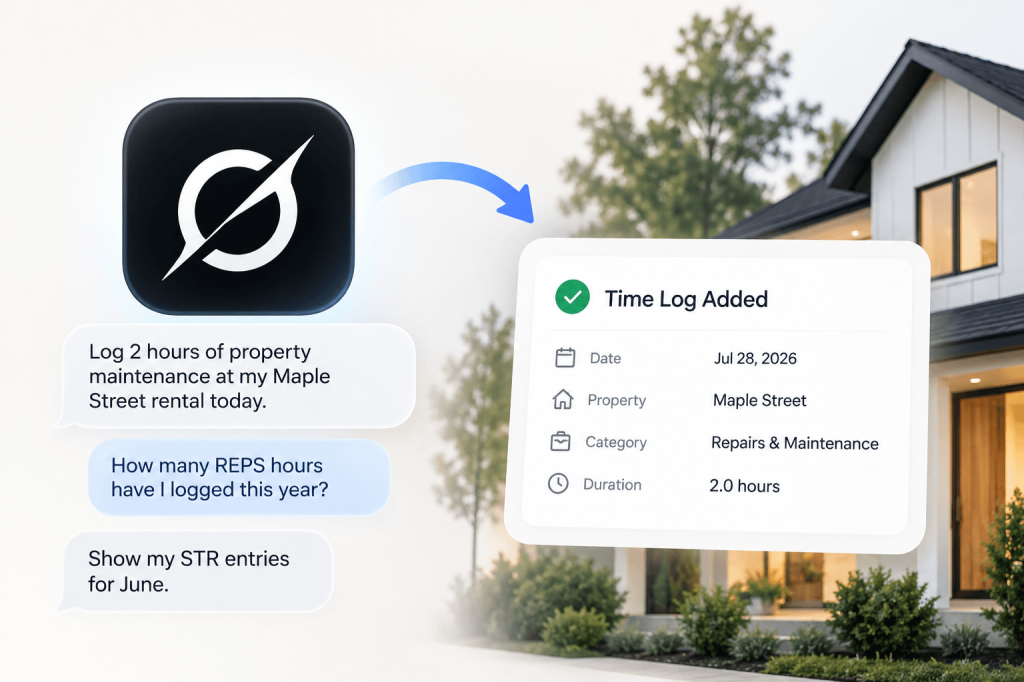
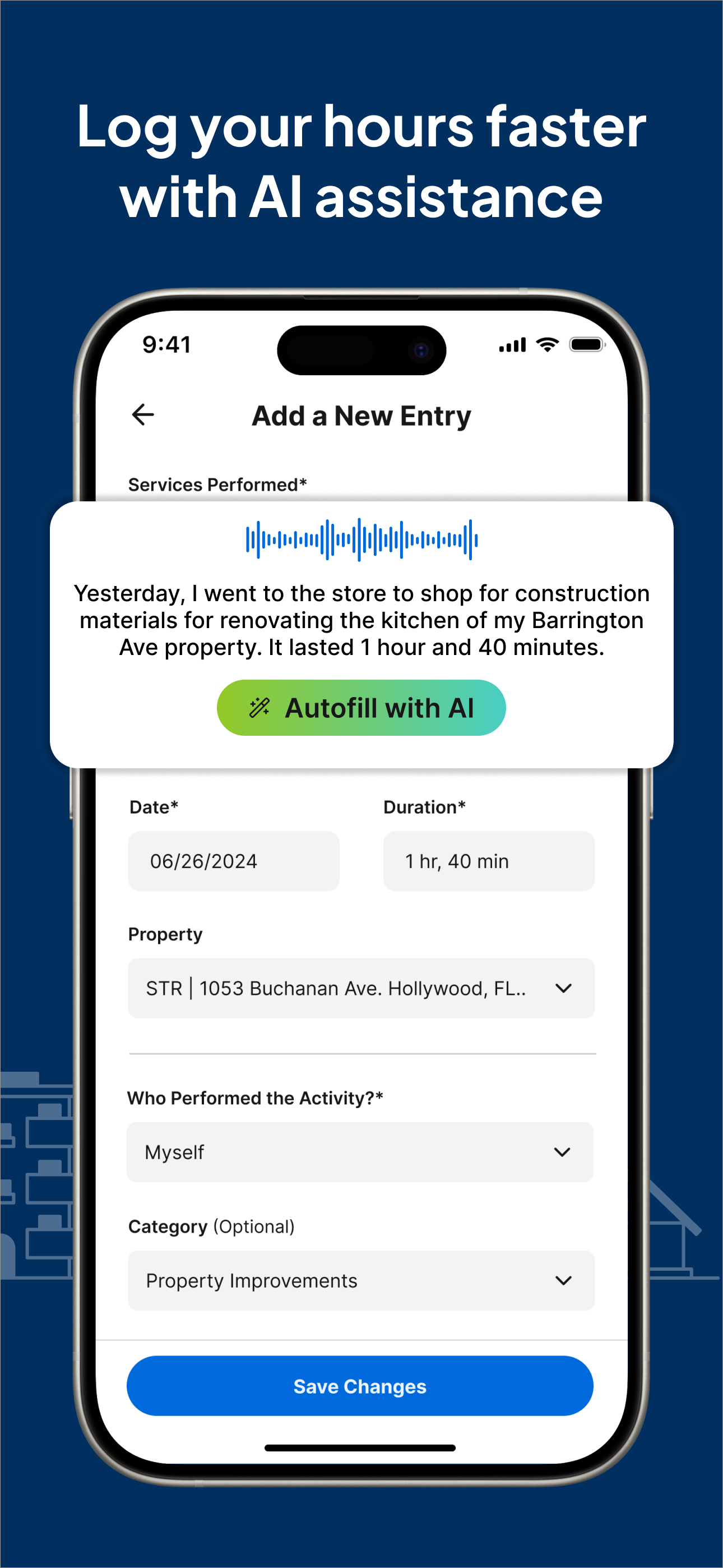
Whether you flip, hold, or both, tracking your hours with precision is what transforms real estate activity into a defensible REPS claim. REPSLog lets you categorize and log activities across your entire real estate portfolio, from flip projects to rental management, in one organized system. Get started on iOS, Android, or Web.
This article is for educational purposes only and does not constitute tax or legal advice. Consult a qualified tax professional for guidance tailored to your situation.
Do this in REPSLog
- Multiple Properties: add each rental by address, mark it LTR or STR, see hours per property.
- Calendar Integration (Google, Microsoft 365, device): turn past Google, Microsoft 365 or device calendar events into logged hours.
- REPS Hour Tracking Goals (750 / 500 / 100): pick the 750, 500 or 100-hour test and watch progress per year and per property.
Step by step in the Help Center: how to use it. Try REPSLog free for 14 days on iPhone, Android or the web app.