“How many properties do I need?” is one of the first questions real estate investors ask when they learn about Real Estate Professional Status. The answer surprises many people: there is no minimum number. You can qualify for REPS with a single property. But the number of properties you own profoundly affects how credible your hour claims appear, how material participation works, and whether a grouping election helps or hurts your position.
This article explains why property count matters even though no minimum exists, how the grouping election interacts with your portfolio size, and what challenges arise when you try to build a REPS case around a small number of properties.
There Is No Minimum Property Requirement
The REPS qualification tests under IRC Section 469(c)(7) do not mention a minimum number of properties. The two tests are purely hour-based:
You must spend more than 750 hours during the tax year in real property trades or businesses in which you materially participate.
Your real estate hours must exceed more than half of your total hours in all trades or businesses.
A taxpayer who owns one rental property and spends 800 hours managing, maintaining, and improving it while working no other job can technically qualify for REPS. The statute does not ask how many doors you have in your portfolio.
However, the practical reality is more nuanced. While no legal minimum exists, the number of properties you own creates the context in which the IRS evaluates whether your claimed hours are plausible.
Why More Properties Makes Hours More Credible
The IRS does not just check whether you logged 750 hours. They evaluate whether the hours you claim are reasonable given the scope of your real estate activities. This is where property count becomes indirectly important.
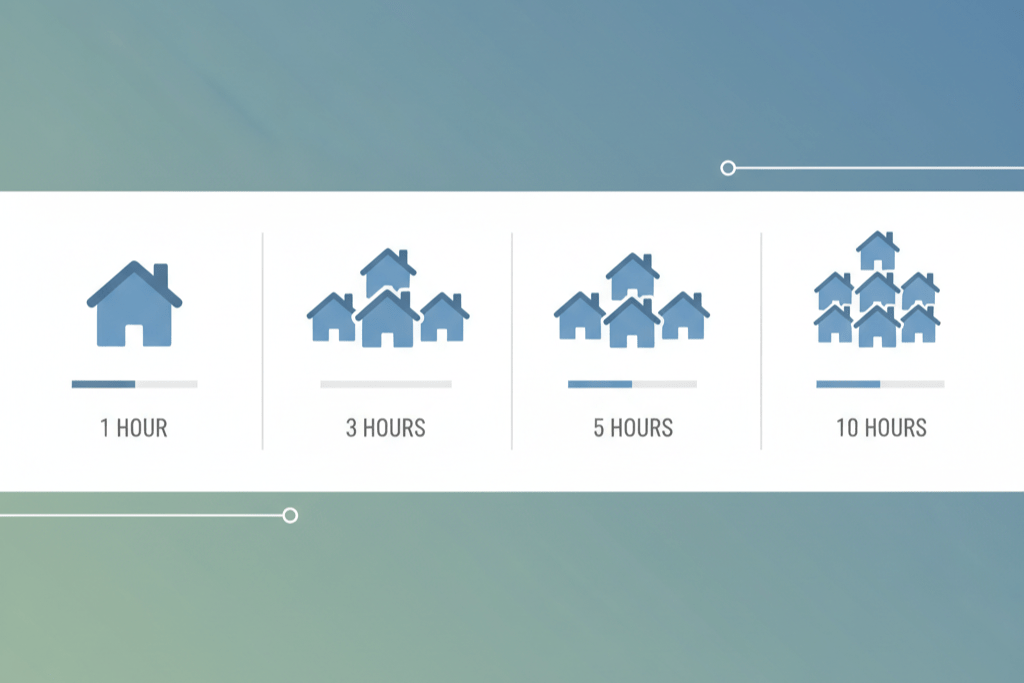
Single property. Claiming 750 hours on a single rental property means you spent an average of approximately 14.5 hours per week managing one property. For a simple single-family rental with a reliable tenant, that level of activity is difficult to justify. What are you doing for 14 hours per week at one property? Unless the property is undergoing a major renovation, has severe maintenance issues, or is a short-term rental with high turnover, the claimed hours may strain credulity.
Three to five properties. At this level, 750 hours translates to roughly 3 to 5 hours per week per property. This is far more plausible, especially if the properties involve tenant turnover, maintenance coordination, rent collection, financial management, and marketing. The IRS can see a reasonable connection between the scope of the portfolio and the hours claimed.
Ten or more properties. With a larger portfolio, 750 hours may actually be conservative. Managing ten rental units involves significant tenant relations, maintenance coordination, financial tracking, lease administration, and strategic planning. The hours almost explain themselves.
The point is not that you need a specific number of properties to qualify legally. It is that your claimed hours must be proportionate to the work your portfolio realistically generates. More properties generally means more work, which means more plausible hours.
The Single-Property Challenge
Qualifying for REPS with a single property is legally possible but practically difficult. Here is why.
Credibility of hours. As discussed above, an IRS examiner will question how a single rental property generates more than 750 hours of work in a year. You need a compelling explanation. Properties undergoing extensive renovation, new construction projects, properties with significant land management requirements, or short-term rentals with very high turnover rates can generate the necessary hours. A stabilized long-term rental with minimal issues cannot.
Material participation. You must materially participate in the rental activity. With a single property, this is actually easier to prove than with multiple properties because there is no ambiguity about where your time went. All your rental hours were spent on that one property.
Loss magnitude. REPS lets you deduct rental losses against ordinary income. A single property generates a limited amount of loss, primarily from depreciation. The tax benefit of REPS may not be worth the documentation effort for a small loss. However, for a high-value property with substantial depreciation (for example, a cost-segregation study accelerating depreciation on a $500,000 property), even a single property can generate significant losses.
Audit risk. REPS claims with a single property attract disproportionate scrutiny because the IRS knows the hours are harder to substantiate. If you claim REPS with one property, prepare for the possibility that your claim will be examined.
The Grouping Election Factor
The grouping election under Treas. Reg. Section 1.469-9(g) allows qualifying real estate professionals to treat all of their rental real estate interests as a single activity for purposes of the material participation test. This election can dramatically change the REPS calculus for investors with multiple properties.
Without a grouping election. Each rental property is a separate activity, and you must demonstrate material participation in each one individually. If you own five properties and spend 200 hours on three of them but only 50 hours on the other two, you might meet material participation on three properties but fail on two. The losses from the two failing properties would be suspended.
With a grouping election. All five properties are treated as a single activity. Your combined 700 hours across all properties easily meets the 500-hour material participation test. All losses from all properties are deductible.
How property count affects the grouping decision. The grouping election becomes more valuable as your portfolio grows. With two or three properties, you might be able to demonstrate material participation in each one individually. With eight or ten properties, grouping often becomes essential because it is difficult to spend 500 or more hours on each property independently.
The grouping election is not always beneficial. Once you group, you cannot ungroup (except in very limited circumstances). If you later sell a property at a gain, the grouped treatment may limit your ability to offset that gain with losses from other properties in the group. The decision to group should be made with your tax advisor’s guidance, considering your long-term portfolio strategy.
How Portfolio Composition Matters
Not all properties generate equal amounts of work. The types of properties in your portfolio affect both the total hours available and the plausibility of your REPS claim.
Short-term rentals (STRs). Properties listed on platforms like Airbnb, VRBO, or similar services generate significantly more management hours than long-term rentals. Guest communication, cleaning coordination, check-in/check-out logistics, listing optimization, pricing adjustments, supply management, and review management can easily produce 5 to 10 hours per week per property. An investor with three STRs can accumulate 750 hours without stretching credibility.
Long-term residential rentals. A stabilized long-term rental with a reliable tenant generates relatively few management hours, perhaps 2 to 4 hours per week on average, with spikes during turnover or maintenance events. You typically need more long-term rentals to justify 750 hours.
Commercial properties. Commercial leasing, tenant improvement coordination, CAM reconciliation, and lease negotiation can be time-intensive, especially during lease-up periods. Commercial properties often generate more hours per unit than residential rentals.
Properties under renovation. Active renovation projects are hour-intensive regardless of property type. A single property undergoing a major renovation can generate several hundred hours of qualifying work.
Mixed portfolios. Investors with a mix of property types often have the strongest REPS claims because the diversity of activities creates a natural, believable pattern of work. An investor who manages three long-term rentals, operates one short-term rental, and is renovating a fifth property has a rich, varied work profile that maps naturally to 750 or more hours.
Scaling Your Portfolio and REPS Together
If you are considering expanding your portfolio partly for REPS purposes, think strategically about acquisitions.
Adding properties that generate work. Properties with deferred maintenance, value-add opportunities, or short-term rental potential create natural hours. Buying a turnkey property with a long-term tenant in place adds a door to your portfolio but may not add significant hours to your log.
Geographic concentration. Properties in the same market reduce travel time and make management more efficient, but efficiency can work against REPS qualification by reducing your hours. There is an inherent tension between being an efficient landlord and accumulating REPS hours.
Self-management vs. property management. Self-managing your properties generates more hours than delegating to a property manager. If REPS qualification is important to your tax strategy, self-management keeps those hours in your column. (This trade-off is explored in detail in our article on qualifying for REPS with a property manager.)

Key Takeaways
- There is no legal minimum number of properties required for REPS qualification. The tests are purely hour-based.
- More properties make your hour claims more credible because a larger portfolio naturally generates more management work.
- Single-property REPS claims are legally valid but face heightened scrutiny and require a compelling explanation for the hours claimed.
- The grouping election under Treas. Reg. Section 1.469-9(g) becomes increasingly valuable as your portfolio grows, simplifying material participation testing across multiple properties.
- Portfolio composition matters as much as property count. Short-term rentals, renovations, and commercial properties generate more hours per unit than stabilized long-term residential rentals.
- Strategic portfolio growth should consider both the financial merits of acquisitions and their impact on your REPS hour generation.
Frequently Asked Questions
Can I qualify for REPS with just one rental property?
Yes, it is legally possible. You must spend more than 750 hours and pass the more-than-half test. The challenge is demonstrating that a single property realistically requires that level of involvement. Properties undergoing renovation, short-term rentals, or properties with significant management demands are the most plausible candidates.
Does the IRS have an unofficial minimum property threshold?
No. The IRS applies the statutory tests as written, which do not reference property count. However, IRS examiners will evaluate the reasonableness of your claimed hours in context, and a small portfolio generates less context for large hour claims.
Should I make a grouping election if I only have two properties?
It depends on whether you can meet material participation for each property individually. If you spend 400 hours on one property and only 80 on the other, grouping gives you a combined 480 hours as a single activity, which does not meet the 500-hour test. You might be better off claiming the 400-hour property under a different material participation test (such as the “substantially all” test if you self-manage) and accepting suspended losses on the second property.
Do properties I own through an LLC count?
Generally yes, depending on the LLC structure. Single-member LLCs are disregarded entities for tax purposes, so the properties are treated as yours. Multi-member LLCs taxed as partnerships or S-Corps have more complex rules about how member-level participation is measured.
What if I sell a property during the year? Do those hours still count?
Yes. Hours you spent on real estate activities related to a property you later sold during the year count toward your REPS qualification for the entire tax year. The 750-hour test is annual, and hours are counted regardless of whether you still own the property at year-end.
Can I count hours spent searching for new properties to buy?
Hours spent on acquisition activities, including property analysis, market research, property tours, due diligence, and negotiation, count toward REPS qualification under the “acquisition” category of real property trades or businesses. These hours count whether or not you actually purchase the property.
Is there a maximum number of properties that would make the IRS suspicious?
No. The IRS does not penalize large portfolios. In fact, a large portfolio generally strengthens your REPS claim because it makes the hour claims more plausible. The risk with a large portfolio managed by property managers is the material participation test, not the REPS qualification itself.
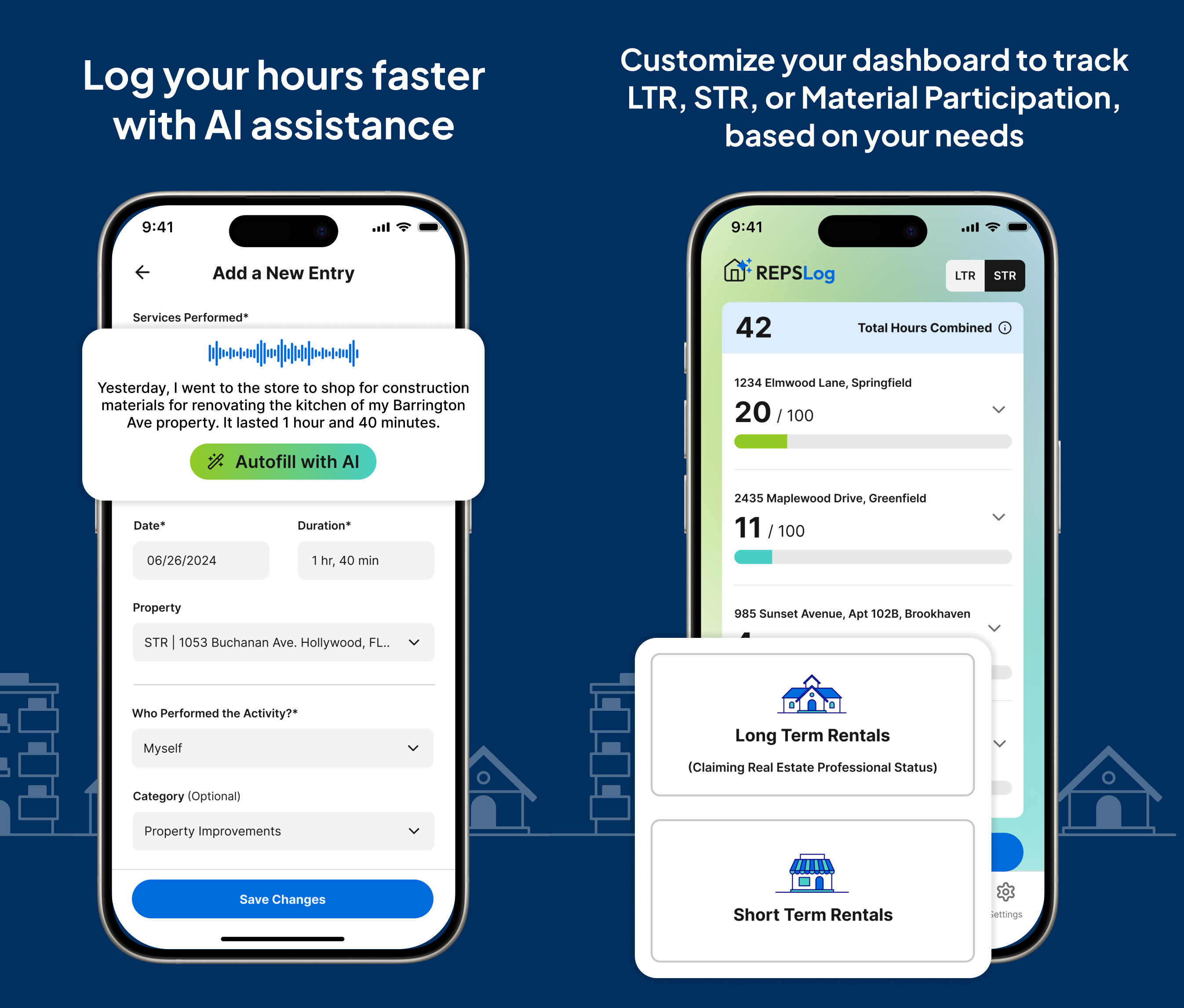
No matter the size of your portfolio, tracking every qualifying hour with precision is what makes your REPS claim defensible. REPSLog organizes your time tracking by property, letting you see exactly how your hours distribute across your portfolio and ensuring you have the detailed, contemporaneous records the IRS expects. Start tracking on iOS, Android, or Web.
This article is for educational purposes only and does not constitute tax or legal advice. Consult a qualified tax professional for guidance tailored to your situation.
Do this in REPSLog
- Multiple Properties: add each rental by address, mark it LTR or STR, see hours per property.
- Calendar Integration (Google, Microsoft 365, device): turn past Google, Microsoft 365 or device calendar events into logged hours.
- REPS Hour Tracking Goals (750 / 500 / 100): pick the 750, 500 or 100-hour test and watch progress per year and per property.
Step by step in the Help Center: how to use it. Try REPSLog free for 14 days on iPhone, Android or the web app.