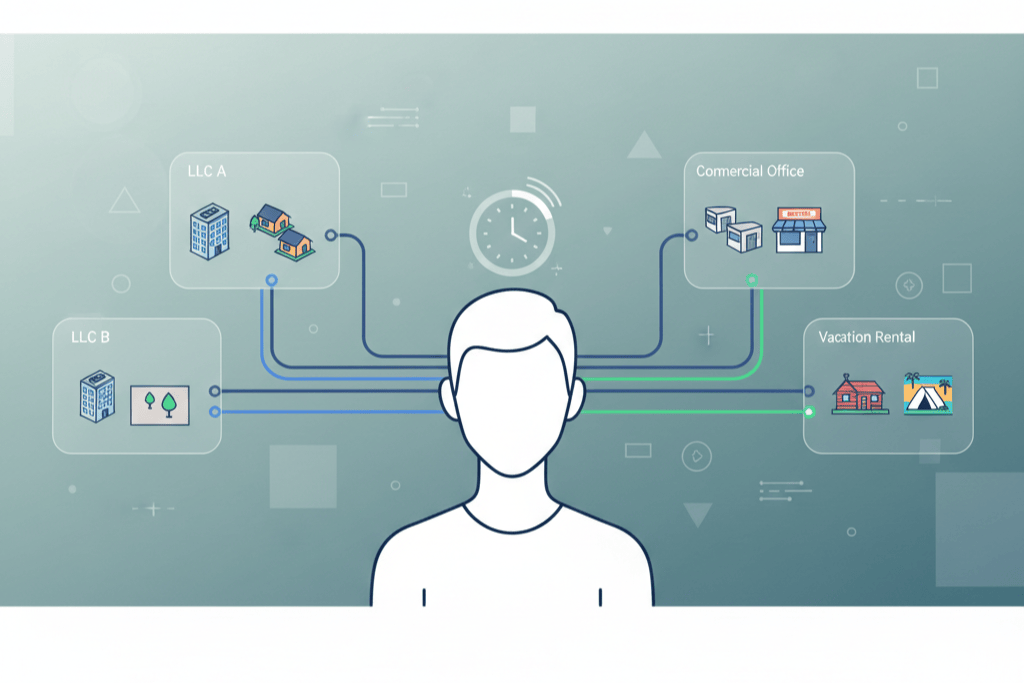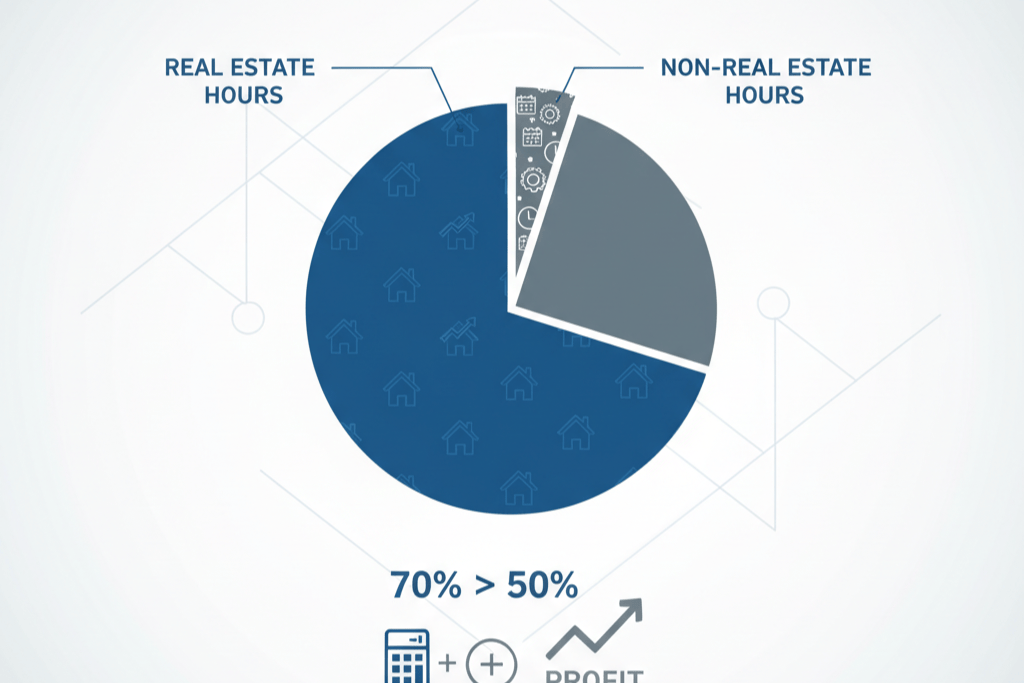
Making the leap from W-2 employment to full-time real estate investing is one of the most consequential financial and tax decisions you can make. From a REPS perspective, this transition fundamentally changes your qualification math: the more-than-half test goes from nearly impossible (when competing against 2,000+ W-2 hours) to nearly automatic (when you have no W-2 hours at all).
But the transition does not happen overnight, and the years leading up to it — and the year of the switch itself — require careful planning. Done well, the transition can unlock six figures in cumulative tax savings through REPS qualification, cost segregation, and accelerated depreciation. Done poorly, you can miss a critical qualification year, leave deductions on the table, or create audit risk during the most scrutinized period of the transition.
This guide provides a year-by-year timeline for transitioning from W-2 employee to full-time real estate investor, with a focus on maximizing REPS benefits at every stage.
Phase 1: Foundation Building (2-3 Years Before Transition)
Building the Portfolio
REPS qualification without a portfolio is pointless — you need properties generating depreciation losses to unlock. During this phase:
- Acquire 3-5 rental properties that will generate sufficient depreciation for meaningful tax savings once you qualify for REPS
- Order cost segregation studies on properties you plan to hold long-term (but consider timing the studies for when you will actually have REPS to use the losses)
- Establish property management systems so you understand the time commitment and can plan your hours realistically
Positioning for the Transition Year
Start tracking your real estate hours now, even though you probably will not qualify for REPS while working full time. This serves two purposes:
- Baseline data: You will know exactly how many hours you currently spend on real estate, helping you project whether you can qualify once you reduce W-2 hours
- Documentation habit: Building the logging habit before you need it is much easier than starting from scratch in the year you actually qualify
Financial Preparation
- Build a cash reserve of 12-24 months of living expenses to cover the transition period before rental income fully replaces your W-2 income
- Pay down high-interest debt while you still have W-2 income
- Maximize retirement contributions — you may have fewer tax-advantaged contribution options after leaving W-2 employment
- Refinance properties while you have W-2 income, as lending qualification is typically easier for employed borrowers
Spousal Strategy Assessment
If you are married, evaluate whether the transition should involve you or your spouse:
- If your spouse stays home or works part-time: Your spouse may already be able to qualify for REPS without any transition. You keep your W-2 income, and your spouse meets the 750-hour and more-than-half tests independently.
- If both spouses work: Determine which spouse leaving their W-2 would create the best financial outcome (consider income replacement, benefits, and long-term career impact)
- If you are single: The transition math is simpler but the financial risk is concentrated

Phase 2: The Bridge Year (1 Year Before Full Transition)
Reducing W-2 Hours
The bridge year is often the key to the entire strategy. If you can reduce your W-2 hours before fully leaving your job, you may be able to qualify for REPS a year earlier than planned.
Options for reducing hours:
- Negotiate a part-time arrangement: Move from 40 hours/week to 20-25 hours/week. This reduces your annual W-2 hours from ~2,080 to ~1,040-1,300.
- Take unpaid leave: A sabbatical or extended leave reduces your annual hours while maintaining your employment relationship.
- Shift to contract work: Converting from W-2 to 1099 does not change the more-than-half calculation, but it may provide more schedule flexibility to accumulate real estate hours.
The Math of the Bridge Year
Full-time W-2 scenario (2,080 hours): You need more than 2,080 real estate hours to pass the more-than-half test. At 40 hours/week of real estate on top of a full-time job, this is nearly impossible.
Part-time W-2 scenario (1,040 hours / 20 hrs per week): You need more than 1,040 real estate hours. At 21 hours/week of real estate (combining mornings, evenings, and weekends), this is achievable with an active portfolio.
Half-year W-2 scenario (leaving mid-year, 1,040 hours through June): Your real estate hours for the full year need to exceed 1,040 W-2 hours. If you shift to full-time real estate in July, you gain roughly 1,000+ hours in the second half of the year. Combined with 400-500 hours in the first half (while working part-time on real estate), you can comfortably exceed the threshold.
Timing the Exit
The calendar matters. If you leave your W-2 job:
- January 1: Your W-2 hours for the year are zero. The entire year is available for real estate hours. This is the cleanest transition.
- March-April: First-quarter W-2 hours (500-700) are manageable to overcome with 9 months of full-time real estate.
- June: Half-year W-2 hours (~1,040) require a strong second half of real estate activity.
- September-October: Late exits leave minimal time to accumulate real estate hours. Qualification for the transition year becomes difficult.
- November-December: Virtually impossible to qualify for REPS in the transition year if you worked full-time through October.
Cost Segregation Timing
If you have been holding off on cost segregation studies, the bridge year or transition year is the time to execute them. Look-back cost segregation studies allow you to claim cumulative catch-up depreciation via Form 3115 in the first year you have REPS to use the losses.
Coordinating cost segregation with your first REPS year creates the maximum impact: catch-up depreciation from prior years plus accelerated depreciation on any new acquisitions.
Phase 3: The Transition Year
Day One Documentation
The moment you leave your W-2 job (or reduce your hours), start documenting aggressively:
- Log every real estate activity with date, property, description, and duration
- Track your remaining W-2 hours precisely (not just your employment dates — your actual hours worked)
- Save your termination letter, final pay stub, and any documentation of your departure date and final hours
Ramping Up Real Estate Activity
With your W-2 hours eliminated or reduced, your real estate activity should expand to fill the time:
- Increase property inspections and oversight
- Take over management tasks you previously outsourced to a property manager
- Pursue acquisitions — due diligence, property tours, financial analysis
- Execute renovation projects that generate substantial qualifying hours
- Attend real estate education (seminars, courses, mastermind groups)
- Network with other investors and evaluate partnership opportunities
The 750-Hour Target
With a clean January 1 start, 750 hours over 52 weeks is roughly 14.4 hours per week. For a full-time investor, this should be well within reach. Target 1,000+ hours to provide a comfortable margin.
With a mid-year start, calculate your required weekly pace based on remaining weeks and your W-2 hours:
| Exit Month | Remaining Weeks | Required RE Hours | Weekly Pace |
|---|---|---|---|
| January | 52 | 751+ | ~14.5 |
| April | 39 | 751+ (also exceed ~800 W-2 hrs) | ~20+ |
| July | 26 | 751+ (also exceed ~1,040 W-2 hrs) | ~40+ |
A mid-year exit in July or later makes the transition year very challenging. Plan accordingly.
Managing the Income Gap
In the transition year, your income profile changes:
- W-2 income drops (partial year or reduced hours)
- Rental income continues (and may increase if you self-manage)
- REPS-qualified depreciation losses begin offsetting remaining income
- Health insurance must be addressed (COBRA, ACA marketplace, or spouse’s employer plan)
The tax savings from REPS can partially offset the income reduction. An investor who saves $40,000-$80,000 annually in taxes through REPS effectively replaces a significant portion of their former after-tax W-2 income.
Phase 4: Year One as Full-Time Investor
Establishing the Pattern
Your first full year without W-2 employment is the year that establishes your REPS qualification pattern. Make it count:
- Log consistently and thoroughly throughout the entire year
- Exceed 750 hours with a comfortable margin — aim for 1,000-1,500+
- Complete cost segregation studies on any properties not yet studied
- Execute your grouping election under Treas. Reg. 1.469-9(g) if you have not already
- Coordinate with your CPA to model the exact tax impact and optimize your filing strategy
Building Additional Income Streams
Many full-time investors build complementary income sources:
- Property management for others: Managing third-party properties generates income AND qualifying real estate hours
- Real estate consulting or coaching: If structured as a real property trade or business, these hours may count
- Real estate brokerage: Getting licensed and conducting transactions generates qualifying hours
- Development and flipping: Active development and construction generate high hours
Continuing the Portfolio Build
With REPS in place, every additional property with depreciation potential amplifies your tax savings:
- New acquisitions with cost segregation generate immediate losses
- Value-add properties generate both hours (renovation management) and enhanced depreciation
- 1031 exchanges allow you to trade into larger properties while deferring gains
Phase 5: Sustaining REPS Long-Term
Annual Qualification
REPS must be re-qualified every tax year. Once you are a full-time investor with no competing employment, the qualification should be straightforward — but do not become complacent:
- Continue logging activities consistently
- Monitor your hours against the 750-hour threshold quarterly
- Avoid taking on significant non-real-estate business activities that could jeopardize the more-than-half test
- Maintain your grouping election and update it when you acquire or dispose of properties
Protecting Against Life Changes
Events that can threaten ongoing REPS qualification:
- Taking a full-time job: Even temporarily, this can destroy the more-than-half test for the year
- Selling most of your portfolio: Fewer properties mean fewer hours and less depreciation
- Health issues: Inability to perform real estate activities reduces your hours
- Significant non-real-estate business ventures: Starting a restaurant, consulting firm, or other business adds hours to the denominator
Plan for contingencies. If you anticipate a life change that could affect qualification, discuss strategies with your CPA in advance.
Frequently Asked Questions
Can I qualify for REPS in the same year I leave my W-2 job?
Yes, but it depends on when you leave. Early departures (January-April) give you the most time to accumulate real estate hours. Late departures (September-December) make qualification for that year extremely difficult because your W-2 hours for the year may already exceed what you can accumulate in remaining months.
Should I keep my W-2 job and have my spouse qualify instead?
If your spouse can meet the 750-hour and more-than-half tests independently, this is often a better financial decision. You keep your W-2 income (and benefits) while your spouse’s REPS qualification allows rental losses to offset your combined income on a joint return. The only requirement is that the qualifying spouse meets both tests on their own.
What if I take a part-time job after becoming a full-time investor?
A part-time job adds hours to the denominator of the more-than-half test. As long as your real estate hours exceed your part-time job hours (and exceed 750), you still qualify. Monitor the ratio carefully and adjust your real estate activity if needed.
How do I handle health insurance after leaving my W-2 job?
Options include COBRA continuation (expensive, time-limited), ACA marketplace plans (income-based subsidies may apply, especially with REPS-reduced AGI), a spouse’s employer plan, or a health-sharing ministry. Note that REPS-qualified rental losses can reduce your modified AGI, potentially qualifying you for larger ACA subsidies.
Can I use the STR loophole during the transition instead of REPS?
Yes. If you own short-term rentals with average stays of 7 days or less, the STR loophole does not require the 750-hour or more-than-half tests. You only need material participation. This can be a bridge strategy while you are building toward REPS qualification.
What documentation should I keep from my W-2 departure?
Retain your final pay stub showing year-to-date earnings and hours, termination or resignation letter with effective date, any documentation of reduced hours or flexible work arrangements, W-2 form for the partial year, and records of any severance or transition compensation.

Key Takeaways
- Plan the transition 2-3 years in advance — build the portfolio, develop documentation habits, and prepare financially
- The bridge year is strategic — reducing W-2 hours before fully leaving can unlock REPS a year earlier
- Timing your exit matters — an early-year departure gives maximum time for qualification in the transition year
- Coordinate cost segregation with your first REPS year for maximum impact (including look-back studies via Form 3115)
- The more-than-half test becomes trivial once you have no W-2 employment, leaving only the 750-hour threshold
- Spousal qualification may be a better path — keeping W-2 income while a spouse qualifies for REPS
- Sustaining REPS requires annual vigilance — continue logging, avoid competing business activities, and plan for life changes
How REPSLog Supports Every Phase of Your Transition
Whether you are in the foundation-building phase (tracking hours alongside your W-2 job), the bridge year (monitoring your ratio as you reduce employment hours), or your first full year as an investor, REPSLog adapts to your stage.
Track real estate activities across all your properties. Monitor your progress toward 750 hours and the more-than-half ratio. Generate reports that your CPA can use to model the tax impact of your transition. And build the contemporaneous documentation habit now, so your records are bulletproof when REPS qualification begins.
Available on iOS and Android, or on the web at app.reps-log.com. Start tracking your hours free →
This article is for educational purposes only and does not constitute tax or legal advice. Consult a qualified tax professional for guidance tailored to your situation.