The 750-hour requirement gets most of the attention in Real Estate Professional Status (REPS) discussions. But it is the more-than-half test that actually disqualifies most aspiring real estate professionals — particularly those with full-time W-2 jobs. This test requires that more than half of the personal services you perform during the tax year are in real property trades or businesses. If your real estate hours do not exceed your non-real-estate hours, you fail, regardless of how many real estate hours you logged.
This guide explains exactly how to calculate the more-than-half test, what counts in the numerator and denominator, common miscalculations that trip up investors, and strategies for passing the test in various work situations.
The More-Than-Half Test Formula
The calculation is straightforward:
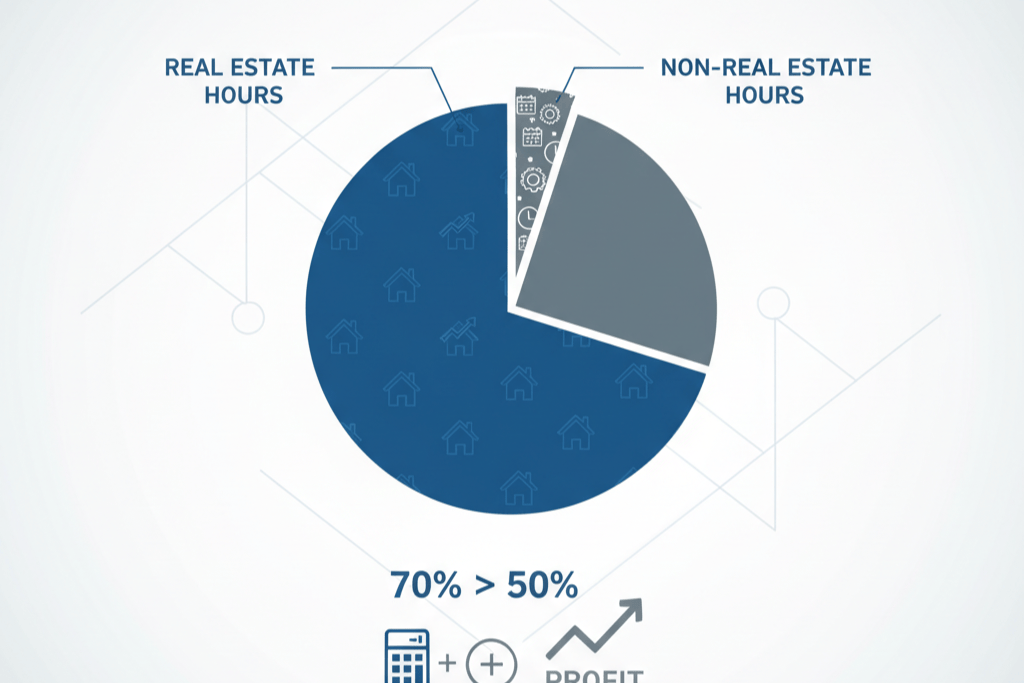
Real property trade or business hours / Total personal service hours in all trades or businesses > 50%
Or equivalently: Real estate hours must be MORE THAN all non-real-estate trade or business hours.
If you spend 1,200 hours in real estate activities and 1,100 hours in non-real-estate activities, your ratio is 1,200 / 2,300 = 52.2%. You pass.
If you spend 1,200 hours in real estate and 1,300 hours in non-real-estate activities, your ratio is 1,200 / 2,500 = 48%. You fail, even though you comfortably exceeded 750 hours in real estate.
What Counts as “Personal Services in Trades or Businesses”
This is where the confusion begins. The more-than-half test does not consider all your waking hours. It only considers personal services performed in “trades or businesses.” Understanding what falls inside and outside this definition is critical.
Included in the Denominator (Counts Against You)
W-2 employment hours: Every hour you work at your job counts. This includes:
- Regular scheduled hours
- Overtime
- Work performed from home or while traveling
- On-call time when you are actually performing work (not merely available)
- Training and professional development required by your employer
Self-employment / business hours: If you operate a non-real-estate business (consulting firm, medical practice, law office, e-commerce business, restaurant), your hours in that business count.
Partnership or LLC business hours: If you are an active participant in a non-real-estate partnership or LLC, your service hours count.
Board of directors service: If board membership constitutes a trade or business activity (compensated, regular, significant duties), those hours count.
Excluded from the Denominator (Does Not Count Against You)
Investment management activities: Managing your personal stock portfolio, reviewing brokerage statements, researching investments, and similar activities are generally NOT a trade or business. These hours do not go into the denominator.
Hobbies and personal activities: Golf, gardening, fitness, reading, travel for pleasure, volunteer work, and other personal activities are not trades or businesses.
Household work: Cooking, cleaning, childcare, and home maintenance are personal activities, not trades or businesses.
Charitable and volunteer work: Time spent volunteering for nonprofit organizations is generally not a trade or business, even if you have significant responsibilities.
Passive investment monitoring: Reviewing K-1s, attending annual partner meetings, or passively monitoring a business you do not actively participate in generally does not constitute personal services in a trade or business.
Retirement: If you are fully retired with no W-2 employment, no active business, and no other trade or business activities, your denominator approaches zero — making the more-than-half test trivially easy.
Calculating the Numerator: Real Estate Hours
The numerator includes all hours in “real property trades or businesses” as defined under IRC Section 469(c)(7)(C):
- Development, redevelopment, construction, reconstruction
- Acquisition and conversion
- Rental, operation, and management
- Leasing and brokerage
Both your rental property management hours AND any other real estate trade or business hours (brokerage, development, construction on your own properties) contribute to the numerator.
Important: Only hours in activities where you materially participate count toward the 750-hour test, but all real property trade or business hours count toward the more-than-half test. This distinction rarely matters in practice because investors typically materially participate in their primary real estate activities.
Common Scenarios and Calculations
Scenario 1: Full-Time W-2 Employee
Profile: Software engineer working full time, manages 3 rental properties on the side
| Activity | Hours |
|---|---|
| W-2 job | 2,080 |
| Rental property management | 850 |
| Total trade/business hours | 2,930 |
More-than-half test: 850 / 2,930 = 29%. FAILS.
Even though this investor exceeds 750 real estate hours, the W-2 job hours make the more-than-half test impossible. This investor needs a different strategy (spousal qualification, reduce W-2 hours, or use the STR loophole).
Scenario 2: Part-Time W-2 Employee
Profile: Nurse working 3 days per week (24 hours/week), actively manages 5 rental properties
| Activity | Hours |
|---|---|
| W-2 job (24 hrs x 50 weeks) | 1,200 |
| Rental property management | 1,250 |
| Total trade/business hours | 2,450 |
More-than-half test: 1,250 / 2,450 = 51%. PASSES.
The part-time schedule keeps W-2 hours low enough for real estate to exceed half. This is a viable REPS strategy, but the margin is thin.
Scenario 3: Stay-at-Home Spouse
Profile: Spouse stays home, manages household and 4 rental properties. No W-2 or other business.
| Activity | Hours |
|---|---|
| Non-RE trade/business hours | 0 |
| Rental property management | 800 |
| Total trade/business hours | 800 |
More-than-half test: 800 / 800 = 100%. PASSES.
With zero non-real-estate trade or business hours, 100% of personal services are in real estate. This is the most common REPS qualification path for married couples with a full-time working spouse.
Scenario 4: Self-Employed Investor with a Side Business
Profile: Full-time real estate investor who also runs an online coaching business
| Activity | Hours |
|---|---|
| Online coaching business | 600 |
| Real estate (property management, acquisitions, development) | 1,400 |
| Total trade/business hours | 2,000 |
More-than-half test: 1,400 / 2,000 = 70%. PASSES.
The coaching business adds hours to the denominator, but real estate still dominates. This investor passes comfortably.
Scenario 5: Retiree with Part-Time Consulting
Profile: Retired executive who consults 10 hours per month and manages rental properties
| Activity | Hours |
|---|---|
| Consulting (10 hrs x 12 months) | 120 |
| Rental property management | 780 |
| Total trade/business hours | 900 |
More-than-half test: 780 / 900 = 86.7%. PASSES.
The small consulting workload barely affects the ratio. This retiree passes easily.
Common Miscalculations
Mistake 1: Counting Only Scheduled Work Hours
Many W-2 employees assume they work exactly 40 hours per week, 50 weeks per year (2,000 hours). In reality, they may work significantly more:
- Early arrivals and late departures add 30-60 minutes daily
- Working through lunch adds 5 hours per week
- Evening email checking adds 3-5 hours per week
- Weekend work adds sporadic hours throughout the year
- Business travel days often exceed 8 hours
An employee who believes they work 2,000 hours may actually work 2,300-2,500 hours. This understated denominator can cause an investor to believe they pass the more-than-half test when they do not.
Solution: Track your actual W-2 hours honestly. If the IRS contacts your employer and obtains records showing you worked more hours than you claimed, your REPS qualification fails.
Mistake 2: Including Personal Activities in the Denominator
Some investors overcount their denominator by including activities that are not trades or businesses:
- “I volunteered 500 hours at the food bank, so my total hours are 3,500, and 1,800 of those are real estate (51%).”
The food bank hours should not be in the denominator at all. The correct calculation is 1,800 / (1,800 + W-2 + other business hours). Including non-business activities inflates the denominator and actually makes the test harder, not easier.
Mistake 3: Confusing the More-Than-Half Test with the 750-Hour Test
These are independent tests. You must pass both. An investor with 2,000 real estate hours and 3,000 W-2 hours passes the 750-hour test but fails the more-than-half test. An investor with 600 real estate hours and 400 W-2 hours passes the more-than-half test but fails the 750-hour test. Both tests must be satisfied simultaneously.
Mistake 4: Combining Spousal Hours
On a joint return, only one spouse needs to qualify as a real estate professional. But that spouse must pass both tests on their own. You cannot add Spouse A’s 400 real estate hours to Spouse B’s 400 real estate hours to reach 800, then compare against their combined non-real-estate hours.
Each spouse’s hours are evaluated independently for the 750-hour and more-than-half tests. However, for material participation on individual rental properties, spouses can combine hours under IRC Section 469(h)(5).
Mistake 5: Forgetting About Part-Time Jobs and Side Hustles
A taxpayer might focus on their primary W-2 job and forget that their weekend gig, freelance work, or side business also counts in the denominator. Every trade or business activity contributes to the total.
Strategies for Passing the More-Than-Half Test
Strategy 1: Spousal Qualification
The most common approach for high-W-2-income households. One spouse focuses on real estate (either as their primary occupation or with a reduced W-2 schedule) while the other spouse earns the W-2 income. The qualifying spouse’s hours are evaluated independently.
Strategy 2: Part-Time Employment
Reducing W-2 hours from full-time (2,080) to part-time (1,000-1,200) can make the more-than-half test achievable. A 20-hour-per-week W-2 position (roughly 1,040 hours annually) requires just over 1,040 real estate hours — manageable for an active property investor.
Strategy 3: Career Transition Year
The year you leave a W-2 job is a natural REPS qualification year. If you work 6 months at a job (1,040 hours) and then spend the remaining 6 months in full-time real estate (1,200+ hours), you pass both tests. Document the transition carefully.
Strategy 4: Real Estate as Primary Career
If your primary career is in a qualifying real property trade or business — real estate agent, property manager, developer, contractor — your professional hours naturally satisfy both tests. The rental properties benefit as a secondary source of hours and losses.
Strategy 5: Retirement
Fully retired individuals with no non-real-estate professional obligations pass the more-than-half test automatically. Even modest real estate activity satisfies the requirement.
Frequently Asked Questions
Does on-call time at my W-2 job count for the more-than-half test?
Time spent actually performing work while on call counts. Merely being available (carrying a pager, having your phone on) without performing work generally does not count as personal services. The distinction matters for medical professionals, IT workers, and others with on-call responsibilities.
If I work from home, do my W-2 hours count differently?
No. Hours spent performing W-2 work count regardless of where you perform them. Working from home does not reduce your W-2 hours for purposes of the more-than-half test. However, if working from home allows you to work fewer total hours (flexible schedule), those reduced actual hours are what count.
Does managing my stock portfolio count as a trade or business?
For most individual investors, managing a personal stock portfolio is investment activity, not a trade or business. These hours do not count in the denominator of the more-than-half test. However, if you are a professional trader who meets the IRS criteria for trader tax status, those hours would count.
Can I elect which spouse qualifies for REPS?
There is no formal election. On a joint return, whichever spouse meets both the 750-hour and more-than-half tests qualifies. If both spouses meet the tests, both qualify. If neither meets both tests, neither qualifies. You choose which spouse to focus on based on who has the best chance of meeting both tests.
What if I change jobs mid-year?
Your W-2 hours are cumulative for the full tax year. If you worked 800 hours at Job A and 600 hours at Job B, your total non-real-estate hours are 1,400. Your real estate hours must exceed 1,400 to pass the more-than-half test.
Does the more-than-half test apply to the STR loophole?
No. The more-than-half test is specific to REPS qualification under IRC Section 469(c)(7). The STR loophole has its own requirements (average stay of 7 days or less, material participation) and does not require the more-than-half test or the 750-hour test.
How does the IRS verify my W-2 hours?
The IRS can request records from your employer, including time sheets, pay records, and employment agreements. They can also review your work patterns through emails, badge-in records, and other sources. Some employers track hours precisely; others use standard assumptions (40 hours/week for salaried employees) unless evidence suggests otherwise.
Key Takeaways
- The more-than-half test requires real estate hours to exceed all other trade or business hours — not total waking hours
- Only personal services in trades or businesses count in the denominator; hobbies, volunteering, and personal activities are excluded
- W-2 hours are the primary obstacle for most aspiring REPS taxpayers
- Each spouse is evaluated independently for the more-than-half and 750-hour tests — spousal hours cannot be combined for REPS qualification
- Common miscalculations include understating W-2 hours, including non-business activities in the denominator, and combining spousal hours
- Part-time employment, spousal qualification, and retirement are the most viable paths for passing the test
- Track both real estate AND non-real-estate hours throughout the year to monitor your ratio
How REPSLog Tracks Both Sides of the Equation
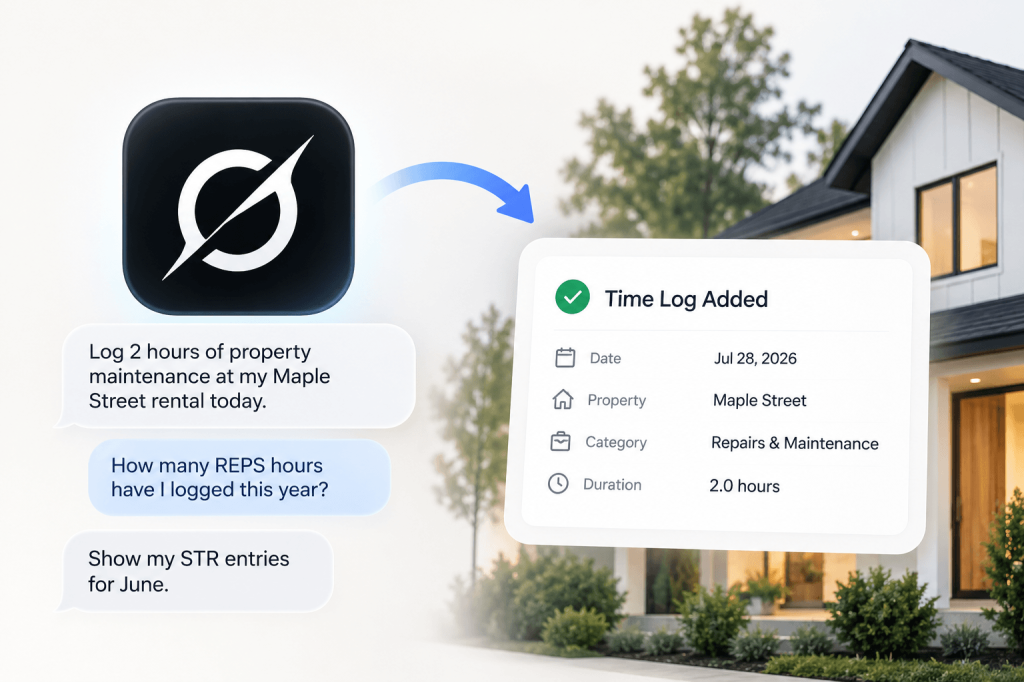
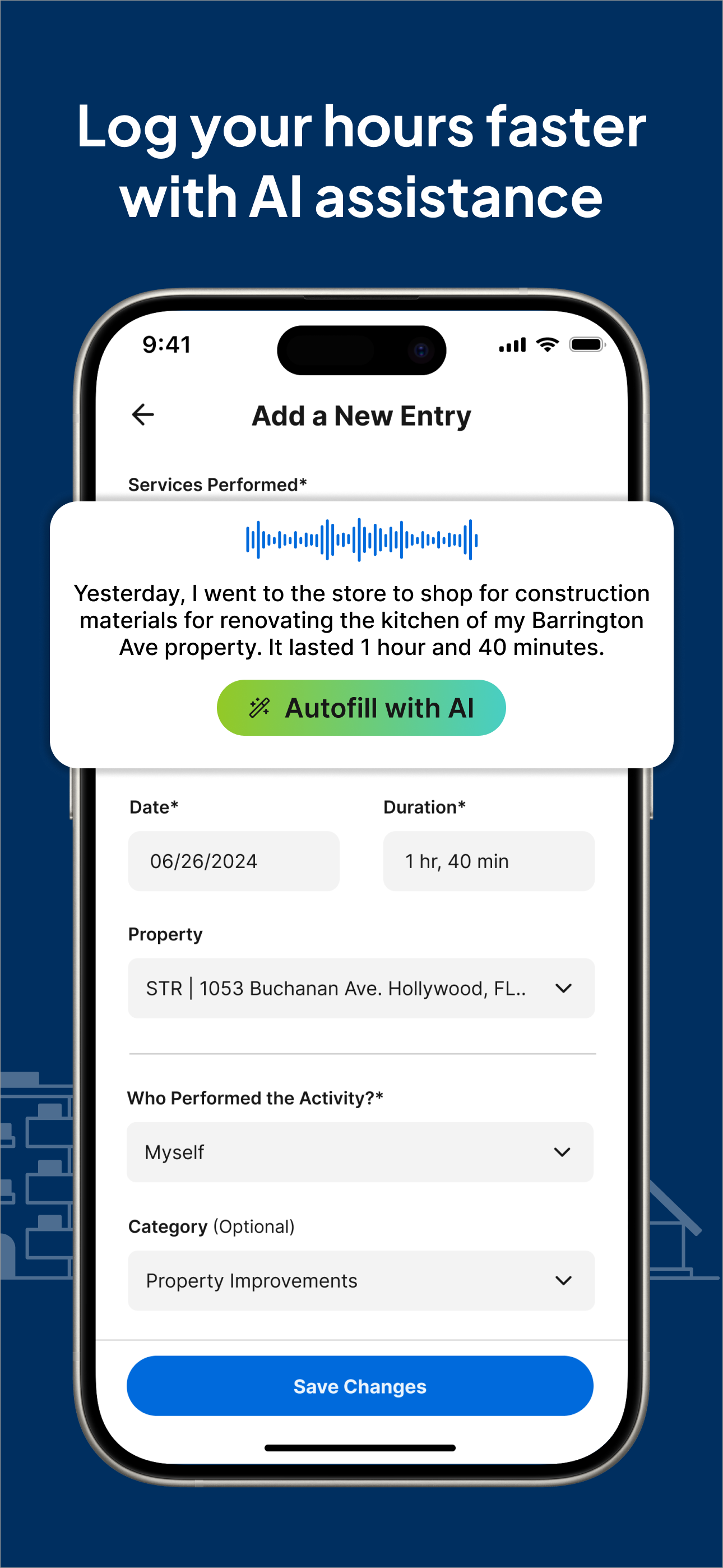
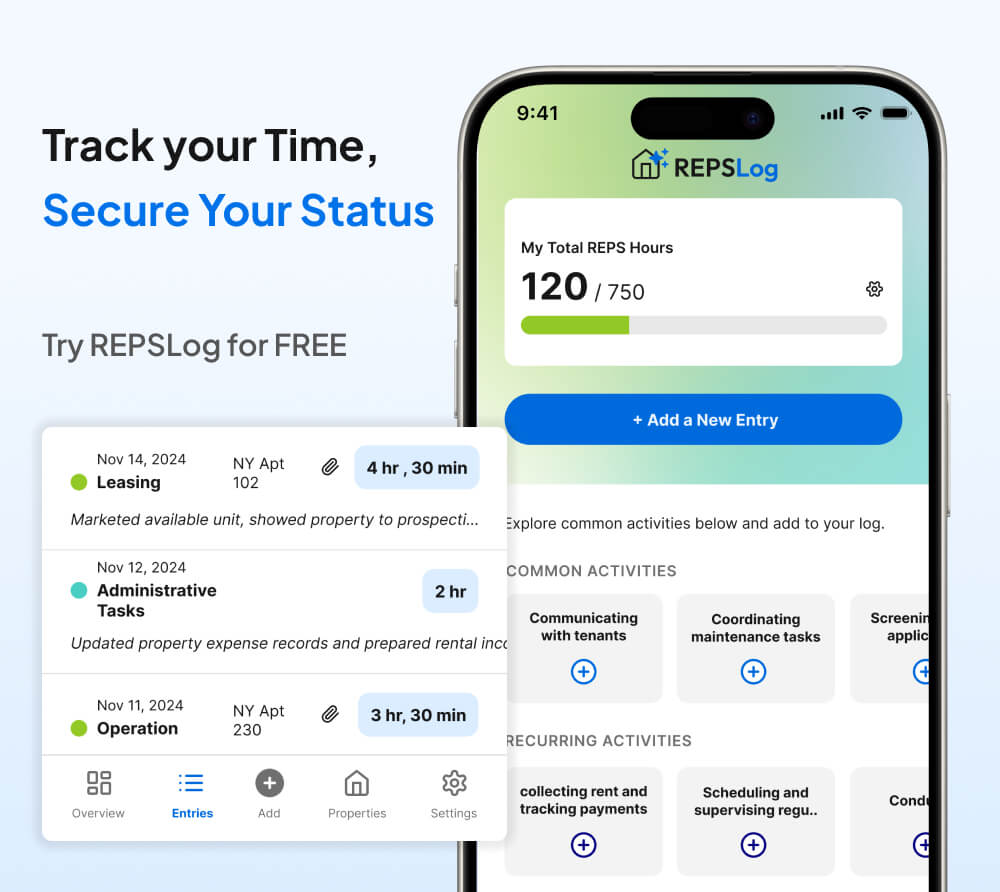
The more-than-half test has two sides: your real estate hours and your total professional hours. REPSLog tracks both. Log your real estate activities with property tags, categories, and specific descriptions. Monitor your progress toward 750 hours and your more-than-half ratio in real time. Know exactly where you stand at any point during the year — not just at tax time.
When the IRS asks how you passed the more-than-half test, your REPSLog data tells the complete story.
Available on iOS and Android, or on the web at app.reps-log.com. Start tracking your hours free →
This article is for educational purposes only and does not constitute tax or legal advice. Consult a qualified tax professional for guidance tailored to your situation.