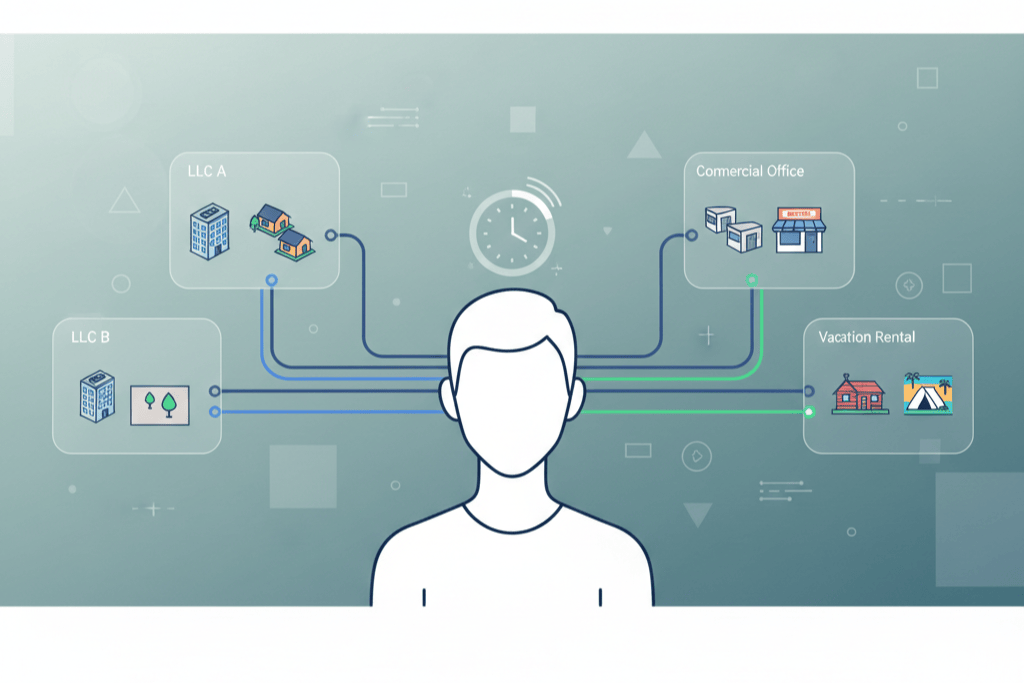
Real estate investors frequently hold properties through multiple LLCs — often one LLC per property. This structure provides liability protection, asset separation, and operational clarity. But it raises important questions about Real Estate Professional Status (REPS): Do your hours need to be tracked per LLC? Can you combine hours across entities? Does the LLC structure affect your qualification?
The short answer is that REPS qualification happens at the individual taxpayer level, not at the entity level. Your hours are your hours, regardless of which LLC owns the property you are working on. But the details matter, especially when it comes to material participation, pass-through treatment, and the grouping election.
This guide explains how REPS interacts with multi-entity structures, what you need to track, and how to avoid common mistakes that trip up investors with complex entity setups.
REPS Is a Personal Status, Not an Entity Status
The most important principle to understand is that REPS qualification under IRC Section 469(c)(7) is determined at the individual taxpayer level. The IRS evaluates whether you — the human being — meet the two time-based tests:
- More than 750 hours in real property trades or businesses in which you materially participate
- More than half of your total personal services in trades or businesses are in real property
It does not matter whether the properties you manage are held in your personal name, in a single LLC, in 10 separate LLCs, in a partnership, or in any combination of structures. Your hours accumulate across all entities.
Example
You manage three rental properties:
- Property A: held in ABC LLC
- Property B: held in XYZ LLC
- Property C: held in your personal name
You spend 300 hours managing Property A, 250 hours managing Property B, and 250 hours managing Property C. Your total real estate hours are 800. All 800 hours count toward the 750-hour threshold, regardless of the entity that owns each property.
How Pass-Through Entities Work with REPS
Most real estate LLCs are treated as pass-through entities for tax purposes. Depending on their structure, they flow through to your personal tax return in one of two ways:
Single-Member LLCs (Disregarded Entities)
A single-member LLC is disregarded for federal tax purposes. The IRS treats it as if you own the property directly. Rental income and expenses flow through on Schedule E of your personal return, exactly as they would if the property were in your name.
For REPS purposes, there is no difference between a property held in a single-member LLC and a property held personally. Your management hours are your hours, and the losses are your losses.
Multi-Member LLCs (Partnerships)
An LLC with two or more members is typically taxed as a partnership (unless it elects S-corp or C-corp treatment). The partnership files Form 1065 and issues K-1s to each member, reporting their share of income, losses, deductions, and credits.
For REPS purposes, the key consideration is which member(s) are performing the real estate management work. Only the hours of the specific taxpayer seeking REPS qualification count toward that taxpayer’s tests.
Important: If both you and your business partner manage properties in a multi-member LLC, only your hours count toward your REPS qualification. Your partner’s hours count toward their own qualification (if they are seeking REPS) but not toward yours.
S-Corporations
Some real estate investors hold properties in S-corporations, though this is less common for rentals. An S-corp is a pass-through entity that files Form 1120-S and issues K-1s. The REPS analysis is the same: the individual shareholder’s hours are evaluated at the personal level.
Note: Holding rental property in an S-corporation introduces additional complexities (no stepped-up basis at death, potential issues with built-in gains, and basis limitations) that may offset the benefits. Consult your CPA before using S-corps for rental property.
Material Participation Across Multiple Entities
While REPS qualification aggregates all your real estate hours, material participation is evaluated at the activity level. Each rental activity must demonstrate material participation independently — unless you make a grouping election.
Without a Grouping Election
If you own 5 properties through 5 separate LLCs and do not make a grouping election, each property is a separate rental activity. You must demonstrate material participation in each one individually using one of the seven tests under Treasury Regulation 1.469-5T.
The most commonly used tests:
- 500-hour test: More than 500 hours of participation in the activity
- Substantially-all test: Your participation constitutes substantially all participation in the activity
- 100-hour / no-one-more test: More than 100 hours, and no other individual participated more than you
For an investor with many properties, meeting the 500-hour test on each property individually is extremely challenging. That is where the grouping election becomes essential.
With a Grouping Election Under Treas. Reg. 1.469-9(g)
The grouping election allows you to treat all of your rental real estate activities as a single activity for material participation purposes. Instead of proving 500 hours on each of five properties, you prove 500 hours (or meet another test) across the grouped activity.
How it works across multiple LLCs:
| Entity | Property | Hours |
|---|---|---|
| Alpha LLC | 123 Main St | 180 |
| Beta LLC | 456 Oak Ave | 200 |
| Gamma LLC | 789 Pine St | 150 |
| Delta LLC | 321 Elm Dr | 120 |
| Personal | 654 Maple Ct | 160 |
| Grouped total | All properties | 810 |
Without grouping, the investor fails the 500-hour test on every single property. With grouping, the investor easily passes the 500-hour test on the single grouped activity (810 hours total).
Making the election: The grouping election is made by attaching a statement to your tax return identifying the properties being grouped and the basis for the election. Once made, the election is generally binding for future years unless there is a material change in circumstances. Your CPA should prepare this statement.
Cross-entity grouping: The election allows grouping across different entity structures. Properties in LLC A, LLC B, and your personal name can all be grouped into a single activity.
Spousal Hours for Material Participation
For material participation on individual properties or a grouped activity, spouses filing jointly can combine their hours under IRC Section 469(h)(5). If one spouse spends 300 hours on the grouped rental activity and the other spends 250 hours, their combined 550 hours satisfies the 500-hour test.
This is distinct from REPS qualification, where each spouse must independently meet the 750-hour and more-than-half tests.
Hours Tracking Best Practices for Multi-LLC Investors
Track by Property, Not by Entity
While REPS does not care about entity structure, your log should identify both the property and the entity for each entry. This serves two purposes:
- Material participation documentation: If you ever need to demonstrate participation on a per-property basis (e.g., if the grouping election is challenged), property-level tracking provides the evidence
- Consistency: Examiners may compare your claimed hours against the number of properties and entities you manage, looking for reasonableness
Document Entity-Level Activities
Some management activities occur at the entity level rather than the property level:
- LLC annual report filings and compliance
- Entity-level bookkeeping and financial reporting
- Partnership agreement amendments or operating agreement updates
- Entity tax return coordination
- Banking and insurance managed at the entity level
These hours count toward REPS if they relate to real property trades or businesses. Log them with the entity as the “property” and a specific description of the activity.
Track Management Company Activities Separately
If you operate a property management company (as a separate LLC or division) that manages your own properties or third-party properties, track those hours separately but include them in your REPS total. Property management is a qualifying real property trade or business, and your hours managing properties through a management company count.
Entity Structure Decisions and REPS Impact
One LLC Per Property vs. One LLC for All Properties
The number of LLCs does not affect REPS qualification. However, it does affect material participation analysis (without a grouping election). With a grouping election, the distinction is irrelevant for REPS purposes.
From a liability protection standpoint, one LLC per property is generally preferred. From a REPS standpoint, the structure does not matter as long as you track your hours and make appropriate elections.
Holding Companies and Operating Companies
Some investors use a tiered structure: a holding company LLC that owns multiple subsidiary LLCs, each holding a property. For REPS purposes, the structure is transparent — your hours managing the properties count regardless of how many layers of entities exist between you and the properties.
When Entity Choice Affects Losses
While entity structure does not affect REPS qualification, it can affect your ability to use losses:
- Basis limitations: You can only deduct losses up to your basis in the entity. For partnerships and S-corps, basis includes your capital contributions and your share of entity debt (with important differences between the two).
- At-risk rules: Your deductions are limited to the amount you have “at risk” in the activity.
- Passive activity rules: This is where REPS comes in — converting passive losses to non-passive.
All three limitations must be satisfied before you can deduct a loss, regardless of entity type. REPS addresses only the passive activity limitation.
Frequently Asked Questions
Do I need to file separate REPS documentation for each LLC?
No. REPS is an individual taxpayer status, not an entity-level designation. You maintain one log of your real estate activities across all entities and properties. The log should identify which property and entity each entry relates to, but the qualification analysis is performed on your aggregate hours.
Can hours from a property management company I own count toward REPS?
Yes. If you operate a property management company (whether as a sole proprietorship, LLC, or corporation), your hours managing properties through that company count as real property trade or business hours. Property management is explicitly listed as a qualifying activity under IRC Section 469(c)(7)(C).
How does the grouping election work across multiple entities?
The grouping election under Treas. Reg. 1.469-9(g) applies at the taxpayer level, not the entity level. You can group rental activities across single-member LLCs, multi-member LLCs, partnerships, and personally held properties into a single activity. The election statement attached to your return should list all the properties and entities included in the group.
Does my business partner’s REPS status affect my losses?
No. In a multi-member LLC or partnership, each partner’s REPS qualification is evaluated independently. If Partner A qualifies for REPS and Partner B does not, Partner A’s share of rental losses is non-passive while Partner B’s share remains passive. The entity itself does not have REPS status.
Can I change my entity structure without affecting my REPS qualification?
Generally, yes. Converting a property from personal ownership to an LLC (or vice versa), forming new entities, or dissolving existing ones does not directly affect your REPS qualification. Your personal hours remain the same. However, changes in entity structure can trigger other tax consequences (transfer taxes, reassessment, depreciation recapture) that should be evaluated by your CPA.
What about properties held in a trust?
Properties held in revocable living trusts are generally treated as owned by the grantor for tax purposes. Your management hours on trust-held properties count toward REPS. Irrevocable trusts are more complex — the trust itself may be a separate taxpayer, and the REPS analysis depends on the trust structure and who performs the management work.
Does holding properties through multiple LLCs increase my audit risk?
Multiple entities can increase complexity on your tax return, which may modestly increase audit risk. However, the entities themselves are not a red flag — multi-entity structures are standard practice in real estate investing. Clean documentation, accurate K-1 reporting, and a well-maintained hour log mitigate any additional risk.

Key Takeaways
- REPS is an individual status, evaluated at the taxpayer level — entity structure does not affect qualification
- All real estate hours aggregate across single-member LLCs, multi-member LLCs, partnerships, and personally held properties
- Material participation is evaluated per activity — the grouping election under Treas. Reg. 1.469-9(g) treats all rental activities as one
- Each partner’s REPS status is independent in multi-member entities
- Spousal hours combine for material participation under IRC Section 469(h)(5), but not for REPS qualification
- Track hours by property and entity even though the qualification is performed on aggregate totals
- Entity structure affects basis, at-risk, and loss limitations separately from the passive activity rules that REPS addresses
How REPSLog Handles Multi-Property, Multi-Entity Tracking
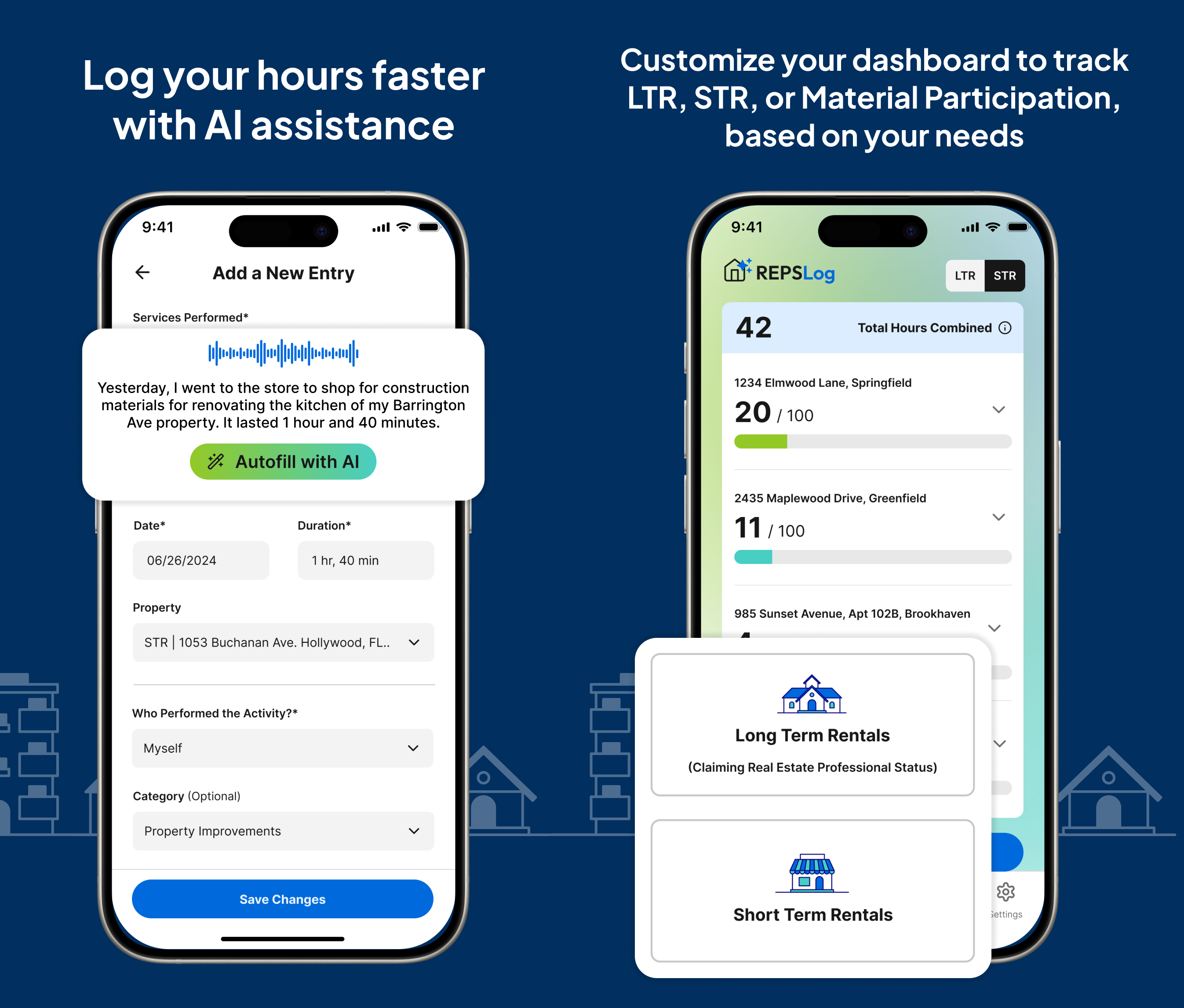
Managing properties across multiple LLCs should not make REPS documentation harder. REPSLog lets you set up each property with its own tag, track activities across your entire portfolio, and see both per-property totals and aggregate totals in one view. Monitor your progress toward 750 hours across all entities. Export reports showing material participation by property or across a grouped election.
Your entity structure protects your assets. REPSLog protects your tax position.
Available on iOS and Android, or on the web at app.reps-log.com. Start tracking your hours free →
This article is for educational purposes only and does not constitute tax or legal advice. Consult a qualified tax professional for guidance tailored to your situation.