The terms “active income” and “passive income” get thrown around constantly in the real estate investing world, often with meanings that have nothing to do with how the IRS actually classifies income. Social media influencers use “passive income” to describe rental cash flow. Financial planners use “active income” to mean W-2 wages. Neither usage aligns with the precise definitions in the Internal Revenue Code that determine how your income is taxed, what deductions you can take, and whether your rental losses can offset your paycheck.
Understanding the IRS classification system is not optional for real estate investors — it is the foundation upon which every tax strategy rests. REPS, the passive activity loss rules, the Net Investment Income Tax, the QBI deduction, and self-employment tax all depend on whether the IRS treats your income as active or passive. Getting this wrong can cost you tens of thousands of dollars in unnecessary taxes or, worse, trigger penalties for incorrectly claimed deductions.
The Three Income Buckets
The IRS does not use a simple “active vs. passive” binary. Under IRC Section 469 and related provisions, there are three categories of income:
1. Active (Non-Passive) Income
Active income includes wages, salaries, tips, and income from a trade or business in which you materially participate. This is what most people earn from their jobs and active business operations.
Examples:
- W-2 wages from your employer
- Self-employment income from a business you run day-to-day
- Commissions and bonuses
- Income from a partnership or S corporation in which you materially participate
Active income is subject to ordinary income tax rates and, in most cases, self-employment tax (for self-employed individuals) or payroll taxes (for employees).
2. Passive Income
Passive income is income from a trade or business in which you do not materially participate, or from rental activities. Under the default rules of Section 469, rental activity is classified as passive regardless of the taxpayer’s level of participation. This is the critical distinction that REPS changes.
Examples:
- Rental income from properties (default classification)
- Income from a business partnership where you are a limited partner
- Income from a business in which you invest but do not materially participate
The defining characteristic of passive income is not that it requires no work — it is that the IRS has classified the activity as passive based on specific rules.
3. Portfolio Income
Portfolio income includes interest, dividends, capital gains from securities, and royalties. This category is neither active nor passive — it occupies its own bucket and is subject to its own set of rules.
Examples:
- Stock dividends
- Bond interest
- Capital gains from selling stocks or mutual funds
- Royalties from intellectual property
Portfolio income cannot be offset by passive losses. It is taxed at ordinary rates (for interest and short-term gains) or preferential rates (for qualified dividends and long-term capital gains).
Why the Classification Matters: The Passive Activity Loss Rules
The entire reason the active/passive distinction matters for real estate investors is the passive activity loss rules under IRC Section 469.
The core rule is straightforward: passive losses can only offset passive income. If your rental properties generate a $100,000 net loss (after depreciation), that loss cannot reduce your W-2 income, business income, or portfolio income. It sits in the “passive” bucket and waits for passive income to absorb it.
If you have no passive income in the current year, the losses are suspended and carried forward to future tax years. They remain suspended until one of three things happens:
- You generate passive income in a future year (from these or other passive activities)
- You dispose of the activity in a fully taxable transaction (at which point all suspended losses are released)
- You qualify for an exception to the passive activity loss rules
The most powerful exception is Real Estate Professional Status.
The $25,000 Rental Loss Exception
Before discussing REPS, it is worth noting the smaller exception available to all rental property owners. Under Section 469(i), taxpayers who actively participate in rental real estate can deduct up to $25,000 of rental losses against non-passive income.
“Active participation” is a lower bar than “material participation.” It requires making management decisions (approving tenants, authorizing repairs, setting rental terms) but does not require specific hour thresholds. Most hands-on landlords qualify.
The $25,000 allowance phases out for taxpayers with adjusted gross income (AGI) between $100,000 and $150,000. Above $150,000 AGI, the allowance is zero. Given that many real estate investors have AGI above this threshold, the $25,000 exception often provides no benefit at all.
How REPS Changes the Classification
This is the pivotal concept. Under IRC Section 469(c)(7), a taxpayer who qualifies as a real estate professional can elect to treat rental real estate activities as non-passive. This reclassification is what makes REPS so powerful.
The reclassification works as follows:
- Without REPS: Rental activity is passive (per se, under Section 469(c)(2)). Rental losses can only offset passive income. The $25,000 exception applies if AGI permits.
- With REPS and material participation: Rental activity is treated as non-passive. Rental losses can offset any income — W-2 wages, business profits, capital gains, everything.
- With REPS but without material participation: Rental activity remains passive. REPS alone is not enough — you must also materially participate in the rental activity (or grouped activity under Treas. Reg. 1.469-9(g)) to convert losses from passive to non-passive.
The material participation test most commonly used by REPS investors is the 500-hour test: you must participate in the activity for more than 500 hours during the tax year. For material participation purposes, spouses on a joint return can combine their hours under IRC 469(h)(5). This is different from REPS qualification, where each spouse must independently meet the more than 750 hours and more-than-half tests.
Common Misconceptions
Misconception 1: “Rental Income Is Always Passive”
This is technically the default rule, but REPS is a widely available exception. Thousands of taxpayers successfully reclassify their rental income as non-passive each year. Saying rental income is always passive ignores the existence of Section 469(c)(7) entirely.
Misconception 2: “Passive Income Is Income You Earn While Sleeping”
The social media definition of passive income — money that flows in without effort — has nothing to do with the tax definition. The IRS classifies income as passive based on specific statutory tests, not on how much work it requires. A landlord who spends 40 hours per week managing properties still earns “passive” income in the eyes of the IRS unless they meet the REPS exception.
Misconception 3: “Active Participation and Material Participation Are the Same”
Active participation (the lower standard required for the $25,000 rental loss exception) is much less demanding than material participation (required for full REPS loss deduction). Active participation requires involvement in management decisions. Material participation requires meeting one of seven specific tests, the most common being more than 500 hours of participation.
Misconception 4: “If I Manage My Own Properties, My Income Is Active”
Self-managing your rentals makes you an active participant, which helps with the $25,000 exception. It does not automatically make the income non-passive. Only REPS qualification plus material participation changes the classification.
Misconception 5: “All Real Estate Income Is Treated the Same”
The IRS treats different types of real estate income very differently:
- Rental income: Passive by default, non-passive with REPS + material participation
- Real estate brokerage commissions: Active income (self-employment)
- House flipping profits: Active income (dealer activity) — subject to ordinary income rates AND self-employment tax
- Capital gains from property sales: Can be non-passive with REPS + material participation, or passive without
- REIT dividends: Portfolio income
Misconception 6: “I Can Choose How to Classify My Income”
You cannot. The classification is determined by the tax code based on the nature of the activity and your participation in it. REPS is not a voluntary election to reclassify income — it is a status you either qualify for (by meeting objective tests) or you do not.
The Practical Impact on Your Tax Return
Here is a concrete example illustrating why the classification matters:
Taxpayer profile: Married couple, filing jointly. One spouse earns $350,000 in W-2 income. They own rental properties generating $50,000 in rental income and $200,000 in depreciation expense, for a net rental loss of $150,000.
Without REPS:
- Rental loss of $150,000 is passive
- AGI exceeds $150,000, so the $25,000 exception is unavailable
- $150,000 loss is suspended and carried forward
- Taxable income: $350,000 (minus standard deduction and other items)
- Federal tax: approximately $66,000
With REPS and material participation:
- Rental loss of $150,000 is non-passive
- $150,000 loss offsets W-2 income
- Taxable income: $200,000 (minus standard deduction and other items)
- Federal tax: approximately $32,000
- Tax savings: approximately $34,000
That $34,000 difference comes entirely from the reclassification of income. The same properties, the same depreciation, the same rental income — the only difference is whether the IRS treats the rental activity as passive or non-passive.
How Classification Affects Other Tax Provisions
The active/passive classification has ripple effects across your entire tax return:
Net Investment Income Tax (3.8% NIIT)
Passive rental income is subject to the 3.8% NIIT for taxpayers with MAGI above $250,000 (married filing jointly). Non-passive rental income (with REPS + material participation) is exempt. On $200,000 of rental income, this is a $7,600 difference.
Self-Employment Tax
Rental income is generally not subject to self-employment tax regardless of REPS status. This is one area where the passive/non-passive distinction does not change the outcome. However, income from real estate brokerage, flipping, or other dealer activities is subject to self-employment tax as active income.
Qualified Business Income (QBI) Deduction
The Section 199A QBI deduction is available for qualified business income, which can include non-passive rental income. REPS helps establish that the rental activity is a trade or business, which is a prerequisite for the QBI deduction.
Loss Limitations on Disposition
When you sell a rental property, any suspended passive losses from that property are released and can offset any type of income. If REPS converts the activity to non-passive, there are no suspended losses to release (they were deducted each year), but the gain on sale is also classified as non-passive.
Key Takeaways
- The IRS uses three income categories: active (non-passive), passive, and portfolio. Rental income defaults to passive.
- Passive losses can only offset passive income under IRC Section 469. This is the rule that suspends most rental losses.
- REPS reclassifies rental activity from passive to non-passive, but only when combined with material participation. REPS alone is not sufficient.
- The $25,000 rental loss exception is available for active participants with AGI below $150,000 — but it phases out rapidly.
- Material participation requires meeting specific tests (most commonly, more than 500 hours). It is a higher bar than active participation.
- Spouses can combine hours for material participation under IRC 469(h)(5), but not for REPS qualification itself.
- The classification affects NIIT, QBI, and disposition rules — it is not just about current-year loss deductions.
Frequently Asked Questions
Is rental income ever classified as active income by default?
No. Under IRC Section 469(c)(2), rental activity is per se passive regardless of the taxpayer’s level of participation. The only exception is REPS qualification under Section 469(c)(7), which removes this per se classification and allows the standard material participation tests to apply.
Can I offset my passive rental losses with stock dividends?
No. Stock dividends are portfolio income, not passive income. Passive losses can only offset passive income. Portfolio income is a separate category that is not affected by the passive activity loss rules.
What happens to my suspended passive losses if I qualify for REPS next year?
Once you qualify for REPS and materially participate, your rental activity becomes non-passive in that year. Current-year losses flow through to offset active income. Previously suspended passive losses from prior years can also be released and deducted, subject to complex transition rules. Consult your CPA on the specific mechanics.
If I flip houses, is that active or passive income?
House flipping is generally classified as active income from a trade or business (dealer activity). It is subject to ordinary income tax rates and self-employment tax. Flipping income is not rental income and is not affected by the passive activity loss rules in the same way.
Can passive rental income offset passive losses from another investment?
Yes. Passive income from any source can absorb passive losses from any source. If you have $50,000 in passive rental losses and $30,000 in passive income from a business partnership, $30,000 of the rental losses can be used. The remaining $20,000 is suspended.
Does the grouping election under Treas. Reg. 1.469-9(g) change whether my income is active or passive?
The grouping election does not change the active/passive classification itself. It allows you to treat all rental activities as a single activity for material participation purposes. This makes it easier to demonstrate material participation (and thus achieve non-passive treatment with REPS), but the election itself is a tool for meeting material participation — not a reclassification mechanism.
Is Airbnb income passive or active?
Short-term rental income from platforms like Airbnb is rental income and is passive by default under the same rules as long-term rentals. REPS with material participation can reclassify it as non-passive. There are also arguments in some cases that short-term rentals with substantial services (like a hotel) may not be “rental” activities at all, which is a separate and complex analysis.
Disclaimer: This article is for educational purposes only and does not constitute tax, legal, or financial advice. Tax laws are complex and subject to change. Consult a qualified tax professional before making any decisions related to income classification or Real Estate Professional Status.
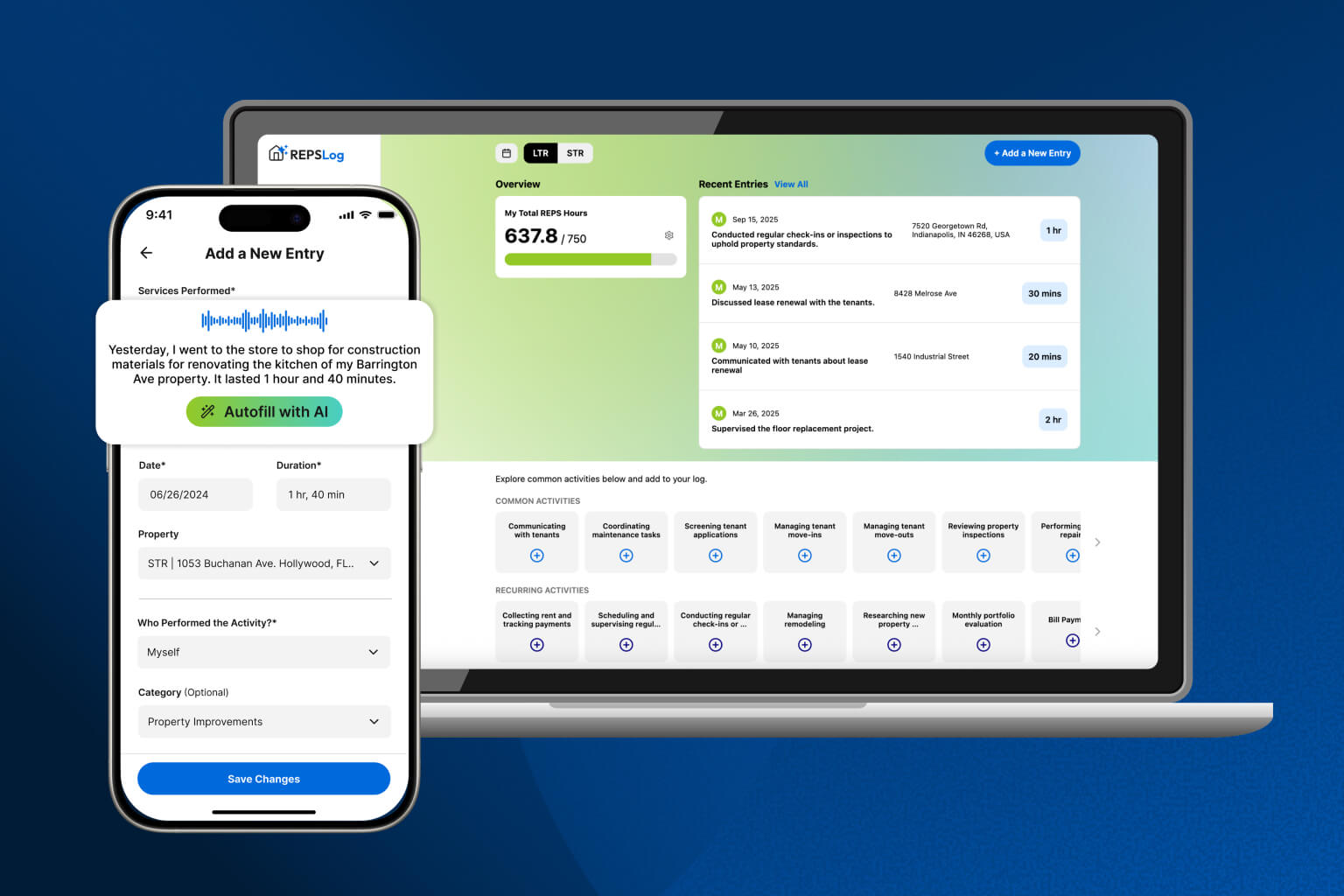
Track Your Hours to Reclassify Your Rental Income
The difference between passive and non-passive rental income can save you tens of thousands in taxes. REPSLog helps you track every qualifying hour toward REPS, so you can turn your rental losses into real deductions against your active income.
Available on iOS | Android | Web