Your CPA is your most important partner in a Real Estate Professional Status (REPS) filing. But here is a reality that many real estate investors discover too late: not every CPA understands REPS, and even those who do cannot file a defensible return without the right information from you. The quality of your REPS filing depends as much on what you bring to the meeting as it does on your CPA’s technical knowledge.
A well-prepared REPS filing meeting looks nothing like dropping off a box of receipts. You need organized documentation, a clear picture of your real estate activities, and enough understanding of the rules to have an informed conversation about elections and strategies. This guide walks you through exactly what to prepare, what questions to ask, and what red flags to watch for.
Before the Meeting: Organizing Your Documentation
Your Activity Log
The single most important document you bring to your CPA is your contemporaneous activity log. This is the record that proves you spent more than 750 hours in real property trades or businesses and met the more-than-half test. It is also the primary evidence for material participation in your rental activities.
Your log should include, for each entry:
- Date the work was performed
- Hours spent (start and end times are ideal but not strictly required)
- Property the work related to (or “all properties” for portfolio-level tasks)
- Description of the activity in enough detail that an IRS examiner could understand what you did
- Category of work (management, maintenance, leasing, acquisition, etc.)
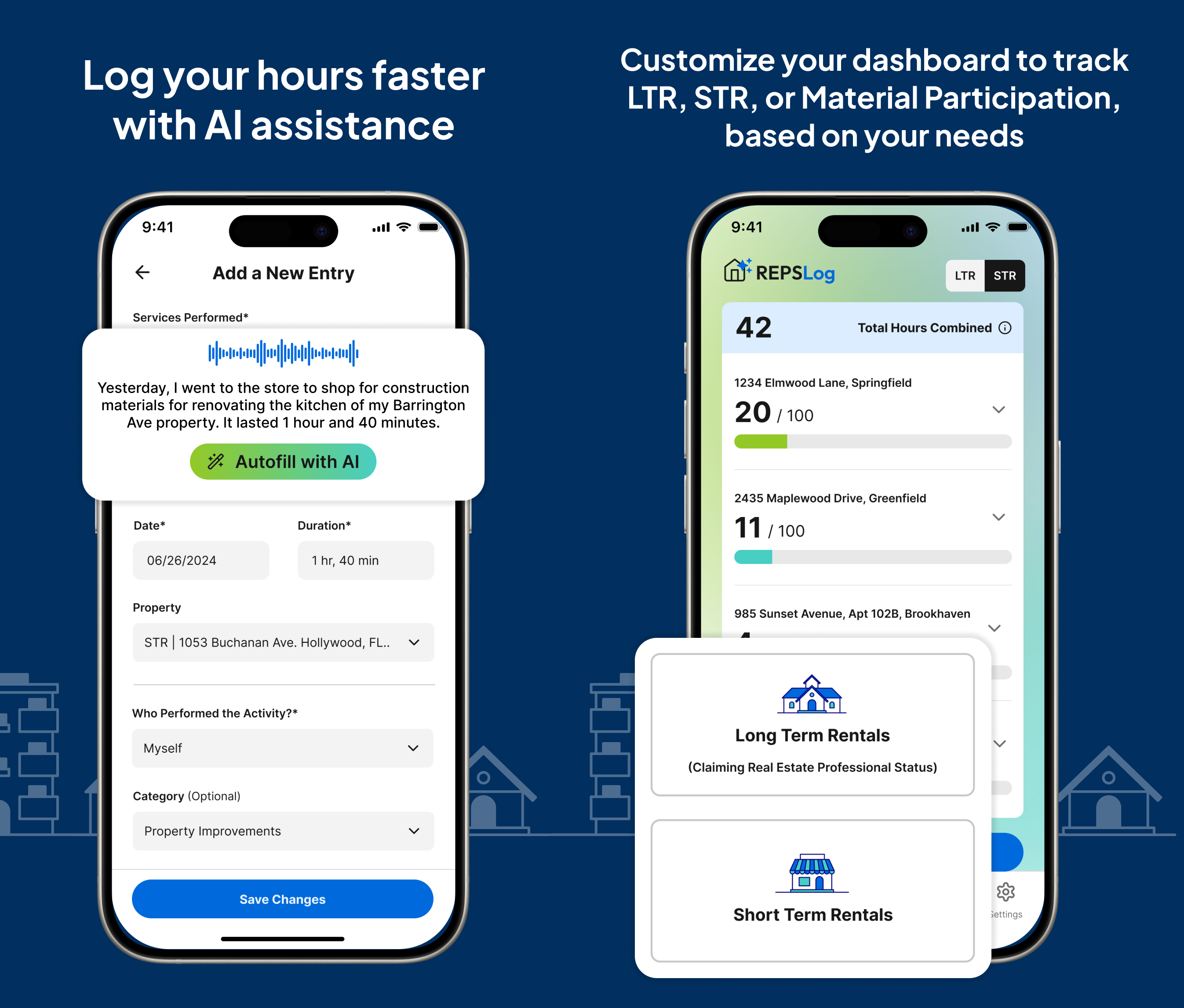
If you use REPSLog, this data is already structured and ready to export. If you have been using a spreadsheet, print it out in a format that is easy to review. If you have been using a paper calendar or notes app, now is the time to organize those entries into a clear format.
What your CPA needs to see: Total hours by property, total hours across all real property activities, total hours in non-real-estate work (for the more-than-half test), and enough detail in each entry to survive scrutiny.
Your Non-Real-Estate Hours
The more-than-half test requires that your real estate hours exceed all other professional hours combined. Your CPA needs to know how many hours you spent in non-real-estate trades or businesses during the year. This includes:
- W-2 employment hours (your employer may provide this, or you can calculate from your schedule)
- Non-real-estate self-employment hours (if you have a side business, consulting practice, etc.)
- Any other trade or business activity that counts as personal services
Be honest and precise. If you worked 2,080 hours at your W-2 job (40 hours x 52 weeks), your real estate hours must exceed 2,080. Rounding down your W-2 hours or inflating your real estate hours is a recipe for audit trouble.
Property-Level Financial Records
For each property, organize the following:
- Rental income received (monthly amounts and totals)
- Operating expenses (repairs, maintenance, insurance, property taxes, HOA fees, utilities, management fees)
- Mortgage interest statements (Form 1098)
- Depreciation schedules (your CPA may already have these from prior years)
- Capital improvements made during the year (new roof, HVAC replacement, renovation costs)
- Purchase and sale documents (closing statements, settlement sheets) for any properties acquired or disposed of during the year
- 1099s received from tenants, property managers, or booking platforms (Airbnb, VRBO)
Entity and Ownership Documentation
If your properties are held in LLCs, partnerships, or other entities, bring:
- K-1 forms from each entity
- Operating agreements or partnership agreements (especially if ownership changed during the year)
- Entity tax ID numbers (EINs)
Your CPA needs to understand the ownership structure to correctly report REPS on your individual return, since the qualification is made at the individual taxpayer level regardless of which entity holds the properties.
The Meeting: Essential Conversations to Have
Discussion 1: The Grouping Election
One of the most consequential decisions in a REPS filing is whether to make the grouping election under Treas. Reg. 1.469-9(g). This election allows you to treat all of your rental real estate activities as a single activity for material participation purposes.
Why it matters: Without the grouping election, you must prove material participation (typically more than 500 hours or more than 100 hours with no one participating more) in each property separately. With the election, you only need to prove it once across your entire portfolio.
What to discuss with your CPA:
- Have you already made this election in a prior year? (It is generally irrevocable once made.)
- If this is your first REPS year, should you make the election now?
- What are the downsides? (If you sell one property at a gain and others have losses, grouping means the gain and losses are in the same activity, which can affect disposition treatment.)
- How is the election documented? (A statement must be attached to your tax return.)
If your CPA is unfamiliar with the grouping election or says it is not necessary, that is a yellow flag. Nearly every REPS taxpayer with multiple properties benefits from this election, and a CPA who does not bring it up may not have deep REPS experience.
Discussion 2: Material Participation Test Selection
There are seven material participation tests under Reg. 1.469-5T. Your CPA should help you identify which test you satisfy and ensure your documentation supports it.
The most common tests for REPS investors:
- 500-hour test: You participated more than 500 hours (most straightforward)
- Substantially all test: Your participation was substantially all of the participation in the activity
- 100-hour test: You participated more than 100 hours and no one else participated more than you
What to discuss: Which test are you relying on? If you use a property manager, does their involvement mean you cannot use the “substantially all” test? Are your hours sufficient for the 500-hour test, or do you need to use the 100-hour test for specific properties?
Discussion 3: The Spouse Strategy
If you file jointly, discuss the spousal rules:
- For REPS qualification: Only one spouse needs to qualify. That spouse must independently meet the more than 750 hours and more-than-half tests. You cannot combine spousal hours for REPS qualification.
- For material participation: Spouses can combine their hours under IRC Section 469(h)(5). If one spouse logs 300 hours and the other logs 250 hours on the rental activities, their combined 550 hours satisfies the 500-hour material participation test.
Your CPA should clearly understand which spouse is claiming REPS and ensure that spouse’s individual hours meet both tests. A common mistake is combining spousal hours for the 750-hour test — this is not permitted.
Discussion 4: Cost Segregation and Bonus Depreciation
If you acquired properties during the year or have not yet performed cost segregation studies on existing properties, discuss whether a cost segregation study makes sense. Cost segregation accelerates depreciation by reclassifying building components into shorter-lived asset categories (5, 7, or 15 years instead of 27.5 or 39 years).
For REPS investors, accelerated depreciation generates larger current-year losses that can offset active income. The combination of REPS and cost segregation is one of the most powerful tax strategies in real estate.
What to discuss: Which properties are candidates for cost segregation? What is the cost of the study versus the projected tax savings? Should you file amended returns for prior years using a look-back method?
Discussion 5: State Tax Implications
REPS is a federal tax concept. State tax treatment of rental losses, passive activities, and real estate professional status varies significantly. Some states conform to the federal passive activity rules; others have their own standards.
Ask your CPA how your state handles REPS and whether any additional filings or elections are needed at the state level.
Red Flags in CPA Advice
Not every CPA is qualified to handle a REPS filing. Here are warning signs that you may need a different advisor:
Red Flag 1: “Just Log 750 Hours and You’re Fine”
A CPA who reduces REPS to a single number does not understand the full picture. REPS requires the 750-hour test AND the more-than-half test AND material participation. If your CPA does not ask about your non-real-estate hours or discuss material participation, they are missing critical components.
Red Flag 2: “You Don’t Need a Log — We’ll Estimate”
The IRS has consistently held that estimated or reconstructed hour logs are far less credible than contemporaneous records. In Truskowsky v. Commissioner, the Tax Court rejected a REPS claim because the taxpayer’s hours were estimated after the fact rather than tracked contemporaneously. A CPA who tells you estimates are sufficient is setting you up for audit risk.
Red Flag 3: “The Grouping Election Doesn’t Matter”
If your CPA dismisses the grouping election under Treas. Reg. 1.469-9(g) or seems unfamiliar with it, they likely do not handle many REPS filings. The grouping election is a fundamental component of REPS strategy for multi-property investors.
Red Flag 4: “You Can Count Your Spouse’s Hours Toward the 750”
This is flatly wrong. For REPS qualification, each spouse must independently meet the tests. Combining spousal hours is only permitted for material participation, not for the 750-hour or more-than-half tests. A CPA who confuses these rules is making a mistake that could invalidate your entire REPS claim.
Red Flag 5: “I’ve Never Had a Client Audited for REPS”
This is not reassuring — it may mean they have not filed many REPS returns, or their clients have not yet been selected. REPS is a known IRS audit target. A good CPA should be preparing every REPS filing as if it will be audited and ensuring the documentation is audit-ready.
What to Ask Your CPA
Before your meeting, prepare these questions:
- How many REPS returns have you prepared? You want a CPA with meaningful REPS experience, not someone learning on your return.
- Do you have experience with IRS REPS audits? Even better if they have successfully defended clients through one.
- How should we document the grouping election? The correct answer involves attaching a statement to your return per Treas. Reg. 1.469-9(g).
- Which material participation test are we using? Your CPA should be able to identify the specific test and explain why it applies to your situation.
- How does REPS affect my state taxes? Demonstrates awareness of state-level nuances.
- Should we consider cost segregation studies? A CPA familiar with REPS will proactively raise this topic for new property acquisitions.
- What happens if I don’t qualify in a future year? A good CPA will explain the implications of losing REPS status, including the recapture of suspended losses and the impact on depreciation.
After the Meeting: What Your CPA Files
Make sure you understand what appears on your return:
- Schedule E reports rental income and expenses for each property
- Form 8582 handles passive activity loss limitations (REPS investors may not need to limit losses if they materially participate)
- The grouping election statement should be attached to the return
- Form 8960 (Net Investment Income Tax) should correctly exclude rental income from NII if REPS and material participation are established
- Depreciation schedules (Form 4562) should reflect any cost segregation or bonus depreciation
Request a draft return to review before filing. Check that your REPS position is reflected correctly and that the grouping election is attached. This is your tax return and your liability — trust your CPA, but verify.

Key Takeaways
- Bring organized, contemporaneous activity logs to your CPA meeting. This is the foundation of a defensible REPS filing.
- Know your non-real-estate hours for the more-than-half test. Your CPA cannot assess your qualification without this number.
- Discuss the grouping election under Treas. Reg. 1.469-9(g) if you own multiple properties. It is one of the most important elections in REPS planning.
- Clarify the spousal rules: hours combine for material participation under IRC 469(h)(5), but not for REPS qualification itself.
- Watch for red flags in CPA advice, particularly around hour estimation, the grouping election, and spousal hour combination.
- Ask about REPS audit experience. A CPA who has defended REPS claims under audit will prepare a stronger return.
Frequently Asked Questions
How do I find a CPA who specializes in REPS?
Look for CPAs who specialize in real estate taxation, not just general tax preparation. Ask about their REPS filing volume, audit experience, and familiarity with the grouping election. Real estate investor groups, property management associations, and real estate attorney referrals are good sources.
Should I bring my activity log in a specific format?
Your CPA needs to see total hours by property, activity descriptions, dates, and a summary showing your total real estate hours versus non-real-estate hours. If you use REPSLog, the app generates reports in a format designed for CPA review. A well-organized spreadsheet with date, hours, property, and description columns also works.
What if my CPA says I don’t need the grouping election?
Ask them to explain why. In rare cases — such as when you own a single property or when you easily exceed 500 hours on each individual property — the grouping election may be unnecessary. But for most multi-property investors, it significantly simplifies compliance. If their answer is not satisfying, seek a second opinion.
How much does a REPS-experienced CPA typically charge?
Expect to pay more for a CPA with REPS expertise than for a general tax preparer. Fees vary by market and complexity, but a REPS filing with multiple properties, cost segregation, and the grouping election is meaningfully more complex than a standard return. The additional cost is well worth it given the audit risk of an improperly prepared REPS return.
Can my CPA help me reconstruct a log if I didn’t track hours during the year?
A CPA can help you create a reasonable estimate based on calendars, emails, phone records, and other evidence. However, reconstructed logs carry significantly less weight in an audit than contemporaneous records. Starting the current year with a proper tracking system (like REPSLog) is the best way to avoid this situation going forward.
What if I change CPAs mid-year?
A new CPA will need all prior-year returns, depreciation schedules, grouping election statements, and any correspondence with the IRS. If your prior CPA made errors in REPS filings, your new CPA may recommend amended returns. Provide your complete activity logs for the current year so the transition is seamless.
Should I have my CPA review my activity log before year-end?
Yes. A mid-year or third-quarter check-in with your CPA allows them to assess whether you are on track for the 750-hour and more-than-half tests, identify any documentation gaps, and plan for cost segregation or other year-end strategies. Do not wait until April to discover a problem.
Disclaimer: This article is for educational purposes only and does not constitute tax, legal, or financial advice. Tax laws are complex and subject to change. Consult a qualified tax professional before making any decisions related to Real Estate Professional Status.
Give Your CPA the Documentation They Need
REPSLog creates the kind of detailed, contemporaneous activity logs that CPAs need to prepare a defensible REPS filing. Track hours by property and category, generate reports, and walk into your CPA meeting fully prepared.
Available on iOS | Android | Web