The Net Investment Income Tax (NIIT) is a 3.8% surtax that applies to certain investment income for taxpayers above specific income thresholds. For real estate investors, this tax can add up quickly — 3.8% on rental income, capital gains from property sales, and other investment returns. But Real Estate Professional Status (REPS) offers a potential escape route. When structured correctly, REPS can exempt rental income from the NIIT entirely, saving thousands of dollars annually.
Understanding how REPS interacts with the NIIT requires navigating IRC Section 1411, the provision that created this tax. The rules are not intuitive, and the material participation requirement for NIIT exemption operates differently from the material participation requirement for passive activity purposes. Getting this wrong means either paying tax you do not owe or, worse, failing to pay tax you do owe and facing penalties.
What Is the Net Investment Income Tax?
The NIIT was enacted as part of the Health Care and Education Reconciliation Act of 2010, effective starting in 2013. It imposes a 3.8% tax on the lesser of:
- Net investment income (NII), or
- The excess of modified adjusted gross income (MAGI) over the threshold amount
The threshold amounts are:
- $250,000 for married filing jointly
- $200,000 for single filers
- $125,000 for married filing separately
These thresholds are not indexed for inflation, which means more taxpayers become subject to the NIIT each year as incomes rise.
What Counts as Net Investment Income?
Under Section 1411, net investment income includes:
- Interest, dividends, and annuities (not derived from a trade or business)
- Rental income and royalties (unless derived from a trade or business that is not passive)
- Net capital gains (including gains from the sale of investment property)
- Other passive business income (income from passive activities under Section 469)
The last two bullets are where real estate investors face the most exposure. Rental income is treated as investment income subject to the 3.8% tax unless the taxpayer can demonstrate that it comes from a non-passive trade or business. Capital gains from the sale of rental properties are also subject to the NIIT unless similar conditions are met.
How REPS Can Exempt Rental Income from the NIIT
The key provision is Section 1411(c)(1)(A)(ii), which excludes from NII any income derived from a trade or business that is not a passive activity. Here is the logical chain:
- Without REPS, rental activity is per se passive under Section 469(c)(2). Passive income is net investment income under Section 1411. The NIIT applies.
- With REPS, rental activity is no longer per se passive under Section 469(c)(7). But it is only treated as non-passive if the taxpayer also materially participates in the activity.
- If the REPS taxpayer materially participates, the rental income is non-passive trade or business income. Non-passive trade or business income is excluded from NII under Section 1411(c)(1)(A)(ii). The NIIT does not apply.
The result: a REPS-qualifying taxpayer who materially participates in their rental activities can exempt that rental income from the 3.8% NIIT.
The Material Participation Requirement Under Section 1411
This is where a critical nuance arises. Section 1411 has its own material participation requirement that references but is distinct from the Section 469 passive activity rules.
Under Treasury Regulation 1.1411-4(g), income from a rental activity is excluded from NII only if:
- The taxpayer qualifies as a real estate professional under Section 469(c)(7), AND
- The taxpayer materially participates in the rental activity under Section 469(h)
The material participation tests are the same seven tests used for passive activity purposes (the 500-hour test, the substantially-all test, the 100-hour/no-one-more test, etc.). But the consequence of failing is different. For Section 469 purposes, failing material participation means the activity is passive and losses are suspended. For Section 1411 purposes, failing material participation means the income is subject to the 3.8% NIIT.
This means that even if you have REPS qualification, you must still demonstrate material participation in your rental activities to get the NIIT exemption. REPS alone is not enough.
Spousal Hours for Material Participation
For material participation purposes under IRC Section 469(h)(5), spouses filing a joint return can combine their hours. If one spouse spends 300 hours on the rental activities and the other spends 250 hours, their combined 550 hours satisfies the 500-hour material participation test.
This is a critical distinction from REPS qualification itself, where only one spouse needs to qualify but must do so independently. For NIIT purposes, the combined hours help establish material participation, which is the gateway to the NIIT exemption.
The Dollar Impact: Why This Matters
The 3.8% NIIT may sound small, but it compounds significantly for real estate investors with substantial portfolios.
Consider a married couple with $600,000 MAGI and $200,000 in net rental income. Without the NIIT exemption:
- MAGI exceeds the $250,000 threshold by $350,000
- NII is $200,000 (the rental income)
- NIIT is 3.8% of the lesser of $200,000 (NII) or $350,000 (excess MAGI) = $7,600
With REPS and material participation, that $200,000 of rental income is excluded from NII. If they have no other investment income, the NIIT is zero. That is $7,600 in annual savings from a single tax provision.
For investors with larger portfolios or higher income, the savings scale proportionally. An investor with $500,000 in rental income saves $19,000 per year on the NIIT alone.
Capital Gains and the NIIT: A Separate Analysis
When you sell a rental property, the capital gain is generally net investment income subject to the 3.8% NIIT. But REPS with material participation can also exempt these gains.
Under Reg. 1.1411-4(a)(1)(ii), gain from the disposition of property held in a trade or business that is not a passive activity is excluded from NII. If the rental activity is non-passive (because you have REPS and material participate), the gain from selling the rental property is also excluded from the NIIT.
This can be enormously valuable. A $1 million capital gain on the sale of a rental property would otherwise generate $38,000 in NIIT. With REPS and material participation, that $38,000 is eliminated.
The Year-of-Sale Requirement
Here is an important caveat: the NIIT exemption for capital gains requires that you qualify as a real estate professional AND materially participate in the activity in the year of the sale. It is not enough to have been a REPS-qualifying investor in prior years. If you sell a property in a year when you do not meet the 750-hour threshold or the more-than-half test, the gain is subject to the NIIT.
This creates a planning imperative: if you are contemplating a significant property sale, ensure that your REPS qualification and material participation are solid in the year the sale closes. Do not let a career change, retirement, or reduced activity jeopardize a five- or six-figure NIIT savings.
Common Pitfalls and Misconceptions
Pitfall 1: Assuming REPS Automatically Exempts All Investment Income
REPS only exempts rental income (and related gains) from the NIIT. It does not affect the NIIT treatment of dividends, interest, or other investment income. If you have $50,000 in stock dividends and $200,000 in rental income, REPS can exempt the rental income but the dividends remain subject to the NIIT.
Pitfall 2: Forgetting Material Participation
Some taxpayers focus so heavily on meeting the 750-hour and more-than-half tests for REPS that they overlook material participation. If you qualify as a real estate professional but do not materially participate in your rental activities (for example, because you hired a full-service property manager and remain mostly uninvolved), the rental income is still treated as passive for NIIT purposes. Material participation requires active, ongoing involvement.
The grouping election under Treas. Reg. 1.469-9(g) is your friend here. By grouping all rentals as a single activity, you only need to demonstrate material participation once across the entire portfolio rather than property by property.
Pitfall 3: Ignoring State-Level Equivalents
Several states impose their own version of the NIIT or similar surtaxes on investment income. California, for example, has the Mental Health Services Tax (an additional 1% on income over $1 million). REPS may or may not provide exemption at the state level, depending on the specific state’s tax code. Always consult with a tax professional familiar with your state’s rules.
Pitfall 4: Conflating NIIT Planning with Self-Employment Tax Planning
The NIIT and self-employment tax (SECA) are different taxes with different rules. Rental income is generally exempt from self-employment tax regardless of REPS status (unless the taxpayer is a real estate dealer or the rentals involve substantial services). The NIIT, by contrast, applies to rental income unless REPS and material participation are established. Do not confuse the two.
Documentation for NIIT Exemption
The documentation needed to support the NIIT exemption is essentially the same as what you maintain for REPS and material participation:
- Contemporaneous activity logs showing hours spent on real property trades or businesses (for the 750-hour and more-than-half tests)
- Property-level or grouped-activity hour logs showing material participation (for the 500-hour test or other applicable test)
- The grouping election statement attached to your tax return if you are grouping rental activities under Treas. Reg. 1.469-9(g)
- Records establishing trade-or-business status for the rental activities
An IRS examiner challenging the NIIT exemption will review the same records they would review in a REPS audit. The standard of proof is the same: contemporaneous, detailed logs beat reconstructed estimates every time.
Planning Strategies
Strategy 1: Ensure Material Participation Every Year
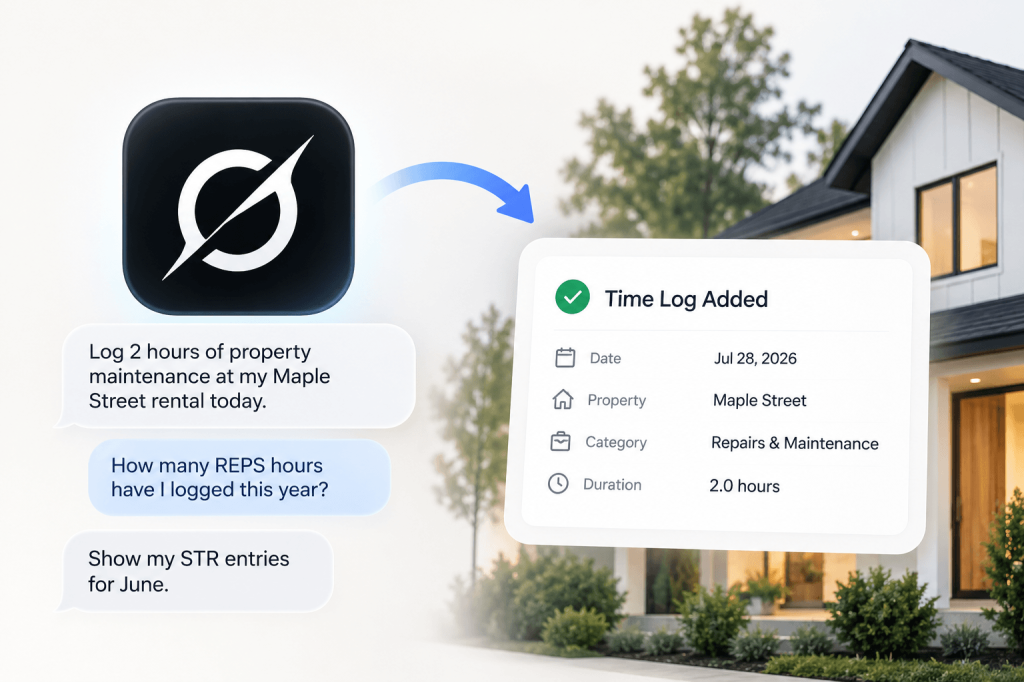
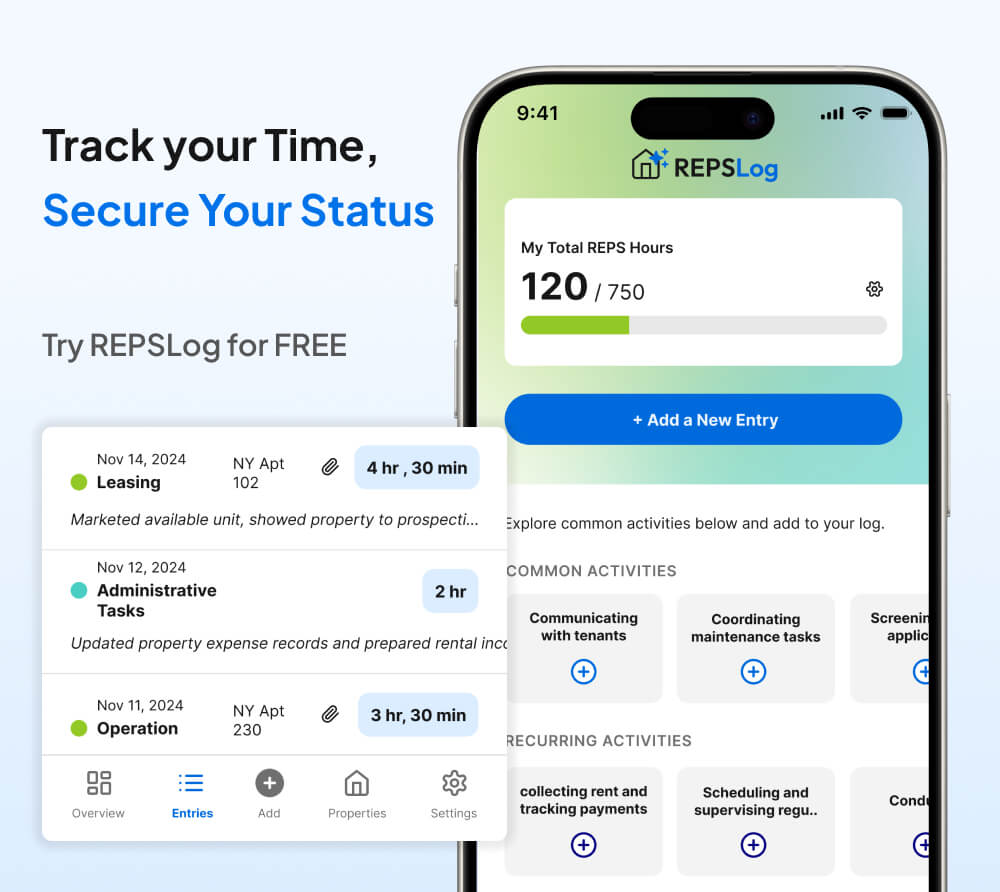
Since the NIIT exemption requires both REPS qualification and material participation, make it a year-round priority. Do not coast through the first six months and try to catch up in November. Use REPSLog to track your progress toward both the 750-hour REPS threshold and the material participation threshold throughout the year.
Strategy 2: Time Property Sales for REPS-Qualifying Years
If you plan to sell a property with a large gain, schedule the closing for a year when you are confident in your REPS qualification and material participation. This is particularly important for investors transitioning into or out of REPS status.
Strategy 3: Consider the Grouping Election for NIIT Purposes
The grouping election under Treas. Reg. 1.469-9(g) simplifies material participation for both Section 469 and Section 1411 purposes. If you own multiple properties and your hours are spread across them, grouping ensures that total hours across all properties are counted for material participation — making it easier to meet the 500-hour test and secure the NIIT exemption.
Strategy 4: Coordinate with Your CPA on Form 8960
The NIIT is reported on Form 8960 (Net Investment Income Tax). Your CPA needs to correctly identify which income items are excluded from NII based on your REPS status and material participation. Provide your REPS documentation to your CPA before filing so they can properly complete this form.
Key Takeaways
- The NIIT is a 3.8% surtax on net investment income for taxpayers with MAGI above $250,000 (married filing jointly) or $200,000 (single).
- Rental income is generally subject to the NIIT, but REPS with material participation can exempt it entirely.
- Both REPS qualification and material participation are required for the NIIT exemption. REPS alone is not sufficient.
- Capital gains from property sales can also be exempted if REPS and material participation are established in the year of sale.
- The grouping election under Treas. Reg. 1.469-9(g) simplifies material participation for NIIT purposes across multiple properties.
- Spouses can combine hours for material participation under IRC 469(h)(5), but not for REPS qualification itself.
- The NIIT exemption only applies to rental and real estate income, not to dividends, interest, or other investment income.
Frequently Asked Questions
Does qualifying as a real estate professional automatically exempt my rental income from the NIIT?
No. REPS qualification is necessary but not sufficient. You must also materially participate in your rental activities. Material participation requires meeting one of the seven tests under Treasury Regulation 1.469-5T, with the most common being more than 500 hours of participation during the tax year.
Can I exempt capital gains from a property sale from the NIIT?
Yes, if you qualify as a real estate professional and materially participate in the rental activity in the year the sale closes. The gain must be from a property held in a non-passive trade or business. You must meet both requirements in the year of disposition.
How much can the NIIT exemption save me?
The savings depend on your income level and rental income. At 3.8%, every $100,000 of rental income exempted saves $3,800 in NIIT. For an investor with $300,000 in rental income, the annual savings could be $11,400.
Does the NIIT exemption apply to depreciation recapture under Section 1250?
Depreciation recapture (taxed at a maximum rate of 25% under Section 1250) is included in net investment income unless the property is held in a non-passive trade or business. REPS with material participation can exempt depreciation recapture from the NIIT, but the recapture itself is still taxed at the 25% rate under its own rules.
Can my spouse’s hours help me qualify for the NIIT exemption?
For material participation (which is required for the NIIT exemption), spouses filing jointly can combine their hours under IRC 469(h)(5). However, for REPS qualification itself, only one spouse needs to qualify and must meet the 750-hour and more-than-half tests independently.
What form reports the NIIT, and how do I claim the exemption?
The NIIT is reported on Form 8960, which is filed with your annual tax return. The form calculates your net investment income and applies the 3.8% tax. Your CPA excludes qualifying rental income from NII based on your REPS status and material participation documentation.
If I have a property manager, can I still claim material participation for NIIT purposes?
Having a property manager does not automatically disqualify you from material participation, but it makes it harder to meet the hour thresholds. You need to demonstrate more than 500 hours of your own participation (or meet another material participation test) even if the property manager handles day-to-day operations. The grouping election can help by allowing you to combine hours across all properties.
Disclaimer: This article is for educational purposes only and does not constitute tax, legal, or financial advice. Tax laws are complex and subject to change. The NIIT thresholds and rules may be modified by future legislation. Consult a qualified tax professional before making any decisions related to REPS or the Net Investment Income Tax.
Protect Your Rental Income from the 3.8% NIIT
Qualifying for the NIIT exemption requires the same contemporaneous, detailed hour logs that support your REPS claim. REPSLog helps you track every qualifying hour, monitor your progress toward material participation, and maintain audit-ready documentation.
Available on iOS | Android | Web