
Real estate syndications have exploded in popularity among high-income investors looking for tax-advantaged exposure to large commercial properties — apartment complexes, self-storage facilities, office buildings, and industrial warehouses. The pitch is compelling: invest passively, receive K-1 tax benefits (particularly accelerated depreciation from cost segregation), and let the sponsor handle everything.
Then someone mentions Real Estate Professional Status. The investor thinks: “If I qualify for REPS, I can use those K-1 losses from my syndication to offset my $500,000 W-2 income.” It sounds like the ultimate tax hack — massive paper losses from institutional-quality real estate, deducted against active income.
There is a problem. For the vast majority of syndication investors, REPS does not help at all. The reason is structural, rooted in how limited partnership interests interact with the material participation rules. Understanding why limited partners cannot benefit from REPS — and what the narrow exceptions look like — is essential for any investor allocating capital between syndications and direct ownership.
How Syndications Are Structured
A typical real estate syndication involves two classes of participants:
General Partners (GPs) / Sponsors
The GP manages the deal. They find the property, negotiate the acquisition, arrange financing, execute the business plan (renovations, lease-up, repositioning), manage the property (or oversee the property manager), and eventually sell. The GP makes all major decisions and bears fiduciary responsibility to the investors.
Limited Partners (LPs) / Investors
LPs provide capital. They receive a share of the profits (typically structured as a preferred return plus a profit split) and tax benefits (depreciation, interest deductions, etc.) in proportion to their ownership interest. In exchange for their investment, LPs give up control — they do not make management decisions, they do not participate in day-to-day operations, and they have limited liability.
This GP/LP structure is the core of the problem for REPS purposes.

The Limited Partner Material Participation Rule
Under IRC Section 469(h)(2), a limited partnership interest is presumptively passive. The statute provides that a taxpayer’s participation in an activity as a limited partner is not treated as material participation except in narrow circumstances.
Treasury Regulation 1.469-5T(e) further restricts the material participation tests available to limited partners. An LP can satisfy material participation only by meeting one of three tests:
- The 500-hour test: The LP participated in the activity for more than 500 hours during the year
- The five-of-ten-years test: The LP materially participated in the activity for any five of the prior ten tax years
- The personal service activity test: The activity is a personal service activity and the LP materially participated for any three prior tax years
For a typical syndication LP, test 2 and test 3 are irrelevant (the LP has not been participating for years, and the activity is not personal service). That leaves the 500-hour test — and here is where the math breaks down.
Why 500 Hours Is Practically Impossible for LPs
To log more than 500 hours of participation in a syndication, an LP would need to be actively involved in the property’s operations — visiting the site, communicating with tenants, coordinating maintenance, overseeing the property manager, making leasing decisions. But that is exactly what the GP does. The entire point of being an LP is that you do not do those things.
Most syndication operating agreements explicitly restrict LP involvement in management decisions. An LP who tried to spend 500 hours managing the property would likely violate the operating agreement, jeopardize their limited liability protection, and create conflicts with the GP.
The result: virtually no syndication LP can materially participate in the syndication activity. The losses remain passive.
Why REPS Does Not Fix This
Here is the sequence that trips up investors:
- The investor qualifies as a real estate professional (meets the more than 750 hours and more-than-half tests through other real estate activities — perhaps they are a real estate agent or manage their own direct rentals).
- The investor invests in a syndication as an LP and receives a K-1 showing significant losses (from accelerated depreciation via cost segregation).
- The investor assumes REPS allows those syndication losses to offset W-2 income.
The assumption fails at step 3. REPS removes the per se passive classification of rental activities, but it does not override the requirement to materially participate. Without material participation, the activity is still passive. And the limited partner material participation restrictions make it nearly impossible for an LP to demonstrate material participation.
In other words, REPS opens the door for rental activities generally, but the limited partnership rules close it again for syndication LPs specifically.
The syndication K-1 losses remain passive. They can only offset passive income from other sources. REPS does not change this outcome.
The GP Exception: When REPS Does Help in Syndications
General partners and active sponsors of syndications can benefit from REPS. As the GP, you are the person performing the management, leasing, construction oversight, and operational work. You are the one spending hundreds or thousands of hours on the property.
If a GP qualifies as a real estate professional and materially participates in the syndication activity, the rental losses (including the GP’s share of depreciation) are non-passive and can offset other income.
This is why many syndication sponsors are real estate professionals: they need REPS to use the depreciation from their promoted interest and co-investment in their own deals.
The Fund Manager Nuance
Some syndication structures involve a management company (an LLC taxed as a partnership or S-corp) that manages the property. The principals of the management company may be GPs in the syndication and also employees or owners of the management company.
In this structure, the management company’s hours (and compensation) may count toward the principal’s REPS qualification, and their participation in the management company may support material participation in the syndication activity. The analysis is fact-specific and depends on how the entities are structured, but it is a legitimate path for active sponsors.
What About LLC-Structured Syndications?
Not all syndications use formal limited partnerships. Some use LLCs with managing members and passive members. The question arises: if the syndication is an LLC rather than an LP, does the limited partner restriction apply?
The answer depends on the investor’s role. Under Reg. 1.469-5T(e)(3)(ii), the limited partner material participation restrictions apply to any interest that is treated as a limited partnership interest. An LLC member who holds an interest analogous to a limited partnership interest — i.e., they do not manage the LLC and their role is purely as an investor — is generally treated as a limited partner for Section 469 purposes.
Several court cases, including Garnett v. Commissioner and Thompson v. United States, have addressed when LLC members are treated as limited partners. The general principle is that substance matters more than form. If you are a passive investor in an LLC-structured syndication, you are functionally a limited partner and the same restrictions apply.
However, if the LLC operating agreement gives you genuine management authority and you actually exercise it, you may not be treated as a limited partner. This is rare in syndication structures, where the whole model depends on centralized management.
Planning Around the LP Limitation
If you qualify for REPS and want to maximize the tax benefit, here are strategies that acknowledge the LP limitation:
Strategy 1: Prioritize Direct Ownership
The most straightforward approach: own properties directly (or through entities you control) rather than investing in syndications. Direct ownership allows you to materially participate in the rental activity, and REPS converts those losses from passive to non-passive.
An investor who could place $200,000 into a syndication might instead use that capital as a down payment on a property they manage directly. The REPS benefit from direct ownership far exceeds the tax benefit of a syndication K-1 that remains passive.
Strategy 2: Use Syndication Losses Against Passive Income
Even without REPS benefits, syndication losses have value. They can offset passive income from:
- Other syndication distributions
- Other passive business income
- Future passive income from any source
If you have a portfolio that generates both passive income and passive losses, the losses absorb the income and reduce your tax bill. This is less powerful than offsetting W-2 income, but it is still valuable.
Strategy 3: Wait for Disposition
When a syndication sells the underlying property, all previously suspended passive losses from that activity are released. They can offset the gain from the sale and any remaining losses can offset other income (active or passive) in the year of disposition.
This means the tax benefit of syndication losses is deferred, not lost. The depreciation benefits accumulate and are ultimately realized when the syndication exits the investment.
Strategy 4: Generate Passive Income to Absorb Syndication Losses
Some REPS investors strategically create passive income to absorb their syndication losses. This might involve:
- Owning rental properties where they do not materially participate (the rental income is passive and can absorb passive syndication losses)
- Investing in passive business activities that generate income
This is an advanced strategy that requires careful planning with a tax advisor.
Strategy 5: Consider GP or Co-GP Opportunities
If you have the expertise, capital, and desire, participating as a GP or co-GP in a syndication allows you to materially participate and use REPS to convert losses to non-passive. Some experienced investors transition from LP roles to GP roles as their knowledge and network grow.
The Grouping Election Does Not Help LPs
A common question: can the grouping election under Treas. Reg. 1.469-9(g) group a syndication with directly owned properties?
The grouping election allows you to treat all rental activities as a single activity for material participation purposes. However, you still must materially participate in the grouped activity. And the limited partner material participation restrictions apply to the LP interest within the group.
Furthermore, some practitioners argue that grouping a syndication LP interest with directly managed properties is not appropriate because the activities are fundamentally different in terms of the taxpayer’s involvement. This is an area where the IRS could challenge the grouping, and the outcome is uncertain.
Key Takeaways
- Limited partners in syndications generally cannot materially participate, making REPS irrelevant for those K-1 losses.
- REPS removes the per se passive classification of rentals but does not override the limited partner material participation rules under IRC 469(h)(2).
- General partners and active sponsors can benefit from REPS because they are the ones performing the qualifying work.
- Syndication losses are not lost — they offset passive income from other sources and are released upon disposition.
- Direct property ownership is the best vehicle for REPS tax benefits. If you qualify for REPS, prioritize assets where you can materially participate.
- LLC-structured syndications follow the same rules when the investor’s role is functionally equivalent to a limited partner.
Frequently Asked Questions
I qualify as a real estate professional. Why can’t I use my syndication losses against my W-2 income?
REPS removes the automatic passive classification of rental activities, but you must still materially participate in the activity to convert losses to non-passive. As an LP, you are restricted to three material participation tests, and the most feasible one (the 500-hour test) is practically impossible because LPs are not involved in property management.
What if the syndication operating agreement allows me to participate?
Even if the operating agreement permits some participation, you need more than 500 hours on the specific syndication property. Very few LP agreements provide the access needed for that level of involvement, and exercising such access could jeopardize your limited liability protection.
Can I group my syndication with my directly owned rentals under Treas. Reg. 1.469-9(g)?
This is a gray area. Some practitioners attempt this grouping, but the IRS may challenge it given the fundamentally different nature of LP participation versus direct ownership participation. Even if grouped, the limited partner material participation restrictions still apply to the LP interest within the group.
Do all my syndication losses disappear without REPS?
No. Passive losses carry forward and can offset passive income in any year. When the syndication disposes of the property, all accumulated suspended losses are released and can offset any type of income. The losses are deferred, not eliminated.
What about syndications structured as tenants-in-common (TIC)?
TIC structures give each investor direct ownership of an undivided interest in the property, which may allow material participation without the LP restrictions. However, TIC structures have their own complications (including potential recharacterization as partnerships by the IRS) and are far less common than LP/LLC syndications.
Can my hours as a real estate agent count toward material participation in a syndication?
No. Hours as a real estate agent count toward your REPS qualification (the 750-hour and more-than-half tests), but material participation must be demonstrated in each specific activity. Being a busy real estate agent does not establish material participation in a syndication you invested in as an LP.
Should I avoid syndications entirely if I have REPS?
Not necessarily. Syndications offer diversification, access to institutional-quality assets, and professional management. The tax benefits (even as passive losses) still have value. But if your primary goal is using REPS to offset W-2 income, direct ownership is the more effective vehicle. Many REPS investors maintain a portfolio of both directly owned properties (for non-passive loss generation) and syndication investments (for passive income offsetting and long-term wealth building).
Disclaimer: This article is for educational purposes only and does not constitute tax, legal, or financial advice. Tax laws are complex and subject to change. Consult a qualified tax professional before making any decisions related to Real Estate Professional Status or syndication investments.
Maximize Your REPS Benefits with Direct Property Tracking
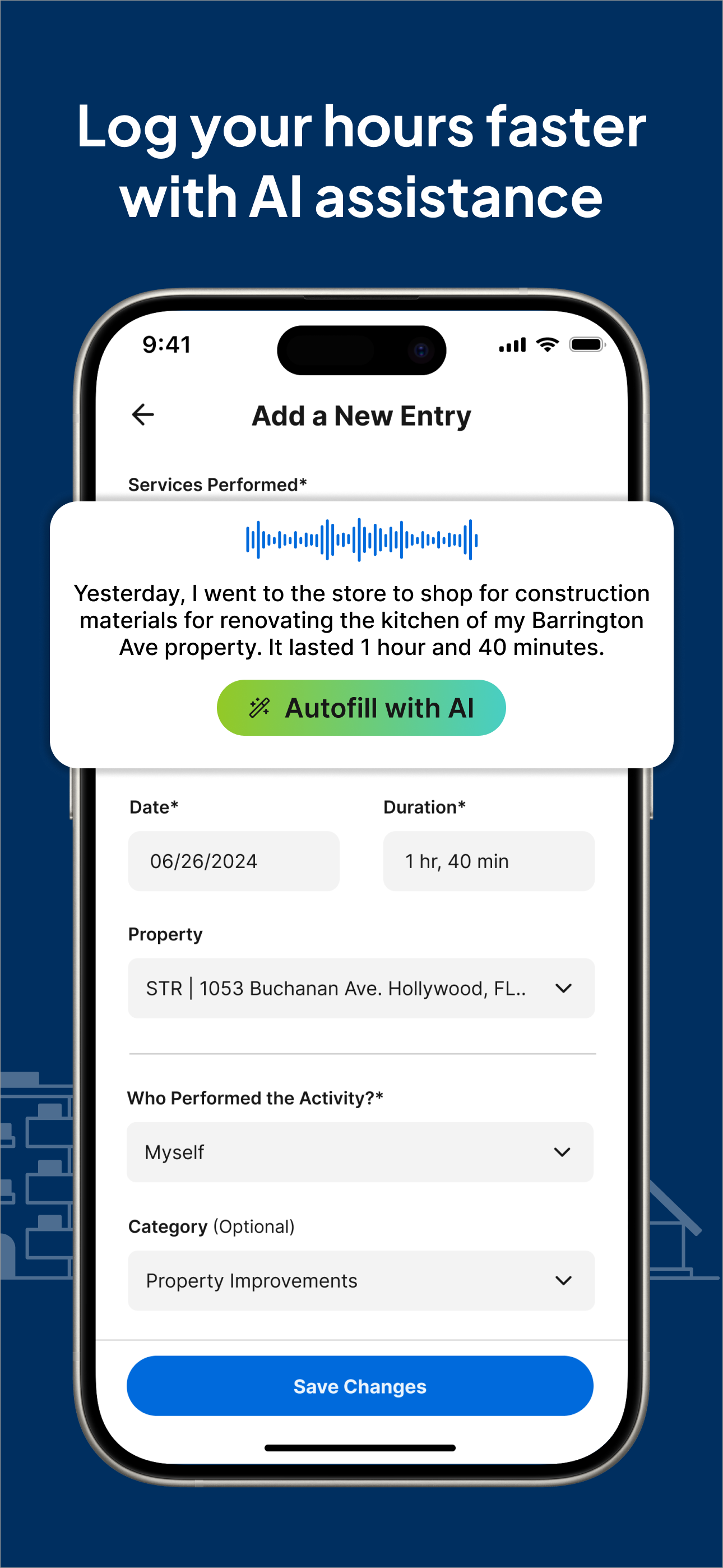
REPS delivers its greatest value when you own and manage properties directly. REPSLog helps you track every qualifying hour across your portfolio, document material participation, and maintain the audit-ready records that make REPS defensible.
Available on iOS | Android | Web