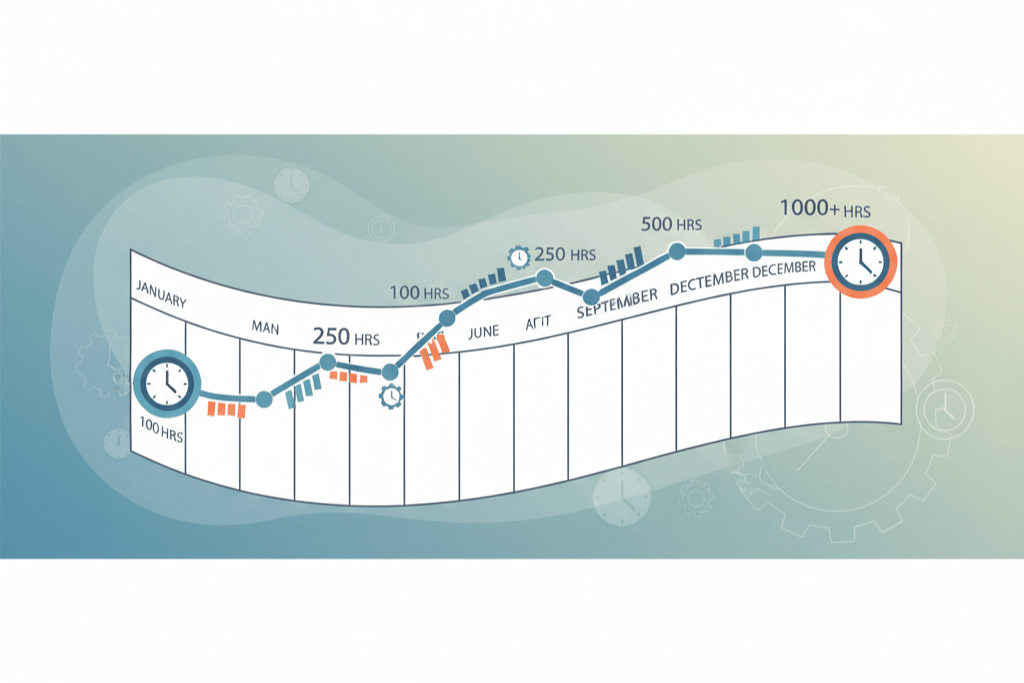
The most common REPS failure is not misunderstanding the rules — it is running out of time. An investor who fully intends to log more than 750 hours in real property trades or businesses reaches October, realizes they are only at 400 hours, and faces an impossible sprint to make up the difference before December 31. The more-than-half test is even harder to rescue at year-end because it depends on the ratio of real estate hours to all other professional hours, a ratio that shifts with every workday.
REPS qualification is a marathon, not a sprint. Treating it as a year-round discipline — with monthly check-ins, seasonal awareness, and a clear pacing strategy — dramatically increases your odds of qualifying and reduces the stress of a last-minute scramble.
This calendar provides a month-by-month framework for staying on pace, identifying risks early, and finishing the year with both tests comfortably satisfied and documentation ready for your CPA.
The Math: Your Monthly Pacing Targets
To accumulate more than 750 hours over 12 months, you need to average approximately 63 hours per month, or roughly 15 hours per week. That is about 2 to 3 hours per day, five days a week.
For the more-than-half test, the math depends entirely on your non-real-estate hours. If you have no W-2 or other non-real-estate employment, any amount of real estate hours passes the test. If you work a part-time non-real-estate job at 20 hours per week (approximately 1,040 annual hours), you need more than 1,040 real estate hours — about 87 hours per month or 20 hours per week.
These averages are just starting points. Real estate activity is inherently seasonal and project-driven. Some months you will log 120 hours (during a renovation or acquisition), and others you will log 30 hours (during a quiet management period). What matters is the annual total.

January: Set the Foundation
January is the most important month of the year for REPS planning, even though it often has the fewest property management hours.
Action items:
- Confirm your tracking system is active. If you use REPSLog, ensure your properties and categories are up to date. If you are starting fresh, set up your account and establish the logging habit immediately.
- Calculate your projected non-real-estate hours. Review your W-2 schedule, consulting commitments, or other business activities. Estimate your total non-real-estate hours for the year. This is your target to beat.
- Set your annual hour goal. Your goal is not 750 — it is 750 plus a buffer. Target at least 800 to 850 hours to account for any hours the IRS might disallow in an audit.
- Identify major projects for the year. Do you have a renovation planned? A new acquisition? A lease-up? Map these out on a calendar. These high-activity periods will generate the most hours.
- Review your grouping election. If you made the grouping election under Treas. Reg. 1.469-9(g) in a prior year, confirm it is still appropriate. If this is your first year, discuss with your CPA whether to make the election.
Monthly target: 50-60 hours (it is okay to start slowly while building momentum).
February: Build the Habit
By the end of February, you should have a reliable daily or weekly logging rhythm.
Action items:
- Log entries in real time. After each activity — a property visit, a contractor call, a tenant screening — log it immediately in REPSLog or your tracking system. Do not batch entries at month-end.
- Review your January hours. Did you hit your target? If not, identify the gap. Were there qualifying activities you performed but did not log?
- Start tracking non-real-estate hours. You need to prove the more-than-half test. Knowing your actual W-2 or business hours (not just estimated) strengthens your documentation.
Cumulative target: 110-130 hours (end of February).
March: First Quarter Check-In
One quarter of the year is gone. This is your first real checkpoint.
Action items:
- Run your first quarterly review. You should be at approximately 190 hours (25% of 750). If you are below 150, you are behind pace and need to assess why.
- Evaluate the more-than-half test. Compare your Q1 real estate hours to your Q1 non-real-estate hours. If the ratio is not in your favor, identify how to shift it.
- Tax season reflection. If you are meeting with your CPA for the prior year’s return, use this meeting to discuss current-year REPS strategy, the grouping election, and any changes to your portfolio.
Cumulative target: 185-200 hours (end of March).
April: Tax Filing Lessons
April is when many investors learn the most about their REPS strategy — by seeing the prior year’s results.
Action items:
- Review your prior-year return. Did you qualify last year? Were there documentation gaps? What feedback did your CPA provide?
- Apply lessons to current-year tracking. If your CPA flagged any issues (vague descriptions, missing categories, insufficient detail), improve your logging practices now.
- Spring property maintenance. This is typically when seasonal maintenance kicks in — landscaping, exterior repairs, HVAC servicing, gutter cleaning. These are all qualifying hours. Log every contractor coordination call, property visit, and vendor negotiation.
Cumulative target: 250-270 hours (end of April).
May: Leasing Season Begins
In many markets, May through August is peak leasing season. This is an opportunity to log significant hours.
Action items:
- Capitalize on lease renewals and turnover. If tenants are moving out, the turnover process generates hours: inspecting the unit, coordinating cleaning and repairs, photographing the property, creating listings, showing the property, screening applicants, and executing new leases.
- Market vacant properties aggressively. Every hour spent marketing, showing, and negotiating leases counts toward REPS.
- Document seasonal activities in detail. “Tenant turnover at 123 Main St — inspected unit, photographed damage, coordinated painter and cleaner, created Zillow listing” is much stronger documentation than “property management.”
Cumulative target: 315-340 hours (end of May).
June: Mid-Year Assessment
You are halfway through the year. This is the most critical checkpoint.
Action items:
- Perform a detailed mid-year review. You should be at or above 375 hours (50% of 750). If you are below 350, you need to significantly increase your activity level in the second half.
- Re-evaluate the more-than-half test. At the halfway point, your real estate hours should ideally exceed your non-real-estate hours. If they do not, calculate the gap and determine whether it is closable.
- Consider whether REPS is achievable this year. If you are significantly behind on the more-than-half test (for example, you work full-time and are not on pace), it may be worth accepting that REPS will not happen this year and pivoting to other strategies (the $25,000 allowance, loss carry-forwards, spousal strategy for next year).
- Identify second-half projects. What acquisitions, renovations, or operational projects can you schedule for Q3 and Q4 to generate additional hours?
Cumulative target: 375-400 hours (end of June).
July: Peak Activity
Summer is typically the busiest season for property management, especially for STR operators and investors in seasonal markets.
Action items:
- Maximize summer maintenance hours. Exterior projects (roofing, painting, landscaping, parking lot sealing) are best done in warm months. Coordinate and oversee these projects.
- STR management peaks. If you operate short-term rentals, summer guest turnover, maintenance between stays, and pricing optimization generate significant hours.
- Continue logging consistently. The temptation to slack on tracking during busy periods is real. Force yourself to log daily, even when the work is hectic.
Cumulative target: 445-470 hours (end of July).
August: Back-to-School Transition
As the leasing season winds down, focus shifts to operational efficiency and planning.
Action items:
- Wrap up summer maintenance projects. Document completion, final inspections, and any follow-up needed.
- Begin year-end planning. If you have potential acquisitions, start due diligence now. The hours spent analyzing deals, touring properties, and meeting with lenders all count.
- Review your pacing. Two-thirds of the year is done. You should be around 500 hours. If you are at 450+, you are in good shape. Below 400, the second half needs to be aggressive.
Cumulative target: 500-530 hours (end of August).
September: Third Quarter Check-In
Action items:
- Run your Q3 review. Three-quarters through the year, you should be at approximately 565 hours (75% of 750). Any gap below 530 requires a concrete plan for October through December.
- Review material participation. If you made the grouping election under Treas. Reg. 1.469-9(g), confirm your total hours across all properties satisfy material participation (typically more than 500 hours). If you have not made the grouping election, check material participation for each property individually.
- Schedule any remaining property projects. Fall is the last practical window for major outdoor work before winter. Plan accordingly.
- Meet with your CPA for a pre-year-end check-in. Discuss your current hour total, any cost segregation studies in progress, and whether any year-end transactions (property sales, purchases) are planned.
Cumulative target: 565-590 hours (end of September).
October: Final Push Preparation
Action items:
- Calculate exactly how many hours you need. Subtract your current total from your target (remember, aim for 800+). This gives you a daily target for the remaining 90 days.
- Winterization projects. Depending on your climate, October brings furnace inspections, pipe insulation, gutter cleaning, and storm preparation. These are all qualifying hours.
- Continue deal sourcing. Acquisition activity counts regardless of whether you close a deal. Hours spent analyzing properties you ultimately decide not to buy are still qualifying hours.
Cumulative target: 625-650 hours (end of October).
November: Year-End Sprint
If you are on pace, November is about maintaining momentum. If you are behind, it is about focused effort.
Action items:
- Double down on high-hour activities. Renovation projects, deep property inspections, and acquisition due diligence generate the most hours per day. Prioritize these.
- Review and organize documentation. Spend time organizing your annual log, filling in any entries you may have missed (note: adding past entries from memory is less credible than contemporaneous records — do not fabricate hours, but do add legitimate activities you performed but forgot to log with a note about the date).
- Confirm the more-than-half test. Calculate your final projected non-real-estate hours and ensure your real estate hours will exceed them.
Cumulative target: 690-720 hours (end of November).
December: Cross the Finish Line
Action items:
- Reach your target early. Do not wait until December 31. Aim to cross 750 hours by December 15, giving yourself a two-week buffer.
- Year-end property activities. Annual inspections, lease reviews, budget preparation for the coming year, vendor contract negotiations, and year-end accounting all count.
- Prepare your CPA package. Generate your final activity report (REPSLog makes this easy), compile your property financial summaries, and organize your documentation for filing.
- Set up next year. On January 1, your REPS clock resets. Plan your next year while the current one is fresh in your mind.
Final target: 800+ hours by December 31.
Key Takeaways
- Pace yourself from January. The investors who fail REPS almost always start tracking too late or fall behind in the first half.
- Quarterly check-ins are essential. Review your hours at the end of March, June, September, and November to catch shortfalls early.
- The more-than-half test runs parallel to the 750-hour test. Track both simultaneously.
- Seasonal patterns are your friend. Leasing season, summer maintenance, and year-end activities all generate above-average hours.
- Build a buffer. Target 800+ hours, not 751. A buffer protects you if the IRS disallows any hours during an audit.
- Meet with your CPA at least twice during the year — once in spring (to review the prior year and set strategy) and once in fall (to confirm pacing and plan year-end actions).
Frequently Asked Questions
What if I fall behind pace at mid-year?
Assess the gap honestly. If you are at 300 hours at mid-year and need 750+, you need 450+ hours in six months (75+ per month). That is achievable if you have major projects planned (renovations, acquisitions) or if you can increase your real estate activity. If the gap is too large, consider whether the spousal strategy or a career change makes REPS feasible for next year.
Do I have to track hours every single day?
Not necessarily, but logging within a day or two of performing the work is ideal. The IRS places the highest credibility on contemporaneous records — entries made at or near the time the work was done. Weekly batch logging is acceptable but less defensible than daily logging.
What if I exceed 750 hours but fail the more-than-half test?
You do not qualify for REPS. Both tests must be satisfied. The more-than-half test is often harder for investors with full-time employment. If you consistently pass the 750-hour test but fail more-than-half, the structural solution is reducing non-real-estate hours (part-time work, career transition, or spousal strategy).
Can I count weekends and holidays toward my hours?
Absolutely. The IRS evaluates calendar-year hours without regard to when they occur. Weekend property visits, holiday maintenance calls, and evening administrative work all count. Many investors accumulate significant weekend hours through property inspections, open houses, and tenant communications.
Should I round up my hours to reach the target?
Never. Rounding up, padding, or fabricating hours is fraud. If you legitimately performed 740 hours of qualifying work, you did not qualify for REPS that year. Accept it, carry forward your losses, and plan better for next year. The consequences of an inflated log that does not survive audit scrutiny are far worse than missing the threshold by a few hours.
What is the best tool for month-by-month tracking?
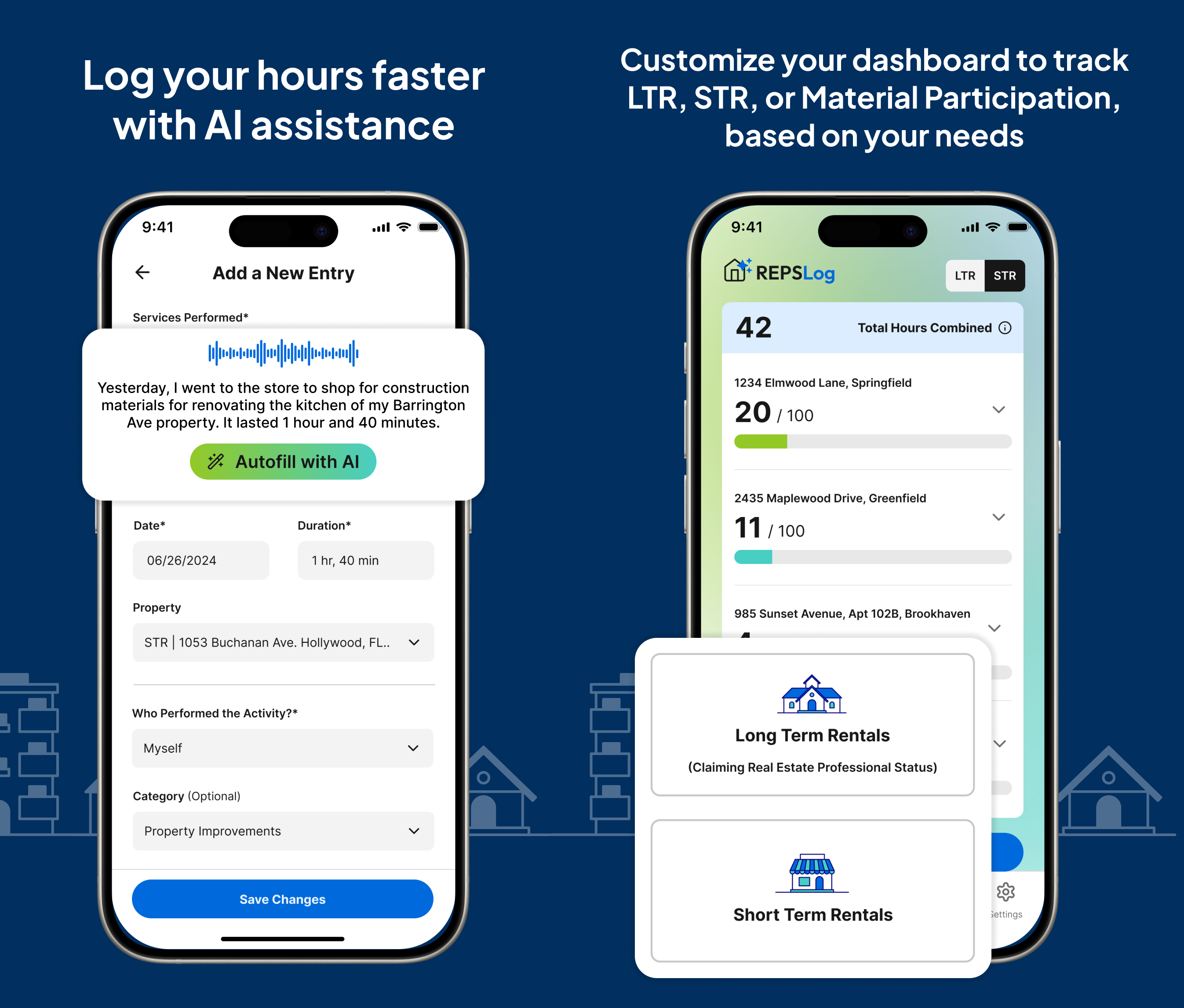
REPSLog is designed specifically for REPS tracking with built-in progress monitoring toward the 750-hour threshold, property-level categorization, and report generation for your CPA. A well-structured spreadsheet can work, but it lacks the real-time progress tracking and structured data entry that reduce the risk of gaps and errors.
Disclaimer: This article is for educational purposes only and does not constitute tax, legal, or financial advice. Tax laws are complex and subject to change. Consult a qualified tax professional before making any decisions related to Real Estate Professional Status.
Stay on Pace All Year with REPSLog
REPSLog tracks your progress toward the 750-hour threshold in real time, so you always know exactly where you stand. Log activities as you go, monitor your pacing month by month, and generate year-end reports for your CPA.
Available on iOS | Android | Web