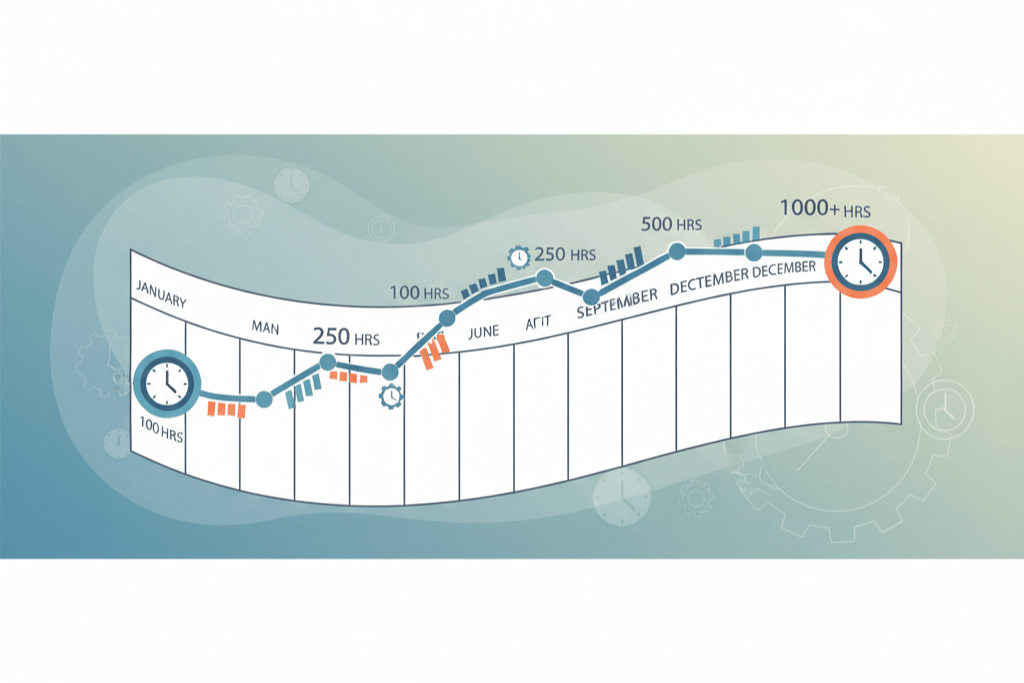
When the IRS audits a REPS claim, they do not just look at total hours. They look at what you did. An activity log showing 900 hours of vague “property management” is far less persuasive than one showing 200 hours of maintenance coordination, 150 hours of tenant management, 180 hours of acquisition activity, 120 hours of financial administration, and 250 hours of construction oversight. The second log tells a story: this person runs a real property trade or business across multiple functions. The first log looks like someone wrote a number on a piece of paper.
Categorizing your REPS activities is not busywork — it is a strategic decision that affects how credible your documentation appears to an IRS examiner, how defensible your hours are in Tax Court, and how efficiently your CPA can prepare your return. The categories you choose should map directly to the statutory language of IRC Section 469(c)(7)(C), which defines the qualifying real property trades or businesses.
The Statutory Categories
IRC Section 469(c)(7)(C) lists the following real property trades or businesses:
- Development — Entitling raw land, obtaining zoning approvals, site planning, and creating buildable lots or parcels
- Redevelopment — Repositioning or renovating existing properties to change their character, improve their condition, or increase their value
- Construction — Building new structures, additions, or improvements
- Reconstruction — Restoring or rebuilding damaged or deteriorated properties
- Acquisition — Identifying, analyzing, negotiating, and purchasing real property
- Conversion — Changing a property’s use from one type to another (residential to commercial, personal to rental, etc.)
- Rental — All aspects of renting property to tenants
- Operation — Day-to-day property operations including maintenance, utilities, and vendor management
- Management — Overseeing property performance, making strategic decisions, managing people who manage properties
- Leasing — Marketing properties, finding tenants, negotiating and executing leases
- Brokerage — Acting as a licensed real estate agent or broker in transactions
These 11 categories are broad enough to encompass virtually every legitimate real estate activity. The challenge is mapping your daily tasks to these categories in a way that is both accurate and defensible.
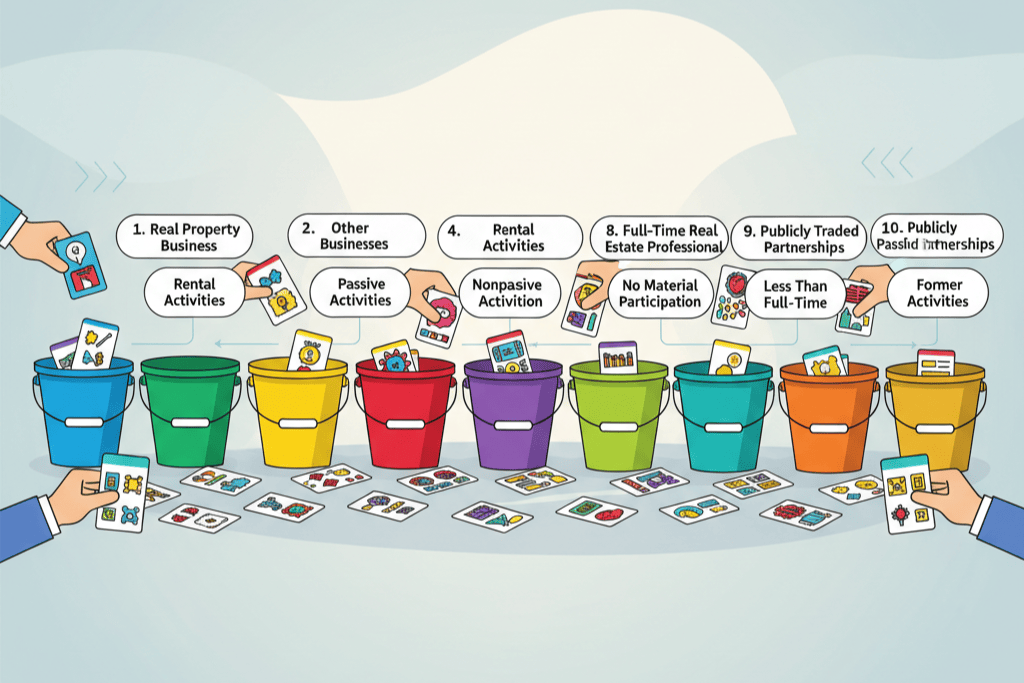
Building Your Category System
Principle 1: Align with the Statute
Your categories should clearly correspond to the statutory list. You do not need to use the exact statutory terms, but your categories should be recognizable as subsets of the 11 qualifying activities. An IRS examiner who sees “Tenant Screening” immediately understands this falls under “Leasing” or “Rental.” An examiner who sees “Miscellaneous Real Estate” does not.
Principle 2: Be Granular Enough to Tell a Story
“Property Management” is technically accurate for almost everything you do, but it tells the examiner nothing. Break your activities into categories that demonstrate the breadth and depth of your involvement. A REPS claim supported by eight or nine distinct activity categories is inherently more credible than one supported by two.
Principle 3: Be Consistent
Use the same categories throughout the year and across years. If you categorize contractor coordination as “Construction Oversight” in January, do not reclassify the same type of work as “Property Maintenance” in August. Consistency shows that your tracking system is genuine, not manufactured.
Principle 4: Do Not Over-Engineer
While granularity is important, splitting activities into 30 micro-categories creates a maintenance burden and can actually reduce clarity. Eight to twelve well-defined categories cover the full spectrum of REPS activities for most investors.
Recommended Category Framework
Here is a practical category system that maps to the statutory language and covers the typical REPS investor’s activities:
Category 1: Acquisition and Due Diligence
Statutory basis: Acquisition
Activities that belong here:
- Market research and deal sourcing
- Property tours and inspections
- Financial analysis (running numbers, modeling returns, comp analysis)
- Due diligence review (title, survey, environmental, inspections)
- Negotiations with sellers and their agents
- Communication with lenders and mortgage brokers
- Closing activities and document review
- 1031 exchange identification and coordination
Example log entry: “Toured three-plex at 789 Elm St with agent. Inspected exterior, all three units, basement, and roof from ground level. Discussed offer strategy with agent afterward. 2.5 hours.”
Category 2: Renovation and Construction
Statutory basis: Construction, Reconstruction, Redevelopment
Activities that belong here:
- Physical renovation labor (painting, flooring, drywall, etc.)
- Contractor coordination and supervision
- Design decisions and material selection
- Permit applications and building inspections
- Project planning and budgeting
- Quality control inspections
- Change order review and approval
Example log entry: “Met with electrician at 456 Oak Ave to review panel upgrade scope. Walked through unit 2 to identify outlet additions needed for code compliance. Approved bid and scheduled start date. 1.5 hours.”
Category 3: Tenant Management
Statutory basis: Rental, Leasing
Activities that belong here:
- Tenant communications (maintenance requests, questions, disputes)
- Rent collection and payment processing
- Lease enforcement and compliance
- Move-in and move-out inspections
- Security deposit accounting
- Tenant relations and dispute resolution
Example log entry: “Received maintenance request from tenant at 123 Main St regarding leaking kitchen faucet. Called plumber, scheduled repair for Thursday. Informed tenant of timeline. 30 minutes.”
Category 4: Marketing and Leasing
Statutory basis: Leasing, Rental
Activities that belong here:
- Creating property listings (photos, descriptions, pricing)
- Posting listings to rental platforms (Zillow, Apartments.com, Craigslist, etc.)
- Responding to inquiries from prospective tenants
- Showing properties
- Screening applicants (background checks, credit checks, reference calls)
- Negotiating lease terms
- Drafting and executing lease agreements
- Lease renewals and rent increase negotiations
Example log entry: “Photographed vacant unit 3 at 456 Oak Ave. Created listing with description and uploaded to Zillow and Apartments.com. Responded to four inquiries from prior listing. 2 hours.”
Category 5: Maintenance and Repairs
Statutory basis: Operation, Management
Activities that belong here:
- Coordinating routine maintenance (landscaping, snow removal, cleaning)
- Scheduling and overseeing repairs
- Performing maintenance yourself (fixing, replacing, cleaning)
- Vendor management (hiring, evaluating, and managing service providers)
- Emergency response (burst pipes, electrical issues, HVAC failures)
- Seasonal maintenance tasks (winterization, spring clean-up, gutter cleaning)
- Appliance and system maintenance
Example log entry: “Drove to 123 Main St to meet HVAC technician for annual furnace inspection and filter replacement. Inspected units while on site. 1.5 hours including travel.”
Category 6: Financial Administration
Statutory basis: Management, Operation
Activities that belong here:
- Bookkeeping and accounting for rental properties
- Reviewing financial statements and cash flow reports
- Paying property-related bills (mortgage, insurance, taxes, vendors)
- Bank reconciliation for property accounts
- Preparing or reviewing financial reports
- Tax record organization and preparation
- Insurance policy review and renewal
- Property tax review and appeal preparation
Example log entry: “Reconciled rental income and expenses for all properties for the month of June. Reviewed property tax assessments for 123 Main St and 456 Oak Ave. Prepared payment for Q2 estimated taxes. 2 hours.”
Category 7: Property Inspection and Assessment
Statutory basis: Operation, Management
Activities that belong here:
- Routine property inspections (interior, exterior, common areas)
- Drive-by property checks
- Capital improvement planning (identifying future renovation needs)
- Safety and compliance inspections
- Condition assessments and reporting
- Photographing property conditions
- Evaluating property performance and operations
Example log entry: “Conducted semi-annual inspection of 789 Elm St. Checked all three units for maintenance issues, inspected roof condition from attic, tested smoke detectors, and noted items for fall maintenance list. 2.5 hours.”
Category 8: Legal and Regulatory
Statutory basis: Management, Operation, Rental
Activities that belong here:
- Consulting with attorneys on real estate matters
- Reviewing and revising lease agreements
- Handling eviction proceedings
- Fair housing compliance activities
- Zoning and regulatory compliance
- HOA meeting attendance and communication
- Insurance claim coordination
- Entity management (LLC maintenance, operating agreement updates)
Example log entry: “Spoke with attorney regarding lease clause update for 2026 leases across all properties. Reviewed draft lease addendum for emotional support animal policy. 1 hour.”
Category 9: Strategic Planning and Analysis
Statutory basis: Management, Development
Activities that belong here:
- Portfolio performance review
- Market analysis and rent surveys
- Long-term capital planning
- Refinancing analysis and coordination
- 1031 exchange planning
- Disposition strategy development
- Networking with other real estate professionals (with business purpose)
Example log entry: “Analyzed rent comps for all three properties to set renewal rates for upcoming lease expirations. Reviewed market trends and vacancy rates in our submarket. Prepared rent increase notices. 1.5 hours.”
How Categorization Strengthens Your Audit Position
When an IRS examiner reviews a REPS claim, they are evaluating two things:
- Quantity: Did you actually spend more than 750 hours? Did your real estate hours exceed your non-real-estate hours?
- Quality: Do the claimed activities actually constitute personal services in real property trades or businesses?
A well-categorized log addresses both questions simultaneously. The examiner can quickly see the total hours in each category, verify that each category maps to a qualifying statutory activity, and assess whether the distribution of hours makes sense for someone running a real property trade or business.
A log with diverse categories — acquisition, renovation, tenant management, maintenance, financial administration — paints a picture of a genuine real estate professional engaged in the full spectrum of property ownership activities. A log with a single catch-all category invites the examiner to dig deeper, question individual entries, and look for padding.
Handling Activities That Span Multiple Categories
Some activities naturally cross category boundaries. A property visit might include inspecting the property (Property Inspection), meeting with a contractor about upcoming work (Renovation and Construction), and discussing a maintenance issue with a tenant (Tenant Management).
You have two options:
- Split the entry: Log three separate entries for the same property visit, allocating time to each category. This provides the most granular record.
- Use the primary category: Log the visit under the category that consumed the most time, and mention the other activities in the description. This is simpler and still defensible.
Either approach works. The key is that your description captures what you actually did, regardless of which category header it falls under.
Key Takeaways
- Categorize your activities to align with the 11 statutory categories in IRC 469(c)(7)(C). This demonstrates that your hours are spent in qualifying real property trades or businesses.
- Use 8 to 12 well-defined categories that cover the breadth of your real estate involvement. Avoid catch-all categories like “Property Management.”
- Be specific in your descriptions. A category label tells the IRS what type of work you did; the description tells them exactly what happened.
- Consistency matters. Use the same categories throughout the year and across years to demonstrate a genuine tracking system.
- Diverse categories strengthen your position. A log showing activity across acquisition, renovation, tenant management, maintenance, and financial administration is more credible than one showing a single category.
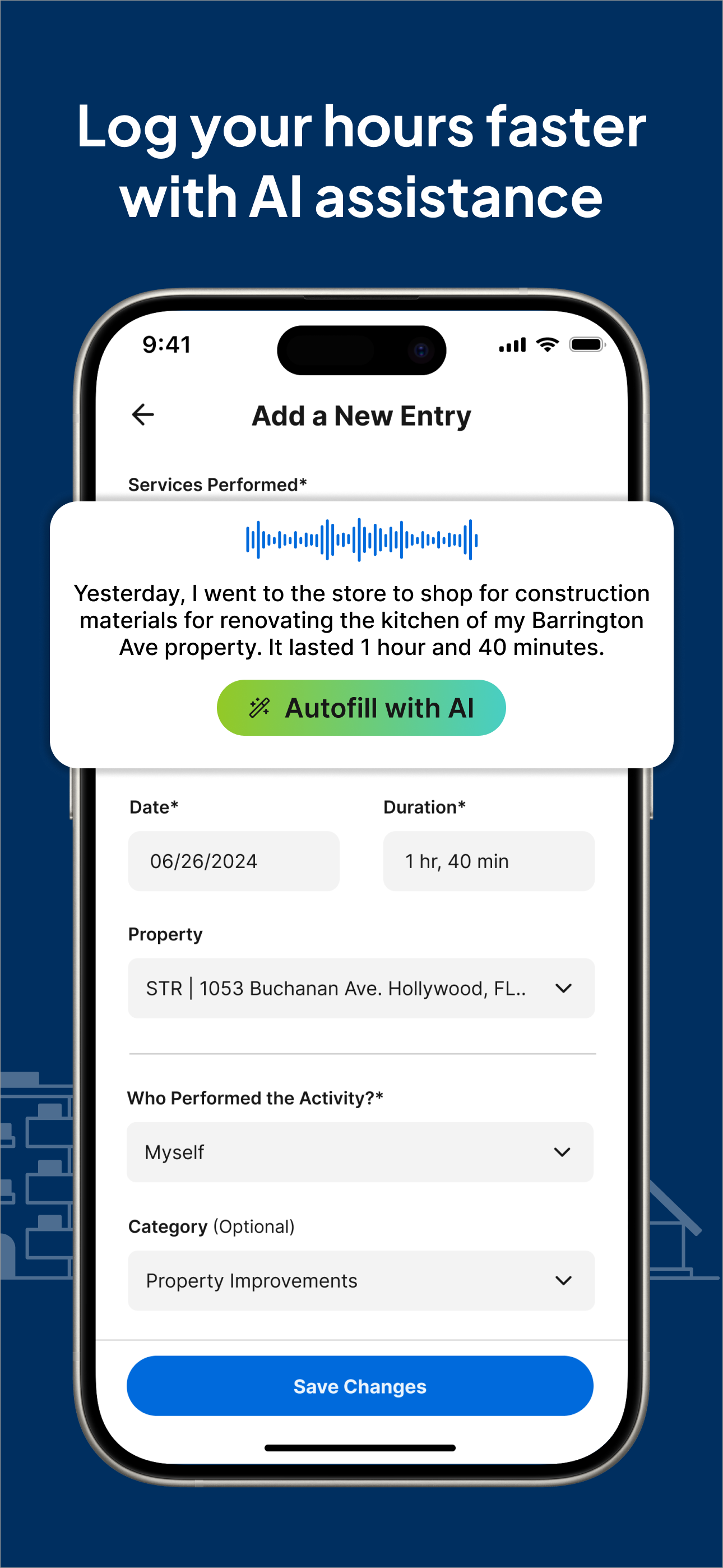
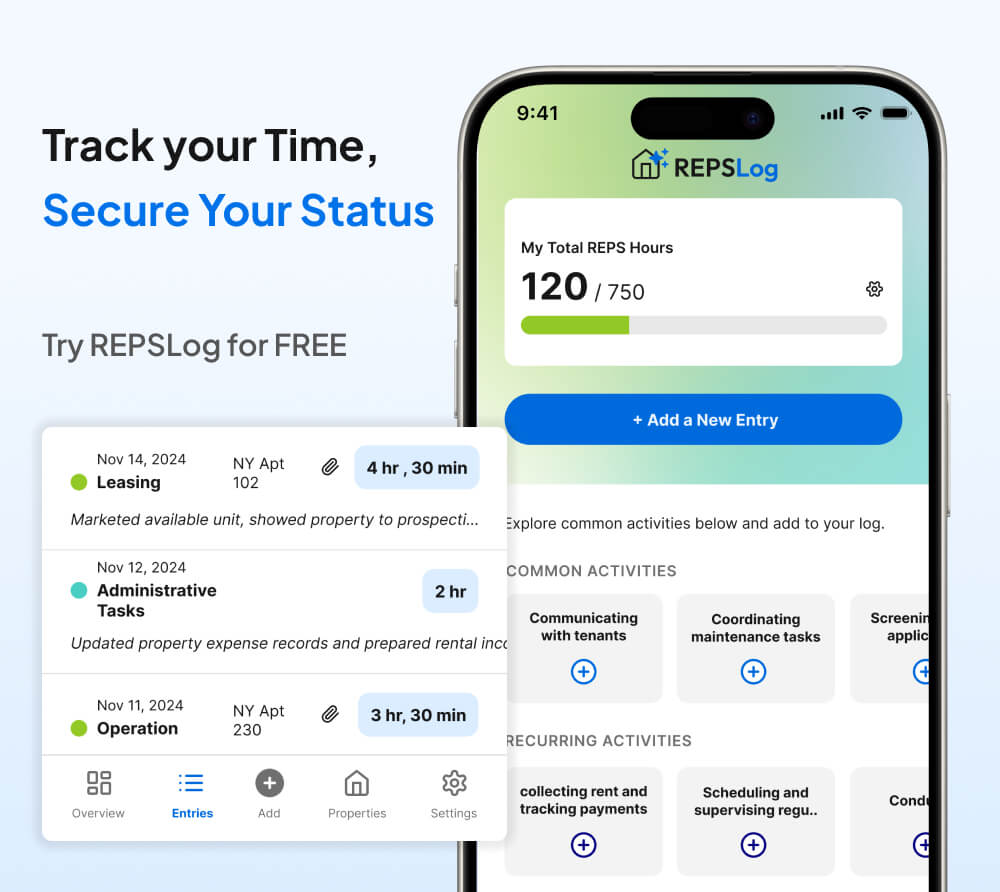
- REPSLog provides built-in categories mapped to qualifying activities, making it easy to categorize as you log.
Frequently Asked Questions
Does the IRS require specific categories in my activity log?
No. The IRS does not prescribe specific categories. However, your log must demonstrate that your hours were spent in qualifying real property trades or businesses as defined in IRC 469(c)(7)(C). Using categories that clearly map to the statutory activities makes this demonstration straightforward.
Can I create my own categories or should I use the exact statutory terms?
You can create your own categories. Most investors use practical labels (like “Tenant Management” or “Renovation”) rather than the statutory terms (like “Rental” or “Reconstruction”). The important thing is that an IRS examiner can easily connect your categories to the statutory activities.
What category should I use for travel time?
Travel time to perform a qualifying activity should be categorized under that activity. If you drive to the property for a maintenance inspection, log the travel time under “Property Inspection” or “Maintenance.” If you drive to a contractor meeting about a renovation, log it under “Renovation and Construction.”
How detailed should my descriptions be within each category?
Detailed enough that someone who was not present could understand what you did, where, and why. “Coordinated painter and electrician schedules for 456 Oak Ave kitchen renovation. Reviewed paint samples and approved color selections.” is strong. “Renovation work” is not.
Can education and training be a separate category?
Yes, but be conservative with education hours. Create a category like “Professional Development” and use it for courses, seminars, and training directly related to your real estate activities. The IRS allows reasonable education hours but views excessive education claims skeptically.
What if most of my hours fall into one or two categories?
This can happen legitimately — during a major renovation, most hours will be in the Renovation category. During a heavy leasing season, most hours will be in Marketing and Leasing. The key is that over the full year, your categories show a mix of activities consistent with running a real property trade or business. If all 750+ hours are in a single category, it raises questions about whether you are truly engaged in the full scope of real estate professional work.
Disclaimer: This article is for educational purposes only and does not constitute tax, legal, or financial advice. Tax laws are complex and subject to change. Consult a qualified tax professional before making any decisions related to Real Estate Professional Status.
Categorize Your REPS Hours Automatically
REPSLog comes with built-in activity categories mapped to the qualifying real property trades or businesses under IRC 469(c)(7)(C). Log each activity with the right category from the start, and generate organized reports that show the IRS exactly where your hours were spent.
Available on iOS | Android | Web