If you earn a high W-2 salary and own a short-term rental, there is a provision buried in the Internal Revenue Code that could let you deduct tens of thousands of dollars in real estate losses against that paycheck. It is commonly called the STR loophole, and it is one of the most significant tax planning opportunities available to real estate investors today.
New to the STR loophole? Start with our STR loophole guide.
This is not a gray-area maneuver or an aggressive interpretation of the law. The provision flows directly from how IRC Section 469 defines “rental activity” and how that definition interacts with the material participation rules. Understanding how these pieces fit together, and what you need to document, is the difference between a legitimate tax strategy and a rejected claim.
This guide explains the mechanics from the ground up: what the STR loophole actually is, how it differs from Real Estate Professional Status, what the IRS expects from you, and how to estimate what it could save.
Plug in your own numbers on the STR tax savings calculator to see your first-year savings on the real 2025 and 2026 tax brackets.
What Is the STR Loophole?
Under the passive activity loss rules in IRC Section 469, rental income is generally treated as passive. Passive losses can only offset passive income. If your rental generates a large paper loss (more on that below) but you have no passive income to absorb it, the loss just sits on your return as a suspended carryforward. It does nothing for your current tax bill.
But Section 469 contains a definitional carve-out. A property is only treated as a “rental activity” under the passive loss rules if the average period of customer use exceeds seven days. If your guests stay an average of seven days or fewer, the IRS does not classify your property as a rental activity for passive loss purposes. Instead, it is treated as a regular trade or business.
Why does that matter? Because the passive-vs.-non-passive classification for a trade or business depends entirely on whether you materially participate. If you do, the activity is non-passive, and any losses it generates can be deducted directly against your W-2 wages, self-employment income, or any other ordinary income.
That is the loophole in plain language: short-term rentals can escape the passive activity trap when the owner meets two requirements.

How the STR Loophole Differs from REPS
Real Estate Professional Status (REPS) is the other well-known strategy for unlocking passive real estate losses. Both strategies accomplish a similar end result, but the qualification path is completely different.
REPS requires two tests:
- You must spend more than 750 hours during the tax year in real property trades or businesses where you materially participate.
- You must spend more time on those real estate activities than on all other trades or businesses combined (the “more-than-half” test).
For a W-2 employee working a standard 2,000-hour year, the more-than-half test alone makes REPS nearly impossible without reducing your employment hours or having a qualifying spouse who works primarily in real estate.
The STR loophole has no 750-hour threshold and no more-than-half test. You need to meet the seven-day average stay requirement and demonstrate material participation in the specific property. Many STR owners accomplish this with 100 to 150 hours of documented work per property per year. That is roughly 2 to 3 hours per week.
The two strategies are not mutually exclusive. An investor who qualifies for REPS might use that status for long-term rentals while simultaneously claiming the STR loophole on short-term properties. Some couples split the approach: one spouse qualifies for REPS while the other uses the STR loophole on properties they actively manage.
Requirement 1: The Seven-Day Average Guest Stay
Your property’s average period of customer use during the tax year must be seven days or fewer. The IRS calculates this using actual booking data, not your listing settings.
The formula: Total guest-nights divided by total number of bookings (rental periods).
If you hosted 90 bookings totaling 315 guest-nights, your average stay is 3.5 days. You qualify. If you hosted 25 bookings totaling 200 guest-nights, your average stay is 8 days. You do not.
Several practical details matter here:
Advertised minimums are irrelevant. You can set a one-night minimum on Airbnb, but if your actual bookings skew toward week-long family vacations, your average may exceed seven days. The IRS looks at what actually happened, not what you intended.
Each property is evaluated independently. If you own three STRs, each one must independently meet the seven-day threshold. A 3-day average on Property A does not help Property C if its average is 9 days.
Monitor your average throughout the year. Accepting a handful of 14-day or 30-day bookings mid-year can pull your average above the threshold. Some investors set a maximum stay length, particularly in the second half of the year, to protect the average. Others decline medium-term requests entirely.
The calculation uses every booking. Owner stays and personal use days are excluded, but every paid rental period counts, including discounted stays, last-minute bookings, and extended stays by repeat guests.
For most traditional vacation rentals and urban Airbnb-style listings, the seven-day average is comfortably met. The risk arises primarily when a property also accepts medium-term or corporate housing stays on the same listing.
Requirement 2: Material Participation
Material participation is where the real work lives. The Treasury Regulations under Section 469 define seven tests, and you only need to pass one. For STR owners, two tests are most relevant.
The 100-Hour Test (Test 3)
You participated in the activity for more than 100 hours during the tax year, and no other single individual participated more hours than you did. This is the most commonly used test for STR investors because:
- 100 hours breaks down to less than 2 hours per week
- Most hands-on STR owners easily exceed this threshold through guest communication, pricing adjustments, maintenance coordination, and turnover management
- It works even if you have a full-time W-2 job
The catch is the “no other individual” component. If you use a property manager who logs 120 hours on your property and you only log 110, you fail this test. You need to beat every other individual’s hours, not just meet the 100-hour floor.
The 500-Hour Test (Test 1)
You participated in the activity for more than 500 hours during the year. No comparison with anyone else is required. If you hit 500 hours, you qualify regardless of how much time your co-host, property manager, or contractor spent.
This test is the fallback for owners who use full-service management. It is harder to reach but eliminates the risk of being outpaced by someone else’s hours.
What Activities Count?
The IRS counts time spent on the day-to-day operations and management of the property. Qualifying activities include:
- Guest communication (inquiries, bookings, reviews, issue resolution)
- Pricing and revenue management (adjusting rates, monitoring competitors, managing channel listings)
- Turnover and cleaning coordination (scheduling cleaners, inspecting between guests, restocking supplies)
- Maintenance and repairs (arranging contractors, performing DIY work, property inspections)
- Financial management (bookkeeping, expense tracking, receipt organization, bank reconciliation)
- Marketing (listing optimization, photography, social media promotion)
- Supply purchasing and inventory management
- Travel to and from the property for operational purposes
- Research directly related to operations (local regulations, tax compliance, market analysis)
What does not count: Investor-type activities such as analyzing whether to buy or sell a property, arranging financing, or reviewing performance purely as a passive investor. Personal use of the property also does not qualify.
How Cost Segregation and Bonus Depreciation Create Paper Losses
The STR loophole itself does not create a tax deduction. It reclassifies losses from passive to non-passive so they can offset your ordinary income. The deductions themselves come primarily from depreciation, and the magnitude of those deductions depends on whether you accelerate the depreciation timeline.
Standard Depreciation
When you acquire a residential rental property, the IRS allows you to depreciate the building (excluding land) over 27.5 years. On a $500,000 purchase where the land is valued at $100,000, that is roughly $14,500 per year in depreciation. Helpful, but not transformative on its own.
Cost Segregation Studies
A cost segregation study is an engineering analysis that breaks your property into its component parts and reclassifies items with shorter useful lives into accelerated depreciation categories:
- 5-year property: Appliances, carpeting, light fixtures, certain plumbing and electrical components
- 7-year property: Furniture, cabinetry, office equipment
- 15-year property: Land improvements such as landscaping, driveways, fencing, patios, pools, outdoor amenities
For a furnished STR, it is common for 20% to 40% of the building’s cost to be reclassified into these shorter-life categories. Properties with extensive outdoor features (hot tubs, decks, fire pits, landscaping) tend to fall on the higher end.
Bonus Depreciation Under the One Big Beautiful Bill Act
The One Big Beautiful Bill Act (OBBBA), signed into law on July 4, 2025, permanently restored 100% bonus depreciation for qualifying property acquired and placed in service after January 19, 2025. This means every dollar reclassified by your cost segregation study into 5-year, 7-year, or 15-year property can be fully deducted in year one.
Prior to the OBBBA, bonus depreciation was phasing down under the original Tax Cuts and Jobs Act schedule (80% in 2023, 60% in 2024, 40% in 2025). That phase-out is now eliminated for new acquisitions.
Real-World Savings Examples
Example 1: Single STR, W-2 Earner
A software engineer earns $250,000 in W-2 income. She purchases a vacation rental for $450,000 (land value $90,000). A cost segregation study reclassifies 30% of the building value ($108,000) into accelerated categories. With 100% bonus depreciation, she deducts $108,000 in year one, plus approximately $9,900 in standard depreciation on the remaining building value, plus $15,000 in operating expenses exceeding rental income.
Total first-year loss: approximately $133,000. Because she meets both STR loophole requirements, this loss is non-passive and offsets her W-2 income. Her taxable income drops from $250,000 to roughly $117,000. At a combined federal and state marginal rate of approximately 37%, she saves about $49,000 in taxes in year one.
Example 2: Two STRs, Dual-Income Household
A married couple earns $400,000 combined. They own two STRs purchased for $350,000 and $300,000. Cost segregation on both properties yields $70,000 and $55,000 in accelerated depreciation respectively. With operating losses factored in, their combined first-year real estate loss is approximately $155,000.
Both spouses each manage one property, logging 130 hours and 110 hours respectively. Each property’s average guest stay is under 4 days. Their taxable income drops from $400,000 to approximately $245,000, saving roughly $57,000 in federal and state taxes.
Example 3: The Year-Two Reality
In subsequent years without a new acquisition, the tax benefit shrinks significantly. Standard depreciation continues ($14,500 per year on the building), but the large bonus depreciation deduction is a one-time event for each property. Year-two losses on the same property might be $20,000 to $30,000, saving $7,000 to $11,000 in taxes. Still meaningful, but dramatically less than year one.
This is why many STR investors acquire a new property every one to three years: each purchase resets the bonus depreciation clock.
Who Does the STR Loophole Work For?
Ideal candidates:
- W-2 employees with high incomes who cannot realistically qualify for REPS
- Investors who actively manage their own STRs (even partially)
- Owners of furnished vacation rentals, urban Airbnbs, or any property with average stays under seven days
- Investors willing to maintain detailed, contemporaneous hour logs
Less ideal candidates:
- Investors who are completely hands-off and use full-service property management (the 500-hour test may be difficult to reach)
- Owners of properties that frequently book stays exceeding seven days (corporate housing, medium-term rentals)
- Investors unwilling to maintain real-time documentation of their participation hours
Tracking Requirements: What the IRS Expects
The IRS requires contemporaneous records of your material participation. This means a log maintained throughout the year, not a spreadsheet reconstructed in March when your CPA asks for it. Tax Court has repeatedly rejected after-the-fact documentation.
Each log entry should include:
- Date the work was performed
- Property the work relates to
- Description of the specific activity (detailed, not vague)
- Duration (start and end time, or total hours and minutes)
Vague entries like “property management — 3 hours” will not hold up. Entries like “Responded to guest inquiry about early check-in, coordinated with cleaner to adjust turnover schedule, updated pricing for Memorial Day weekend — 1.5 hours” will.
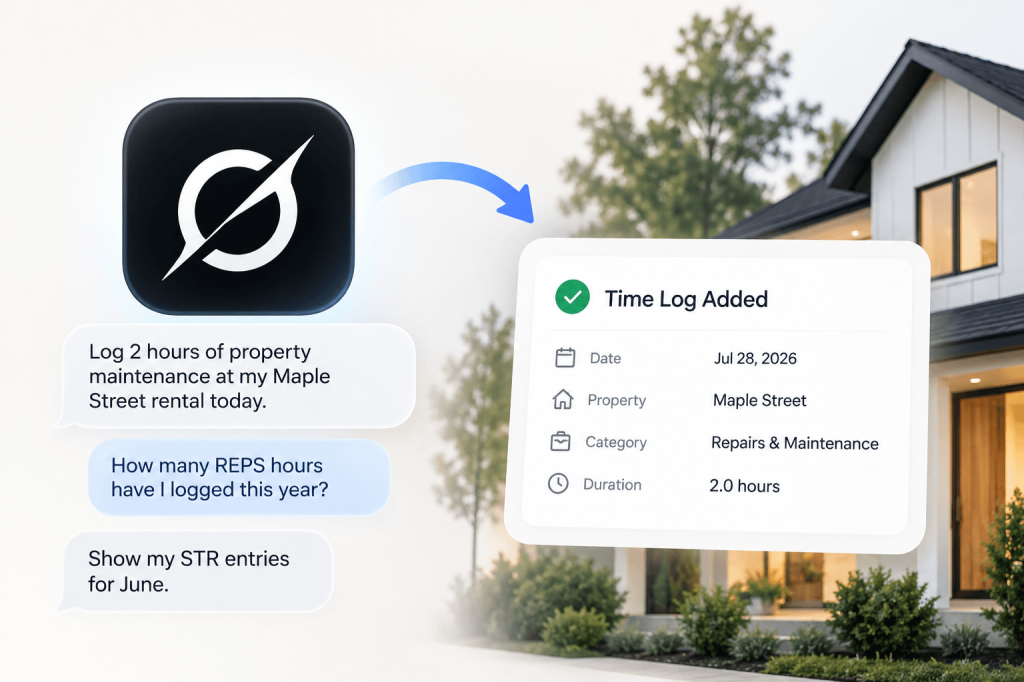
Digital logs with timestamps are significantly stronger than paper records. An app that records the date and time each entry was created provides built-in proof that the log was maintained contemporaneously, not backdated.
REPSLog is built specifically for this purpose. It lets you log hours by property and activity category on your phone as you do the work, creating timestamped, audit-ready records automatically. It tracks your progress toward the 100-hour and 500-hour thresholds and separates hours by property so you can see exactly where you stand for each STR. Available for iOS and Android, or on the web at app.reps-log.com. Start tracking your hours free →.
Frequently Asked Questions
Can I use the STR loophole if I have a property manager?
Yes, but it complicates the 100-hour test because you must log more hours than any other individual, including your property manager. If your manager handles most day-to-day operations, you may need to rely on the 500-hour test instead. Some owners structure a co-hosting arrangement where they retain the highest-hour responsibilities (guest communication, pricing, financial management) and delegate lower-hour tasks (turnover logistics, emergency maintenance) to the manager.
Does the STR loophole work for properties listed on both Airbnb and a medium-term platform?
It depends on your actual booking data. If some bookings are 3-day weekend stays and others are 30-day corporate stays, you need to calculate whether the blended average is still seven days or fewer. One or two long-term bookings can drag your average above the threshold. Consider using separate listings or setting maximum stay limits if you want to protect the average.
Is the STR loophole the same as the “Airbnb tax loophole”?
They refer to the same provision. The term “Airbnb loophole” became popular because so many STR investors use Airbnb as their primary platform, but the tax treatment has nothing to do with any specific booking platform. It applies to any short-term rental that meets the seven-day and material participation requirements, whether listed on Airbnb, VRBO, Booking.com, or through direct bookings.
Can both spouses use the STR loophole on the same property?
Only one spouse needs to meet the material participation requirements for a jointly owned property on a joint return. However, the hours of both spouses can be combined when determining material participation. If one spouse logs 60 hours and the other logs 50, the combined 110 hours satisfies the 100-hour minimum. Just note that under the 100-hour test, neither spouse’s combined total can be exceeded by any other single individual.
What happens if my average guest stay goes above seven days?
If your average period of customer use exceeds seven days for the tax year, the property is classified as a rental activity under IRC Section 469. Your losses become passive. They cannot offset W-2 income. You may still be able to use them if you qualify for REPS or have passive income from other sources, but the STR loophole itself no longer applies for that year.
Is the STR loophole at risk of being eliminated?
Tax law can always change, but the provision is not a loophole in the colloquial sense. It is a direct consequence of how Section 469 defines rental activity, and it has been part of the code since 1986. The IRS has acknowledged this treatment in multiple proceedings. The bigger legislative risk is to bonus depreciation, which is the mechanism that generates large first-year losses. For now, the OBBBA has permanently restored 100% bonus depreciation, but future legislation could modify this.

Key Takeaways
- The STR loophole allows short-term rental owners to treat property losses as non-passive, enabling those losses to offset W-2 and other ordinary income.
- Two requirements must be met: average guest stay of seven days or fewer, and material participation in the property’s operations.
- The 100-hour test is the most common path to material participation for STR owners, though the 500-hour test serves as a fallback.
- Cost segregation combined with 100% bonus depreciation (restored by the OBBBA in 2025) is what generates the large first-year paper losses that make this strategy powerful.
- Documentation is non-negotiable. The IRS requires contemporaneous, detailed logs of your participation hours.
- The STR loophole and REPS serve different investor profiles and can be used together across different properties in the same portfolio.
Start Tracking Your STR Hours Today
The STR loophole is only as strong as the documentation behind it. If you cannot prove material participation with detailed, timestamped records, the strategy falls apart in an audit.
REPSLog makes it simple. Log your hours on iOS or Android as you do the work, or on the web at app.reps-log.com. Start tracking your hours free →. Track each property separately. See your progress toward the 100-hour and 500-hour thresholds in real time. When tax season arrives, your records are organized and ready.
This article is for educational purposes only and does not constitute tax or legal advice. Consult a qualified tax professional regarding your specific situation before implementing any tax strategy.
Do this in REPSLog
- Booking Calendar Sync (Airbnb, Vrbo and any iCal): pull every Airbnb, Vrbo or other booking into your log and get an entry suggested per stay.
- STR Loophole Tracking: a 100 or 500-hour counter per short-term rental, with hours by participant.
- Participants: log who did each activity, so spouse hours count where allowed and contractor hours stay separate.
Step by step in the Help Center: how to use it. Try REPSLog free for 14 days on iPhone, Android or the web app.