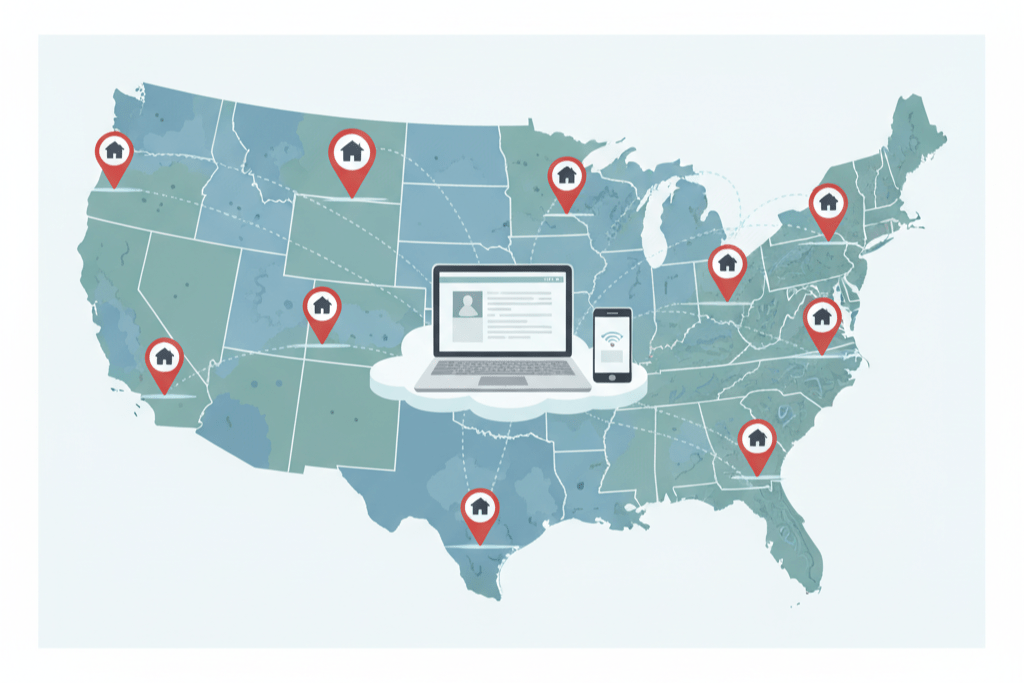
Owning rental properties in another state does not disqualify you from claiming Real Estate Professional Status. The tax code makes no distinction between local and distant properties when it comes to REPS qualification. But distance creates real challenges: documenting remote management activities, accounting for travel time, demonstrating material participation from hundreds or thousands of miles away, and maintaining the kind of hands-on involvement the IRS expects.
This article addresses the specific documentation challenges, travel considerations, and strategies that out-of-state rental property owners need to navigate when building a REPS claim.
Distance Does Not Disqualify You
Nothing in IRC Section 469(c)(7) requires you to live near your rental properties. The statute focuses entirely on hours spent in real property trades or businesses and whether those hours exceed the required thresholds. A landlord in California who owns rentals in Texas and Ohio faces the same two tests as a landlord who owns rentals across the street:
More than 750 hours in qualifying real estate activities during the tax year.
More than half of all working hours spent in real estate trades or businesses.
The IRS evaluates what you did and for how long, not where your properties are relative to your home. That said, distance changes how you work and how you prove that work, which creates unique challenges worth understanding.

Remote Management Hours That Count
Many property management activities can be performed from anywhere. These remote management hours count toward REPS qualification just as much as on-site hours do.
Tenant communication. Responding to tenant inquiries, addressing maintenance requests, negotiating lease terms, handling complaints, and coordinating move-ins and move-outs. These interactions happen via phone, email, and text regardless of where the property sits.
Financial management. Reviewing rental income statements, tracking expenses, paying property-related bills, analyzing cash flow, preparing budgets, reviewing tax documents, and coordinating with your accountant. All of this work is location-independent.
Contractor coordination. Sourcing contractors for repairs or improvements, obtaining and comparing bids, reviewing scope of work proposals, approving estimates, scheduling work, and following up on completion. Modern communication makes it entirely feasible to manage contractors remotely.
Lease administration. Drafting leases, reviewing and modifying lease terms, processing lease renewals, handling security deposit accounting, and managing lease compliance issues.
Market research and analysis. Monitoring rental rates in your property’s market, analyzing comparable properties, evaluating refinancing opportunities, and researching capital improvement options.
Insurance and compliance management. Managing property insurance policies, ensuring compliance with local regulations, handling HOA communications, and coordinating with attorneys on legal matters.
Vendor management. Coordinating with landscapers, cleaning services, pest control, and other recurring service providers. Even though you cannot inspect their work in person easily, the coordination and management of these relationships counts.
The key documentation principle for remote activities is the same as for local ones: log what you did, when you did it, and how long it took. The IRS does not give extra weight to on-site hours over remote management hours. An hour spent on the phone negotiating a contractor bid from your home office counts the same as an hour spent at the property.
Travel Time Considerations
Travel to out-of-state properties creates both qualifying hours and additional documentation requirements.
Travel time counts. Time spent traveling to and from your rental properties for the purpose of performing real estate activities generally qualifies as participation time. A three-hour flight to inspect your rental properties, meet with contractors, and handle tenant issues generates travel hours in addition to the on-site activity hours.
Documentation of travel. Keep records of every trip: flight confirmations, hotel receipts, rental car records, toll receipts, and gas purchases. These records corroborate your travel log entries and establish that you actually made the trip. Log the travel time separately from on-site activity time, specifying the purpose of the trip.
Trip frequency. The IRS may question the frequency and necessity of trips. Regular quarterly visits are generally reasonable for out-of-state properties. Monthly visits are justifiable for properties with active renovation projects, high tenant turnover, or management issues. Weekly trips to a distant property with a stable tenant may raise questions about necessity.
Combined purpose trips. If you combine a property management trip with personal travel (visiting family, vacation, etc.), only the portion of travel time attributable to the property management purpose counts. If you fly to Austin to check on your rental and visit your parents, you need to allocate travel time between business and personal purposes. Keeping a clear itinerary that distinguishes business activities from personal activities helps defend this allocation.
Driving vs. flying. The IRS does not dictate which mode of travel is appropriate. However, if you drive 10 hours to a property when you could have flown in 2 hours, an examiner might question whether the additional 8 hours of drive time represents genuine real estate participation or simply a personal preference for driving. Choose your travel method based on legitimate business considerations and be prepared to explain the choice.
The Material Participation Challenge
Proving material participation in an out-of-state rental activity requires extra attention. The IRS may question how you can materially participate in managing a property you rarely visit.
The seven material participation tests still apply. You need to satisfy at least one of them:
Spending more than 500 hours on the activity.
Your participation constituting substantially all the participation.
Spending more than 100 hours and no other individual spending more.
Participating in a significant participation activity (more than 100 hours) and your aggregate significant participation across all such activities exceeding 500 hours.
Material participation in any five of the preceding ten tax years.
A personal service activity with participation in any three preceding tax years.
Participation on a regular, continuous, and substantial basis based on facts and circumstances.
For out-of-state owners, the first three tests are most commonly used. The challenge is that if you employ a local property manager who handles day-to-day operations, their hours may exceed yours, making the third test (more than 100 hours and not less than anyone else) difficult to pass.
The grouping election helps. Under Treas. Reg. Section 1.469-9(g), grouping all rental real estate interests into a single activity means your combined hours across all properties are measured against the combined hours of any single individual across the same activity. Unless you have one property manager handling your entire portfolio, grouping generally works in your favor because no single individual is likely to spend more total hours across all your properties than you do.
Technology Solutions for Remote Management
Modern technology has significantly narrowed the gap between local and remote property management, both in terms of actual management capability and documentation.
Property management platforms. Software that handles tenant screening, rent collection, maintenance requests, and financial reporting creates an automatic record of your management activities. The platform logs show when you processed applications, responded to requests, collected rent, and managed expenses.
Communication records. Email, text messages, and phone call logs provide timestamped evidence of your management communications. These records are especially valuable for out-of-state owners because they demonstrate consistent, ongoing engagement with property-related matters.
Smart home technology. Remote monitoring systems, smart locks, water leak detectors, and security cameras allow you to manage property access, monitor conditions, and respond to issues without being physically present. The time you spend reviewing camera footage, adjusting smart lock codes for new tenants, responding to sensor alerts, and managing these systems counts as property management activity.
Video inspections. Conducting property inspections via video call with a contractor, tenant, or local contact allows you to perform inspections remotely. The video provides visual documentation of the inspection while your log records the activity and time spent.
Digital document management. Handling lease agreements, notices, financial records, and compliance documents through cloud-based systems creates a natural audit trail of your management activities.
State Tax Implications
Out-of-state rental properties introduce state income tax considerations that local properties do not.
You may owe state income tax in the state where the property is located, regardless of where you live. REPS is a federal tax designation and does not automatically apply at the state level. Some states follow federal REPS rules; others have their own passive activity limitations.
State tax filing requirements for rental income earned in another state can be complex, especially when REPS status is a factor. Consult with a tax professional who understands multi-state taxation when planning your REPS strategy with out-of-state properties.
Building a Defensible Out-of-State REPS Claim
Here is a practical framework for documenting your out-of-state REPS activities.
Daily activity log. Maintain a detailed log of all remote management activities. Every phone call, email, financial review, contractor coordination, and research session should be logged with dates, descriptions, and time spent. This log is your primary evidence.
Trip documentation. For every property visit, keep travel records, daily itineraries of on-site activities, and post-trip summaries of actions taken and decisions made.
Communication archive. Preserve all property-related communications, organized by property. These serve as corroborating evidence for your activity log entries.
Financial records. Keep organized records of all property-related income and expenses, including invoices, receipts, and bank statements.
Technology logs. If you use property management software, smart home systems, or other technology, the platform records can supplement your activity log.
Annual summary. At year-end, compile a summary of your total hours by property and by activity type. This makes it easy for your tax preparer to evaluate your REPS qualification and prepares you for a potential audit.

Key Takeaways
- Out-of-state property ownership does not disqualify you from REPS. The qualification tests are entirely hour-based with no geographic requirements.
- Remote management activities, including tenant communication, financial management, contractor coordination, and lease administration, generate qualifying hours from any location.
- Travel time to properties counts, but document it separately from on-site activities and be prepared to explain trip frequency and purpose.
- Material participation can be harder to prove with out-of-state properties, particularly if a local property manager’s hours exceed yours. The grouping election under Treas. Reg. Section 1.469-9(g) can help.
- Technology creates both management capability and documentation opportunities. Property management platforms, communication records, and smart home systems supplement your activity log.
- Multi-state tax implications require attention. Federal REPS does not automatically apply at the state level.
Frequently Asked Questions
Does the IRS view out-of-state properties differently than local ones?
The IRS applies the same REPS tests regardless of property location. However, distance can affect the credibility of your hour claims. An examiner might question how you can spend 20 hours per week managing properties located 1,500 miles away. Strong documentation of remote management activities addresses this concern.
Can I deduct travel expenses for visiting my out-of-state rentals?
Yes. Travel expenses incurred for the purpose of managing your rental properties, including airfare, lodging, car rental, and meals, are generally deductible as rental property expenses. Keep detailed records of the business purpose of each trip and separate business expenses from personal ones if the trip has a dual purpose.
How often should I visit my out-of-state properties?
There is no required frequency. What matters is that you maintain consistent management involvement, whether remote or in person. Quarterly visits are common and defensible for most properties. The key is that your visits serve genuine management purposes (inspections, contractor meetings, tenant relations) rather than being primarily social or personal trips.
Can I use a local property manager and still claim REPS?
Yes, but having a property manager makes material participation harder to demonstrate. If the manager spends more hours on your properties than you do, you may fail the “more than 100 hours and not less than anyone else” material participation test. You will need to meet material participation through one of the other six tests or use the grouping election.
Do hours spent researching markets for potential acquisitions count?
Yes. Acquisition research is a qualifying real estate activity under IRC 469(c)(7)(C). Hours spent analyzing markets, evaluating deals, touring properties, and conducting due diligence count toward REPS qualification, even for properties in states where you do not currently own real estate.
What if I own properties in multiple states?
Properties in multiple states can all contribute hours to your REPS qualification. The grouping election under Treas. Reg. Section 1.469-9(g) is particularly useful for multi-state portfolios because it consolidates material participation testing across all properties regardless of location.
Is it easier to qualify for REPS if I live in the same state as my properties?
Proximity is not a legal factor, but as a practical matter, local ownership does make certain activities easier (property visits, contractor meetings, inspections) and may reduce questions about the plausibility of your claimed hours. However, investors who manage their out-of-state properties actively and document their activities thoroughly can qualify just as effectively.
Managing out-of-state rentals demands organized documentation of remote activities, and that is exactly what REPSLog delivers. Log your phone calls, contractor coordination, financial management, and on-site visits with property-level detail that makes your remote management verifiable and defensible. Track your hours from anywhere on iOS, Android, or Web.
This article is for educational purposes only and does not constitute tax or legal advice. Consult a qualified tax professional for guidance tailored to your situation.
Do this in REPSLog
- Multiple Properties: add each rental by address, mark it LTR or STR, see hours per property.
- Calendar Integration (Google, Microsoft 365, device): turn past Google, Microsoft 365 or device calendar events into logged hours.
- REPS Hour Tracking Goals (750 / 500 / 100): pick the 750, 500 or 100-hour test and watch progress per year and per property.
Step by step in the Help Center: how to use it. Try REPSLog free for 14 days on iPhone, Android or the web app.