Hiring a property manager does not automatically disqualify you from Real Estate Professional Status. This is a persistent misconception in real estate investing circles, and it causes some investors to either avoid property managers unnecessarily or abandon REPS claims prematurely. The truth is more nuanced: using a property manager makes certain aspects of REPS qualification harder, but not impossible.
This article explains exactly how a property manager affects your REPS claim, which material participation tests become problematic, what oversight activities still count as your hours, and how to structure the relationship to preserve your REPS eligibility.
Why Property Managers Do Not Auto-Disqualify You
The REPS qualification tests under IRC Section 469(c)(7) measure your hours in real property trades or businesses. Nothing in the statute says you must perform all property management functions yourself. Many qualifying real estate professionals, including agents, brokers, developers, and construction professionals, delegate portions of their work to employees, contractors, or service providers. A property manager is simply another service provider in this chain.
The presence of a property manager affects your REPS claim in two ways. First, it reduces the number of management hours available to you because the property manager is performing many of the activities that would otherwise generate your REPS hours. Second, it creates a comparison problem for certain material participation tests, because the property manager may spend more hours on your rental activity than you do.
Neither of these issues is fatal, but both require strategic planning.
The 100-Hour Comparative Test Problem
The material participation test that creates the most difficulty for investors with property managers is the third test under Treasury Regulation 1.469-5T(a)(3): you participate in the activity for more than 100 hours during the tax year, and your participation is not less than the participation of any other individual.
With a property manager, you have a problem. A professional property manager who handles day-to-day operations for your rentals may easily spend 200, 300, or more hours per year on your properties. If you spend 150 hours on the same properties, you pass the 100-hour minimum but fail the comparative element because the property manager’s hours exceed yours.
This test is the one most taxpayers default to when they own rental properties, which is why the property manager issue feels like a deal-breaker. But it is only one of seven material participation tests, and you only need to pass one.
Alternative Material Participation Tests
If the comparative test is off the table because of your property manager’s hours, focus on one of these alternatives.
The 500-hour test. If you spend more than 500 hours on the rental activity during the year, you meet material participation regardless of how many hours your property manager or anyone else spends. With a property manager handling routine tasks, you need to fill 500 hours with the oversight, strategic, and management activities described later in this article. This is achievable for investors with larger portfolios or investors who remain actively involved in their properties.
The substantially-all test. Your participation must constitute substantially all of the participation in the activity by any individual. This test essentially requires that nobody else does significant work on the activity. With a property manager actively managing your properties, this test is very difficult to meet and is generally not a viable option.
Significant participation activities. If you participate for more than 100 hours in a rental activity and that activity is a “significant participation activity,” and your combined participation across all significant participation activities exceeds 500 hours, you meet material participation. This can work for investors who have multiple business activities, each with more than 100 hours of participation.
Five-of-ten-years test. If you materially participated in the rental activity in any five of the previous ten tax years, you qualify for the current year. This rewards long-term, consistent involvement and protects investors who recently transitioned to using property managers after years of self-management.
Facts and circumstances test. You participate on a regular, continuous, and substantial basis. This is the broadest test and the most subjective. Courts evaluate the totality of your involvement, including strategic decision-making, financial oversight, and regular engagement with the activity. This test can work for investors who are deeply involved in their properties’ strategy and finances even though a property manager handles daily operations.
What Oversight Activities Count as Your Hours
Using a property manager does not mean you stop working on your rental activities. The management-of-the-manager role, combined with strategic and financial oversight, generates legitimate qualifying hours. Here is what counts.
Hiring and evaluating the property manager. Researching management companies, interviewing candidates, checking references, reviewing management agreements, negotiating fees and terms, and periodically evaluating performance all constitute real estate management activities.
Reviewing property manager reports. Monthly or quarterly review of financial statements, occupancy reports, maintenance logs, and tenant communications from your property manager counts as active management. You are evaluating performance, identifying issues, and making strategic decisions based on the data.
Approving significant expenditures. If your management agreement requires your approval for expenses above a certain threshold, the time you spend reviewing proposals, evaluating contractor bids, and authorizing expenditures counts. Structure your management agreement to include approval requirements that keep you involved in financial decisions.
Setting rental rates and policies. Determining rent levels, approving lease terms, setting pet policies, establishing maintenance priorities, and deciding on capital improvement plans are ownership-level activities that remain with you regardless of whether you use a property manager.
Tenant selection decisions. Even if your property manager screens tenants, the final approval decision can remain with you. Reviewing applications, evaluating screening reports, and approving or rejecting tenants generates qualifying hours.
Property inspections. Conducting periodic inspections of your properties, either in person or via video, constitutes participation. Even if your property manager performs routine inspections, you can perform your own strategic inspections focused on deferred maintenance, capital improvement needs, and overall property condition.
Financial and tax management. Reviewing income and expense reports, managing property-level budgets, coordinating with your CPA, handling insurance renewals, and performing financial analysis of your portfolio are activities that the property manager does not perform on your behalf.
Capital improvement planning. Evaluating potential improvements, researching costs, planning renovation projects, coordinating financing, and managing major improvement projects are high-level activities that remain with the owner.
Acquisition and disposition activities. Researching potential acquisitions, evaluating new markets, performing due diligence, and making buy/sell decisions are ownership activities that count toward REPS.
Structuring the Relationship to Preserve REPS
How you structure your property management relationship affects your REPS qualification. Here are strategies to maintain active involvement while still benefiting from professional management.
Retain decision authority. Structure your management agreement to require your approval for tenant selection, rent changes, expenditures above a defined threshold, lease modifications, and eviction proceedings. This keeps you in the decision-making loop and generates documented management hours.
Establish regular reporting requirements. Require monthly financial reports, occupancy updates, maintenance logs, and market analysis from your property manager. Schedule regular review meetings to discuss the reports and make strategic decisions. These meetings and the preparation time count as your participation.
Conduct your own inspections. Do not rely entirely on your property manager for property condition assessment. Schedule your own quarterly or semi-annual inspections and document your findings, concerns, and follow-up actions.
Manage the big picture. Reserve strategic decisions for yourself: refinancing, capital improvements, insurance reviews, portfolio rebalancing, market analysis, and long-term planning. These activities are time-intensive and clearly constitute ownership-level management.
Document everything. When you interact with your property manager, document the interaction. When you review a report, note what you reviewed, what questions you raised, and what decisions you made. When you approve an expenditure, log the review time and the basis for your decision.
The Grouping Election Advantage
For investors with multiple properties managed by one or more property managers, the grouping election under Treas. Reg. Section 1.469-9(g) provides an important strategic advantage.
Without grouping, you must prove material participation in each rental activity separately. If you have five properties and a property manager handles three of them, you might fail material participation on those three while passing on the two you self-manage.
With grouping, all five properties become a single activity. Your combined hours across all properties are measured against the combined hours of any single individual. Unless one property manager handles all five properties (spending more total hours than you across the entire grouped activity), grouping typically works in your favor.
Even with a single property manager covering your entire portfolio, the grouping election still helps because you only need to meet one material participation test for the combined activity rather than testing each property separately.
When a Property Manager Makes REPS Impractical
There are situations where using a property manager genuinely undermines your REPS claim.
Full-service management with minimal owner involvement. If you hire a property manager who handles everything, from tenant screening to maintenance to financial reporting, and you do not actively review, direct, or oversee any of these functions, your actual participation may be insufficient to meet any material participation test.
Small portfolio with comprehensive management. If you own two rental units and a property manager handles both, the management work available to you may simply be too limited to generate meaningful hours. Two long-term rentals under full professional management might offer 50 to 100 hours per year of genuine ownership-level activity, which is insufficient for most material participation tests.
No documented oversight. If you use a property manager and do not document your own oversight and management activities, you have no evidence of participation to present during an audit. The property manager’s records show what the property manager did, not what you did. Without your own records, your claim rests entirely on oral testimony, which is weak.
Key Takeaways
- Using a property manager does not automatically disqualify you from REPS. The qualification tests focus on your hours, not on whether you employ service providers.
- The main challenge is the material participation comparative test: if your property manager spends more hours on your properties than you do, you fail that specific test.
- You only need to pass one of the seven material participation tests. The 500-hour test, the five-of-ten-years test, and the facts-and-circumstances test are alternatives when the comparative test is not viable.
- Oversight, strategic, and financial management activities generate qualifying hours even when a property manager handles daily operations.
- Structure your management agreement to retain decision authority over tenant selection, significant expenditures, rent changes, and capital improvements.
- The grouping election under Treas. Reg. Section 1.469-9(g) is particularly valuable when property managers are involved because it consolidates the material participation test.
- Document every management, review, and decision-making activity you perform. Your property manager’s records do not prove your participation.
Frequently Asked Questions
Does it matter whether my property manager is a company or an individual?
For material participation purposes, what matters is the hours any individual spends on your rental activity. If you hire a property management company, the IRS looks at the hours of each individual employee, not the company’s aggregate hours. If no single employee spends more hours than you on your properties, the comparative test may still work in your favor.
Can I count time spent communicating with my property manager?
Yes. Phone calls, emails, meetings, and other communications with your property manager about your properties count as participation in the rental activity. Log these communications with dates, durations, topics discussed, and decisions made.
What if I switch from self-management to a property manager mid-year?
Your hours for the entire year count toward material participation, including the months when you self-managed. If you self-managed for six months and accumulated 400 hours before hiring a property manager, those hours remain valid. The challenge is sustaining sufficient participation for the remainder of the year under professional management.
Does property manager’s fee affect my REPS qualification?
The management fee itself has no bearing on REPS qualification. It is a deductible rental expense but does not factor into the hour-based tests. However, the scope of services covered by the fee affects how many management hours remain available to you.
Can I use the five-of-ten-years test if I used to self-manage?
Yes. If you materially participated in your rental activity in five of the previous ten tax years (when you self-managed), you qualify for material participation in the current year even if you now use a property manager and your involvement has decreased. This test provides a valuable transitional bridge for investors moving to professional management.
Should I fire my property manager to qualify for REPS?
That depends on your circumstances. If REPS qualification provides significant tax benefits and you have the time, skills, and desire to self-manage, it might make financial sense. But property managers provide genuine value in terms of expertise, time savings, and tenant relations. The decision should weigh the full financial picture, including the tax benefits of REPS, the cost of the management fee, and the value of your time.
How do I document that my oversight is genuine and not just rubber-stamping?
Show evidence of actual decision-making. Log times when you rejected a property manager’s recommendation, modified a proposed approach, asked follow-up questions, requested additional bids, or made independent assessments. A pattern of consistent approvals with no questions or modifications looks like rubber-stamping; a pattern of engaged review with documented input looks like genuine management.
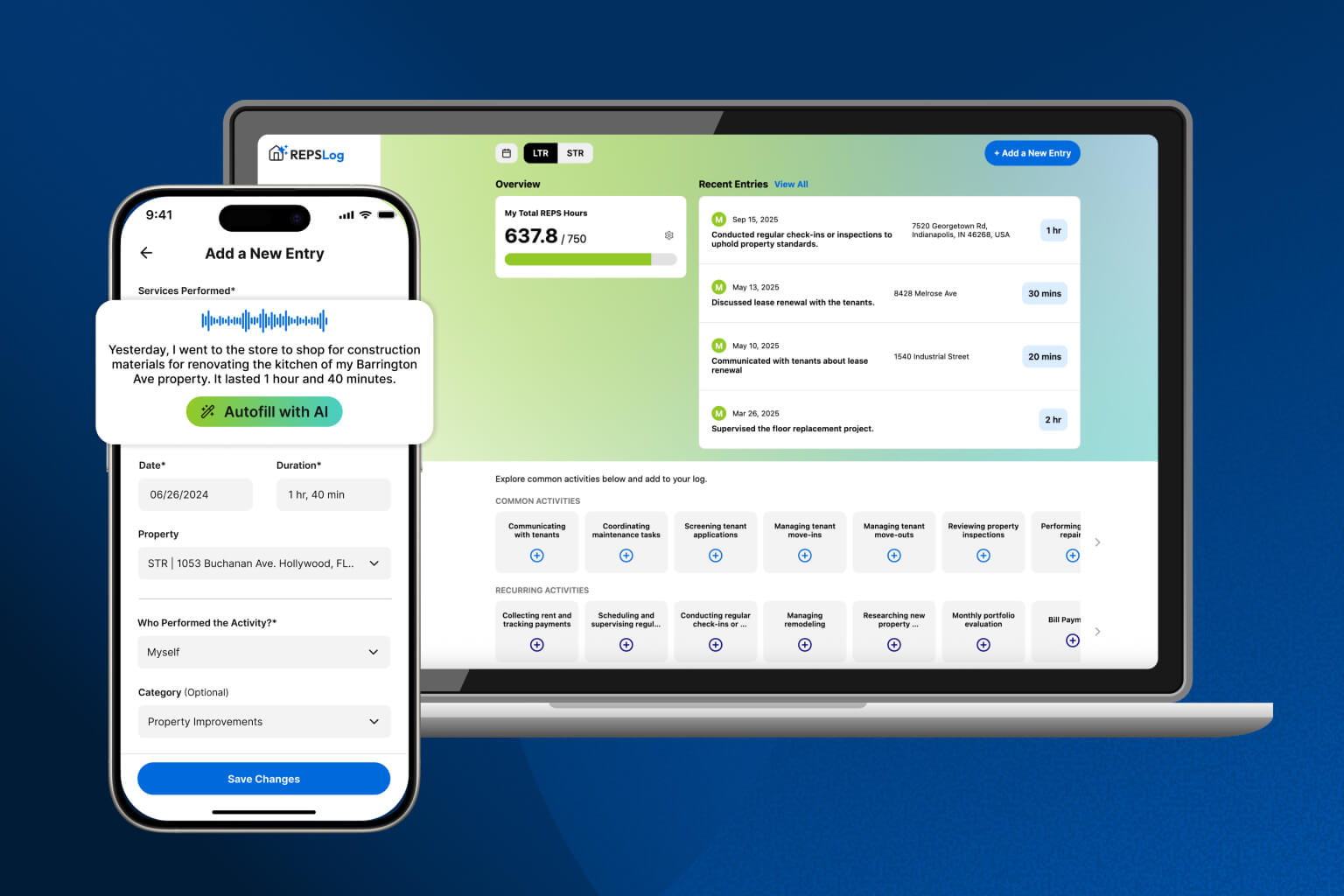
If you use a property manager, meticulous documentation of your oversight and management activities becomes even more critical. REPSLog gives you the tools to track every interaction, review, decision, and inspection with the detail needed to demonstrate genuine material participation. Available on iOS, Android, and Web.
This article is for educational purposes only and does not constitute tax or legal advice. Consult a qualified tax professional for guidance tailored to your situation.
Do this in REPSLog
- Team Access (managed accounts): give your spouse, CPA or property manager access to your log.
- Participants: log who did each activity, so spouse hours count where allowed and contractor hours stay separate.
- Multiple Properties: add each rental by address, mark it LTR or STR, see hours per property.
Step by step in the Help Center: how to use it. Try REPSLog free for 14 days on iPhone, Android or the web app.