You qualify as a Real Estate Professional. You own multiple rental properties. You should have grouped them as a single activity for material participation purposes, but you did not. Maybe your CPA did not know about the grouping election. Maybe you did not realize it was available. Maybe you filed your return without considering it.
Whatever the reason, the grouping election under Treas. Reg. Section 1.469-9(g) was not made on your original return, and now you want to fix it. Revenue Procedure 2011-34 provides a path to file a late grouping election, but it comes with conditions. This article explains who qualifies for late election relief, the four conditions you must satisfy, the mechanics of filing, and the situations where this relief cannot help.
What the Grouping Election Does
Before diving into the late filing rules, let us review why the grouping election matters.
Under the passive activity loss rules, material participation is tested at the activity level. Without a grouping election, each rental property you own is treated as a separate activity. You must demonstrate material participation in each property individually to deduct its losses.
For an investor with eight rental properties, this means proving you spent more than 500 hours on each property separately (or meeting another material participation test for each one). That is 4,000 hours across eight properties, which is impractical for most investors.
The grouping election under Treas. Reg. Section 1.469-9(g) allows qualifying real estate professionals to treat all of their rental real estate interests as a single activity. Instead of testing each property individually, you test the entire grouped portfolio once. If you spend 800 hours managing all eight properties collectively, you meet the 500-hour material participation test for the single grouped activity. Every property’s losses become deductible.
The election is made by attaching a statement to your tax return for the first year it applies, and it remains in effect for subsequent years unless revoked or invalidated by specific changes in circumstances.
When the Election Was Missed
The grouping election should be made on the original, timely filed tax return (including extensions) for the first year the taxpayer wants it to apply. If you filed your return without the election statement and later realize you should have grouped, the election was missed.
Common reasons for missing the election include: the taxpayer or CPA was unaware of the election, the taxpayer did not qualify as a real estate professional in prior years and did not realize they qualified this year until after filing, the return preparer used software that did not prompt for the election, or the taxpayer changed CPAs and the new preparer assumed the election had already been made.
Revenue Procedure 2011-34: The Late Election Path
Revenue Procedure 2011-34 provides a simplified method for taxpayers to request an extension of time to make certain regulatory elections, including the grouping election under Treas. Reg. Section 1.469-9(g). It replaces the need for a private letter ruling (PLR), which would be far more expensive and time-consuming.
To qualify for relief under Rev. Proc. 2011-34, you must meet all four of the following conditions.
Condition 1: The Taxpayer Acted Reasonably and in Good Faith
You must demonstrate that you had a legitimate reason for failing to make the election on time. Reasonable cause includes reliance on a tax professional who failed to advise you about the election, a misunderstanding of the rules, or lack of awareness that the election existed.
Acting in good faith means you did not deliberately skip the election for strategic reasons (for example, choosing not to group in an early year and then trying to retroactively group when it becomes advantageous). The late filing must reflect a genuine oversight, not a tactical decision.
What strengthens this condition: A letter from your CPA acknowledging the oversight. Documentation showing you asked about REPS deductions and were not advised about grouping. Evidence that you intended to group but the election statement was inadvertently omitted.
What weakens this condition: Changing your position after an IRS inquiry or audit notice. Filing the late election after being informed by the IRS that your material participation is being challenged. Any indication that the late filing is retroactive tax engineering.
Condition 2: The Election Would Have Been Timely if Made
The election must have been available to you for the year you are requesting it. Specifically, you must have qualified as a real estate professional for that year. If you did not meet the REPS tests (the 750-hour test and the more-than-half test) for a particular year, the grouping election would not have been valid for that year, and you cannot retroactively claim it.
This condition also means the election must relate to a return that was required to be filed. You cannot claim a late grouping election for a year in which you did not file a return.
Condition 3: The Interests to Be Grouped Were Consistent with the Late Election
The rental real estate interests you are requesting to group must have been reported on your original return in a manner consistent with having made the election. This means you should not have reported the activities in a way that explicitly treated them as separate activities with separate material participation tests and then seek to retroactively change that treatment.
If your original return already reported your rental activities as separate activities and relied on separate material participation determinations, this condition becomes harder to satisfy. However, if your return simply reported rental income and losses without explicitly addressing grouping or material participation, the consistency requirement is generally easier to meet.
Condition 4: The Request Must Be Filed Within a Specific Timeframe
Rev. Proc. 2011-34 generally requires that the late election request be filed within a reasonable period after the original due date of the return. The procedure does not specify a hard deadline in all cases, but the sooner the request is made, the stronger the position.
In practice, the late election is typically filed by amending the relevant return (filing Form 1040-X) and attaching the grouping election statement that should have been included on the original return. The amendment should be filed as soon as the missed election is discovered.
How to File the Late Election
The mechanical process involves several steps, ideally coordinated with your tax professional.
Step 1: Prepare the election statement. Draft the grouping election statement that should have been attached to the original return. The statement should identify the taxpayer, the tax year, the rental real estate activities being grouped, and a declaration that the taxpayer elects to treat all rental real estate interests as a single rental real estate activity under Treas. Reg. Section 1.469-9(g).
Step 2: File an amended return. File Form 1040-X for the year(s) affected, attaching the election statement. The amended return should also reflect any changes to the tax liability that result from the grouping (for example, additional rental loss deductions that become available once material participation is established for the grouped activity).
Step 3: Include a reasonable cause statement. Attach a statement explaining why the election was not made timely and how you satisfy the conditions of Rev. Proc. 2011-34. This narrative supports your claim of reasonable cause and good faith.
Step 4: File for all affected years. If the grouping election should have been in effect for multiple years, you may need to file amended returns for each year. The election, once made, applies to the year of election and all subsequent years until revoked or invalidated.
When Late Election Relief Does Not Help
There are situations where Rev. Proc. 2011-34 cannot solve your problem.
You did not qualify for REPS. The grouping election is available only to qualifying real estate professionals. If you did not meet the 750-hour and more-than-half tests for the year in question, the election was not available to you, and you cannot file a late version of an election you were not eligible to make.
You already grouped differently. If you already made a grouping election for some but not all of your properties, changing that grouping is a different matter. Rev. Proc. 2011-34 addresses elections that were missed entirely, not modifications to elections that were already made.
The statute of limitations has closed. If the statute of limitations for the tax year in question has expired (generally three years from the filing date), you cannot amend the return to claim additional deductions. The late election must be filed while the year is still open for amendment.
Deliberate non-election. If you consciously chose not to group your properties (perhaps because your tax advisor recommended against it at the time), claiming the election was an “oversight” lacks credibility. Rev. Proc. 2011-34 is designed for genuine mistakes, not for retroactive changes of strategy.
IRS examination is underway. If the IRS has already begun examining the return in question, filing a late election becomes significantly more complicated. While not automatically prohibited, the IRS may view the late election skeptically if it appears to be a response to the examination rather than an independent correction.
The Private Letter Ruling Alternative
If you do not meet the conditions of Rev. Proc. 2011-34, or if your situation is complex enough to warrant additional certainty, you can request a private letter ruling (PLR) from the IRS for an extension of time to make the election under Treasury Regulation Section 301.9100-3.
A PLR provides definitive IRS approval for the late election but comes with significant cost (the IRS user fee alone is several thousand dollars, plus professional fees for preparing the request) and time (processing can take months). PLRs are typically reserved for high-dollar situations where the tax impact justifies the expense.
Working with Your Tax Professional
Filing a late grouping election is not a DIY project. The interaction between REPS qualification, material participation, the grouping election, amended return procedures, and Rev. Proc. 2011-34 requirements creates enough complexity that professional guidance is essential.
When engaging a tax professional for this process, provide complete documentation of your real estate activities for all affected years, your REPS hour logs, your original tax returns, and any correspondence with the IRS. The professional needs the full picture to assess whether late election relief is viable and to prepare the filings correctly.

Key Takeaways
- The grouping election under Treas. Reg. Section 1.469-9(g) is a critical tool for REPS-qualifying investors with multiple rental properties, and missing it can cost significant tax deductions.
- Rev. Proc. 2011-34 provides a streamlined path to file a late grouping election without needing a private letter ruling.
- Four conditions must be met: reasonable cause and good faith, the election would have been timely if made, consistent reporting, and timely filing of the correction.
- The late election is filed by amending the affected return(s), attaching the election statement, and including a reasonable cause explanation.
- Late election relief is unavailable if you did not qualify for REPS, the statute of limitations has closed, or the non-election was deliberate.
- A private letter ruling is the alternative when Rev. Proc. 2011-34 conditions cannot be met, but it is significantly more expensive and time-consuming.
- Professional tax guidance is essential for navigating the late election process.
Frequently Asked Questions
How much does it cost to file a late grouping election?
The direct cost of filing is the cost of preparing the amended return(s), which depends on your tax professional’s fees. If you go the Rev. Proc. 2011-34 route, there is no separate IRS user fee. If you need a private letter ruling instead, the IRS user fee starts at several thousand dollars, plus professional fees for preparing the ruling request.
Can I file a late grouping election for multiple years at once?
Yes. If the election should have been in effect for several years, you can file amended returns for each year simultaneously. The election applies from the first year it should have been effective through all subsequent years.
What if my CPA did not tell me about the grouping election?
Your CPA’s failure to advise you about the election is one of the strongest bases for demonstrating reasonable cause under Rev. Proc. 2011-34. Document the oversight with a letter or acknowledgment from the CPA if possible.
Does the late election affect my state tax return too?
Potentially. If your state follows federal passive activity rules, the grouping election flows through to your state return. You may need to file amended state returns as well. Some states have their own passive activity rules that do not follow federal treatment, so check with a professional familiar with your state’s tax law.
Can the IRS deny my late election request?
Yes. If the IRS determines you do not meet the conditions of Rev. Proc. 2011-34, they can deny the late election. However, if you have a genuine reasonable cause and meet all four conditions, denial is uncommon.
Is the grouping election permanent once filed?
The grouping election remains in effect until you revoke it or until a change in facts and circumstances makes it inconsistent with the regulations. Revocation is generally allowed, but there may be restrictions on re-electing after revocation. The election cannot be revoked retroactively to take advantage of a different tax treatment for a prior year.
What happens to my suspended losses if the late election is approved?
If the late grouping election allows you to establish material participation for the grouped activity in a prior year, previously suspended losses from that year may become deductible. Your amended return should reflect the release of these suspended losses. This can result in a significant refund.
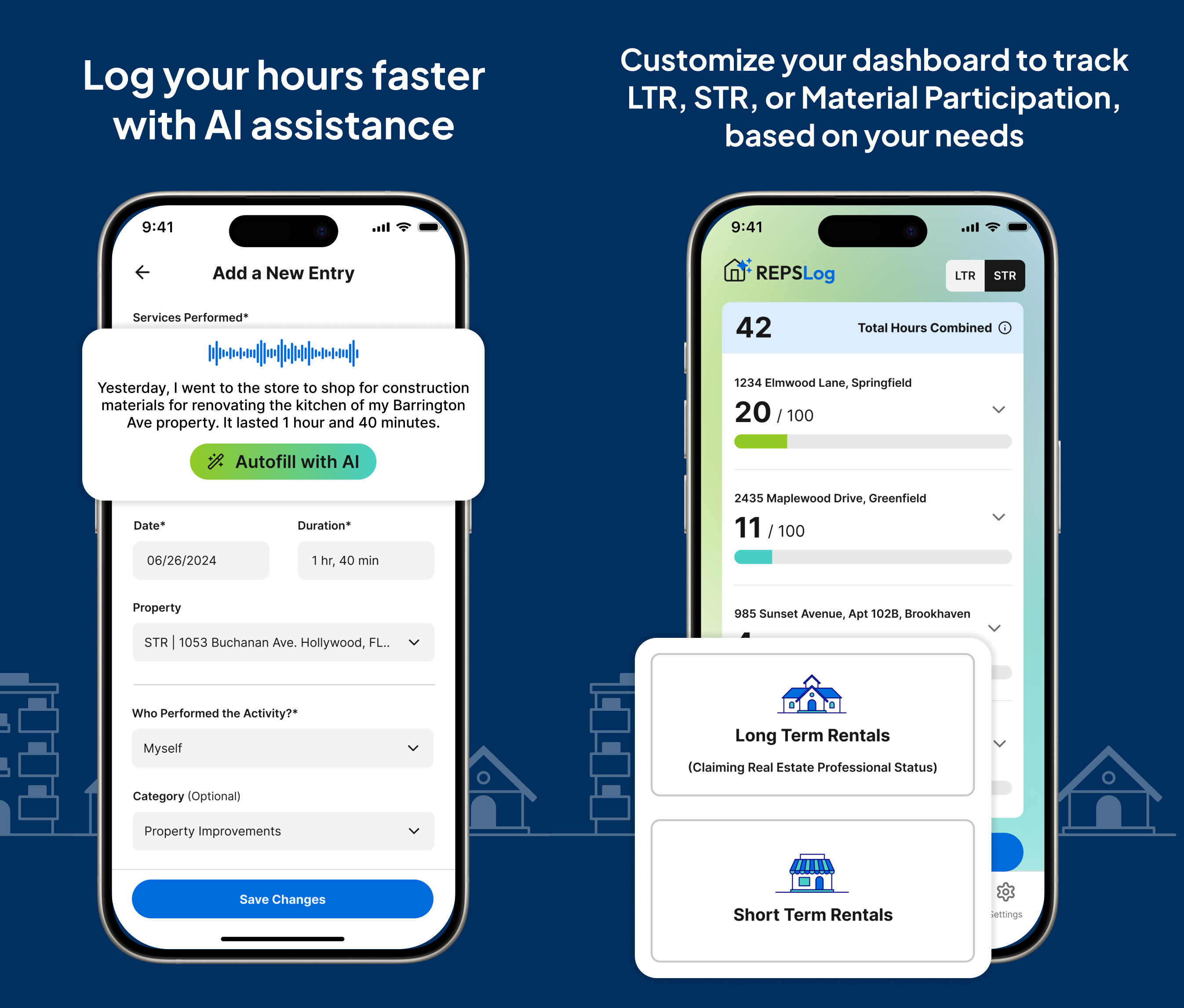
Avoiding missed elections and documentation gaps starts with the right tracking system. REPSLog helps real estate professionals maintain the organized, property-level records that make tax-time decisions, including the grouping election, straightforward for you and your CPA. Track your hours and properties on iOS, Android, or Web.
This article is for educational purposes only and does not constitute tax or legal advice. Consult a qualified tax professional for guidance tailored to your situation.
Do this in REPSLog
- Multiple Properties: add each rental by address, mark it LTR or STR, see hours per property.
- Hours Dashboard and Stats: hours by property, category and year against your goal.
- CPA-ready Export (PDF and CSV): a tax year as PDF and CSV, split by LTR and STR, with receipts.
Step by step in the Help Center: how to use it. Try REPSLog free for 14 days on iPhone, Android or the web app.