Real estate professional status (REPS) is one of the most powerful tax strategies available to high-income households, and physician families stand to benefit the most. When a doctor earns a substantial W-2 salary while their spouse manages rental properties full-time, the household can unlock massive passive loss deductions that shelter the physician’s clinical income from federal taxes. This guide breaks down exactly how the spouse strategy works, the math behind it, and what documentation you need to make it audit-proof.
Why Physician Households Are Ideal Candidates for REPS
Physicians regularly earn between $250,000 and $600,000 or more in W-2 income. At those levels, federal marginal tax rates hit 35% to 37%, and the $25,000 passive activity loss allowance phases out between $100,000 and $150,000 modified adjusted gross income (MAGI). Without REPS, rental losses from depreciation and cost segregation studies sit suspended on the tax return, providing zero current-year benefit.
The spouse strategy changes everything. If one spouse qualifies as a real estate professional, the couple can deduct rental losses against the physician’s W-2 income on a joint return. A single cost segregation study on a $1 million rental property might generate $200,000 or more in accelerated depreciation in year one. At a 37% marginal rate, that translates to roughly $74,000 in tax savings from a single property.

The Two-Part REPS Qualification Test
To qualify as a real estate professional under IRC Section 469(c)(7), an individual must meet both of the following requirements in the same tax year:
Part 1: More than 750 hours spent performing services in real property trades or businesses in which the taxpayer materially participates.
Part 2: More than half of all personal services the taxpayer performs during the year must be in real property trades or businesses.
These tests apply to the individual, not the couple. In a physician household, the practicing doctor almost certainly cannot meet the more-than-half test because clinical hours dominate their schedule. That is precisely why the non-physician spouse is the qualifying candidate.
How the Spouse Strategy Works Step by Step
The strategy is straightforward in concept but demands disciplined execution:
- The non-physician spouse manages the rental portfolio. This spouse handles property management tasks such as tenant screening, lease negotiations, maintenance coordination, bookkeeping, property inspections, market research, and strategic planning.
- The managing spouse logs more than 750 hours in real property activities during the tax year. If this spouse does not hold a separate full-time job, the more-than-half test is typically satisfied automatically because real estate is their primary occupation.
- The managing spouse materially participates in each rental activity. This requires meeting one of the seven material participation tests under Treas. Reg. 1.469-5T(a). The most common is Test 1: more than 500 hours of participation in the activity during the year.
- The couple files jointly and claims the rental losses against all income on the joint return, including the physician’s W-2.
- A grouping election under Treas. Reg. 1.469-9(g) may be filed to treat all rental activities as a single activity for material participation purposes, simplifying the hour requirement across multiple properties.
A Note on Spousal Hours
A critical distinction that trips up many taxpayers: spousal hours may be combined when testing for material participation under IRC Section 469(h)(5), but each spouse must independently meet the REPS qualification. You cannot add the doctor’s weekend property visits to the managing spouse’s total for the 750-hour and more-than-half tests. The qualifying spouse must reach those thresholds on their own.
The Math: How Much Can You Actually Save?
Consider a physician household earning $500,000 in W-2 income with three rental properties worth $1.2 million total (excluding land value). Here is a simplified illustration:
Without REPS:
- Cost segregation generates $300,000 in year-one depreciation
- Rental losses are passive and fully suspended (AGI exceeds $150,000)
- Tax savings in year one: $0 from rental losses
- The losses carry forward indefinitely but provide no immediate benefit
With REPS (spouse qualifies):
- Same $300,000 in year-one depreciation
- Losses are now non-passive because the qualifying spouse materially participates
- $300,000 deducted against W-2 income on the joint return
- At a 37% marginal rate: approximately $111,000 in federal tax savings in year one
- Additional state tax savings may apply depending on jurisdiction
Over a five-year acquisition plan adding one property per year, cumulative tax savings can easily exceed $300,000 to $500,000, depending on property values and depreciation strategies.
What Activities Count Toward the 750 Hours
The IRS defines real property trades or businesses broadly under IRC Section 469(c)(7)(C). Qualifying activities include:
- Property management: Tenant communications, lease preparation, rent collection, eviction proceedings, move-in and move-out inspections
- Maintenance and repairs: Coordinating contractors, obtaining bids, supervising work, performing hands-on repairs
- Bookkeeping and accounting: Recording income and expenses, reconciling accounts, preparing financial reports
- Market research: Analyzing potential acquisitions, studying rental comps, evaluating neighborhoods
- Property inspections: Regular walkthroughs, seasonal maintenance checks, responding to tenant issues
- Education and professional development: Attending real estate courses, investor meetups, reading industry publications (in moderation and directly related to your properties)
- Strategic planning: Evaluating refinancing options, planning capital improvements, reviewing insurance policies
- Acquisition activities: Identifying properties, negotiating purchases, conducting due diligence, attending closings
Documentation Requirements: The Make-or-Break Factor
The IRS scrutinizes REPS claims closely, especially when one spouse earns a high W-2 income. Contemporaneous logs are your strongest defense. “Contemporaneous” means recorded at or near the time the activity occurs, not reconstructed at year-end.
Your log should capture:
- Date of each activity
- Description of what you did
- Hours spent on the activity
- Which property the activity relates to
- Category of work (management, maintenance, acquisition, etc.)
The Tax Court has repeatedly upheld REPS claims backed by detailed, contemporaneous logs and denied claims supported only by estimates or after-the-fact reconstructions. In cases like Moss v. Commissioner and Pohoski v. Commissioner, the court placed heavy emphasis on the quality and timeliness of hour documentation.
Common Mistakes Physician Households Make
Mistake 1: The managing spouse has a full-time non-real-estate job. If the spouse works 2,000 hours at another job, they need more than 2,000 hours in real estate to meet the more-than-half test. This is extremely difficult to achieve.
Mistake 2: Relying on a property manager for everything. Hiring a property manager does not disqualify you, but you must still personally perform more than 750 hours of real estate work. If the property manager handles nearly all tasks, it becomes difficult to demonstrate sufficient personal involvement.
Mistake 3: Counting the physician’s hours toward REPS qualification. As noted above, spousal hours count for material participation in a specific activity under 469(h)(5), but the REPS qualification tests must be met individually.
Mistake 4: Failing to make the grouping election. Without the grouping election under Treas. Reg. 1.469-9(g), you must demonstrate material participation in each rental activity separately. With five properties, that could mean needing more than 500 hours per property, or 2,500 hours total. The grouping election lets you treat them as one activity.
Mistake 5: Reconstructing logs at tax time. A spreadsheet created in March for the prior tax year is not contemporaneous. The IRS and Tax Court can distinguish between real-time records and year-end reconstructions.
Building an Audit-Proof System
The strongest approach combines three elements:
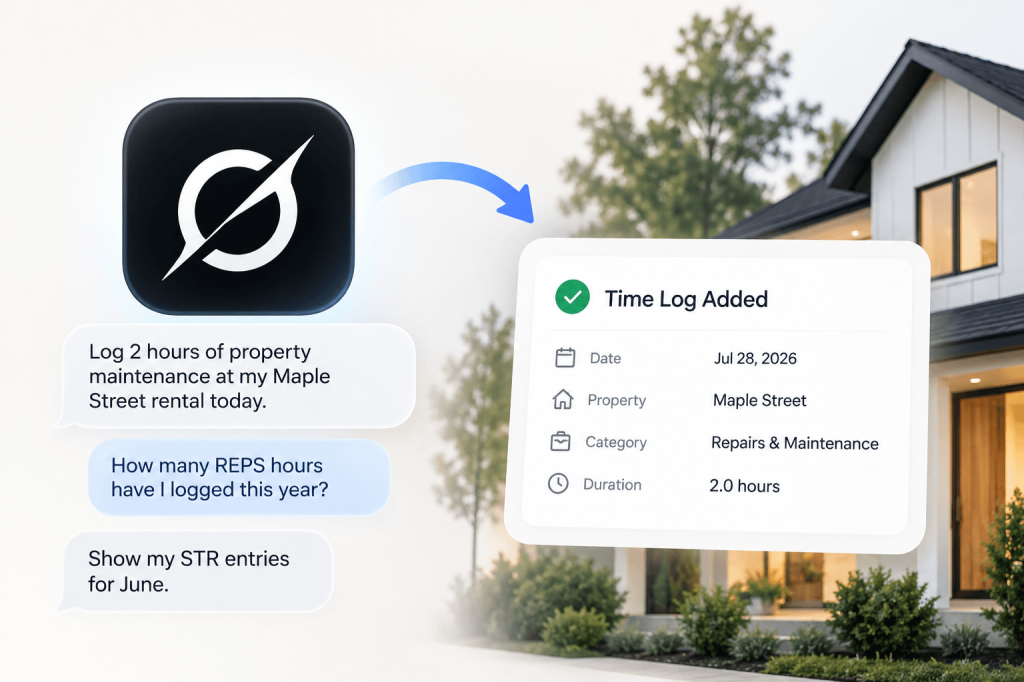
- Daily or weekly logging using a dedicated tracking tool. REPSLog is purpose-built for this, allowing you to log activities by property, category, and participant directly from your phone as you complete each task.
- Supporting documentation that corroborates your logs: receipts, emails with contractors, text messages with tenants, photos of maintenance work, mileage records, and calendar entries.
- Annual summary prepared before filing that totals hours by property and category, reconciled against your log entries.
The Role of Cost Segregation
REPS alone does not create the deductions. It unlocks the ability to use them. The deductions themselves come primarily from depreciation, and cost segregation studies dramatically accelerate the depreciation timeline.
A cost segregation study reclassifies building components into shorter depreciation categories:
- 5-year property (appliances, carpeting, certain fixtures)
- 7-year property (furniture, certain equipment)
- 15-year property (land improvements, landscaping, parking lots)
- Remaining components stay on the standard 27.5-year (residential) or 39-year (commercial) schedule
Under current bonus depreciation rules, 5-year, 7-year, and 15-year property may be eligible for accelerated first-year deductions, though the bonus depreciation percentage has been phasing down. Consult your tax advisor for the current year’s applicable percentage.
Frequently Asked Questions
Can both spouses qualify as real estate professionals?
Yes, but it is uncommon in physician households. The practicing physician would need to spend more than 750 hours in real estate activities and more than half of their total personal service hours in real estate. With a typical clinical schedule of 2,000 or more hours, this is nearly impossible.
Does the managing spouse need a real estate license?
No. REPS does not require a license, certification, or formal business entity. The qualification is based solely on hours spent and material participation in real property activities.
Can we use REPS if we only own one rental property?
Yes. With a single property, you do not need the grouping election. You simply need the qualifying spouse to meet both REPS tests and materially participate in that one rental activity with more than 500 hours (Test 1) or satisfy another material participation test.
What happens if we lose REPS status in a future year?
Losses generated in years when you qualified remain valid deductions. However, any current-year rental losses in a non-qualifying year revert to passive status and will be suspended. Previously deducted losses are not clawed back.
How does the IRS typically audit REPS claims?
Audits usually focus on three areas: (1) whether the qualifying spouse truly met the 750-hour and more-than-half tests, (2) whether material participation in each rental activity (or the grouped activity) was demonstrated, and (3) whether the hour logs are contemporaneous and credible.
Can the managing spouse count hours spent on a short-term rental toward REPS?
Yes. Short-term rental management hours count toward the 750-hour REPS test. However, STR properties have additional considerations regarding whether they are treated as rental activities at all under Treas. Reg. 1.469-1T(e)(3)(ii)(A).
Is there a risk of the IRS reclassifying the managing spouse as not a real estate professional?
The primary risk arises when documentation is weak, when the spouse has significant non-real-estate employment, or when the claimed hours seem inconsistent with the size and nature of the portfolio. Strong contemporaneous records substantially mitigate this risk.
Key Takeaways
- Physician households with a non-working or part-time spouse are ideal candidates for the REPS spouse strategy
- The qualifying spouse must independently meet both the more than 750 hours test and the more-than-half test
- Spousal hours combine for material participation under 469(h)(5) but not for REPS qualification
- Cost segregation studies create the large depreciation deductions; REPS unlocks the ability to deduct them against W-2 income
- Contemporaneous, detailed hour logs are the single most important factor in surviving an audit
- The grouping election under Treas. Reg. 1.469-9(g) simplifies material participation across multiple properties
- Tax savings of $100,000 or more per year are realistic for high-income physician households with properly structured portfolios
Start Tracking Your REPS Hours Today
If your household is pursuing the REPS spouse strategy, accurate hour tracking is not optional. REPSLog makes it simple to log every activity by property, category, and participant, building the contemporaneous record that stands up to IRS scrutiny.
Available on iOS | Android | Web
This article is for educational purposes only and does not constitute tax or legal advice. Consult a qualified tax professional for guidance tailored to your situation.
Do this in REPSLog
- Participants: log who did each activity, so spouse hours count where allowed and contractor hours stay separate.
- Team Access (managed accounts): give your spouse, CPA or property manager access to your log.
- REPS Hour Tracking Goals (750 / 500 / 100): pick the 750, 500 or 100-hour test and watch progress per year and per property.
Step by step in the Help Center: how to use it. Try REPSLog free for 14 days on iPhone, Android or the web app.