Filing the grouping election under Treas. Reg. 1.469-9(g) is one of the most important steps a qualifying real estate professional can take. This election allows you to treat all of your rental real estate interests as a single rental activity for material participation purposes. Yet despite its significance, the IRS does not provide an official form for the election. You must draft and attach a statement to your tax return. This article provides a word-for-word template, a filled-in example, instructions on where to attach it, and a review of common mistakes that can invalidate the election.
Why the Grouping Election Matters
Without the grouping election, each rental property you own is treated as a separate activity under the passive activity rules. To deduct losses from each property as non-passive, you must demonstrate material participation in each activity individually. For an investor with five properties, that could mean documenting more than 500 hours per property (under Test 1 of Treas. Reg. 1.469-5T(a)), totaling 2,500 hours or more.
The grouping election under Treas. Reg. 1.469-9(g) solves this by combining all rental real estate interests into one activity. You then need to demonstrate material participation just once, across the entire portfolio. If you spend more than 500 hours managing your entire portfolio, you satisfy Test 1 for the grouped activity.
This election is available only to taxpayers who qualify as real estate professionals under IRC Section 469(c)(7). That means meeting both the more than 750 hours test and the more-than-half test.

The Template
Below is a statement template you can adapt for your own filing. Replace all bracketed items with your specific information.
Election to Treat All Rental Real Estate Interests as a Single Rental Activity
Pursuant to Treasury Regulation Section 1.469-9(g), the undersigned taxpayer hereby elects to treat all interests in rental real estate as a single rental real estate activity for purposes of IRC Section 469(c)(7)(A).
Taxpayer Name: [Full Legal Name]
Taxpayer SSN: [XXX-XX-XXXX]
Spouse Name (if applicable): [Spouse Full Legal Name]
Spouse SSN (if applicable): [XXX-XX-XXXX]
Tax Year: [Year]
Qualifying Real Estate Professional: [Name of Qualifying Spouse or Taxpayer]
The qualifying taxpayer listed above has met both requirements of IRC Section 469(c)(7)(B) for the tax year indicated:
- More than 750 hours were spent performing services in real property trades or businesses in which the taxpayer materially participated during the tax year.
- More than one-half of the personal services performed by the taxpayer during the tax year were performed in real property trades or businesses in which the taxpayer materially participated.
Rental Real Estate Interests Included in This Election:
- [Property Address 1] – [Property Type, e.g., Single Family Rental]
- [Property Address 2] – [Property Type]
- [Property Address 3] – [Property Type]
[Add additional properties as needed]
This election is being made with the taxpayer’s original return for the tax year indicated above and applies to all rental real estate interests held by the taxpayer during the tax year and in all subsequent tax years in which the taxpayer qualifies as a real estate professional.
The undersigned understands that this election, once made, is irrevocable.
Signature: ________________________
Date: ________________________
A Filled-In Example
Here is the same statement completed with sample information. Note that all names and details below are fictional.
Election to Treat All Rental Real Estate Interests as a Single Rental Activity
Pursuant to Treasury Regulation Section 1.469-9(g), the undersigned taxpayer hereby elects to treat all interests in rental real estate as a single rental real estate activity for purposes of IRC Section 469(c)(7)(A).
Taxpayer Name: John A. Smith
Taxpayer SSN: XXX-XX-1234
Spouse Name (if applicable): Jane B. Smith
Spouse SSN (if applicable): XXX-XX-5678
Tax Year: 2026
Qualifying Real Estate Professional: Jane B. Smith
The qualifying taxpayer listed above has met both requirements of IRC Section 469(c)(7)(B) for the tax year indicated:
- More than 750 hours were spent performing services in real property trades or businesses in which the taxpayer materially participated during the tax year.
- More than one-half of the personal services performed by the taxpayer during the tax year were performed in real property trades or businesses in which the taxpayer materially participated.
Rental Real Estate Interests Included in This Election:
- 123 Maple Street, Austin, TX 78701 – Single Family Rental
- 456 Oak Avenue, Unit 204, Denver, CO 80202 – Condominium Rental
- 789 Pine Road, Scottsdale, AZ 85251 – Short-Term Vacation Rental
This election is being made with the taxpayer’s original return for the tax year indicated above and applies to all rental real estate interests held by the taxpayer during the tax year and in all subsequent tax years in which the taxpayer qualifies as a real estate professional.
The undersigned understands that this election, once made, is irrevocable.
Signature: Jane B. Smith
Date: March 15, 2027
Where to Attach the Statement
The grouping election statement must be filed with your original federal income tax return (Form 1040) for the election year. Here is how to handle the attachment depending on your filing method:
Paper filing: Print the statement and include it immediately after Schedule E (Supplemental Income and Loss). Some practitioners attach it as a separate statement referenced in Part II of Schedule E. Label it clearly with your name, SSN, and “Treas. Reg. 1.469-9(g) Election.”
E-filing: Most tax software allows you to attach PDF statements to your electronic return. Look for options labeled “Additional Statements,” “Miscellaneous Forms,” or “Election Statements.” In professional software like ProSeries, Lacerte, or Drake, there is typically a dedicated input for passive activity elections or regulatory statements. Attach the election as a PDF.
Through your CPA or tax preparer: Provide the completed statement to your preparer and specifically request that they attach it to the return. Follow up to confirm it was included. This is a step that occasionally gets missed, especially during busy filing seasons.
Timing Requirements
First-year election: The election must be made with the original return for the first tax year in which you qualify as a real estate professional and wish to group your rental activities. You cannot retroactively make the election for a prior year by filing an amended return.
Late elections: The IRS has granted relief for late elections in some circumstances under Rev. Proc. 2011-34 and subsequent guidance. If you failed to make the election on your original return, consult a tax professional about whether late election relief is available. This typically requires filing within the period for requesting such relief and demonstrating reasonable cause.
Subsequent years: Once validly made, the election does not need to be re-filed each year. It automatically applies in all subsequent years in which you qualify as a real estate professional. However, some practitioners recommend including a reference to the election on each subsequent return for clarity.
Common Mistakes That Can Invalidate the Election
Mistake 1: Not Attaching the Statement at All
Surprisingly common. The taxpayer treats rental activities as grouped on their return but never files the formal election statement. Without the statement, the IRS can argue the election was never validly made. This can unwind years of tax positions.
Mistake 2: Filing the Election on an Amended Return
The regulations specify that the election must be made with the original return. Filing it on an amended return for a prior year is generally not valid unless you qualify for late election relief. If you missed the election for a prior year, talk to your advisor about available options rather than simply amending.
Mistake 3: Not Listing All Properties
The election applies to all rental real estate interests. Omitting a property from the list does not exclude it from the election. However, an incomplete list can create confusion during an audit. List every rental property you own, including properties held in pass-through entities (LLCs, partnerships) where you have an interest.
Mistake 4: Making the Election When You Do Not Qualify as a REPS
The election under Treas. Reg. 1.469-9(g) is available only to taxpayers who qualify as real estate professionals under IRC Section 469(c)(7). If you do not meet both the more than 750 hours test and the more-than-half test, the election is invalid. Filing the statement alone does not create REPS status.
Mistake 5: Confusing the 1.469-9(g) Election with Other Grouping Rules
Treas. Reg. 1.469-4 provides separate rules for grouping activities into appropriate economic units. This is a different provision with different requirements and different flexibility. The 1.469-9(g) election is specific to real estate professionals grouping rental real estate interests. Make sure your statement references the correct regulation.
Mistake 6: Forgetting the Election Is Irrevocable
Some taxpayers make the election in a year when grouping is beneficial, then want to undo it in a year when it is not (for example, when selling a property). The election cannot be revoked. It remains in effect for all future qualifying years. Consider the long-term implications before electing.
Mistake 7: Not Having Both Spouses Sign (When Applicable)
If filing jointly and one spouse is the qualifying real estate professional, make sure the election statement is clear about which spouse is qualifying. While the IRS has not been perfectly consistent on signature requirements, having the qualifying spouse sign the statement adds certainty.
Special Situations
Properties Held in LLCs or Partnerships
If you hold rental properties in LLCs or partnerships, those interests are still included in the grouping election. List them by entity name and property address. The election groups your rental real estate interests regardless of the ownership structure.
Properties Acquired Mid-Year
Properties acquired during the tax year are included in the grouped activity from the date of acquisition. List them on the election statement even if you owned them for only part of the year.
Properties Sold During the Year
If you sold a property during the tax year in which you first make the election, include it on the list. The election applies to all rental real estate interests held at any time during the year.
Short-Term Rentals
Short-term rentals with an average guest stay of seven days or less may not be treated as rental activities under Treas. Reg. 1.469-1T(e)(3)(ii)(A). If a property qualifies as a non-rental activity, it falls outside the scope of the grouping election. However, if you are uncertain about a property’s classification, it is safer to include it on the list and let your tax advisor determine whether it is a rental activity subject to the election.
Frequently Asked Questions
Do I need to file the election statement every year?
No. The election is made once and applies to all subsequent qualifying years. However, many practitioners include a reference to the election on subsequent returns for documentation purposes.
What if I acquire new properties after making the election?
New properties are automatically included in the grouped activity. You do not need to file an updated election statement, though noting new properties on your return is good practice.
Can I make the election if I only own one rental property?
Technically yes, but it has no practical effect. The election groups multiple rental interests into one activity. With a single property, there is nothing to group.
What if my CPA forgot to attach the election to my return?
Consult a tax professional immediately about late election relief options. The sooner you address this, the more options may be available. Do not simply assume the election is valid because you intended to make it.
Does the election affect state returns?
Not necessarily. States are not required to follow the federal grouping election. Some states have their own passive activity rules that may require separate activity treatment regardless of your federal election. Check with your advisor for each state where you file.
Is there a specific form number for this election?
No. The IRS does not provide a dedicated form. The election is made by attaching a written statement to your return. The template provided in this article covers the necessary elements.
Can I make the 1.469-9(g) election and also use the 1.469-4 grouping rules?
These are separate provisions. The 1.469-9(g) election groups all rental real estate interests into one activity. The 1.469-4 rules allow grouping of activities into appropriate economic units based on various factors. In practice, once you make the 1.469-9(g) election, all rental real estate interests are in one group, and the 1.469-4 rules would apply to other types of activities.
Key Takeaways
- The grouping election under Treas. Reg. 1.469-9(g) must be filed as a written statement attached to your original tax return
- There is no official IRS form for this election; you must draft the statement yourself or use a template
- The election is irrevocable and applies to all current and future rental real estate interests
- List every rental property you own, including those held in LLCs or partnerships
- Common mistakes include failing to attach the statement, filing on an amended return, and confusing this election with other grouping rules
- Late election relief may be available if you missed the filing deadline, but consult a professional promptly
- The election is only available to taxpayers who qualify as real estate professionals under IRC Section 469(c)(7)
Document Your REPS Qualification with REPSLog
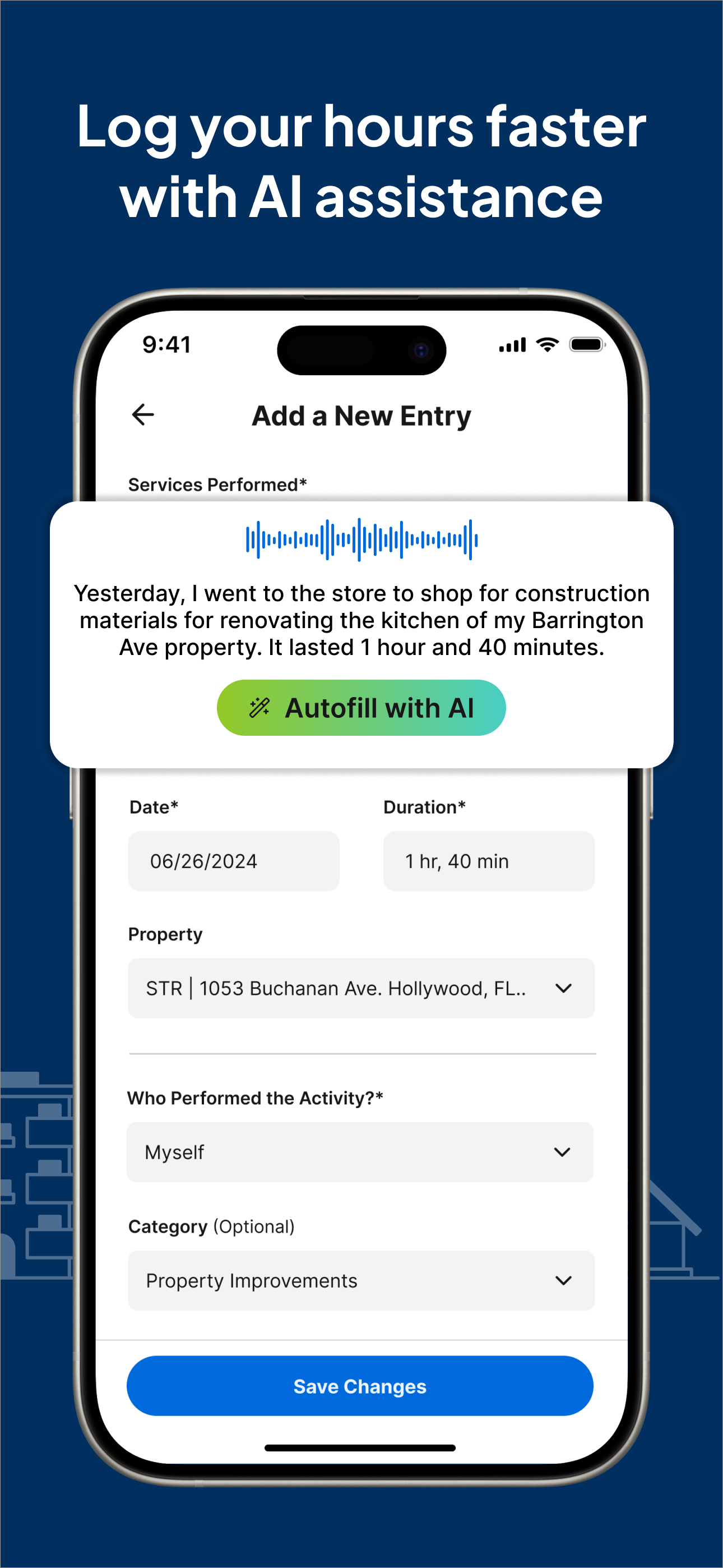
The grouping election requires that you qualify as a real estate professional. REPSLog helps you build the contemporaneous hour log that proves your qualification, tracking activities by property, category, and participant throughout the year.
Available on iOS | Android | Web
This article is for educational purposes only and does not constitute tax or legal advice. Consult a qualified tax professional for guidance tailored to your situation.
Do this in REPSLog
- Multiple Properties: add each rental by address, mark it LTR or STR, see hours per property.
- Hours Dashboard and Stats: hours by property, category and year against your goal.
- CPA-ready Export (PDF and CSV): a tax year as PDF and CSV, split by LTR and STR, with receipts.
Step by step in the Help Center: how to use it. Try REPSLog free for 14 days on iPhone, Android or the web app.