Stay-at-home parents have one of the clearest paths to qualifying as a real estate professional. Without a competing W-2 job consuming thousands of hours each year, the more-than-half test is far easier to satisfy. The challenge is not whether you can qualify but whether you can build the habits and documentation to prove it. This month-by-month roadmap shows exactly how to structure your year, what activities to prioritize, and how to hit your hour targets without scrambling in December.
Why Stay-at-Home Parents Have the Easiest Path
The two-part test for real estate professional status under IRC Section 469(c)(7) requires:
- More than 750 hours in real property trades or businesses in which you materially participate
- More than half of your total personal services during the year in real property trades or businesses
For someone working a 40-hour-per-week job, the more-than-half test means they need more than 2,000 hours in real estate, which is essentially a second full-time career. For a stay-at-home parent, the calculus is entirely different.
If you do not hold a separate job, your personal service hours outside of real estate may be minimal. Household and childcare duties are generally not counted as personal services for the more-than-half test. This means that if real estate is your only occupation generating personal service hours, even 751 hours can satisfy both prongs of the test.
That said, “easy” does not mean “automatic.” You still need to reach more than 750 hours, materially participate in your rental activities, and maintain contemporaneous documentation throughout the year. Here is how to do it.

Setting Your Annual Hour Target
Your minimum target is more than 750 hours for the year. However, aiming for the minimum leaves no margin for error. If December arrives and you are at 740 hours, you are in trouble.
Recommended target: 850 to 1,000 hours. This provides a comfortable buffer and makes the more-than-half test unambiguous. At 1,000 hours, you are averaging just over 19 hours per week, which is well within the range of a part-time commitment.
Weekly breakdown:
- 750 hours / 52 weeks = approximately 14.4 hours per week
- 850 hours / 52 weeks = approximately 16.3 hours per week
- 1,000 hours / 52 weeks = approximately 19.2 hours per week
Even at the lower end, this is fewer than three hours per day on average. For someone managing a rental portfolio as their primary occupation, this is entirely achievable.
Month-by-Month Activity Plan
January: Set the Foundation (Target: 70-80 Hours)
The beginning of the year is about establishing systems and planning.
- Review prior year records. Compile your previous year’s hour log (if any), identify gaps, and set improvement targets.
- Set up tracking tools. If you are not already using REPSLog or another tracking system, set it up now. Do not wait until February.
- Annual property inspections. Visit each property for a thorough start-of-year assessment. Document condition, needed repairs, and planned improvements.
- Review leases. Check which leases expire this year, plan renewal strategies, and review rent comp data.
- Insurance review. Contact your insurance provider, review coverage, compare quotes, and update policies as needed.
- Budget planning. Create annual budgets for each property covering expected maintenance, capital expenditures, and operating costs.
February: Maintenance Season Prep (Target: 65-75 Hours)
- Contractor outreach. Contact your maintenance team, get bids for planned projects, and establish new vendor relationships.
- Tax preparation support. Work with your CPA to prepare prior year filings, gather documentation, and review the prior year’s REPS qualification.
- Market analysis. Research rental market trends in your areas, analyze comparable rents, and identify potential acquisitions.
- Tenant communication. Send lease renewal notices for upcoming expirations, address any outstanding maintenance requests.
March: Tax Season and Spring Planning (Target: 65-75 Hours)
- Tax filing. Work with your tax preparer on the current filing. If this is your first REPS year, ensure the grouping election statement is attached to your return.
- Spring maintenance planning. Schedule exterior work, landscaping, and any weather-dependent projects.
- Property inspections. Conduct quarterly inspections of all properties.
- Education. Attend a real estate investor meetup, webinar, or course relevant to your portfolio management.
April: Active Maintenance Begins (Target: 70-80 Hours)
- Spring cleaning and repairs. Coordinate or perform exterior maintenance, pressure washing, landscaping, gutter cleaning.
- Turnover management. If any units turned over, handle tenant screening, lease signing, move-in inspections.
- Capital improvement projects. Begin any planned renovations or upgrades.
- Bookkeeping. Reconcile Q1 financials for each property, review income and expense reports.
May: Portfolio Optimization (Target: 70-80 Hours)
- Rental rate analysis. Review current rents against market data, prepare rent increase notices if applicable.
- Property tours. If acquiring new properties, conduct viewings, due diligence, and market research.
- Vendor management. Review contractor performance, get competitive bids for upcoming work.
- Tenant relations. Address mid-year concerns, conduct informal check-ins, handle maintenance requests promptly.
June: Mid-Year Check-In (Target: 70-80 Hours)
This is your most important progress check. At the halfway point, you should have accumulated at least 375 to 425 hours. If you are behind, adjust your second-half plan accordingly.
- Hour audit. Total your logged hours through June 30. Compare to your target pace.
- Gap analysis. Identify categories where you have fewer hours than expected. Plan to increase activity in those areas.
- Semi-annual property inspections. Thorough mid-year walkthrough of all properties.
- Insurance mid-year review. Check for any coverage needs triggered by improvements or market changes.
- Financial review. Analyze profitability by property, assess cash flow, review debt service coverage.
July: Summer Operations (Target: 65-75 Hours)
- Seasonal maintenance. HVAC servicing, pest control coordination, exterior upkeep.
- Capital projects. Continue or begin summer renovation work while weather cooperates.
- Market research. Analyze summer rental market conditions, evaluate potential acquisitions for Q3-Q4.
- Education. Summer real estate conferences, online courses, industry reading.
August: Peak Management (Target: 65-75 Hours)
- Back-to-school tenant turnover. College-area or family rental turnovers often cluster around August.
- Lease renewals. Process renewals for fall expirations.
- Preventive maintenance. Schedule fall and winter prep work: heating system inspections, weatherization.
- Bookkeeping. Reconcile Q2 financials, year-to-date budget review.
September: Fall Preparation (Target: 70-80 Hours)
- Quarterly inspections. Full property walkthroughs.
- Winterization planning. Schedule furnace inspections, pipe insulation, gutter cleaning for fall.
- Acquisition activity. Fall can be a strong buying season. Research deals, analyze properties, attend open houses.
- Refinance evaluation. Review current interest rates and loan terms, explore refinancing opportunities.
October: Year-End Strategy (Target: 70-80 Hours)
- Hour target review. You should have at least 625 to 700 hours logged. If you are short, intensify activity in remaining months.
- Tax planning. Meet with your CPA to discuss year-end tax strategies, cost segregation timing, and REPS qualification status.
- Capital expenditure timing. Evaluate whether to accelerate or defer planned expenditures for tax purposes.
- Annual vendor review. Assess all contractor and vendor relationships, negotiate contracts for the coming year.
November: Documentation and Year-End Push (Target: 65-75 Hours)
- Documentation review. Audit your hour logs for completeness. Fill in any missing descriptions (not hours, which should have been logged contemporaneously).
- Winterization execution. Complete all winter-prep maintenance.
- Budget preparation. Draft next year’s property budgets.
- Insurance renewal. Annual policy renewals often fall in Q4. Review, compare, and renew.
December: Close the Year Strong (Target: 65-80 Hours)
- Final hour count. Verify your total exceeds 750 hours with margin. If you are at 740, focus on legitimate activities to close the gap before December 31.
- Year-end inspections. Final property walkthroughs of the year.
- Annual record compilation. Organize all logs, receipts, contractor invoices, and correspondence for your tax preparer.
- Next year planning. Set property management goals, acquisition targets, and improvement plans for the coming year.
- CPA prep. Deliver organized records to your tax preparer.
Activity Breakdown by Category
Here is how your hours might break down across a year with a three-property portfolio:
| Category | Annual Hours | Weekly Average |
|---|---|---|
| Property Management (tenant communications, leases, screening) | 200-250 | 3.8-4.8 |
| Maintenance Coordination (repairs, contractors, inspections) | 180-220 | 3.5-4.2 |
| Financial Management (bookkeeping, budgeting, banking) | 100-130 | 1.9-2.5 |
| Market Research and Acquisitions | 80-120 | 1.5-2.3 |
| Strategic Planning and Education | 60-80 | 1.2-1.5 |
| Property Inspections and Travel | 80-120 | 1.5-2.3 |
| Administrative (insurance, legal, compliance) | 50-80 | 1.0-1.5 |
| Total | 750-1,000 | 14.4-19.2 |
The Year-End Review Ritual
In the last two weeks of December, perform this review:
- Total all hours by property and category. Make sure every entry has a date, description, property assignment, and duration.
- Verify the more than 750 hours threshold. Your total must exceed 750 hours. Not equal, but exceed.
- Confirm the more-than-half test. List any other personal service activities (part-time work, volunteer activities that could be classified as services). Ensure real estate hours are more than half of total personal services.
- Check material participation. If you have not elected to group under Treas. Reg. 1.469-9(g), verify material participation in each property individually. If grouped, verify for the single combined activity.
- Gather supporting documentation. Match your log entries against receipts, emails, photos, contractor invoices, and bank statements.
- Prepare a summary for your CPA. A clean annual summary by property and category makes tax preparation faster and strengthens your audit position.
Managing Childcare and REPS Activities
One practical question stay-at-home parents face: can you count hours when children are present? The answer depends on what you are doing.
Hours that count: You are on the phone negotiating a contractor bid while your child plays nearby. You are reviewing financial statements at the kitchen table during nap time. You are driving to a property inspection with your child in the car (the travel time counts; entertaining the child does not).
Hours that do not count: You are at the playground supervising your child and happen to respond to a tenant text. Brief, incidental activities intertwined with childcare are not countable real estate hours.
The key is whether real estate is the primary activity during the time period you are logging. Honest, conservative logging protects you in an audit. Log the actual time spent on real estate work, not the total time you were in a location where some real estate work occurred.
Building Habits That Stick
The biggest risk for stay-at-home parents pursuing REPS is inconsistency. Without an employer enforcing a schedule, it is easy to let weeks slip by with minimal logged activity.
Tip 1: Block dedicated real estate hours. Treat your REPS work like a part-time job with set hours. Even three hours per day, five days per week, yields 780 hours per year.
Tip 2: Log activities the same day. Do not batch your logging. The longer you wait, the less accurate your records become, and the less “contemporaneous” they appear.
Tip 3: Vary your activities. An audit-resistant log shows diverse activities across multiple categories, not repetitive entries of “managed properties” for two hours every day. Be specific: “Called ABC Plumbing for quote on water heater replacement at 123 Maple St” is far stronger than “property management.”
Tip 4: Use a purpose-built tool. General note-taking apps and spreadsheets work, but they lack the structure that a dedicated REPS tracking app provides. REPSLog organizes entries by property, category, and participant, building the exact documentation format the IRS expects.
Frequently Asked Questions
Do household chores count toward REPS hours?
No. Cleaning your own home, cooking, childcare, and general household management are not real property trade or business activities. Only activities related to your rental properties count.
What if I also do some freelance work on the side?
Your freelance hours count as personal services for the more-than-half test. If you freelance 400 hours and log 800 hours in real estate, you satisfy the test (800 is more than half of 1,200). But if your freelance hours creep up significantly, the test becomes harder to meet.
How many properties do I need to reach 750 hours?
There is no minimum number. With intensive management, some investors reach 750 hours with a single property, especially during acquisition and renovation phases. Two to four properties is a comfortable range for sustaining 750 or more hours annually with normal management activities.
Can I count time spent looking for properties I have not yet purchased?
Yes. Acquisition research, property tours, market analysis, due diligence, and related activities for properties you are evaluating count toward your real property trade or business hours, even if you do not ultimately purchase the property.
What if I start managing properties mid-year?
You still need more than 750 hours for the full tax year. Starting in July means you need to average about 28 hours per week for six months. It is doable but demanding. If possible, begin your REPS activities on January 1 to spread the requirement across the full year.
Does my spouse’s income affect my ability to qualify?
Your spouse’s income does not affect your REPS qualification. The tests are applied to you individually. However, spousal hours can be combined when testing for material participation in a specific activity under IRC Section 469(h)(5). Your spouse’s hours do not count toward your 750-hour or more-than-half REPS tests.
Can I count hours even if my properties are managed by a property manager?
Yes, but you must still be performing real estate activities yourself. Hours spent overseeing the property manager, reviewing their reports, making decisions they bring to you, and performing tasks outside their scope all count. However, if the property manager handles everything and you do nothing, you will not reach 750 hours.
Key Takeaways
- Stay-at-home parents can satisfy the more-than-half test more easily because they typically have few competing personal service hours
- Target 850 to 1,000 hours for a comfortable buffer above the more than 750 hours minimum
- Spread activities evenly throughout the year rather than cramming hours into Q4
- Perform a mid-year hour audit in June to catch any shortfalls early
- Childcare time is not countable, but real estate work performed while children are nearby may count if real estate is the primary activity
- Log activities daily and vary your task descriptions for audit credibility
- Spousal hours combine for material participation under 469(h)(5) but not for REPS qualification
Track Every Hour with REPSLog
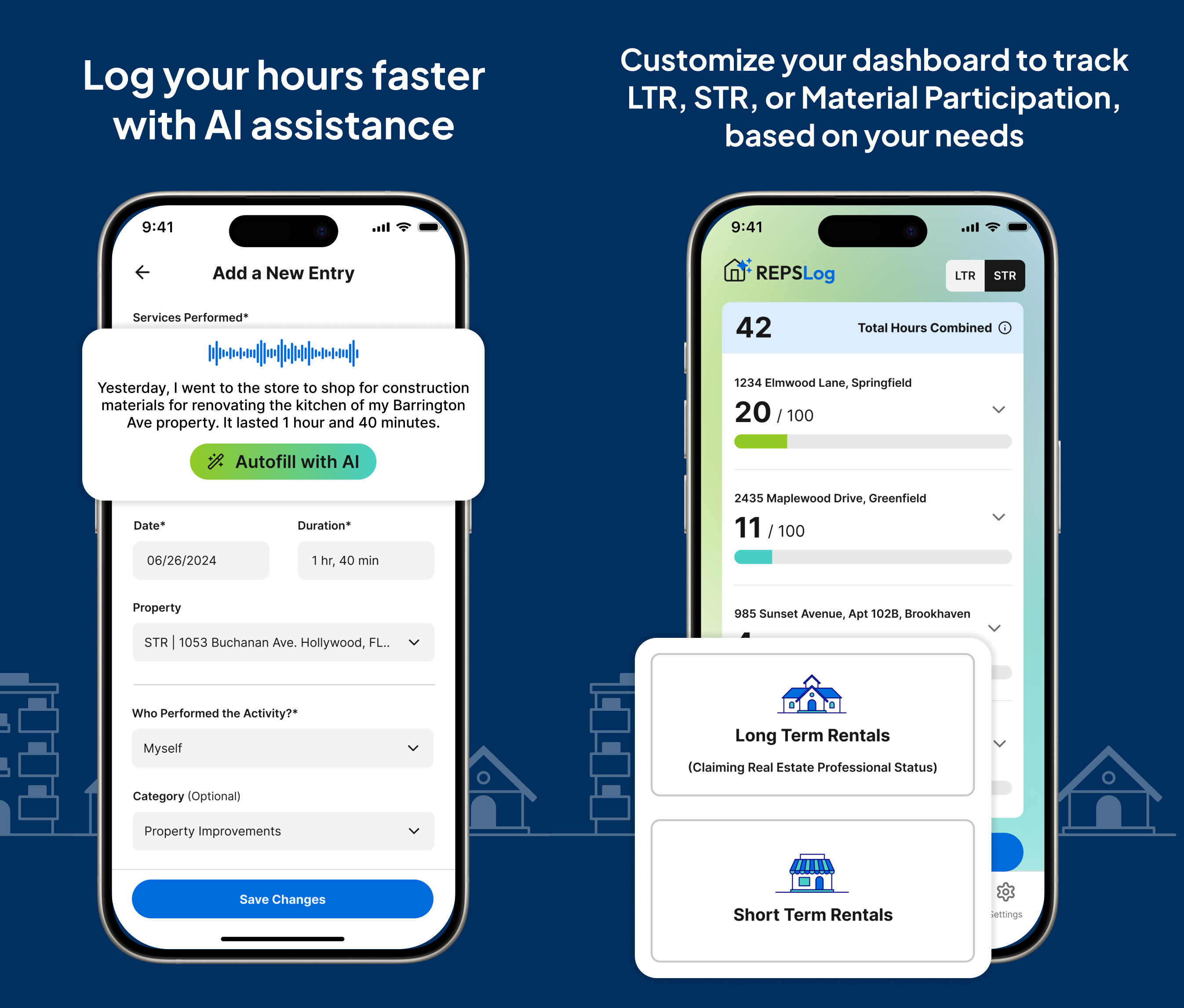
Consistent, contemporaneous logging is the foundation of your REPS qualification. REPSLog is designed for exactly this purpose, making it easy to log activities by property, category, and time spent directly from your phone throughout the day.
Available on iOS | Android | Web
This article is for educational purposes only and does not constitute tax or legal advice. Consult a qualified tax professional for guidance tailored to your situation.
Do this in REPSLog
- REPS Hour Tracking Goals (750 / 500 / 100): pick the 750, 500 or 100-hour test and watch progress per year and per property.
- Hours Dashboard and Stats: hours by property, category and year against your goal.
- Built-in Timer with Live Activity: time an activity live and drop the minutes into an entry.
Step by step in the Help Center: how to use it. Try REPSLog free for 14 days on iPhone, Android or the web app.