The grouping election under Treas. Reg. 1.469-9(g) is often presented as a slam-dunk move for real estate professionals. Group all your rentals together, meet material participation once, and unlock your passive losses. What rarely gets discussed are the situations where this election creates problems that cost you thousands of dollars or trigger complications you did not anticipate. This article examines four specific scenarios where the grouping election can backfire, and what you should consider before making this irrevocable choice.
A Quick Refresher on the Grouping Election
When a taxpayer qualifies as a real estate professional under IRC Section 469(c)(7), they may elect to treat all of their rental real estate interests as a single rental activity for purposes of the material participation tests. This election is made under Treas. Reg. 1.469-9(g) and is filed with the tax return for the year it first applies.
Without the election, each rental property is a separate activity that requires its own material participation analysis. With it, you combine all properties into one activity and test material participation once across the entire portfolio.
The election sounds like an obvious win. But “irrevocable” is a word that should always make you pause.
Scenario 1: Selling One Property at a Gain
This is the most commonly overlooked downside of the grouping election. When you sell a rental property at a gain, the tax treatment depends on whether you have suspended passive losses from that specific property.
Without grouping: Each property maintains its own passive loss history. When you sell Property A, all suspended passive losses attributable to Property A are released and offset the gain under IRC Section 469(g). If Property A has $80,000 in suspended losses and you sell it for a $100,000 gain, only $20,000 is taxable.
With grouping: All properties are treated as one activity. Selling one property is not a complete disposition of the grouped activity because the other properties remain. The suspended losses stay locked up within the group. You sell Property A for a $100,000 gain, but the losses from Property A are blended into the group and cannot be separately released.
The result is that you pay tax on the full gain from the sale, and the losses that should have offset it remain suspended until you dispose of the entire grouped activity. For investors who regularly buy and sell properties, this can mean paying significantly more tax on each disposition.
The workaround: Some practitioners argue that you can identify the suspended losses allocable to a disposed property within a group. However, the regulations are not clear-cut on this point, and the IRS has taken the position that a disposition of one property within a grouped activity is not a qualifying disposition under Section 469(g). This is an area where you need professional guidance specific to your facts.
Scenario 2: Losing REPS Status in a Future Year
Life changes. The spouse who qualified as a real estate professional takes a full-time job, has a health issue, or simply cannot meet the more than 750 hours threshold one year. When you lose REPS status, the implications of the grouping election become significant.
Without grouping: Each property stands alone. If you lose REPS status, each property reverts to a separate passive activity. You can still test material participation on each individual property. If you materially participate in some but not all, you can still deduct losses from the properties where you meet the participation tests (assuming you meet the REPS requirements for those properties, or they qualify under other provisions).
With grouping: All properties are one activity. When you lose REPS, the entire group becomes passive. You cannot selectively claim that you materially participated in some properties but not others, because the election merged them into a single activity. Every property in the group generates passive income or loss.
Additionally, the grouping election under Treas. Reg. 1.469-9(g) is only available to qualifying real estate professionals. In a year when you do not qualify, the election does not apply, and the properties are treated as separate activities again. However, there is ambiguity about what happens to the losses that accumulated during the grouped period and how they are allocated back to individual properties.
This scenario is particularly dangerous for physician households where the managing spouse’s REPS status depends on not having other substantial employment. A career change or part-time job can unexpectedly end qualification.
Scenario 3: Mixing Profitable and Unprofitable Properties
Portfolio diversity is generally a good thing, but from a passive activity loss perspective, mixing properties with different financial profiles can create suboptimal tax outcomes under the grouping election.
Without grouping: Property A generates a $50,000 loss after depreciation. Property B generates $30,000 in net income. If you materially participate in both and qualify as a REPS, you deduct the $50,000 loss and report the $30,000 income separately. Net tax benefit from the properties: a $20,000 net loss deduction.
With grouping: The results are the same in this simple case because the income and losses net together within the single activity. The group produces a $20,000 net loss.
Where it gets problematic is when you do not qualify as a REPS in a given year, or when you have properties in different categories:
- Profitable properties mask losses. If some properties generate significant positive cash flow (perhaps fully depreciated properties you have held for years), their income offsets the losses from newer properties with large depreciation deductions. Without grouping, you could potentially use the profitable properties’ income to offset other passive income while separately tracking the loss properties.
- Net income from the group. If your profitable properties generate more income than your loss properties generate losses, the grouped activity shows net income. You have turned what could have been separately deductible losses (with proper qualification) into a net income activity, and the losses have been consumed within the group rather than sheltering other income.
- Different holding periods. Properties acquired at different times have different depreciation schedules and cost basis structures. Grouping them blends these distinct tax profiles in ways that complicate future planning, especially around 1031 exchanges and dispositions.
Scenario 4: State Tax Differences
This scenario affects investors who own properties in multiple states, which is increasingly common with the growth of short-term rental investing in vacation markets.
The federal-state disconnect: The grouping election is a federal tax concept under the Treasury Regulations. States are not required to follow the federal grouping election, and several do not.
- Some states require you to compute passive activity limitations using their own rules, which may not recognize the federal grouping election.
- States with no income tax (Texas, Florida, Nevada, etc.) are irrelevant to this analysis, but states that tax rental income often have their own passive loss rules.
- California, New York, and other high-tax states may require separate activity-by-activity analysis regardless of your federal grouping election.
The practical problem: You may need to maintain two sets of records: one for your grouped federal return and one for state returns that require separate activity treatment. This increases compliance costs and complexity.
Cross-state loss allocation: When properties are grouped federally but treated separately at the state level, losses from a property in State A cannot offset income from a property in State B on the state returns, even though they net together on the federal return. This can result in paying state taxes on income from profitable properties while getting no current state benefit from losses on properties in other states.
State-level REPS recognition: Some states do not recognize REPS at all, meaning rental losses are always passive regardless of your federal qualification. In these states, the grouping election is irrelevant, but you may have mistakenly planned your tax strategy around federal benefits without accounting for state-level limitations.
When the Grouping Election Still Makes Sense
Despite these downsides, the grouping election remains the right choice for many real estate professionals. It generally works well when:
- You plan to hold all properties long-term and do not anticipate selling individual properties
- Your properties are all in the same state
- You have confidence in maintaining REPS qualification consistently
- Your portfolio is relatively uniform in profitability
- You would not meet material participation on each property individually without grouping
The election is especially valuable for investors who own many properties and cannot realistically spend more than 500 hours on each one individually. Without grouping, a ten-property portfolio would require 5,000 hours of documented material participation to meet Test 1 on every property.
Alternatives to the Grouping Election
If the scenarios above concern you, consider these alternatives:
Appropriate economic unit grouping under Treas. Reg. 1.469-4: This is a different grouping provision that allows you to group activities that form an appropriate economic unit. Unlike the 1.469-9(g) election, this grouping is more flexible and can be structured to keep certain properties separate while grouping others.
Meeting material participation per property: If your portfolio is small enough (three to five properties), you may be able to document sufficient hours on each property individually. This preserves the ability to release suspended losses upon disposition of any single property.
Strategic timing of the election: You do not have to make the grouping election in the first year you qualify as a REPS. You can wait and evaluate your portfolio and plans before electing. Once you elect, however, it applies to all current and future rental properties.
Making the Decision: A Framework
Before making the grouping election, work through these questions with your tax advisor:
- Do you plan to sell any properties in the next five years? If yes, carefully model the impact of not being able to release suspended losses on disposition.
- How stable is the qualifying spouse’s REPS status? If there is any chance of losing qualification, consider whether separate activities provide more flexibility.
- Do you own properties in multiple states? If yes, research each state’s treatment of the grouping election and passive activity rules.
- What is the profitability mix of your properties? If some properties are significantly profitable while others generate large losses, model both scenarios to see which produces better results.
- Can you meet material participation on each property individually? If yes, you may not need the grouping election at all.
Frequently Asked Questions
Can I revoke the grouping election once it is made?
No. The election under Treas. Reg. 1.469-9(g) is irrevocable. Once made, it applies for the year of election and all future years in which you qualify as a real estate professional. The only way it stops applying is if you no longer qualify as a REPS.
Does the grouping election apply to properties I acquire after making it?
Yes. The election applies to all rental real estate interests, including those acquired in future years. You cannot selectively exclude newly acquired properties from the group.
What if I made the grouping election and now realize it was a mistake?
Unfortunately, there is no formal mechanism to undo the election. Your options are limited. Some practitioners explore whether the election was properly made (technical deficiencies might allow an argument that it was never valid), but this is aggressive territory. Consult a tax professional.
Does the grouping election affect my ability to do a 1031 exchange?
The grouping election itself does not directly affect 1031 exchange eligibility. However, the passive activity implications of selling (or exchanging) one property within a grouped activity can be complex. A 1031 exchange defers gain recognition, which may reduce some of the disposition concerns discussed in Scenario 1.
Can I group only some properties and leave others separate?
Not under Treas. Reg. 1.469-9(g). The REPS grouping election is all-or-nothing. You can, however, use the separate appropriate economic unit grouping rules under Treas. Reg. 1.469-4, which allow more selective grouping. These are different provisions with different rules.
How does the grouping election interact with the STR loophole?
Short-term rentals with an average guest stay of seven days or less may not be treated as rental activities under Treas. Reg. 1.469-1T(e)(3)(ii)(A). If a property is not a rental activity, it falls outside the scope of the REPS grouping election entirely. This means STR properties that qualify under the loophole are already treated separately and do not need to be grouped.
Does my CPA need to attach anything to my return to make the election?
Yes. The grouping election must be made by filing a statement with the original tax return for the year. The statement should identify the election under Treas. Reg. 1.469-9(g) and list the rental real estate interests being grouped. Failure to properly attach this statement could mean the election was never validly made.
Key Takeaways
- The grouping election under Treas. Reg. 1.469-9(g) is irrevocable and applies to all current and future rental properties
- Selling one property within a grouped activity may prevent the release of suspended passive losses for that property
- Losing REPS status in a future year causes the entire group to become passive, eliminating the ability to selectively claim material participation on individual properties
- Mixing highly profitable and loss-generating properties in a group can produce suboptimal tax results
- States may not recognize the federal grouping election, creating compliance complexity for multi-state investors
- Always model both grouped and ungrouped scenarios with your tax advisor before making the election
Track Your Hours Property by Property
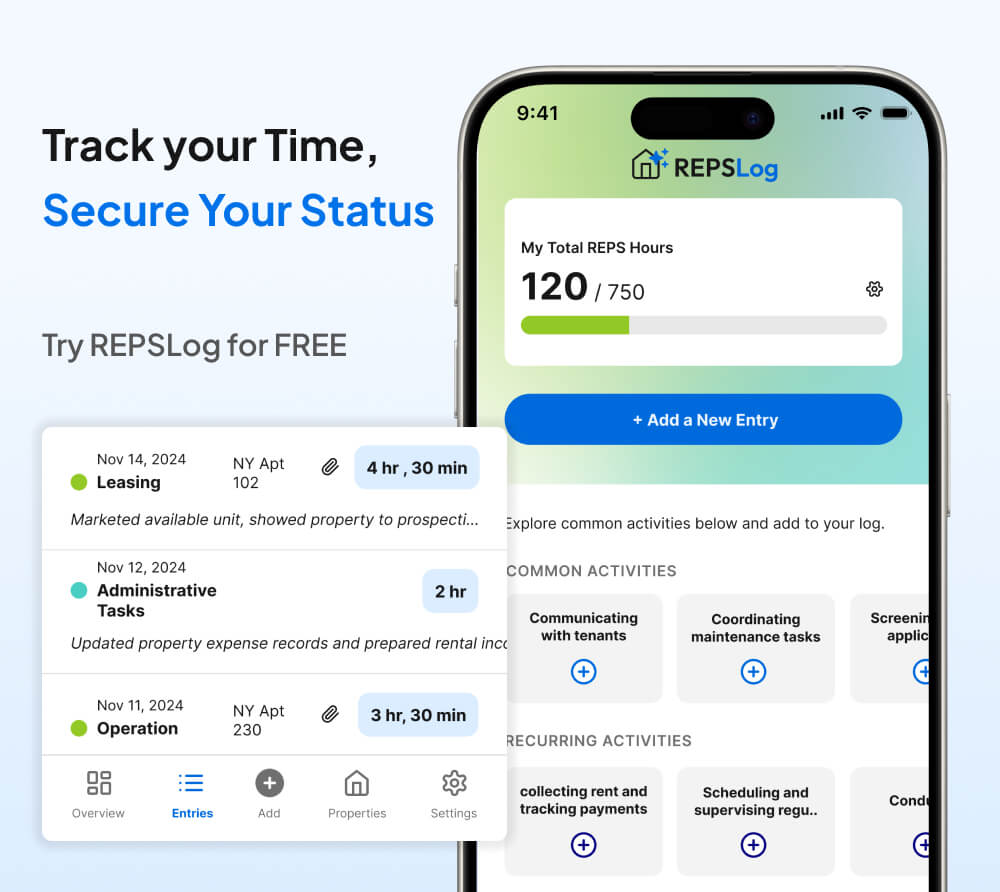
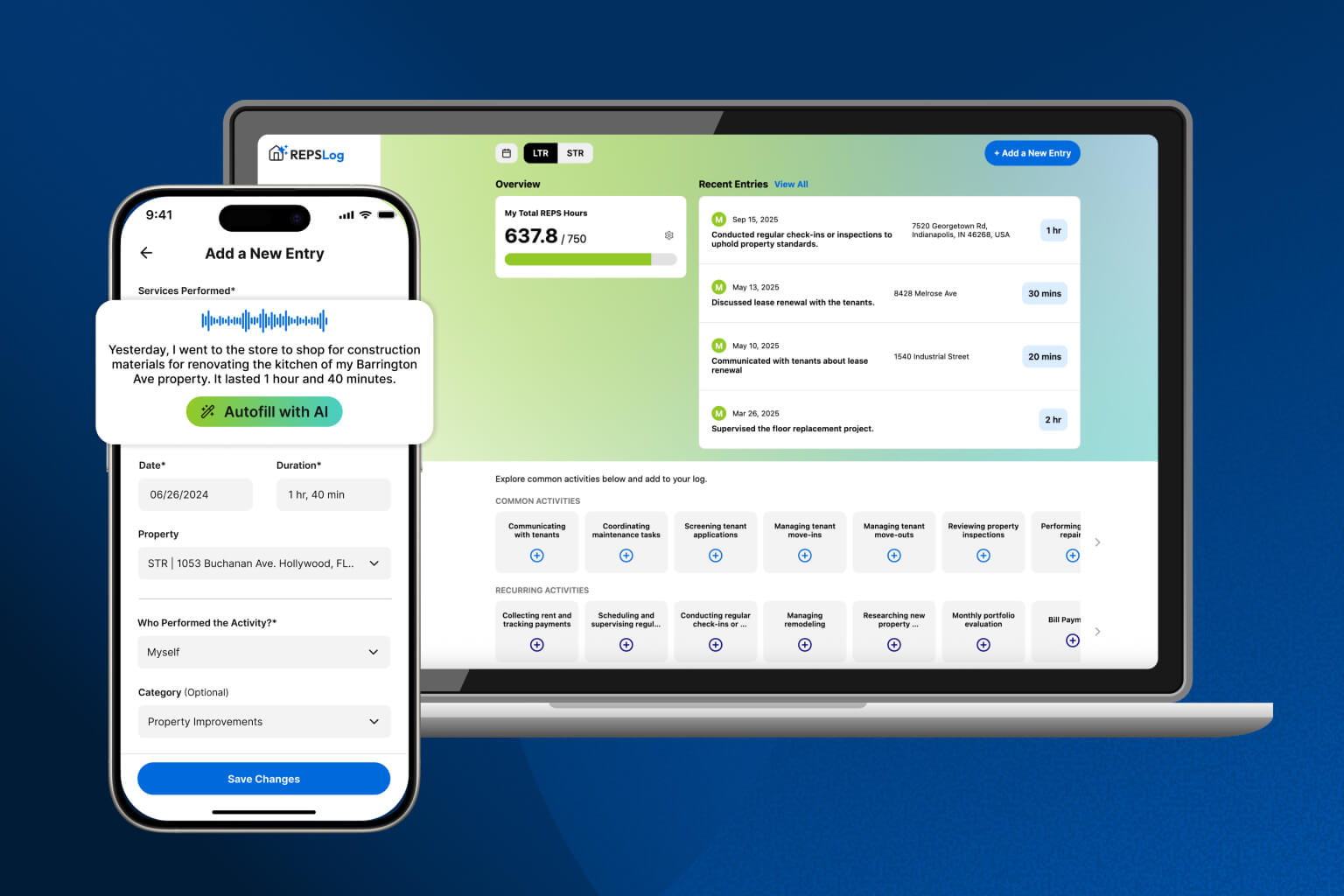
Whether you use the grouping election or not, maintaining detailed per-property hour logs is essential. REPSLog lets you track activities by individual property, giving you the flexibility to demonstrate material participation at both the individual and grouped levels.
Available on iOS | Android | Web
This article is for educational purposes only and does not constitute tax or legal advice. Consult a qualified tax professional for guidance tailored to your situation.
Do this in REPSLog
- Multiple Properties: add each rental by address, mark it LTR or STR, see hours per property.
- Hours Dashboard and Stats: hours by property, category and year against your goal.
- CPA-ready Export (PDF and CSV): a tax year as PDF and CSV, split by LTR and STR, with receipts.
Step by step in the Help Center: how to use it. Try REPSLog free for 14 days on iPhone, Android or the web app.