The seven-day rule is the gateway to the short-term rental tax loophole, and understanding how it works is essential for any investor using STR properties to offset income. Under Treas. Reg. 1.469-1T(e)(3)(ii)(A), a rental activity with an average period of customer use of seven days or less is not treated as a rental activity for passive activity purposes. This reclassification opens the door to treating STR income and losses as non-passive, potentially allowing losses to offset your W-2 or business income without qualifying as a real estate professional. This article breaks down how to calculate the average stay, handle mixed-use scenarios, and avoid the pitfalls that catch investors off guard.
New to the STR loophole? Start with our STR loophole guide.
If your average guest stay is seven days or less and you materially participate, run your numbers on the STR tax savings calculator to see the first-year savings.
What the Seven-Day Rule Actually Says
The passive activity loss rules under IRC Section 469 generally treat rental activities as passive, regardless of the taxpayer’s level of participation. However, the regulations carve out an exception: if the average period of customer use is seven days or less, the activity is not treated as a rental activity.
The specific regulatory language comes from Treas. Reg. 1.469-1T(e)(3)(ii)(A):
An activity involving the use of tangible property is not a rental activity if the average period of customer use of the property is seven days or less.
When an activity is not a rental activity, it falls under the general passive activity rules rather than the rental-specific rules. This means you can apply the material participation tests directly. If you materially participate in the STR activity, the income or loss is non-passive and can offset other income.
This is the foundation of what investors commonly call the “STR loophole.”
How to Calculate the Average Period of Customer Use
The calculation is straightforward in concept but requires careful record-keeping:
Step 1: Identify every customer use period during the tax year. A “customer use period” is a continuous period during which a single guest (or group) occupies the property. A three-night stay is one customer use period of three days.
Step 2: Total all the days of customer use across all stays.
Step 3: Divide by the total number of customer use periods (stays).
Formula: Average Period of Customer Use = Total Days of Customer Use / Total Number of Stays
Example Calculation
Suppose your STR had the following bookings during the year:
| Stay | Duration (Days) |
|---|---|
| 1 | 3 |
| 2 | 4 |
| 3 | 2 |
| 4 | 5 |
| 5 | 7 |
| 6 | 3 |
| 7 | 2 |
| 8 | 4 |
| 9 | 3 |
| 10 | 5 |
| 11 | 4 |
| 12 | 3 |
| Total | 45 |
Average Period of Customer Use = 45 days / 12 stays = 3.75 days
Since 3.75 is less than or equal to seven, this property qualifies under the seven-day rule. The activity is not treated as a rental activity.
What Counts as a “Day”?
The regulations do not explicitly define a “day” in this context, but the standard practice is:
- A one-night stay = one day of customer use (some practitioners count it as the number of nights; others count calendar days of occupancy)
- Check-in and check-out days where the guest occupies the property for any portion of the day are generally counted
- The key is consistency: whatever method you use, apply it uniformly to all stays
Consult your tax advisor on the exact counting methodology they recommend, as this can matter when your average is close to the seven-day threshold.
The Critical Distinction: Seven Days or Less vs. More Than Seven Days
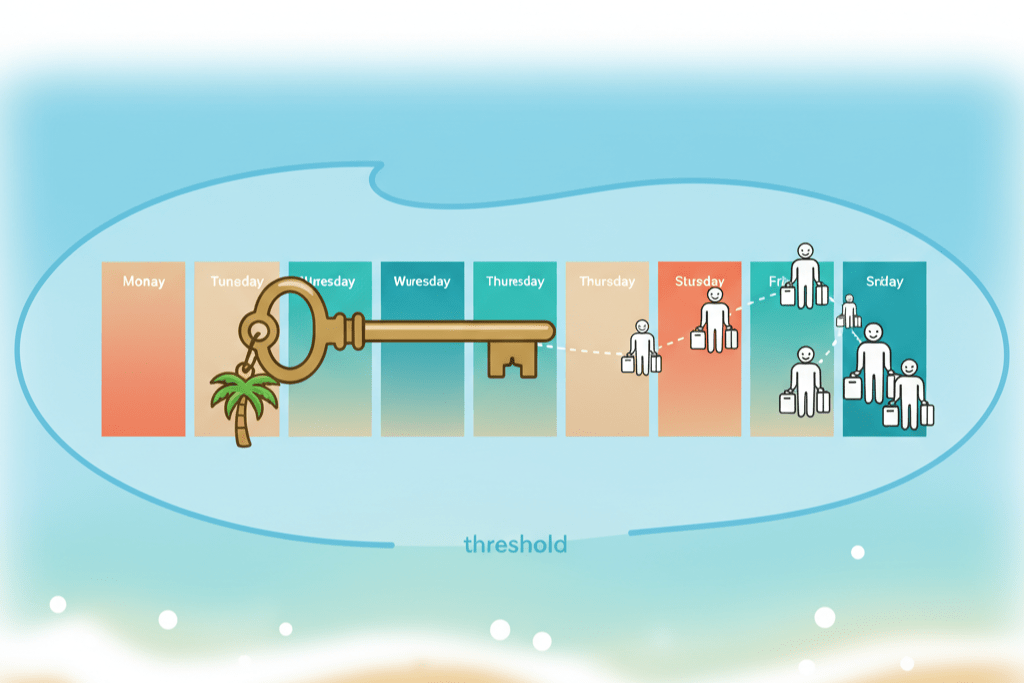
The threshold is “seven days or less,” not “less than seven days.” An average period of customer use of exactly seven days qualifies. An average of 7.1 days does not.
This distinction matters most for properties that mix shorter and longer stays. A single long-term booking can pull your average above the threshold and disqualify the entire property from the seven-day rule for that year.
Mixed Stays: When Short and Long Bookings Collide
Many STR operators experience a mix of short weekend stays and longer bookings, particularly in vacation markets with both weekend visitors and seasonal guests.
Scenario: The Long Stay That Breaks the Average
Consider a property with the following booking profile:
| Stay | Duration (Days) |
|---|---|
| 1-10 | 3 days each (total: 30 days, 10 stays) |
| 11 | 28 days (monthly rental) |
Average = (30 + 28) / 11 = 58 / 11 = 5.27 days
This still qualifies (5.27 is less than 7). But watch what happens with more long-term bookings:
| Stay | Duration (Days) |
|---|---|
| 1-8 | 3 days each (total: 24 days, 8 stays) |
| 9 | 30 days |
| 10 | 14 days |
Average = (24 + 30 + 14) / 10 = 68 / 10 = 6.8 days
Still under seven. But add one more 30-day stay:
| Stay | Duration (Days) |
|---|---|
| 1-8 | 3 days each (total: 24 days, 8 stays) |
| 9 | 30 days |
| 10 | 14 days |
| 11 | 30 days |
Average = (24 + 30 + 14 + 30) / 11 = 98 / 11 = 8.9 days
Now you exceed seven days. The property is treated as a rental activity for the entire year. The STR loophole does not apply.
Strategy: Managing Your Average
Some investors actively manage their booking policies to maintain a seven-day-or-less average:
- Set maximum stay limits on booking platforms (for example, maximum of 14 nights)
- Decline or redirect long-term booking requests that would push the average above seven days
- Monitor the running average throughout the year and adjust booking policies if a long stay pulls the number up
This is legitimate tax planning, not avoidance. You are structuring your business operations with tax consequences in mind, which is exactly what the regulations allow.
Seasonal Properties and the Seven-Day Rule
Seasonal properties present unique challenges. A beach house might operate as a short-term rental during summer (with three- to five-day stays) and sit vacant or be rented monthly during the off-season.
If you rent monthly in the off-season: Those 30-day stays count in your average calculation and can push you above the seven-day threshold.
If the property sits vacant in the off-season: Vacant periods are not customer use periods. They do not factor into the average calculation. Only actual stays count.
If you use the property personally in the off-season: Personal use days are not customer use periods and do not enter the average calculation. However, personal use can trigger other tax consequences (under IRC Section 280A) that limit your deductions.
The seasonal dynamic means your booking strategy for the off-season can determine your tax treatment for the entire year. An investor who rents their beach house for two 30-day periods in winter might disqualify from the seven-day rule despite having fifty short stays during summer.
The 30-Day Rule: A Related but Different Exception
Treas. Reg. 1.469-1T(e)(3)(ii)(B) provides a second exception from rental activity treatment: if the average period of customer use exceeds seven days but does not exceed 30 days, AND significant personal services are provided in connection with the rental, the activity is also not treated as a rental activity.
This “significant personal services” exception covers hotel-like operations where the operator provides services beyond simply making the property available. Examples include daily housekeeping, meals, concierge services, and organized activities.
For most STR investors, the seven-day rule is simpler and more straightforward. But if your average exceeds seven days, the 30-day rule with significant personal services may be an alternative path.
Documentation Best Practices
The IRS can review your average calculation during an audit. Proper documentation is essential:
Booking records: Maintain a complete record of every stay, including guest name (or booking reference), check-in date, check-out date, and number of nights. Platform records from Airbnb, Vrbo, or Booking.com are excellent primary documentation, but keep your own backup.
Annual calculation worksheet: At year-end, prepare a simple spreadsheet listing every stay and computing the average. This worksheet should reconcile to your booking platform data and your tax return.
Booking policy documentation: If you set maximum stay limits to manage your average, document those policies (screenshots of platform settings, written rental policies). This demonstrates that your booking structure is an intentional business decision.
Platform settings: Save records of your minimum and maximum stay settings on each booking platform. These corroborate your average calculation and show proactive management.
Interaction with REPS
The seven-day rule and REPS are distinct strategies that can work independently or in combination:
Seven-day rule alone (no REPS): If your STR meets the seven-day rule and you materially participate (more than 100 hours and more than anyone else, or more than 500 hours), the losses are non-passive. You do not need REPS qualification. This is the standalone STR loophole.
REPS alone (no seven-day rule): If your properties have average stays exceeding seven days, they are rental activities. REPS qualification plus material participation makes those rental losses non-passive.
Both together: If you qualify as a REPS and also have STR properties meeting the seven-day rule, you get the benefit of both. The STR properties are non-rental activities (material participation makes their losses non-passive without REPS), and your other rental properties benefit from your REPS qualification.
The practical implication: if all your properties are STRs with average stays under seven days, you may not need REPS at all. But if you have a mix of STR and long-term properties, REPS qualification covers the long-term rentals while the seven-day rule covers the STRs.
Frequently Asked Questions
Does the seven-day rule apply per property or across all properties?
The average period of customer use is calculated separately for each property (each separate activity). One property might qualify with a four-day average while another fails with a nine-day average.
What if my average is exactly seven days?
An average of exactly seven days qualifies. The regulation says “seven days or less,” so seven days is included.
Do I need to calculate the average before filing my return?
Yes. You should calculate the average for each STR property at year-end to determine the correct tax treatment before filing. This calculation should be part of your year-end tax preparation process.
Can I exclude certain stays from the average calculation?
No. All customer use periods during the tax year must be included. You cannot cherry-pick stays to manipulate the average. However, personal use days and vacant days are not customer use periods and are correctly excluded.
What happens if I fail the seven-day rule in one year but passed in prior years?
The test is applied annually. If you fail in a given year, the property is treated as a rental activity for that year. Prior years when you qualified are not affected. Your tax treatment can change from year to year based on actual booking patterns.
Does Airbnb or Vrbo report my average stay length to the IRS?
Not directly. Booking platforms report gross income on Form 1099-K, but they do not calculate or report your average period of customer use. You are responsible for this calculation.
Can I have a property manager and still use the seven-day rule?
Yes. The seven-day rule depends on the average stay length, not on who manages the property. However, if you are relying on material participation to make the losses non-passive, you must personally meet the participation tests. Having a property manager does not disqualify you from the seven-day rule, but it may make meeting material participation harder.
Key Takeaways
- The seven-day rule under Treas. Reg. 1.469-1T(e)(3)(ii)(A) reclassifies STR activities with average stays of seven days or less as non-rental activities
- Calculate the average by dividing total days of customer use by the total number of stays during the tax year
- A single long-term booking can push your average above seven days and disqualify the property for the entire year
- Seasonal properties need careful management of off-season booking strategies to maintain compliance
- The calculation is done per property, not across your entire portfolio
- You must still materially participate in the activity for losses to be non-passive
- Document all stays, platform settings, and booking policies to support your calculation in an audit
- The seven-day rule and REPS are independent strategies that can work separately or together
Track Your STR Hours and Stay Data with REPSLog
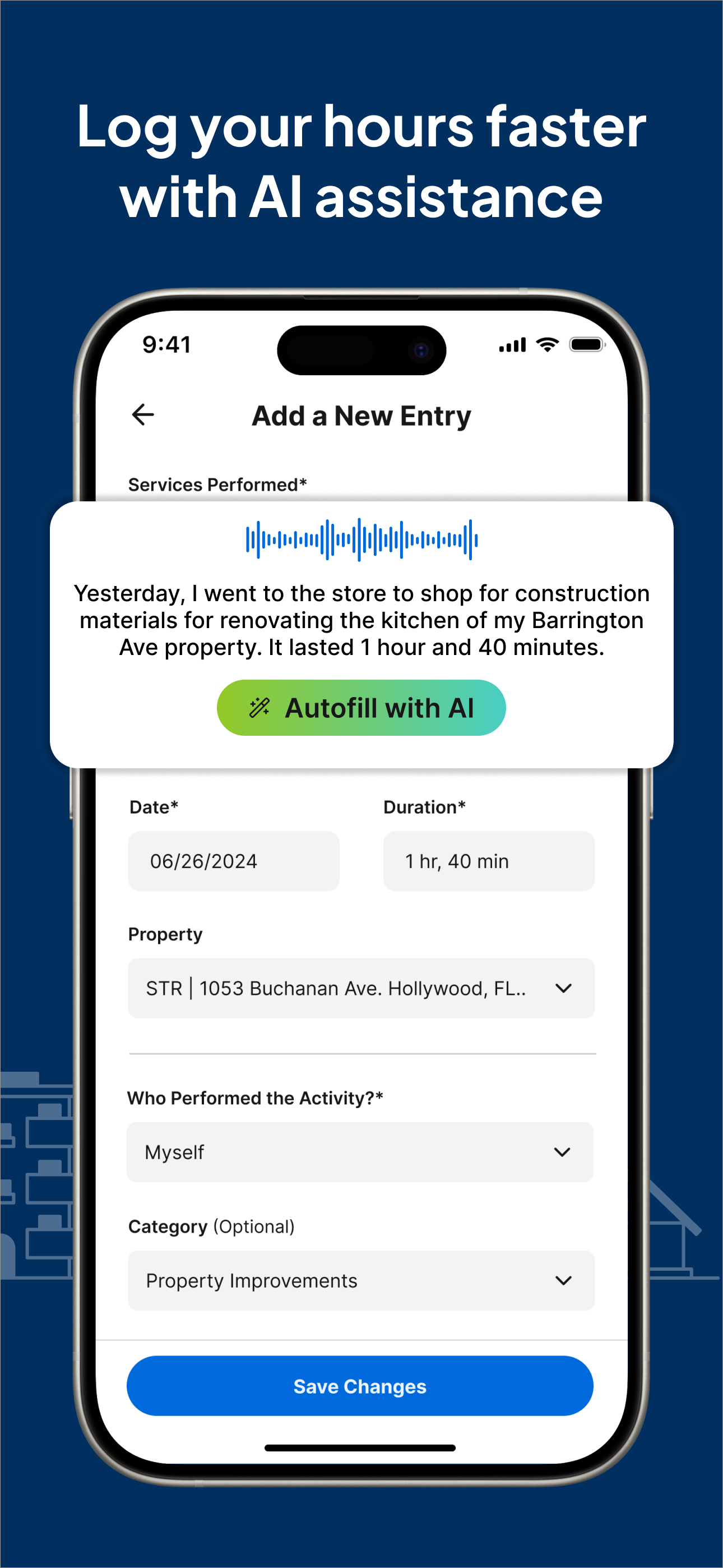
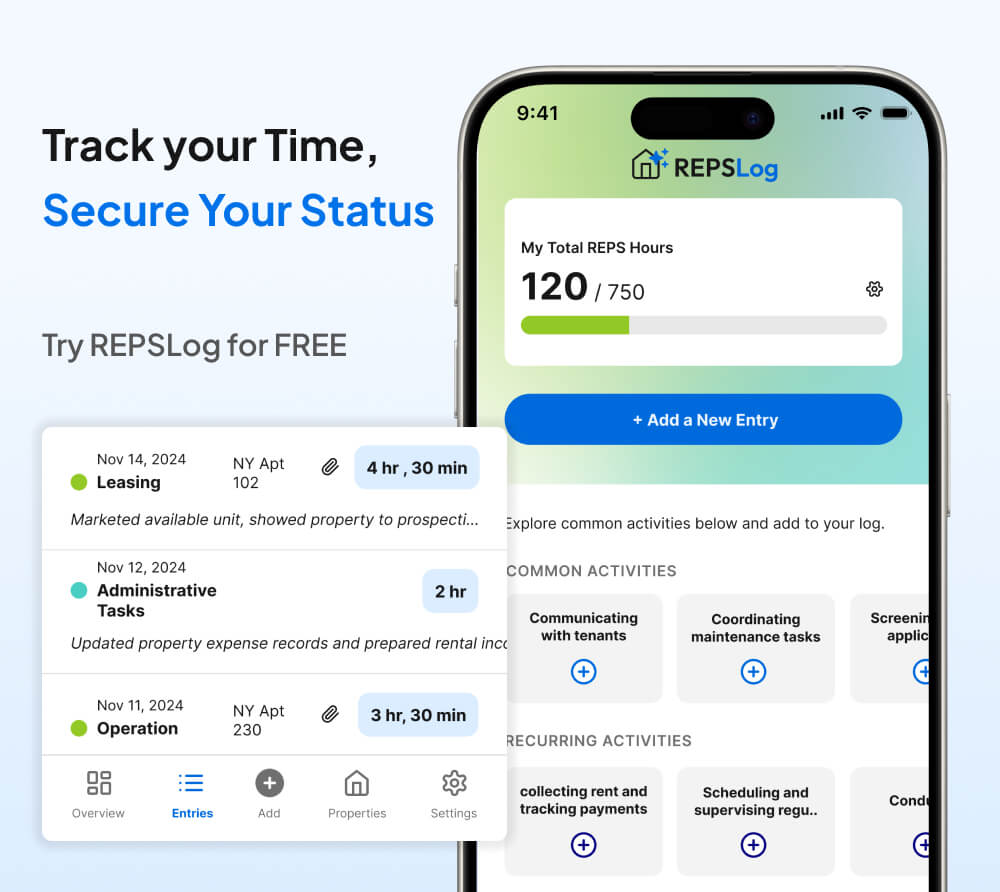
REPSLog helps STR investors track both their management hours and their qualification for material participation tests. Whether you are using the seven-day rule or pursuing full REPS status, organized hour tracking by property keeps you audit-ready year-round.
Available on iOS | Android | Web
This article is for educational purposes only and does not constitute tax or legal advice. Consult a qualified tax professional for guidance tailored to your situation.
Do this in REPSLog
- Booking Calendar Sync (Airbnb, Vrbo and any iCal): pull every Airbnb, Vrbo or other booking into your log and get an entry suggested per stay.
- STR Loophole Tracking: a 100 or 500-hour counter per short-term rental, with hours by participant.
- Participants: log who did each activity, so spouse hours count where allowed and contractor hours stay separate.
Step by step in the Help Center: how to use it. Try REPSLog free for 14 days on iPhone, Android or the web app.