Bonus depreciation has been one of the most powerful accelerators in the real estate investor’s tax toolkit. By allowing a substantial percentage of an asset’s cost to be deducted in the first year, bonus depreciation front-loads tax savings in a way that standard depreciation schedules never could. But the rules are changing, and 2026 represents a pivotal year for investors who rely on this strategy.
This guide explains how bonus depreciation works for rental properties in 2026, how it interacts with Real Estate Professional Status (REPS) and the short-term rental (STR) loophole, and what investors should be planning for as the phase-down continues.
The cost segregation calculator runs the current bonus depreciation rate against your own numbers, with a 10-year schedule and recapture.
What Is Bonus Depreciation?
Under normal depreciation rules, when you purchase a rental property, the IRS requires you to spread the deduction of the building’s cost over its useful life — 27.5 years for residential property and 39 years for commercial property. Certain components within the property (appliances, carpeting, landscaping, etc.) qualify for shorter recovery periods of 5, 7, or 15 years, but even those deductions are spread out over multiple years.
Bonus depreciation, codified under IRC Section 168(k), allows taxpayers to deduct a specified percentage of the cost of qualifying property in the year it is placed in service, rather than spreading that deduction over the asset’s full recovery period.
The Phase-Down Schedule
The Tax Cuts and Jobs Act of 2017 (TCJA) expanded bonus depreciation to 100% for qualified property acquired and placed in service after September 27, 2017, through December 31, 2022. Since then, the rate has been declining:
| Tax Year | Bonus Depreciation Rate |
|---|---|
| 2022 | 100% |
| 2023 | 80% |
| 2024 | 60% |
| 2025 | 40% |
| 2026 | 20% |
| 2027+ | 0% |
In 2026, investors can deduct 20% of the cost of qualifying assets in the first year through bonus depreciation, with the remaining 80% depreciated over the asset’s normal recovery period.
Legislative Uncertainty
Congress has considered multiple proposals to restore 100% bonus depreciation, including provisions in the One Big Beautiful Bill Act (OBBBA) and other legislation. As of the publication of this article, investors should monitor developments closely and consult with their tax advisors about the rules in effect at the time they file. The analysis below uses the 20% rate currently scheduled for 2026, but the strategies discussed become even more powerful if higher rates are restored.

What Qualifies for Bonus Depreciation in Rental Properties?
Bonus depreciation applies to tangible personal property with a recovery period of 20 years or less and certain qualified improvement property (QIP). For rental property investors, the qualifying assets typically include:
5-Year Property
- Appliances
- Carpeting
- Specialty flooring
- Window treatments
- Security systems
- Decorative lighting
7-Year Property
- Furniture and fixtures
- Office equipment
15-Year Property
- Land improvements (parking lots, driveways, landscaping, fencing, pools)
- Qualified improvement property (interior improvements to non-residential buildings)
What Does NOT Qualify
- The building structure itself (27.5-year or 39-year property)
- Land
- Property acquired from a related party (in certain circumstances)
This is where cost segregation studies become essential. Without a cost segregation study, your entire building is depreciated over 27.5 or 39 years. A cost segregation study identifies the components within the building that qualify for shorter recovery periods — and therefore qualify for bonus depreciation.
How Bonus Depreciation and Cost Segregation Work Together
The synergy between cost segregation and bonus depreciation is powerful, even at the reduced 2026 rate.
Example: $1 Million Residential Rental (2026)
Assume you purchase a residential rental property for $1 million, with $750,000 allocated to the building and $250,000 to land. A cost segregation study reclassifies 30% of the building:
- $112,500 in 5-year property
- $37,500 in 7-year property
- $75,000 in 15-year property
- $525,000 remaining 27.5-year property
Without cost segregation:
- Year 1 depreciation: $750,000 / 27.5 = $27,273
With cost segregation and 20% bonus depreciation in 2026:
- 5-year property: $112,500 x 20% bonus = $22,500 + regular first-year depreciation on remaining $90,000
- 7-year property: $37,500 x 20% bonus = $7,500 + regular first-year depreciation on remaining $30,000
- 15-year property: $75,000 x 20% bonus = $15,000 + regular first-year depreciation on remaining $60,000
- 27.5-year property: $525,000 / 27.5 = $19,091
Total approximate Year 1 depreciation: roughly $90,000+ versus $27,273 under standard depreciation.
The difference of approximately $63,000 in additional depreciation, for an investor in the 37% federal tax bracket, translates to roughly $23,000 in additional federal tax savings in Year 1.
The REPS Connection: Why Bonus Depreciation Matters More for Real Estate Professionals
Accelerated depreciation through bonus depreciation and cost segregation creates large paper losses on your rental properties. But the value of those losses depends on whether you can actually use them.
Without REPS
Rental activities are passive under IRC Section 469. Losses from passive activities can only offset passive income. If your rental losses exceed your passive income, the excess is suspended and carried forward to future years (or until you dispose of the property).
There is a limited exception: taxpayers with adjusted gross income under $100,000 can deduct up to $25,000 in rental losses against non-passive income if they actively participate. This phases out between $100,000 and $150,000 AGI. For most investors pursuing bonus depreciation strategies, their income far exceeds this threshold.
With REPS
When you qualify as a real estate professional (more than 750 hours in real property trades or businesses, more than half of your total professional hours in real estate, and material participation in your rental activities), your rental losses are reclassified as non-passive. They can offset any income — W-2 wages, business income, capital gains, interest, dividends.
This means the accelerated depreciation from bonus depreciation and cost segregation is immediately usable. A $90,000 paper loss does not sit on the shelf — it reduces your taxable income by $90,000 in the year it is generated.
The Multiplier Effect
REPS does not increase your depreciation — it increases the utility of your depreciation. Consider two identical investors who each purchase a $1 million rental property with cost segregation generating $90,000 in Year 1 depreciation:
Investor A (no REPS, $300,000 W-2 income, no passive income):
- $90,000 depreciation creates a rental loss
- Loss is passive and fully suspended
- Current-year tax savings: $0
Investor B (REPS qualifying, $300,000 W-2 income):
- $90,000 depreciation creates a rental loss
- Loss is non-passive and offsets W-2 income
- Taxable income reduced to $210,000
- Current-year tax savings: ~$33,300 federal
Same property, same depreciation, vastly different outcomes. REPS is the mechanism that transforms bonus depreciation from a theoretical benefit into an immediate cash-in-hand tax reduction.
Bonus Depreciation and the STR Loophole
The short-term rental loophole provides an alternative path to non-passive treatment for rental activities where the average guest stay is 7 days or less. Under this rule, the rental activity is not treated as a rental activity for purposes of the passive activity rules — it is treated as a regular trade or business.
If the STR owner materially participates in the activity, losses are non-passive without needing REPS. This makes bonus depreciation on STR properties particularly attractive for investors who have full-time W-2 jobs and cannot meet the REPS more-than-half test.
When to Use REPS vs. STR Loophole vs. Both
STR loophole alone: Best for investors with short-term rental properties who have a full-time W-2 job. Material participation in the STR (more than 100 hours and more than anyone else, or more than 500 hours) is sufficient to deduct losses.
REPS alone: Best for investors with long-term rental properties who can meet both the 750-hour and more-than-half tests.
Both REPS and STR loophole: Ideal for investors with mixed portfolios of short-term and long-term rentals. REPS covers the long-term rental losses, and the STR loophole covers the short-term rental losses. The bonus depreciation on all properties becomes fully usable.
Planning Around the Phase-Down
With bonus depreciation at 20% in 2026 and scheduled to reach 0% in 2027, investors should consider several strategic moves:
Accelerate Acquisitions
If you are planning to purchase investment properties, doing so while bonus depreciation is still available — even at 20% — provides benefits that will not be available after 2027 (unless Congress acts). The 20% rate is less dramatic than 100%, but combined with cost segregation, it still meaningfully accelerates deductions.
Prioritize Cost Segregation Studies Now
For existing properties that have not undergone cost segregation, completing a look-back study while bonus depreciation is still available allows you to capture both the catch-up depreciation and apply bonus depreciation to the reclassified components.
Consider Renovation Timing
Qualified improvement property placed in service in 2026 can still benefit from 20% bonus depreciation. If you have planned renovations, completing them before 2027 captures this benefit.
Monitor Legislation
The political landscape around bonus depreciation is fluid. Both parties have shown support for extending or restoring higher rates. Stay connected with your CPA to react quickly if rates change mid-year.
Strengthen Your REPS Documentation
As bonus depreciation declines, some investors may feel less urgency around their REPS qualification. This is a mistake. Even without bonus depreciation, standard depreciation and cost segregation create substantial paper losses that only REPS (or the STR loophole) can unlock. The documentation habits you build now are essential regardless of the bonus depreciation rate.
Section 179 as a Complement
While bonus depreciation receives the most attention, Section 179 expensing is another accelerated depreciation mechanism that can benefit rental property investors in certain circumstances. Section 179 allows you to deduct the full cost of qualifying property in the year it is placed in service, up to an annual cap ($1,250,000 for 2026, subject to phase-out thresholds).
Historically, Section 179 could not be used for property held in a rental activity. However, the TCJA and subsequent legislation expanded its applicability in some situations. For properties that qualify, Section 179 can fill gaps left by the declining bonus depreciation rate. Discuss with your CPA whether any of your properties are eligible.
Frequently Asked Questions
Does bonus depreciation apply to the entire rental property?
No. Bonus depreciation applies only to components with a recovery period of 20 years or less — not the building structure itself (27.5 or 39 years) and not land. A cost segregation study is needed to identify and reclassify the qualifying components.
Can I take bonus depreciation without REPS?
Yes, you can claim bonus depreciation regardless of your REPS status. However, without REPS (or the STR loophole), the resulting rental losses are passive and may be suspended if you lack passive income to offset them.
What is the bonus depreciation rate for 2026?
Under current law, the bonus depreciation rate for 2026 is 20%. This applies to qualifying assets placed in service during the 2026 tax year. Legislation could change this rate.
Does bonus depreciation apply to used property?
Yes, since the TCJA, bonus depreciation applies to both new and used property, as long as the property is new to the taxpayer (not previously used by the same taxpayer in the same or related capacity).
How does bonus depreciation affect depreciation recapture when I sell?
All depreciation claimed — including bonus depreciation — is subject to recapture when you sell the property. Personal property depreciation is recaptured at ordinary income rates (up to 37%), while real property depreciation is recaptured at 25% under Section 1250. A 1031 exchange defers recapture.
Is it worth doing cost segregation at only 20% bonus depreciation?
In most cases, yes. Cost segregation accelerates depreciation even without any bonus depreciation at all. The 20% bonus is an additional enhancement on top of the accelerated depreciation schedules (5, 7, and 15 years versus 27.5 or 39 years). The ROI on a cost segregation study remains strongly positive for properties above $250,000-$500,000 in building basis.
What happens if bonus depreciation is restored to 100%?
If Congress retroactively restores 100% bonus depreciation for 2026, investors who complete cost segregation studies would be able to deduct the full cost of reclassified components in Year 1. This would significantly increase first-year deductions and make cost segregation even more impactful.
Key Takeaways
- Bonus depreciation is 20% in 2026 and scheduled to reach 0% in 2027 under current law
- Cost segregation is essential to identify property components that qualify for bonus depreciation
- REPS transforms bonus depreciation from a passive deduction to an active-income offset, making it dramatically more valuable
- The STR loophole provides an alternative path to non-passive treatment for short-term rental properties
- Planning around the phase-down means accelerating acquisitions, completing cost segregation studies, and monitoring legislation
- Even at 20%, bonus depreciation combined with cost segregation meaningfully accelerates first-year deductions
- Solid REPS documentation is critical regardless of the bonus depreciation rate
How REPSLog Supports Your Depreciation Strategy
Bonus depreciation and cost segregation create the tax savings. REPS qualification unlocks them. But qualifying as a real estate professional requires rigorous documentation of more than 750 hours in real property trades or businesses, the more-than-half test, and material participation in each rental activity or a grouped election under Treas. Reg. 1.469-9(g).
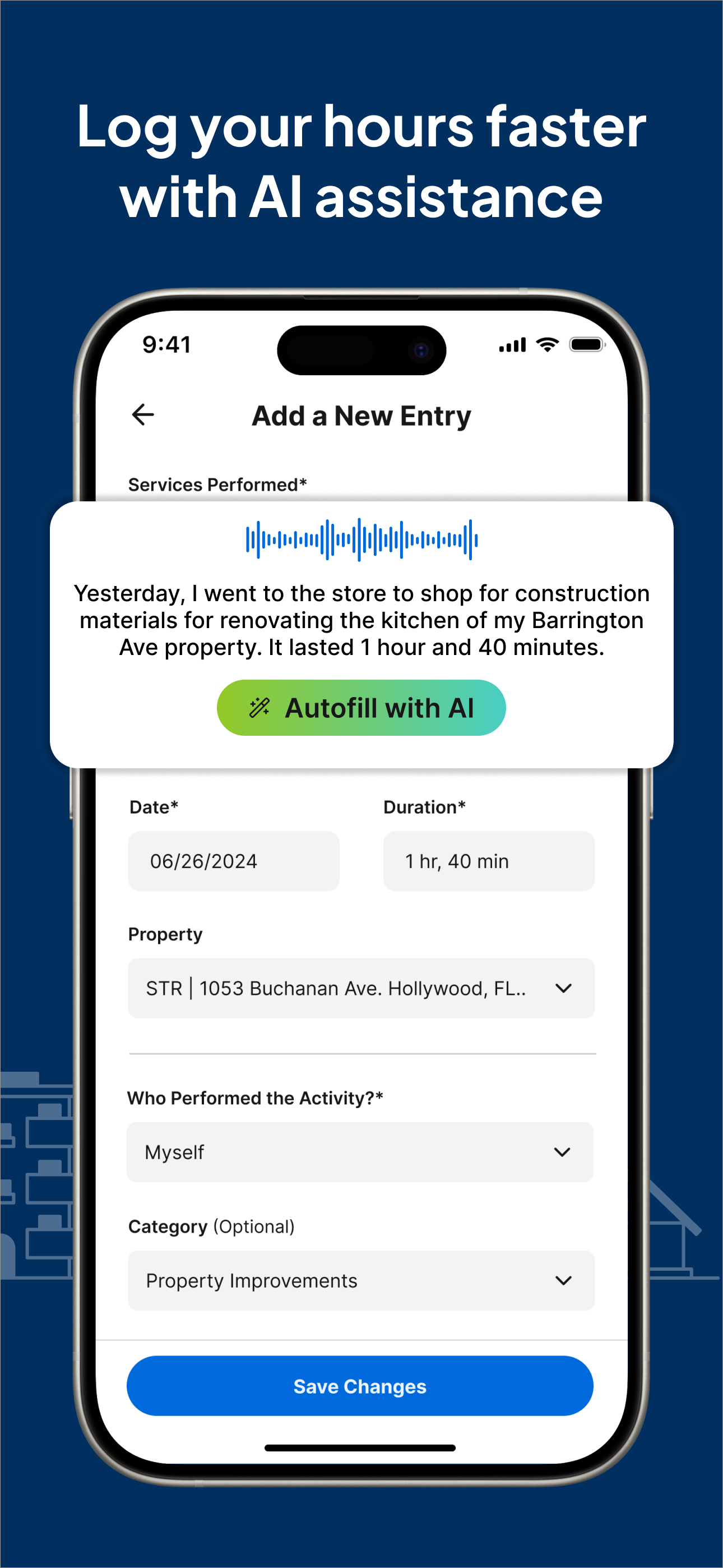
REPSLog makes this documentation effortless. Track your real estate hours in real time, categorize activities by property and type, monitor your progress toward the 750-hour threshold, and generate audit-ready exports for your CPA. When large depreciation deductions draw IRS scrutiny, your REPSLog records provide the contemporaneous evidence that supports your REPS claim.
Available on iOS and Android, or on the web at app.reps-log.com. Start tracking your hours free →
This article is for educational purposes only and does not constitute tax or legal advice. Consult a qualified tax professional for guidance tailored to your situation.
Do this in REPSLog
- REPS Hour Tracking Goals (750 / 500 / 100): pick the 750, 500 or 100-hour test and watch progress per year and per property.
- Entry logging: what, when, how long, which property, with evidence, in one form.
- CPA-ready Export (PDF and CSV): a tax year as PDF and CSV, split by LTR and STR, with receipts.
Step by step in the Help Center: how to use it. Try REPSLog free for 14 days on iPhone, Android or the web app.