Real Estate Professional Status (REPS) and 1031 exchanges are two of the most powerful tax tools available to real estate investors. REPS converts passive rental losses into deductions against active income. Section 1031 allows you to defer capital gains and depreciation recapture when you sell a property and reinvest in a like-kind replacement. Used together, they form a comprehensive tax strategy that can shelter income during ownership and defer taxes upon sale.
But the interaction between REPS and 1031 exchanges raises questions that even experienced investors and CPAs sometimes get wrong. What happens to suspended passive losses when you exchange a property? Does your REPS status carry over to the replacement property? How do you handle depreciation on the new property? This guide answers those questions and more.
A Brief Refresher: How 1031 Exchanges Work
Under IRC Section 1031, a taxpayer can defer recognition of gain on the sale of real property held for productive use in a trade or business or for investment, provided the proceeds are reinvested in “like-kind” replacement property within specified time frames:
- 45 days to identify potential replacement properties after selling the relinquished property
- 180 days to close on the replacement property (or by the tax return due date, including extensions, whichever comes first)
The exchange must be structured through a qualified intermediary (QI) who holds the sale proceeds between transactions. The taxpayer cannot take constructive receipt of the funds.
When executed properly, a 1031 exchange defers:
- Capital gains tax on the appreciation of the relinquished property
- Depreciation recapture tax on the depreciation claimed during ownership (25% rate for real property under Section 1250, ordinary rates for personal property)
- Net Investment Income Tax (3.8% NIIT) on applicable gains
The gain is not eliminated — it is deferred. The tax basis of the replacement property is reduced by the amount of deferred gain, meaning you will face that tax liability in the future unless you execute another 1031 exchange or hold the property until death (receiving a stepped-up basis).

Suspended Passive Losses and 1031 Exchanges
This is where the REPS interaction gets nuanced. If you did not qualify as a real estate professional in prior years, you may have accumulated suspended passive losses from your rental activities. These losses were generated but could not be used because you lacked sufficient passive income or REPS status to unlock them.
The General Rule: Losses Released on Taxable Disposition
Under IRC Section 469(g), when you dispose of your entire interest in a passive activity in a fully taxable transaction, all suspended passive losses from that activity are released and become deductible. This is why some investors who never qualified for REPS still benefit from accumulated losses — they get to use them all in the year they sell.
The 1031 Exception: Losses Remain Suspended
A 1031 exchange is not a fully taxable disposition. Because gain is deferred, the suspended passive losses associated with the relinquished property are not released. Instead, they carry forward and attach to the replacement property.
This means:
- You sell Property A in a 1031 exchange. Property A had $50,000 in suspended passive losses.
- You acquire Property B as the replacement property.
- The $50,000 in suspended losses from Property A now attach to Property B.
- The losses remain suspended until you either generate passive income to absorb them, qualify for REPS and materially participate in Property B, or dispose of Property B in a fully taxable transaction.
Partial Exchanges and Boot
If you receive “boot” (cash or non-like-kind property) in a 1031 exchange, you recognize gain to the extent of the boot received. In this situation, a proportionate share of suspended losses may be released to offset the recognized gain. The specifics depend on the amounts involved and should be modeled by your CPA.
Does REPS Status Carry to the Replacement Property?
REPS is a taxpayer-level status, not a property-level attribute. You qualify as a real estate professional based on your personal hours and activities across all real property trades or businesses. Your status does not “attach” to any specific property.
When you exchange Property A for Property B:
- If you qualified as a real estate professional in the year of the exchange, your rental losses (including those from Property B) are non-passive for that year
- If you continue to qualify in subsequent years, Property B’s rental losses remain non-passive
- If you stop qualifying, Property B’s losses become passive, regardless of your status in prior years
The replacement property benefits from REPS exactly as any other rental property in your portfolio would. There is no special carryover of REPS status from the relinquished property to the replacement property because REPS status is not property-specific.
Material Participation in the Replacement Property
While REPS status applies at the taxpayer level, material participation must be demonstrated at the activity level. When you acquire a replacement property through a 1031 exchange, you need to materially participate in that property (or include it in a grouping election under Treas. Reg. 1.469-9(g)) for its losses to be non-passive.
If you had a grouping election in place for your rental activities, the replacement property generally falls into the same group. If you were treating properties individually, you need to establish material participation on the replacement property — which means logging your hours on that specific property from the day you acquire it.
Depreciation on the Replacement Property
The depreciation treatment of a 1031 replacement property is more complex than a standard acquisition. The replacement property’s depreciable basis has two components:
The Exchange Basis (Carryover)
The deferred gain from the relinquished property reduces the basis of the replacement property. The portion of the replacement property’s basis attributable to the exchanged property continues to be depreciated using the same method and remaining useful life of the relinquished property.
For example, if Property A had 15 years remaining on its 27.5-year depreciation schedule, that portion of the replacement property’s basis is depreciated over the remaining 15 years.
The Excess Basis (New Investment)
If the replacement property costs more than the relinquished property (which is common, as investors typically trade up), the difference — the excess basis — is treated as newly placed-in-service property. This portion starts a fresh 27.5-year or 39-year depreciation schedule and may qualify for cost segregation and bonus depreciation.
This creates a planning opportunity for REPS investors: the excess basis can be cost-segregated and subjected to bonus depreciation, generating additional accelerated deductions in the acquisition year.
Timing Considerations for REPS Investors
Year of the Exchange
The year you execute a 1031 exchange is a critical year for REPS qualification. Your REPS status determines whether the rental losses on both the relinquished and replacement properties (for the portions of the year you held each) are passive or non-passive.
If you lose REPS qualification in the year of the exchange, several negative consequences follow:
- Rental losses become passive for the entire year
- Any suspended losses from prior years remain suspended
- The exchange itself may generate boot or recognized gain that cannot be offset by the now-passive losses
Planning Your Hours Around the Exchange
If you are selling a property that represents a significant portion of your real estate hours, be aware that losing that property mid-year reduces your available hours. The replacement property must generate sufficient qualifying activities to maintain your more-than-half test and 750-hour requirement.
Start planning your hour allocation early in the year. If you know an exchange is coming in Q2, make sure your other real estate activities are robust enough to carry your qualification for the full year.
Documenting Hours on the Replacement Property
The moment you close on the replacement property, start logging your hours. Due diligence, inspections, tenant transitions, contractor coordination, property management setup — every qualifying activity contributes to your material participation and REPS hours for the year.
REPS, 1031 Exchanges, and Long-Term Tax Planning
The “1031 Until Death” Strategy
Some investors plan to execute 1031 exchanges throughout their lifetime, continually deferring gains and depreciation recapture while using REPS to deduct rental losses against active income annually. At death, the replacement property receives a stepped-up basis under IRC Section 1014, potentially eliminating the deferred gain entirely.
This strategy creates an extraordinary tax benefit:
- During ownership: REPS allows depreciation and other rental losses to offset active income year after year
- At each exchange: Gains and recapture are deferred, and the replacement property generates fresh depreciation (especially on any excess basis)
- At death: Stepped-up basis eliminates the deferred gains
Combining 1031 Exchanges with Cost Segregation
When you acquire a replacement property through a 1031 exchange, the excess basis (the amount above the exchanged value) is eligible for cost segregation and bonus depreciation. This means trading into a more expensive property not only defers gains from the sale but also creates new accelerated depreciation on the additional investment.
For a REPS investor, this is a compounding benefit: defer the past, accelerate the future, and deduct everything against current income.
Reverse Exchanges
In a reverse exchange, you acquire the replacement property before selling the relinquished property. The REPS implications are the same, but the timing requires careful hour tracking. You will be managing both properties simultaneously, which actually makes it easier to accumulate qualifying hours — but the documentation must clearly distinguish activities on each property.
Common Mistakes at the REPS-1031 Intersection
Assuming suspended losses are released in an exchange. They are not. Only a fully taxable disposition releases suspended passive losses.
Failing to maintain REPS in the exchange year. If you lose qualification in the year you exchange, the tax consequences can be severe. Plan your hours proactively.
Ignoring material participation on the replacement property. Even with a grouping election under Treas. Reg. 1.469-9(g), you should document your involvement with the new property from day one.
Not cost-segregating the excess basis. The additional investment in the replacement property is a fresh depreciation opportunity. Skipping cost segregation on this amount leaves tax savings on the table.
Combining spousal hours incorrectly. Remember: spouses can combine hours for material participation on a property under IRC Section 469(h)(5), but each spouse must independently meet the REPS 750-hour and more-than-half tests. An exchange does not change this rule.
Frequently Asked Questions
Do suspended passive losses transfer to the replacement property in a 1031 exchange?
Yes. Suspended passive losses from the relinquished property carry forward and attach to the replacement property. They are not released because a 1031 exchange is not a fully taxable disposition.
Do I need REPS to do a 1031 exchange?
No. Any taxpayer holding qualifying real property for investment or business use can execute a 1031 exchange. REPS is relevant to whether the rental losses on the properties are passive or non-passive, but it is not a requirement for the exchange itself.
Can I cost-segregate a 1031 replacement property?
Yes, but only the excess basis (the portion above the exchanged value) is treated as newly placed-in-service property eligible for cost segregation and bonus depreciation. The carryover basis continues on its original depreciation schedule.
What happens to my REPS qualification if I sell my only rental property in a 1031 exchange?
You must maintain REPS qualification for the entire tax year. If your relinquished property generated most of your qualifying hours, you need to ensure the replacement property and any other real estate activities provide enough hours to meet both the 750-hour and more-than-half tests for the full year.
Does a 1031 exchange affect my grouping election?
Generally, the replacement property takes the place of the relinquished property within your existing grouping election under Treas. Reg. 1.469-9(g). However, significant changes in your portfolio composition could affect the election. Discuss with your CPA if your exchange substantially alters your property mix.
Can I use a 1031 exchange to convert a personal residence to an investment property (or vice versa)?
A 1031 exchange requires both the relinquished and replacement properties to be held for investment or use in a trade or business. A primary residence does not qualify. However, a property that was previously a primary residence but converted to a rental may qualify, subject to specific rules and limitations. This requires careful planning with your tax advisor.
What is the “boot” in a 1031 exchange and how does it interact with REPS?
Boot is any non-like-kind property or cash received in the exchange. Gain is recognized to the extent of boot received. If you have REPS and materially participate, any gain recognized can potentially be offset by rental losses. Without REPS, the gain may be treated differently depending on whether it is passive or non-passive.
Key Takeaways
- Suspended passive losses do not release in a 1031 exchange — they carry forward to the replacement property
- REPS is a taxpayer-level status, not property-specific, so it applies equally to replacement properties
- Material participation must be established on the replacement property (or covered by a grouping election under Treas. Reg. 1.469-9(g))
- The excess basis on a replacement property is eligible for cost segregation and bonus depreciation
- Maintaining REPS in the exchange year is critical — plan your hours well in advance
- The 1031-until-death strategy compounds REPS benefits by deferring gains while deducting losses annually
- Document your hours on replacement properties from day one of ownership
How REPSLog Supports Your Exchange Strategy
A 1031 exchange introduces complexity into your tax year: transitioning from one property to another, adjusting your hour allocations, and maintaining qualification through the change. You need airtight documentation showing your real estate hours met the more-than-750-hour threshold and the more-than-half test for the full year.
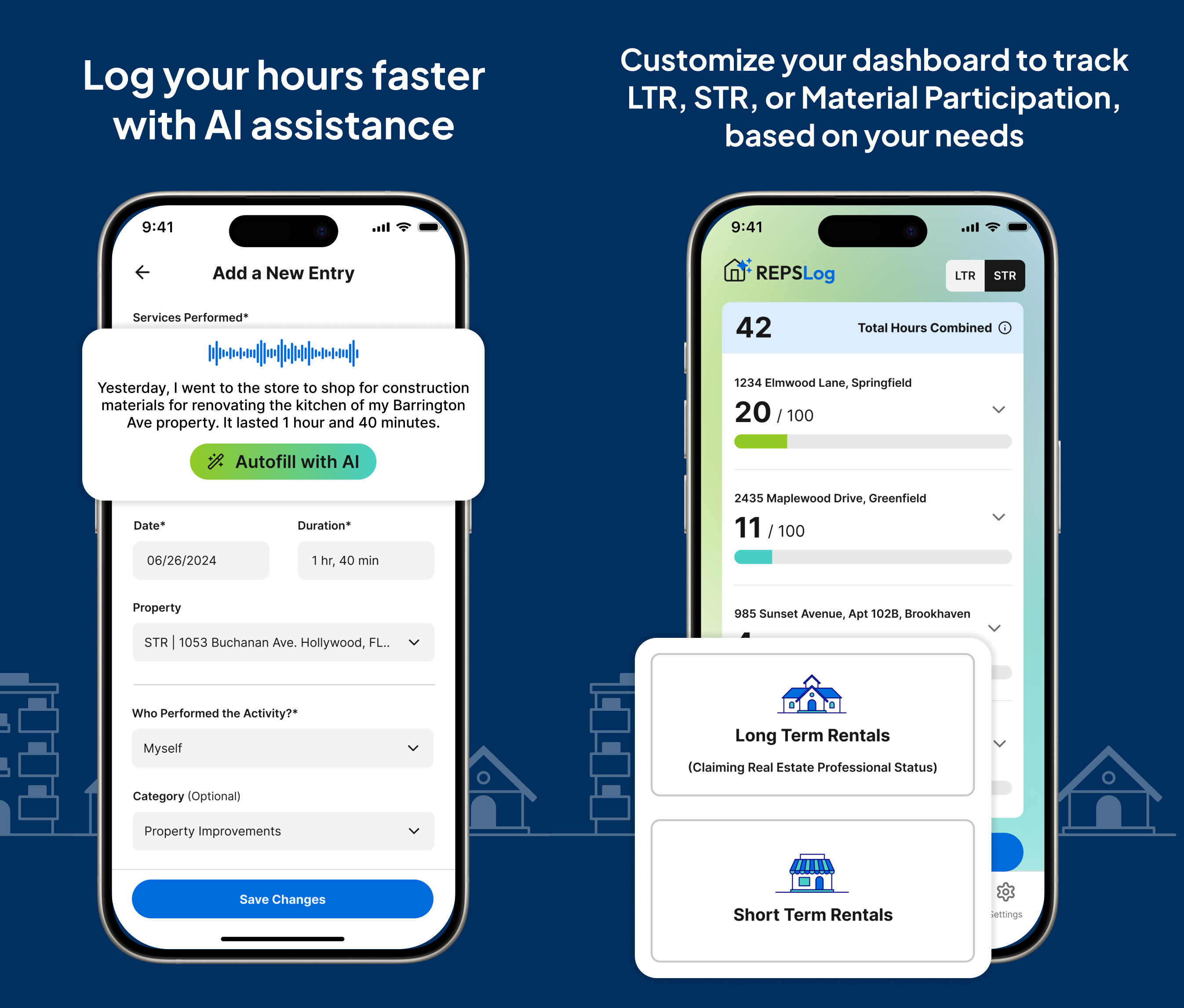
REPSLog gives you real-time visibility into your progress. Tag activities by property, track hours on your replacement property from day one, and export year-end reports showing exactly how you met both REPS tests. When your CPA is coordinating the exchange with your REPS qualification, your REPSLog data makes their job easier and your position stronger.
Available on iOS and Android, or on the web at app.reps-log.com. Start tracking your hours free →
This article is for educational purposes only and does not constitute tax or legal advice. Consult a qualified tax professional for guidance tailored to your situation.
Do this in REPSLog
- REPS Hour Tracking Goals (750 / 500 / 100): pick the 750, 500 or 100-hour test and watch progress per year and per property.
- Entry logging: what, when, how long, which property, with evidence, in one form.
- CPA-ready Export (PDF and CSV): a tax year as PDF and CSV, split by LTR and STR, with receipts.
Step by step in the Help Center: how to use it. Try REPSLog free for 14 days on iPhone, Android or the web app.