If you claim Real Estate Professional Status (REPS) on your tax return, you should operate under the assumption that the IRS may one day ask you to prove it. REPS claims are among the most frequently audited positions in individual tax returns, and the reason is straightforward: REPS allows taxpayers to deduct large rental losses against W-2 wages and other active income, which is exactly the kind of aggressive-looking deduction that draws scrutiny.
The good news is that surviving a REPS audit is entirely within your control. The IRS is not looking to trick you or catch you in a technicality. They want to see evidence that you genuinely spent more than 750 hours in real property trades or businesses, that real estate constituted more than half of your professional activity, and that you materially participated in the rental activities generating the losses. If you did the work and documented it properly, an audit is a procedural exercise, not an existential threat.
This guide walks through what triggers a REPS audit, what the IRS asks for, how to respond effectively, and the common mistakes that cause taxpayers to lose their claims.
What Triggers a REPS Audit?
The IRS uses both automated screening (the Discriminant Function System, or DIF score) and manual review to select returns for audit. Several factors make REPS claims more likely to be flagged:
High W-2 Income Combined with Large Rental Losses
This is the single biggest trigger. A taxpayer earning $400,000 in W-2 income who claims $150,000 in rental losses stands out in any automated screening. The IRS knows that a full-time employee logging 2,000+ hours at their job faces a very difficult more-than-half test, and the magnitude of the deduction makes the return worth examining.
Inconsistent Year-to-Year Patterns
Claiming REPS intermittently — qualifying one year, not the next, then qualifying again — can suggest that the taxpayer is manipulating their hours to match their tax needs. Consistent qualification year after year is more credible.
Round Numbers in Hour Logs
A log showing exactly 800 hours with entries like “property management — 4 hours” every Saturday for 50 weeks looks fabricated. The IRS examiner knows that real work does not come in perfectly round numbers and perfectly consistent patterns.
Large Depreciation Deductions
Cost segregation studies and bonus depreciation create large first-year deductions that increase the overall loss from rental activities. Larger losses mean larger tax savings, which means higher audit priority.
Certain Professional Profiles
Doctors, lawyers, executives, and other high-income professionals who claim REPS receive particular attention. The IRS assumes (often correctly) that these individuals work full-time in their primary profession, making the more-than-half test extremely difficult to pass.
What the IRS Asks For
When the IRS audits your REPS claim, the examination typically proceeds through several phases. Understanding what they want helps you prepare.
Phase 1: The Initial Information Document Request (IDR)
The IRS will send a letter (or your CPA will receive one) requesting specific documentation. Common requests include:
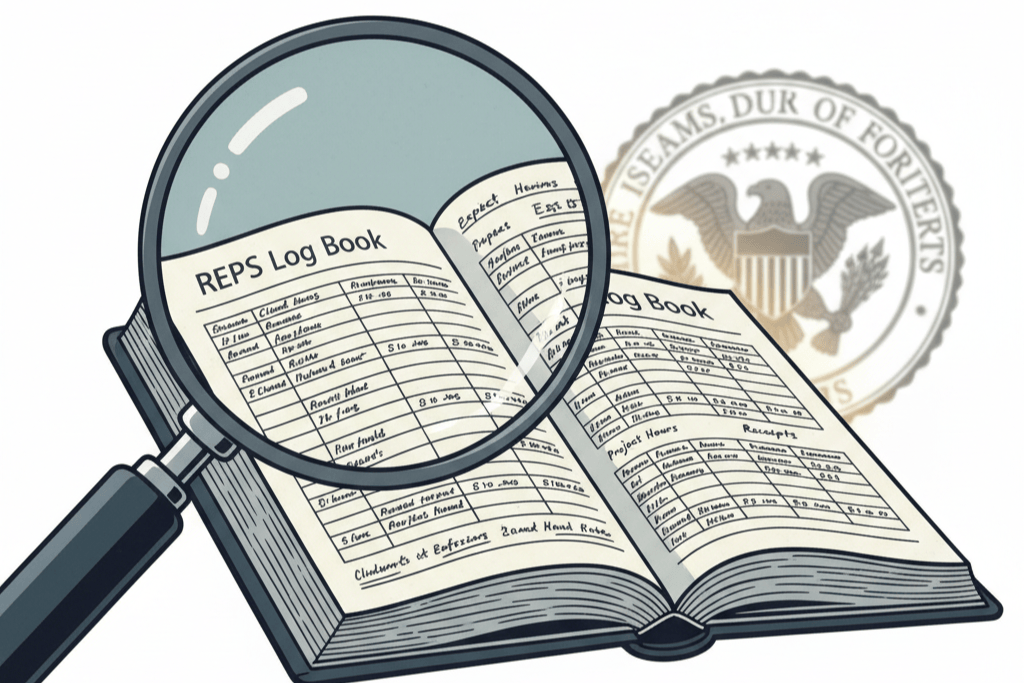
- Activity log or time records showing your real estate hours by date, activity, property, and duration
- Description of your real estate activities — what you do, how you spend your time, which properties you manage
- W-2s, 1099s, and other income documentation to establish your non-real-estate work hours
- Employment records if you have a W-2 job — your employer’s records of hours worked
- Property management agreements if you use a property manager
- Evidence of the properties — deeds, leases, mortgage statements
- Tax returns for the years under examination (they already have these, but may request copies)
Phase 2: The Examination Conference
After reviewing your initial submission, the examiner may schedule a conference (in person or virtual) to ask follow-up questions. Common topics include:
- Walk through a typical week: The examiner wants to hear you describe, in your own words, how you spend your time. They are looking for consistency between your description and your log entries.
- Specific entries: The examiner may point to particular log entries and ask you to explain what you did, why it took the recorded amount of time, and what the outcome was.
- Property management: If you use a property manager, the examiner will probe what you personally do versus what the manager handles. Hours that duplicate the property manager’s work are suspect.
- Non-real-estate work: How many hours do you work at your W-2 job? Do you work overtime? Do you have a side business? The examiner is calculating your more-than-half test.
Phase 3: Third-Party Verification
The IRS may contact third parties to corroborate your claims:
- Employers: To verify your work schedule, hours, and any remote work arrangements
- Property managers: To confirm the scope of services they provide (and by implication, what you handle yourself)
- Contractors and vendors: To verify that you coordinated work as your log claims
- Tenants: In rare cases, to confirm your involvement in the property
How to Respond to a REPS Audit
Work with Your CPA or Tax Attorney
Do not represent yourself in an IRS audit unless you have significant experience with the process. Your CPA or tax attorney should handle communications with the examiner. They understand the process, know what to disclose and what to withhold, and can negotiate on your behalf.
If your CPA prepared the return, they can represent you under their preparer authority. A tax attorney provides the additional benefit of attorney-client privilege, which can be important if the audit uncovers issues beyond REPS.
Organize Your Documentation Before Responding
Do not send a disorganized pile of records. Present your documentation in a clear, professional format:
- Summary page: Total hours by category and property for the year, demonstrating that you exceed 750 hours and pass the more-than-half test
- Detailed log: Chronological entries with date, description, property, category, and duration
- Supporting evidence: Relevant receipts, emails, photos, contracts, or other corroborating documents organized by property
- Grouping election statement: A copy of the grouping election attached to your return under Treas. Reg. 1.469-9(g), if applicable
Provide What Is Requested — Nothing More
Answer the examiner’s questions directly and provide the requested documentation. Do not volunteer additional information, narrative explanations, or documents that were not requested. Your CPA or attorney will guide you on the appropriate scope of each response.
Be Consistent
Your log entries, your verbal descriptions, and your supporting evidence must tell the same story. Inconsistencies — even minor ones — erode credibility. If your log says you spent 3 hours inspecting 123 Main Street on March 15, you should be able to corroborate that with a calendar entry, a contractor email, a photo with metadata, or another piece of evidence.
Stay Professional
The examiner is doing their job. Being confrontational, evasive, or condescending never helps your case. Professional, organized, and responsive taxpayers receive better treatment than combative ones.
Common Mistakes That Lose REPS Audits
Reconstructed Logs
The most damaging thing you can present is a log that was clearly created after the fact. The IRS looks for signs of reconstruction:
- All entries in the same handwriting, ink, or digital format with identical timestamps
- Entries that are too uniform (always the same duration, always the same description)
- Logs that perfectly match the 750-hour threshold with no margin
- No log at all until the audit request arrived
Contemporaneous records — created at or near the time of the activity — are essential. The Tax Court has repeatedly sided with the IRS when taxpayers presented reconstructed logs, even when the taxpayer genuinely performed the work.
Vague Descriptions
“Property management — 3 hours” tells the examiner nothing. It could mean anything from hands-on renovation work to sitting on the couch thinking about your properties. Specific descriptions like “met plumber at 456 Oak Avenue to assess kitchen faucet leak, reviewed estimate, authorized repair” are credible and verifiable.
Counting Non-Qualifying Hours
Not all real-estate-adjacent activity counts toward REPS. Reading real estate blogs, attending networking events with no specific property purpose, and general “research” without a connection to your properties are commonly disallowed. Investment analysis and deal evaluation count, but passive consumption of information generally does not.
Ignoring the More-Than-Half Test
Many taxpayers focus exclusively on the 750-hour requirement and forget that they must also spend more than half of their total professional hours in real estate. If you work a W-2 job for 1,800 hours, you need more than 1,800 real estate hours — not just 751.
Double-Counting Hours
If you use a property manager and also claim hours for the same tasks the manager performs, the examiner will catch this. Your hours should reflect work you personally performed that is distinct from your manager’s responsibilities.
Failing to Document the Spouse Correctly
On a joint return, only one spouse needs to qualify for REPS. But that spouse must meet both tests independently — you cannot combine spousal hours for the 750-hour or more-than-half tests. However, spouses can combine hours for material participation under IRC Section 469(h)(5). Mixing up these rules is a common audit failure.
Building an Audit-Proof Documentation System
The best audit defense is a system you maintain throughout the year, not a pile of records you assemble after receiving an audit notice.
Log Daily or Weekly
The closer in time your log entries are to the actual activities, the more credible they are. Daily logging is ideal. Weekly is acceptable. Monthly summaries are risky. Annual reconstructions are indefensible.
Be Specific in Every Entry
Every log entry should answer four questions:
- What did you do? (Specific activity description)
- Where did you do it? (Which property or properties)
- When did you do it? (Date and approximate time)
- How long did it take? (Duration in hours and minutes)
Keep Corroborating Evidence
Your log is the primary record, but corroborating evidence strengthens it enormously:
- Emails to/from contractors, tenants, and property managers
- Photos of work in progress (with metadata showing date and location)
- Receipts and invoices for materials and services
- Calendar entries showing property-related appointments
- GPS data showing travel to properties
- Bank and credit card statements showing property-related purchases
Track Non-Real-Estate Hours Too
To defend the more-than-half test, you need to know your total professional hours across all activities. Track your W-2 job hours, any side business hours, and any other professional activities so you can demonstrate that real estate hours exceed the total.
Export Regular Reports
Generate monthly or quarterly summaries from your tracking system. These create a paper trail showing that you were monitoring your progress throughout the year, not fabricating records at year-end.
Frequently Asked Questions
How likely is it that my REPS claim will be audited?
Overall individual audit rates are relatively low (under 1% for most income levels), but REPS claims with large rental losses and high W-2 income face significantly higher odds. The exact probability depends on your specific return profile, but treating the possibility as a certainty in terms of documentation preparedness is the prudent approach.
What happens if I lose the REPS audit?
The IRS reclassifies your rental losses as passive. You lose the deductions against your active income for the years under examination. You will owe back taxes plus interest, and potentially accuracy-related penalties (typically 20% of the underpayment). If the IRS determines the claim was fraudulent, civil fraud penalties (75%) or criminal prosecution are possible, though this is rare for honest mistakes.
Can I appeal an IRS audit decision?
Yes. If you disagree with the examiner’s findings, you can request a conference with the IRS Appeals division before the case goes to Tax Court. Appeals conferences often result in settlements that are more favorable than the initial examination result.
Does using a property manager disqualify me from REPS?
No, but it changes the analysis. You can still qualify if you perform substantial work beyond what the property manager handles — oversight, strategic decisions, tenant selection, renovation management, acquisition analysis, and similar activities. The examiner will scrutinize the division of labor.
How far back can the IRS audit my REPS claim?
Generally, the IRS has three years from the date you filed your return (or the due date, whichever is later) to initiate an audit. If they find a substantial understatement (more than 25% of gross income), the window extends to six years. Fraud has no statute of limitations.
What if I genuinely did the work but have poor documentation?
This is the most common and most frustrating scenario. The Tax Court has generally been unsympathetic to taxpayers who performed qualifying work but failed to keep adequate records. Some taxpayers have partially prevailed by presenting indirect evidence (contractor testimony, email records, financial records), but the burden of proof is on you, and inadequate documentation dramatically weakens your position.
Should I get an audit defense insurance policy?
Some tax professionals and insurance companies offer audit defense coverage that pays for CPA or attorney representation if you are audited. These policies can be worthwhile for REPS-claiming investors given the higher audit probability and the cost of professional representation.

Key Takeaways
- REPS claims are high-audit-risk, especially when combined with high W-2 income and large rental losses
- Contemporaneous, specific documentation is the single most important factor in surviving an audit
- Work with your CPA or tax attorney — do not represent yourself in an IRS examination
- Present organized, professional documentation with summaries, detailed logs, and corroborating evidence
- Avoid the classic pitfalls: reconstructed logs, vague descriptions, round numbers, and double-counted hours
- The more-than-half test is just as important as the 750-hour requirement — track all professional hours
- Build your documentation system now, not after you receive an audit notice
How REPSLog Prepares You for an Audit Before One Happens
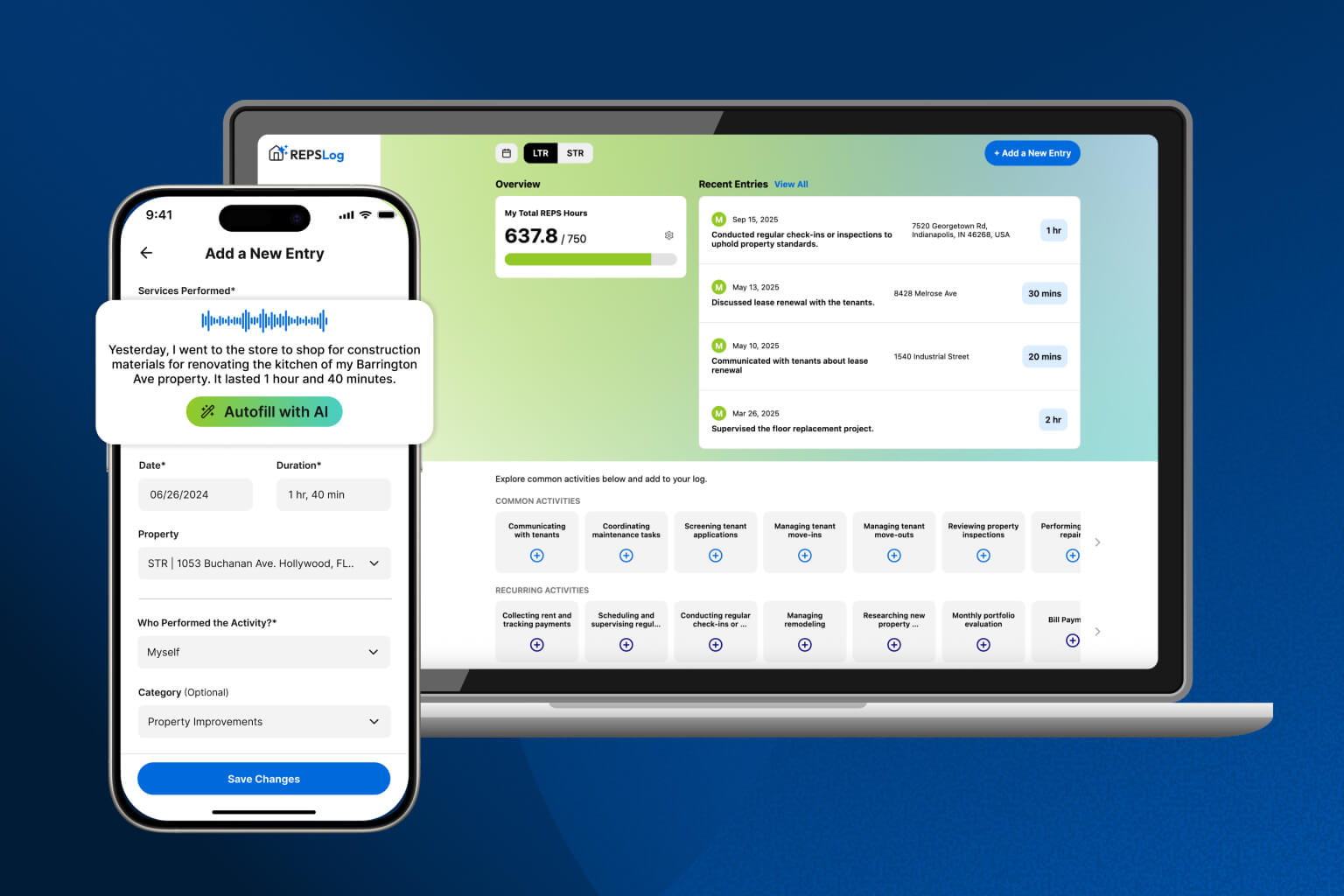
The best time to prepare for an IRS audit is every day of the year you are claiming REPS. REPSLog is built for exactly this purpose. Log entries in seconds with timestamps, property tags, activity categories, and detailed descriptions. Track your progress toward the 750-hour threshold and the more-than-half test in real time. Export comprehensive reports formatted for your CPA or an IRS examiner.
When the audit notice arrives, your REPSLog records provide the contemporaneous, specific, and consistent documentation that the IRS — and the Tax Court — expect to see. No reconstruction. No guesswork. Just a clear record of the work you did, when you did it, and for which properties.
Available on iOS and Android, or on the web at app.reps-log.com. Start tracking your hours free →
This article is for educational purposes only and does not constitute tax or legal advice. Consult a qualified tax professional for guidance tailored to your situation.
Do this in REPSLog
- Evidence Attachments: attach receipts, invoices and photos to any entry.
- Backdate Entries: log past work on the date it happened, back to 2020.
- CPA-ready Export (PDF and CSV): a tax year as PDF and CSV, split by LTR and STR, with receipts.
Step by step in the Help Center: how to use it. Try REPSLog free for 14 days on iPhone, Android or the web app.