Most discussions about Real Estate Professional Status (REPS) focus on the challenge of qualifying while holding a full-time W-2 job. And that challenge is real — the more-than-half test requires your real estate hours to exceed all other professional hours combined, which can be nearly impossible when you are logging 2,000+ hours at an employer.
But there is a group of investors for whom REPS qualification becomes dramatically easier: retirees. If you have left the traditional workforce and own rental properties, the math shifts decisively in your favor. Without W-2 hours competing against your real estate hours, the more-than-half test becomes almost trivial. You only need to meet the 750-hour threshold and demonstrate material participation — both of which are highly achievable for an engaged rental property owner.
This guide explains why retirement is one of the best positions from which to claim REPS, how retirees can structure their real estate activities to qualify, and why the tax savings can be particularly meaningful in retirement.
Why Retirement Changes the REPS Math
REPS requires two time-based tests in the same tax year:
- The 750-Hour Test: You must spend more than 750 hours in real property trades or businesses in which you materially participate
- The More-Than-Half Test: More than half of your total personal services performed during the year must be in real property trades or businesses
For someone with a full-time W-2 job logging 2,000 hours per year, the more-than-half test demands more than 2,000 hours of real estate work. That is a second full-time job on top of the first.
For a retiree with no W-2 employment, no active business, and no other professional obligations, the more-than-half test requires only that your real estate hours exceed your non-real-estate professional hours. If you have zero non-real-estate professional hours, any amount of real estate work satisfies the more-than-half test.
This means a retiree’s sole binding constraint is the 750-hour requirement. And 750 hours across a 52-week year is roughly 14.4 hours per week — well within reach for anyone actively managing rental properties.
What Counts as “Personal Services” for the More-Than-Half Test
A common misconception is that all activities you perform during retirement count toward the denominator of the more-than-half test. That is not correct. The test considers “personal services performed in trades or businesses” — not hobbies, leisure, or personal activities.
Activities that do NOT count toward the denominator:
- Golf, travel, recreation, and hobbies
- Volunteering and charitable work (unless structured as a trade or business)
- Personal financial management (managing your own stock portfolio is generally not a trade or business)
- Household activities
Activities that DO count toward the denominator:
- Any compensated work (consulting, part-time employment, freelancing)
- Operating any business, even part-time
- Board memberships that constitute a trade or business
- Any other trade or business activity as defined under the tax code
For a fully retired individual with no consulting gigs, no part-time work, and no other business activities, the denominator of the more-than-half test may be zero (or close to it). In this scenario, any real estate hours easily satisfy the test.
The Part-Time Retirement Scenario
Many retirees do not fully stop working. They may consult, serve on boards, teach part-time, or run a small side business. This does not disqualify you from REPS, but it changes the math.
If you consult 10 hours per week (520 hours per year), you need more than 520 hours of real estate work plus at least 751 hours total. Since 751 exceeds 520, meeting the 750-hour test automatically satisfies the more-than-half test in this scenario.
The key is to track both your real estate hours and your non-real-estate professional hours so you can demonstrate compliance with both tests.
Where Retirees Find 750+ Hours
Accumulating more than 750 hours of qualifying real estate activity over a full year is manageable for most retirees who own rental properties and are actively involved in managing them. Here is how the hours typically break down:
Property Management Activities
- Visiting and inspecting properties
- Coordinating maintenance and repairs
- Communicating with tenants about issues, renewals, and concerns
- Handling move-ins and move-outs
- Reviewing and paying property-related bills
- Managing landscaping and seasonal maintenance
- Monitoring security and safety systems
Financial and Administrative Activities
- Bookkeeping and accounting for rental activities
- Reviewing financial statements and cash flow
- Managing property insurance policies
- Handling property tax matters and appeals
- Preparing documentation for your CPA at tax time
Tenant Management
- Marketing vacancies and listing properties
- Screening tenant applications
- Conducting showings
- Negotiating and drafting leases
- Addressing tenant complaints and requests
- Managing eviction processes when necessary
Acquisition and Disposition Activities
- Researching potential new acquisitions
- Performing due diligence on properties you are considering
- Attending property tours and inspections
- Analyzing deals and financial projections
- Working with brokers, attorneys, and lenders on transactions
Improvement and Renovation Activities
- Planning and managing renovation projects
- Meeting with contractors and reviewing bids
- Overseeing construction and rehab work
- Selecting materials and finishes
- Inspecting completed work
Education and Professional Development
- Attending real estate investing seminars and courses directly related to your properties
- Studying market trends and rental rate analysis for your market
- Consulting with real estate attorneys, CPAs, and advisors about your portfolio
Example: A Retiree with 4 Rental Properties
Consider a retiree who owns four single-family rental homes. A realistic annual hour allocation might look like:
| Activity | Hours/Month | Annual Hours |
|---|---|---|
| Property visits and inspections | 6 | 72 |
| Maintenance coordination | 8 | 96 |
| Tenant communications | 5 | 60 |
| Bookkeeping and financial review | 6 | 72 |
| Tenant turnover (showing, screening, leasing) | 8 | 96 |
| Research and deal analysis | 10 | 120 |
| Travel to/from properties | 8 | 96 |
| Insurance, tax, and legal matters | 4 | 48 |
| Renovation and improvement oversight | 10 | 120 |
| Market research and education | 6 | 72 |
| Total | 71 | 852 |
This retiree comfortably exceeds 750 hours with a realistic level of engagement. And this example does not include any major renovation projects, new acquisitions, or other activities that would add substantially to the total.
The Tax Benefits of REPS in Retirement
Offsetting Retirement Income
Retirees often have taxable income from multiple sources:
- Social Security benefits (up to 85% may be taxable)
- IRA and 401(k) distributions (fully taxable for traditional accounts)
- Pension income
- Investment income (dividends, interest, capital gains)
- Rental income (net operating income from properties)
Without REPS, rental losses are passive and can only offset passive income. With REPS and material participation, rental losses — driven primarily by depreciation — can offset all of the income sources listed above.
The Depreciation Advantage
Even if your rental properties are cash-flow positive (generating more income than expenses), depreciation creates a paper loss on your tax return. A retiree with four properties, each with a $200,000 depreciable basis, generates roughly $29,000 in annual depreciation ($800,000 / 27.5). With cost segregation, first-year depreciation could be significantly higher.
Under REPS, this depreciation reduces taxable income from all sources. For a retiree in the 24% federal bracket, $29,000 in depreciation saves roughly $7,000 in federal taxes — and potentially more in state taxes.
Reducing Social Security Taxation
Here is a benefit many retirees overlook: rental losses from REPS-qualifying activities can reduce your adjusted gross income (AGI), which in turn can reduce the portion of your Social Security benefits that is subject to tax. Since up to 85% of Social Security can be taxable depending on your combined income, reducing AGI through rental losses provides a double benefit.
IRA Distribution Planning
Retirees who must take required minimum distributions (RMDs) from traditional IRAs and 401(k)s face guaranteed taxable income each year. REPS-qualified rental losses can offset this income, effectively making your RMDs less painful from a tax perspective.
Structuring Your Retirement for REPS Success
Self-Manage Your Properties
Retirees who use full-service property managers face a documentation challenge: the IRS will scrutinize what work you personally performed versus what the manager handled. While using a property manager does not disqualify you, it reduces your available qualifying hours and creates questions about duplicative effort.
Self-management is ideal for REPS-seeking retirees. You have the time, you eliminate management fees (typically 8-12% of rental income), and your hours accumulate naturally.
If you prefer some management support, consider using a property manager for specific tasks (tenant placement, maintenance dispatch) while retaining the strategic and oversight functions yourself. Document clearly which responsibilities are yours.
Maintain a Consistent Portfolio
REPS is a year-by-year qualification. Having a stable portfolio of properties provides consistent activity and hours. Selling properties reduces your available hours; acquiring new ones adds them. Plan portfolio changes with your REPS qualification in mind.
Keep Your Non-Real-Estate Activities Low
The more-than-half test is rarely binding for fully retired individuals, but it becomes relevant if you take on significant consulting, part-time work, or other business activities. Before committing to non-real-estate professional activities, calculate the impact on your more-than-half test.
Consider the Grouping Election
Under Treas. Reg. 1.469-9(g), you can elect to treat all of your rental properties as a single activity for material participation purposes. This means you only need to prove material participation once across your entire portfolio, rather than for each property individually.
For retirees with multiple properties, this simplifies documentation and makes it easier to demonstrate more than 500 hours (or meet another material participation test) across the grouped activity.
Start Logging From Day One of Retirement
If you are transitioning from a W-2 job to retirement, the year you retire may be a split year — part of the year working, part retired. Your REPS qualification must cover the full tax year. Plan your real estate hours carefully to ensure you meet both tests for the entire 12 months.
Spousal Considerations in Retirement
If both spouses are retired, only one needs to qualify as a real estate professional. The qualifying spouse must independently meet the more-than-750-hour and more-than-half tests.
However, for material participation on individual properties (or a grouped election), spouses can combine their hours under IRC Section 469(h)(5). This means both retired spouses can contribute to the material participation requirement, making it even easier to satisfy.
Strategy for Couples
In many retired couples, one spouse takes the lead on property management while the other contributes supplementary hours. The lead spouse qualifies as the real estate professional, and both spouses’ hours count toward material participation on the properties.
This division of labor works well as long as the qualifying spouse’s hours are properly documented and clearly exceed the 750-hour threshold and any non-real-estate professional hours.
Frequently Asked Questions
I am fully retired with no other income besides rentals and Social Security. Can I claim REPS?
Yes, and retirement makes qualification easier. With no W-2 or business hours, the more-than-half test is effectively automatic. You only need to meet the 750-hour requirement and demonstrate material participation in your rental activities.
Does volunteer work count against me in the more-than-half test?
Generally, no. Volunteer work for charitable organizations is not a trade or business, so it does not count as “personal services in trades or businesses” for the more-than-half test. However, if your volunteer role involves business-like responsibilities (e.g., serving as a managing officer), consult your CPA.
Can I count hours spent on properties I own but do not rent out?
Hours on properties held for investment purposes (such as land you are holding for development or a property you are renovating for resale) can count toward the 750-hour requirement if the activity qualifies as a real property trade or business. However, material participation must be demonstrated on the rental activities specifically (or through a grouping election) for the rental losses to be deductible.
I retired mid-year. Can I qualify for REPS in my retirement year?
Yes, but you must meet both tests for the full tax year. Your W-2 hours from January through your retirement date count toward the denominator of the more-than-half test. You need enough real estate hours for the full year to exceed those W-2 hours and also exceed 750 hours total.
Do IRA distributions count as personal services for the more-than-half test?
No. IRA and 401(k) distributions are investment income, not compensation for personal services in a trade or business. They do not factor into the more-than-half test at all.
How many rental properties do I need to qualify for REPS?
There is no minimum number. You could qualify with a single property if you are actively managing it and accumulating more than 750 hours of qualifying real estate activity. However, more properties generally make it easier to accumulate hours and create more depreciation to unlock.
Can I qualify for REPS if I use a property management company?
Yes, but your hours must reflect work you personally perform that is separate from the property manager’s duties. The IRS will scrutinize this closely. Retirees who self-manage avoid this complication entirely.
Key Takeaways
- Retirement eliminates the biggest barrier to REPS — the more-than-half test becomes easy or automatic without W-2 hours
- Only the 750-hour test is binding for most fully retired investors, and 750 hours equals roughly 14-15 hours per week
- REPS rental losses can offset retirement income including Social Security, IRA/401(k) distributions, pensions, and investment income
- Self-managing properties is ideal for retired REPS investors — it maximizes qualifying hours and eliminates management fees
- The grouping election under Treas. Reg. 1.469-9(g) simplifies material participation across multiple properties
- Spousal hours combine for material participation under IRC Section 469(h)(5), but each spouse must qualify for REPS independently
- Start documenting from day one of retirement, especially in a split year
How REPSLog Makes Retirement REPS Tracking Effortless
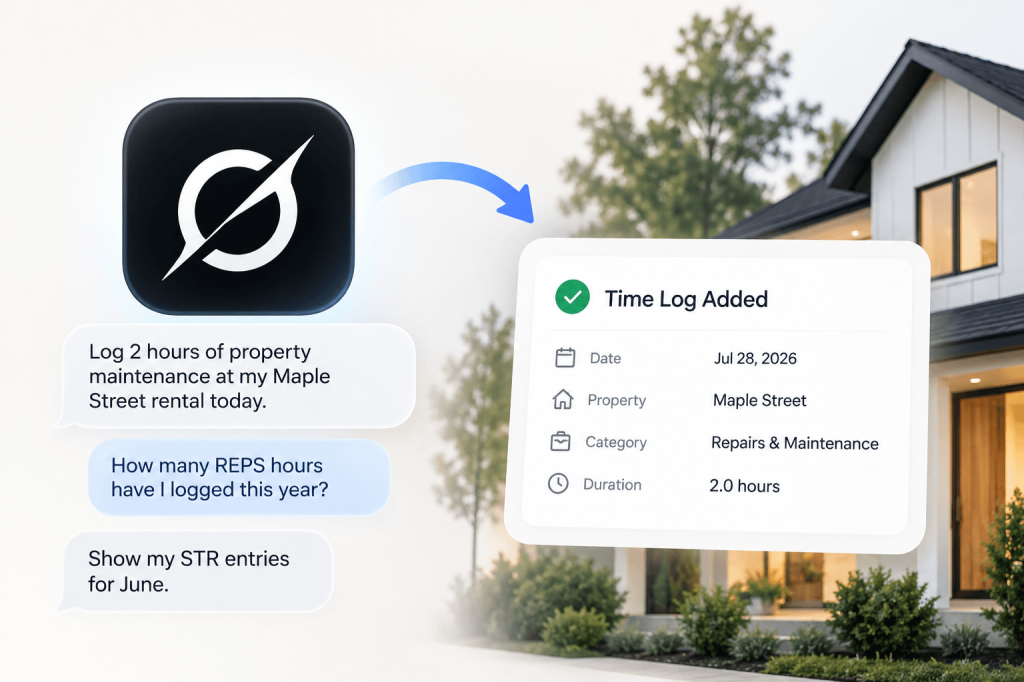
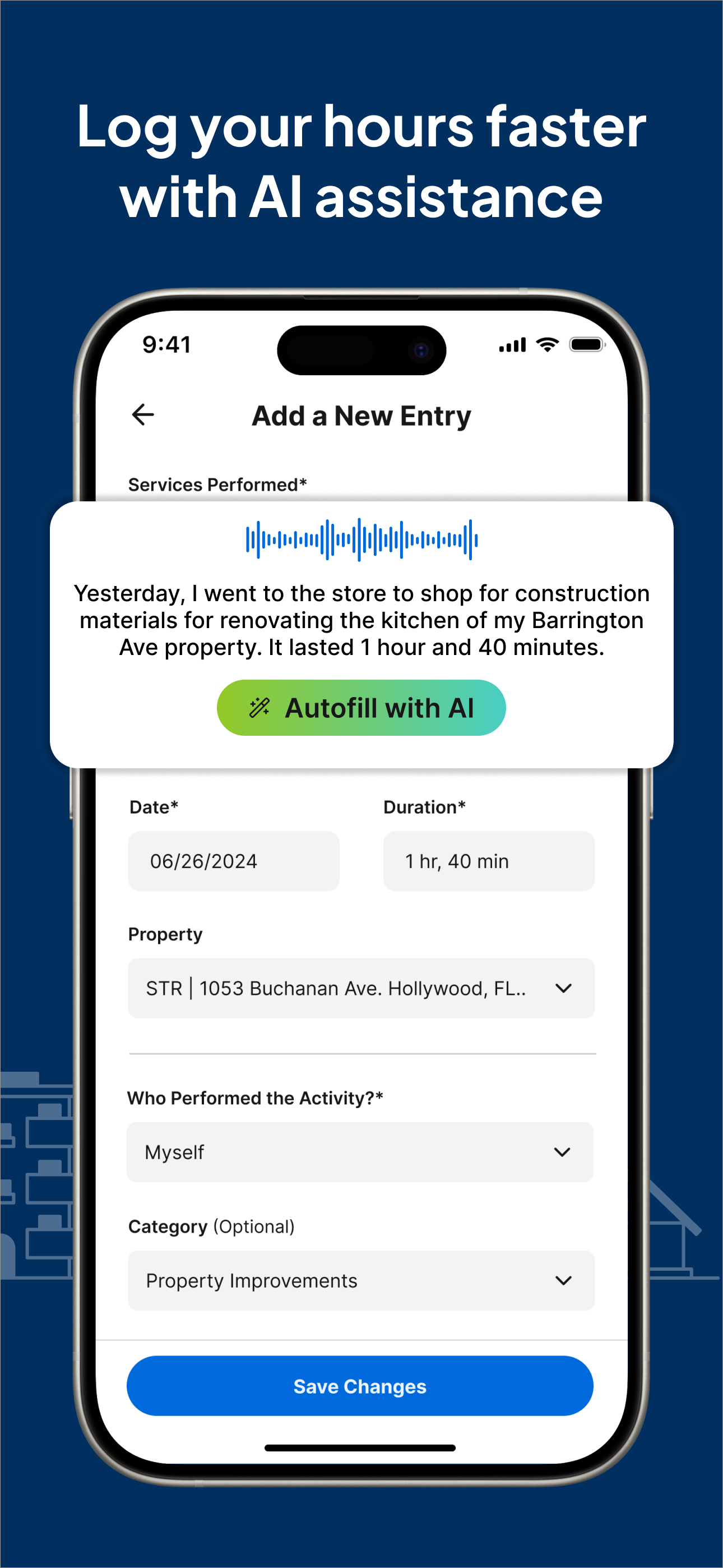
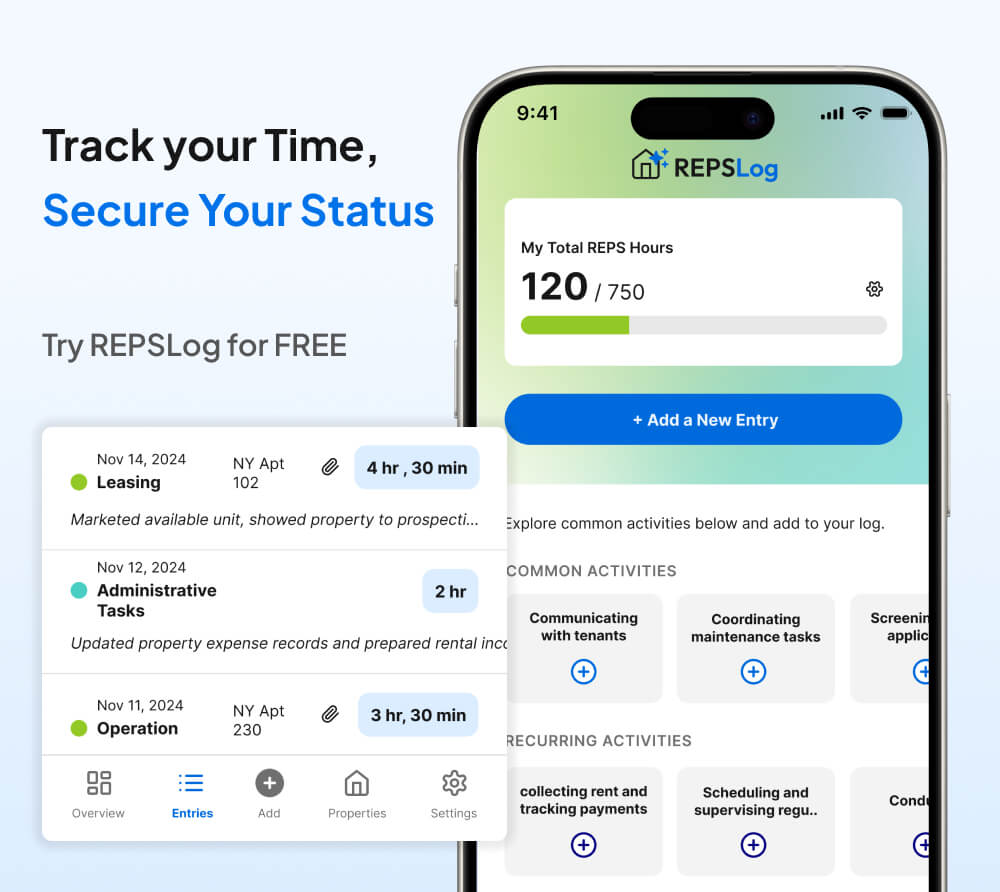
Retirement should be about spending time on the things that matter — including managing your real estate portfolio. REPSLog makes the documentation side effortless. Log entries in seconds from your phone, tablet, or computer. Track your hours against the 750-hour threshold in real time. Categorize activities by property and type. Generate audit-ready reports for your CPA at tax time.
You are already doing the work. REPSLog ensures the IRS knows it too.
Available on iOS and Android, or on the web at app.reps-log.com. Start tracking your hours free →
This article is for educational purposes only and does not constitute tax or legal advice. Consult a qualified tax professional for guidance tailored to your situation.
Do this in REPSLog
- REPS Hour Tracking Goals (750 / 500 / 100): pick the 750, 500 or 100-hour test and watch progress per year and per property.
- Hours Dashboard and Stats: hours by property, category and year against your goal.
- Built-in Timer with Live Activity: time an activity live and drop the minutes into an entry.
Step by step in the Help Center: how to use it. Try REPSLog free for 14 days on iPhone, Android or the web app.