If you own short-term rental properties listed on Airbnb, VRBO, or similar platforms, you have access to two distinct strategies for deducting rental losses against your active income: Real Estate Professional Status (REPS) and the short-term rental (STR) loophole. Both can unlock significant tax savings, but they work through different mechanisms, have different qualification requirements, and are suited to different investor profiles.
New to the STR loophole? Start with our STR loophole guide. Weighing the two strategies? See REPS vs STR loophole.
Choosing the right path, or deciding to pursue both simultaneously, is one of the most consequential tax decisions a short-term rental owner can make. This guide explains how each strategy works for STR hosts, when you need REPS versus when the STR loophole is sufficient, and how the two interact.
The STR Loophole: A Quick Review
Under IRS rules, a rental activity is generally treated as passive, which means losses can only offset passive income. However, there is an exception for properties where the average guest stay is 7 days or less. These short-term rental activities are not treated as rental activities for purposes of the passive activity rules under IRC Section 469. They are treated as regular trades or businesses.
The practical consequence is significant: if you materially participate in a short-term rental that qualifies under this rule, your losses are non-passive. They can offset W-2 wages, business income, capital gains, and any other active income.
STR Loophole Qualification Requirements
- Average stay of 7 days or less: Calculate the average guest stay across all bookings for the property during the tax year. If the average is 7 days or less, the property qualifies.
- Material participation: You must materially participate in the STR activity. The most commonly used tests are: more than 500 hours of participation during the year; more than 100 hours of participation, and no other individual participated more than you; or substantially all of the participation in the activity was performed by you
- No REPS required: This is the critical distinction. The STR loophole does not require you to be a real estate professional. You do not need to meet the 750-hour or more-than-half tests.
REPS: What It Adds for STR Owners
REPS requires meeting two additional tests:
- More than 750 hours in real property trades or businesses in which you materially participate
- More than half of your total personal services during the year must be in real property trades or businesses
If you already qualify under the STR loophole, why would you pursue REPS? There are several reasons.
Covering Long-Term Rentals in a Mixed Portfolio
The STR loophole only applies to properties with an average stay of 7 days or less. If you own a mix of short-term and long-term rental properties, the STR loophole covers your short-term rentals but leaves your long-term rental losses passive.
REPS covers everything. When you qualify as a real estate professional and materially participate (or make a grouping election under Treas. Reg. 1.469-9(g)), all of your rental activities, short-term and long-term, produce non-passive losses.
Properties with Average Stays Exceeding 7 Days
Some STR properties do not qualify under the 7-day rule. If your market caters to longer stays (30-day corporate housing, seasonal rentals with month-long bookings, or vacation rentals that frequently see 10-day reservations), your average stay may exceed 7 days. In that case, the STR loophole does not apply, and REPS is your only path to non-passive treatment.
There is a nuance here: properties with average stays between 7 and 30 days fall into a middle category. If significant personal services are provided (concierge, daily cleaning, meals), the activity may still avoid passive classification. But this is a fact-specific determination that requires careful analysis with your CPA.
Belt-and-Suspenders Protection
Tax law is subject to change, and the STR loophole, while well-established, is based on regulatory interpretation rather than explicit statutory language. Some tax professionals recommend qualifying for REPS as a backup position, so that even if the STR loophole is challenged or modified, you have an independent basis for non-passive treatment.
Future Portfolio Changes
If you plan to expand into long-term rentals, develop properties, or diversify your real estate activities, having REPS in place provides flexibility. You do not need to restructure your tax strategy every time your portfolio composition changes.
When the STR Loophole Is Enough
For many short-term rental hosts, the STR loophole alone provides everything they need. You likely do not need REPS if:
- All of your rental properties are short-term with average stays of 7 days or less
- You have a full-time W-2 job that makes the more-than-half test impossible (you would need more hours in real estate than your job hours)
- You materially participate in each STR property (or group them)
- You have no plans to add long-term rentals to your portfolio
In this scenario, REPS qualification is unnecessary overhead. The STR loophole provides non-passive treatment for all of your rental losses, and you avoid the documentation burden of tracking hours against the 750-hour and more-than-half tests.
When You Need REPS
You should pursue REPS in addition to (or instead of) the STR loophole if:
- You own a mix of short-term and long-term rentals: REPS covers the long-term properties that the STR loophole cannot reach
- Your average stays exceed 7 days on some or all properties
- You are a full-time real estate investor with no W-2 job, making the more-than-half test easy
- You or your spouse can dedicate the hours to meet both the 750-hour and more-than-half requirements
- You want maximum audit protection with both qualifications available
Material Participation for STR Hosts
Whether you pursue the STR loophole, REPS, or both, material participation is required for each rental activity (or for a grouped activity). For STR hosts, material participation hours come from a wide range of activities:
Guest Management
- Responding to booking inquiries and messages
- Communicating with guests before, during, and after stays
- Handling guest complaints and resolving issues
- Managing reviews and responding to feedback
- Processing bookings, cancellations, and modifications
Property Operations
- Coordinating cleaning and turnover between guests
- Inspecting properties before guest arrivals
- Managing supplies and inventory (linens, toiletries, kitchen items)
- Handling maintenance and repair issues
- Updating listings with photos, descriptions, and pricing
Pricing and Revenue Management
- Monitoring market rates and competitor pricing
- Adjusting nightly rates based on demand
- Managing seasonal pricing strategies
- Analyzing booking patterns and occupancy rates
- Optimizing listing placement and search ranking
Regulatory and Administrative
- Maintaining compliance with local STR regulations
- Managing permits and licenses
- Handling tax remittances (occupancy tax, sales tax)
- Managing bookkeeping and financial records
- Coordinating with your CPA on STR-specific tax issues
Travel to Properties
- Driving to properties for inspections, turnovers, or maintenance
- Visiting potential new STR acquisitions
- Meeting with contractors, vendors, or local contacts
For a busy STR with 200+ nights booked per year, it is common for an active host to accumulate 300-600 hours per property. Multiple properties can easily push total hours above the 750-hour threshold needed for REPS.
Spousal Strategies for STR Households
For the STR Loophole
Both spouses can contribute hours toward material participation on an STR property under IRC Section 469(h)(5). If one spouse handles guest communications and the other manages turnovers and maintenance, their combined hours count toward the material participation tests.
For REPS
Only one spouse needs to qualify as a real estate professional, but that spouse must independently meet the more-than-750-hour and more-than-half tests. You cannot combine spousal hours for REPS qualification.
This creates a common strategy for STR-owning households:
- One spouse qualifies for REPS (typically the spouse without a full-time W-2 job)
- Both spouses contribute hours toward material participation on each property
- All rental losses (short-term and long-term) become non-passive on the joint return
The Stay-at-Home Spouse STR Strategy
A stay-at-home parent who manages Airbnb properties is an ideal REPS candidate. With no W-2 hours competing in the more-than-half test, they only need 751+ hours of real estate activity. Managing a few active STR properties easily generates this level of hours while providing a flexible schedule compatible with family responsibilities.
Cost Segregation and Bonus Depreciation for STR Properties
Short-term rental properties are particularly well-suited to cost segregation studies because they tend to have a higher percentage of personal property (furniture, appliances, electronics, decor) compared to long-term rentals. This means a larger share of the property’s basis can be reclassified into 5-year and 7-year recovery periods.
Combined with bonus depreciation (20% in 2026), cost segregation on an STR property can generate substantial first-year deductions. For an STR host who qualifies under either the STR loophole or REPS, these accelerated depreciation deductions create large paper losses that immediately offset active income.
Furnishings as a Separate Deduction
STR-specific purchases (furniture, bedding, kitchen equipment, smart home devices, outdoor furniture, hot tubs, recreational equipment) can be expensed under Section 179 or depreciated over their useful lives. These costs add to your deduction base beyond the building itself.
Documentation Requirements for STR Hosts
STR Loophole Documentation
To support the STR loophole, you need:
- Evidence of average stay length: Booking records from Airbnb, VRBO, or your direct booking platform showing each guest’s check-in and check-out dates. Calculate the weighted average stay for the year.
- Material participation log: Hours spent on STR activities by date, description, property, and duration.
REPS Documentation (if pursuing REPS)
In addition to the above:
- 750-hour log: Total hours in real property trades or businesses, potentially including activities beyond just STR management (acquisitions, development, other real estate work)
- More-than-half test calculation: Total real estate hours compared to total personal services in all trades or businesses
- Non-real-estate hour tracking: W-2 job hours, side business hours, and any other professional activities
Best Practices
- Log activities as they happen, not at year-end
- Be specific in descriptions (“cleaned and restocked Unit 2 after guest checkout, laundered 4 sets of linens, restocked bathroom supplies” not “property management”)
- Keep booking data exports from your platforms as supporting evidence
- Save guest communications that demonstrate your involvement
- Document pricing changes and the research behind them
Frequently Asked Questions
Can I use the STR loophole and REPS at the same time?
Yes. They are complementary strategies. You might use the STR loophole for your short-term rentals and REPS for your long-term rentals. Or you might qualify under both, providing redundant protection for your STR deductions.
What if my average stay is exactly 7 days?
The STR loophole requires an average stay of 7 days or LESS. If your average is exactly 7.0 days, you qualify. If it is 7.1 days, you do not. Track your bookings carefully and consider the impact of longer stays on your average.
Does self-check-in count against the STR loophole?
No. The 7-day average stay test is based on the duration of guest stays, not the level of service you provide. Self-check-in does not affect whether the activity is classified as an STR for this purpose.
Can I group my STR properties with my long-term rentals under a REPS grouping election?
Yes. Under Treas. Reg. 1.469-9(g), you can elect to treat all rental real estate activities as a single activity. This grouping covers both STR and long-term properties, simplifying your material participation requirement. Note that once made, the grouping election is generally binding for future years.
How do co-hosting hours count for material participation?
If you co-host with someone (a friend, family member, or co-hosting service), their hours do not count toward your material participation. Only your personal hours (and your spouse’s hours on a joint return) count. Additionally, for the more-than-100-hours test, you must have participated more than any other individual, including co-hosts.
Do hours managing my Airbnb listing count toward REPS?
Yes. Time spent managing listings, adjusting pricing, responding to inquiries, coordinating turnovers, and performing other STR management tasks all qualify as real property trade or business activities for REPS purposes.
What if I use a property management company for my STRs?
You can still qualify under both the STR loophole and REPS, but your hours must reflect work you personally perform beyond what the management company handles. The IRS will compare your claimed hours against the management company’s scope of services.

Key Takeaways
- The STR loophole provides non-passive treatment for properties with average stays of 7 days or less, without requiring REPS
- REPS adds value for mixed portfolios (STR + long-term), properties with longer average stays, and as backup protection
- Material participation is required under both paths: log your STR management hours consistently
- The more-than-half test is the main barrier to REPS for W-2 workers; the STR loophole bypasses this requirement entirely
- Stay-at-home spouses managing STRs are ideal REPS candidates: no competing W-2 hours
- Cost segregation is especially powerful for STRs due to higher personal property content (furnishings, appliances)
- Spousal hours combine for material participation under IRC Section 469(h)(5), but not for REPS qualification itself
How REPSLog Helps STR Hosts Track Every Hour
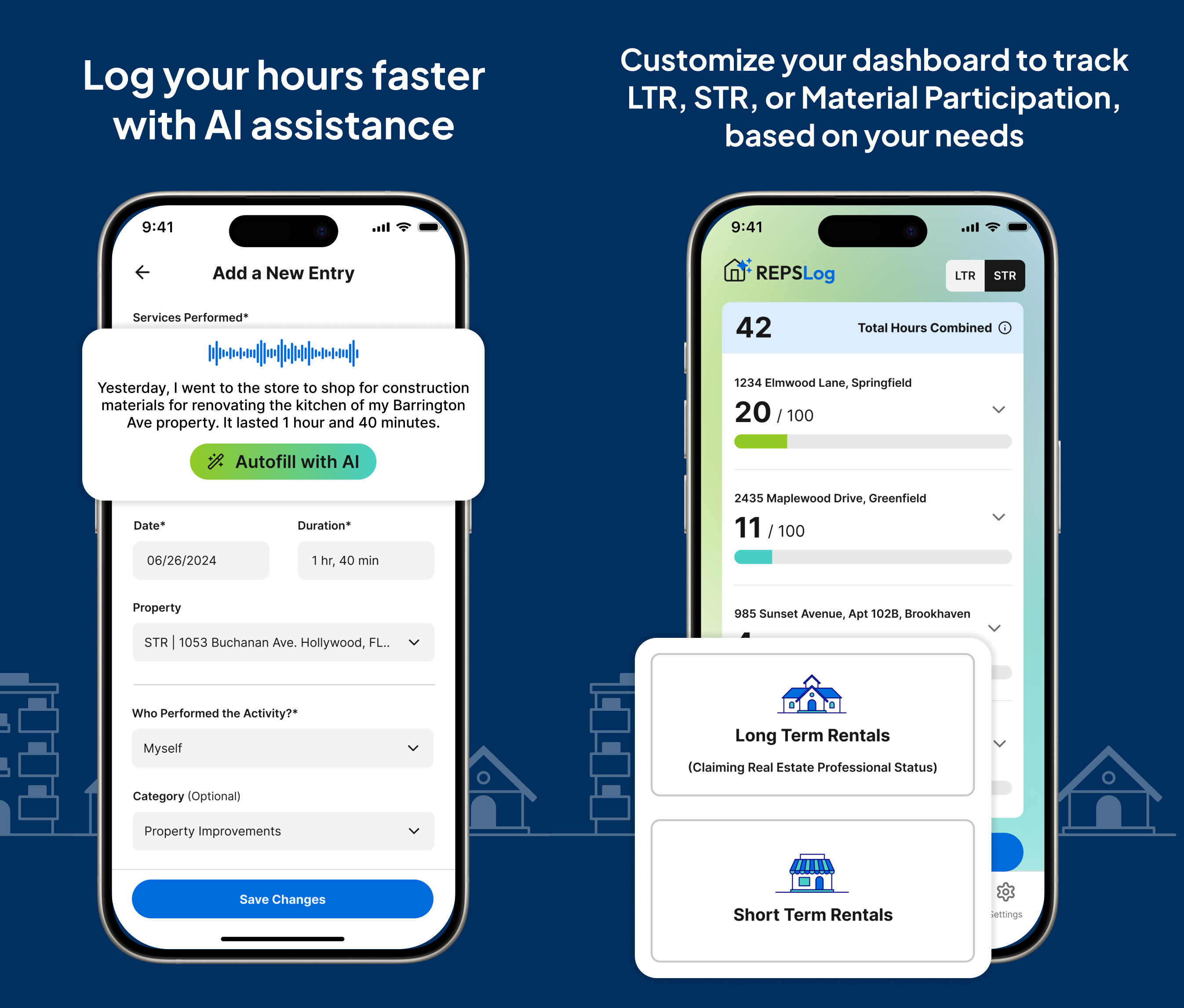
Whether you are pursuing the STR loophole, REPS, or both, documentation is your foundation. REPSLog lets you log guest turnovers, maintenance visits, pricing adjustments, and every other qualifying activity in seconds. Track your hours by property to demonstrate material participation. Monitor your progress toward 750 hours if you are pursuing REPS. Export audit-ready reports that show exactly how you qualified.
Short-term rental management already keeps you busy. REPSLog ensures that every hour you invest is properly documented and defensible.
Available on iOS and Android, or on the web at app.reps-log.com. Start tracking your hours free →
This article is for educational purposes only and does not constitute tax or legal advice. Consult a qualified tax professional for guidance tailored to your situation.
Do this in REPSLog
- Booking Calendar Sync (Airbnb, Vrbo and any iCal): pull every Airbnb, Vrbo or other booking into your log and get an entry suggested per stay.
- STR Loophole Tracking: a 100 or 500-hour counter per short-term rental, with hours by participant.
- Participants: log who did each activity, so spouse hours count where allowed and contractor hours stay separate.
Step by step in the Help Center: how to use it. Try REPSLog free for 14 days on iPhone, Android or the web app.