
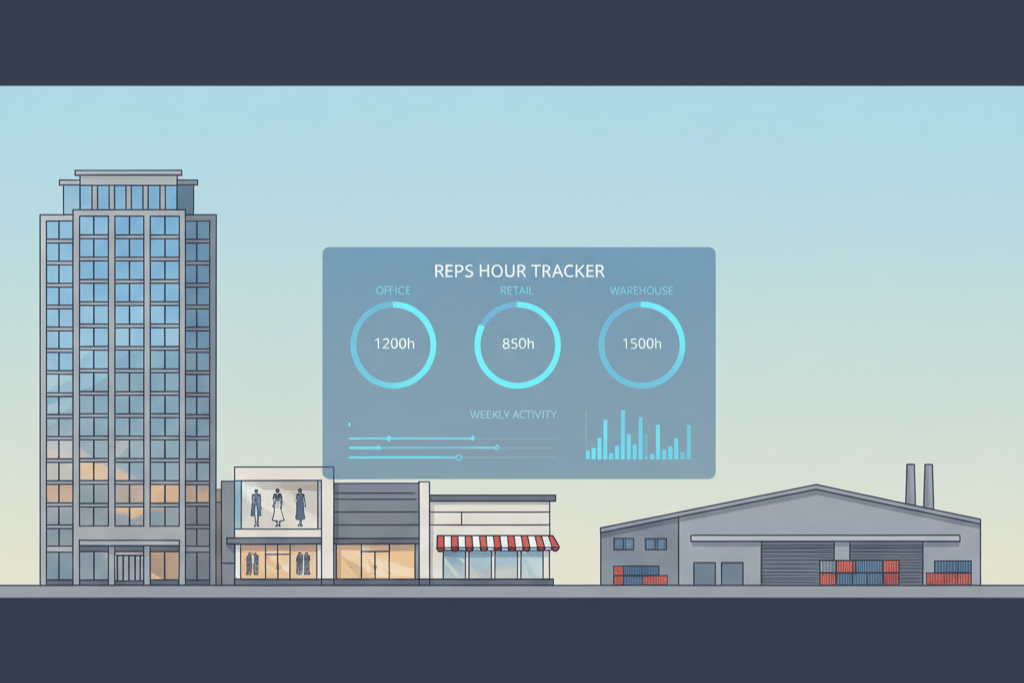
When investors think about Real Estate Professional Status (REPS), they almost always picture residential rentals — single-family homes, duplexes, small multifamily buildings. But REPS is not limited to residential property. The tax code’s definition of qualifying “real property trades or businesses” is broad enough to encompass virtually every type of real estate, including commercial properties.
If you own commercial real estate — office buildings, retail centers, industrial warehouses, mixed-use developments, or any other non-residential property — your management and operational hours count toward REPS qualification. However, commercial real estate presents some unique challenges, particularly around material participation and certain lease structures.
This guide explains how commercial real estate fits into the REPS framework, where the opportunities lie, and what commercial property owners need to watch out for.
The Qualifying Activities Under IRC Section 469(c)(7)
REPS qualification requires more than 750 hours and more than half of your total professional hours in “real property trades or businesses.” The tax code defines these broadly under IRC Section 469(c)(7)(C) to include:
- Development
- Redevelopment
- Construction
- Reconstruction
- Acquisition
- Conversion
- Rental
- Operation
- Management
- Leasing
- Brokerage
Notice that the statute does not distinguish between residential and commercial property types. It refers to “real property” without qualification. This means that hours spent developing, acquiring, managing, leasing, or operating commercial real estate count toward the 750-hour threshold and the more-than-half test, just as residential property hours do.
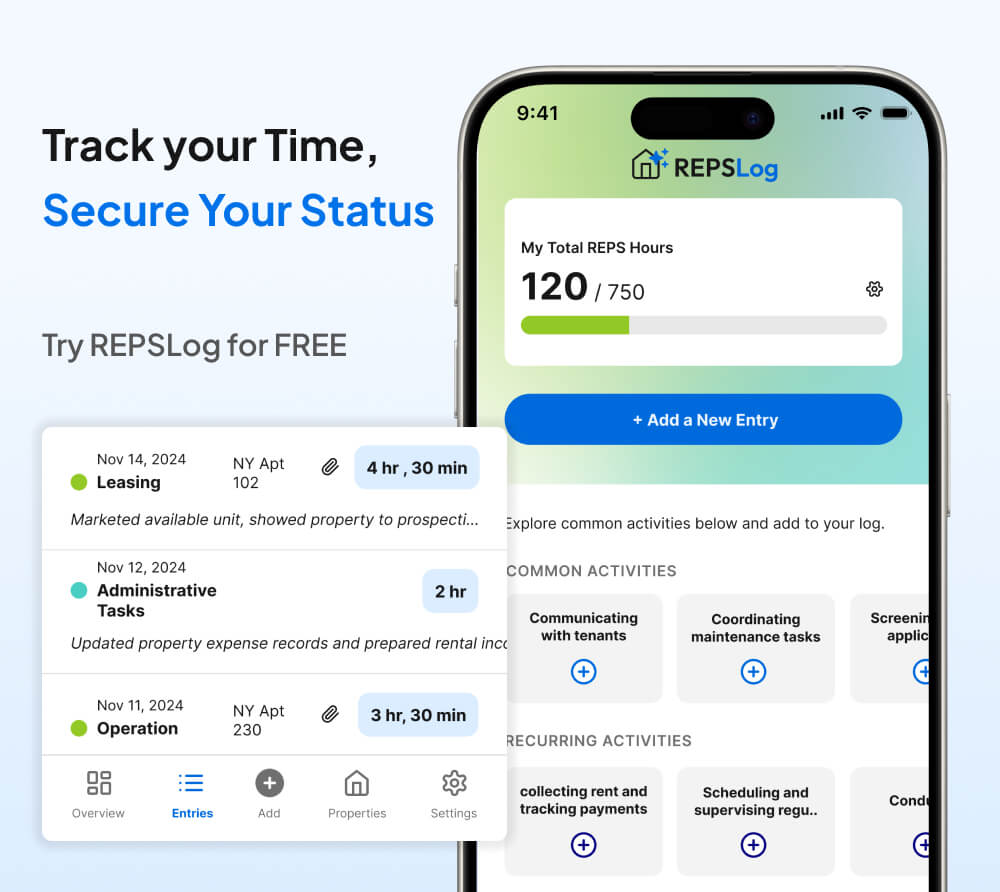
How Commercial Property Hours Accumulate
Commercial real estate management generates qualifying hours through many of the same activities as residential management, plus several categories unique to the commercial sector.
Lease Administration
Commercial leases are significantly more complex than residential leases. Activities include:
- Negotiating lease terms, tenant improvement allowances, and build-out requirements
- Reviewing and drafting letters of intent and lease agreements
- Managing lease renewals, extensions, and amendments
- Calculating and billing common area maintenance (CAM) charges
- Reconciling annual CAM and operating expense true-ups
- Managing percentage rent calculations for retail tenants
- Tracking lease expirations and executing renewal strategies
Tenant Relations and Management
- Corresponding with commercial tenants about building operations
- Handling tenant complaints and service requests
- Coordinating tenant move-ins and move-outs
- Managing tenant improvement construction
- Overseeing shared amenity spaces (lobbies, conference rooms, fitness centers)
- Addressing ADA compliance and accessibility issues
Building Operations
- Overseeing HVAC, electrical, plumbing, and elevator maintenance
- Managing janitorial and landscaping contractors
- Coordinating capital improvement projects (roof replacement, parking lot resurfacing, facade repair)
- Monitoring building systems and energy management
- Ensuring fire safety compliance (sprinklers, alarms, extinguishers)
- Managing parking facilities
Financial Management
- Preparing annual operating budgets
- Reviewing monthly financial statements
- Managing accounts receivable and rent collection
- Negotiating and managing insurance policies
- Handling property tax assessments and appeals
- Preparing financial reports for lenders and partners
Leasing and Marketing
- Marketing vacant space to prospective tenants
- Working with commercial brokers on listings
- Showing available space to prospects
- Analyzing market rents and competitive properties
- Developing marketing materials and property websites
Acquisition and Disposition
- Sourcing and evaluating potential acquisitions
- Performing due diligence (financial analysis, property inspection, environmental review)
- Negotiating purchase agreements
- Coordinating with lenders on commercial financing
- Managing disposition processes (listing, showing, negotiating sales)
The NNN Lease Challenge
One of the biggest hurdles for commercial property owners seeking REPS is the triple-net (NNN) lease structure. Under a NNN lease, the tenant is responsible for property taxes, insurance, and maintenance, leaving the landlord with minimal management responsibilities.
Why NNN Leases Create Problems
If your tenant handles all property management, maintenance, tax, and insurance obligations, what work do you actually perform? The answer determines whether you can demonstrate material participation and accumulate meaningful hours toward REPS.
With a single NNN-leased property, your annual management hours might consist of:
- Reviewing quarterly rent payments: 2-4 hours
- Annual lease review and tenant communication: 5-10 hours
- Insurance certificate verification: 2-3 hours
- Property tax monitoring: 2-4 hours
- Annual property inspection: 4-8 hours
- Financial reporting: 5-10 hours
Total: 20-40 hours per year per property. That is far too few hours to demonstrate material participation on a per-property basis, and even multiple NNN properties may not generate enough hours for the 750-hour threshold.
Strategies for NNN Property Owners
Portfolio diversification: If you own a mix of NNN properties and actively managed commercial or residential properties, the actively managed properties can generate the bulk of your hours. A grouping election under Treas. Reg. 1.469-9(g) allows you to treat all rental activities as one, so the aggregate hours cover material participation.
Active management beyond the lease: Even with NNN structures, landlords can perform qualifying work including acquisition analysis, disposition planning, refinancing negotiations, capital improvement oversight, lease renegotiations, and market analysis for future investment decisions.
Transitional periods: Lease expirations, vacancies, and tenant turnovers generate significant management hours even in NNN portfolios. Re-leasing a commercial space involves marketing, tenant screening, lease negotiation, and potentially tenant improvement coordination.
Development and redevelopment: If you are developing commercial properties, repositioning existing buildings, or managing significant capital improvement projects, these hours count toward REPS regardless of the eventual lease structure.
Commercial Real Estate Depreciation and REPS
Commercial buildings are depreciated over 39 years (versus 27.5 years for residential). This longer depreciation schedule means smaller annual deductions per dollar of basis, which makes cost segregation even more impactful for commercial property owners.
Cost Segregation for Commercial Properties
Commercial buildings typically have substantial components eligible for reclassification:
- Specialized electrical and plumbing systems
- Flooring and floor coverings
- Decorative finishes and millwork
- Signage
- Parking lots and landscaping (15-year property)
- Security and fire protection systems
- HVAC components serving specific areas
A cost segregation study on a commercial building commonly reclassifies 15-35% of the building’s basis into shorter-lived categories. Combined with REPS (which makes the resulting losses non-passive), this creates meaningful tax savings.
Qualified Improvement Property (QIP)
Interior improvements to non-residential buildings may qualify as qualified improvement property with a 15-year recovery period and eligibility for bonus depreciation. This is particularly relevant for commercial property owners who invest in tenant improvements or building renovations.
Mixed-Use Properties
Mixed-use buildings that combine commercial and residential space present interesting REPS considerations. Your hours managing both the commercial and residential portions count toward the 750-hour threshold. The property generates depreciation at different rates for each portion (27.5 years for residential, 39 years for commercial), and cost segregation can be applied to both.
For material participation purposes, a mixed-use property is generally treated as a single rental activity unless you elect to separate the commercial and residential components. Most REPS-seeking investors keep them grouped.
Commercial Real Estate Through Partnerships and Syndications
Many commercial property investments are structured as limited partnerships, LLCs taxed as partnerships, or syndications. The REPS rules apply at the individual taxpayer level, not the entity level. However, your ability to count hours and claim non-passive losses depends on your role in the entity.
General Partners and Managing Members
If you are the general partner or managing member of a commercial real estate partnership, your management hours on the partnership’s properties count toward your REPS qualification and material participation. These investors are typically in the best position to benefit from REPS.
Limited Partners
Limited partners face a significant constraint: under IRC Section 469(h)(2), a limited partner is generally treated as not materially participating in the partnership’s activities. Limited partners can only demonstrate material participation under a narrow set of tests (primarily the 500-hour test or the “participation in 5 of the prior 10 years” test).
This means passive investors in commercial real estate syndications — who contribute capital but perform no management work — generally cannot use REPS to convert their share of losses to non-passive, regardless of their status on other properties.
LLC Members
Members of an LLC taxed as a partnership are generally not treated as limited partners for the material participation rules (unless state law restricts their participation rights). This means LLC members can use all seven material participation tests, which is more favorable than the limited partner restrictions.
Frequently Asked Questions
Do hours managing commercial properties count the same as residential for REPS?
Yes. The tax code makes no distinction between residential and commercial real estate for REPS qualification purposes. Hours spent on any real property trade or business — including commercial property management, leasing, development, and operations — count toward the 750-hour threshold and the more-than-half test.
Can I combine hours from commercial and residential properties?
Yes. All real property trade or business hours are aggregated for the 750-hour and more-than-half tests. You can also make a grouping election under Treas. Reg. 1.469-9(g) to treat all rental activities (commercial and residential) as a single activity for material participation purposes.
I own a NNN-leased retail building. Can I qualify for REPS?
It depends on your total real estate activities. A single NNN property generates very few management hours. But if you have other real estate activities (additional properties, development work, brokerage, property management) that bring your total above 750 hours and satisfy the more-than-half test, you can qualify. The NNN property’s losses would then be non-passive if you demonstrate material participation (easier with a grouping election).
Does commercial real estate depreciation work differently under REPS?
The depreciation schedules are different (39 years for commercial vs. 27.5 years for residential), but the REPS treatment is the same. When you qualify for REPS and materially participate, commercial rental losses — including depreciation — are non-passive and can offset active income.
Can I count hours on a commercial property I co-own through a partnership?
If you are a general partner, managing member, or active LLC member who performs real property management work, yes. If you are a limited partner or passive investor, your participation is generally limited and may not satisfy material participation requirements.
What about self-storage facilities? Do they count as commercial real estate for REPS?
Self-storage facilities are real property, and management hours count toward REPS. However, some self-storage operations (especially those with significant personal services like packing, moving, or climate-controlled specialty storage) may be classified differently for passive activity purposes. Consult your CPA about the specific facts of your operation.
Do commercial property development hours count toward REPS?
Absolutely. Development, construction, redevelopment, and reconstruction are explicitly listed as qualifying real property trades or businesses. Hours spent entitling land, managing construction, overseeing contractors, and coordinating development activities all count.
Key Takeaways
- Commercial real estate absolutely counts toward REPS — the tax code makes no distinction between residential and commercial property types
- NNN lease structures create challenges for accumulating management hours and demonstrating material participation
- Cost segregation is especially impactful for commercial properties due to the longer 39-year depreciation baseline
- A grouping election under Treas. Reg. 1.469-9(g) allows commercial and residential properties to be treated as a single activity for material participation
- Partnership structure matters — general partners and active LLC members are better positioned than limited partners to claim REPS benefits
- Mixed portfolios of commercial and residential properties can be combined for hour tracking and material participation
- Development and redevelopment hours are among the most substantial sources of qualifying time for commercial real estate investors
How REPSLog Tracks Commercial and Residential Hours Together
Whether your portfolio is all commercial, all residential, or a mix of both, REPSLog provides a unified platform for tracking every qualifying hour. Tag activities by property, category (leasing, operations, maintenance, acquisition), and duration. Monitor your progress toward the 750-hour threshold across your entire real estate portfolio. Export comprehensive reports that demonstrate material participation by property or across a grouped election.
Commercial real estate management is demanding work. REPSLog ensures every hour is captured, categorized, and ready for your CPA or an IRS examiner.
Available on iOS and Android, or on the web at app.reps-log.com. Start tracking your hours free →
This article is for educational purposes only and does not constitute tax or legal advice. Consult a qualified tax professional for guidance tailored to your situation.
Do this in REPSLog
- Multiple Properties: add each rental by address, mark it LTR or STR, see hours per property.
- Calendar Integration (Google, Microsoft 365, device): turn past Google, Microsoft 365 or device calendar events into logged hours.
- REPS Hour Tracking Goals (750 / 500 / 100): pick the 750, 500 or 100-hour test and watch progress per year and per property.
Step by step in the Help Center: how to use it. Try REPSLog free for 14 days on iPhone, Android or the web app.



 REPSLog Blog