Real estate portfolios rarely consist of neatly categorized properties. Investors frequently own buildings that serve multiple purposes — a retail storefront with apartments above, a farmhouse with a detached rental cottage, or a commercial property where the owner also maintains an office. These mixed-use properties create specific challenges for taxpayers pursuing Real Estate Professional Status (REPS), particularly around which hours qualify, how income and expenses are allocated, and whether the property can generate deductible losses.
The tax code does not have a single, clean set of rules for mixed-use properties. Instead, the answer depends on the nature of the mix — residential versus commercial, rental versus personal, or active business versus passive rental. Each combination triggers different provisions, and REPS investors who fail to understand these distinctions risk miscounting hours, misallocating expenses, or losing deductions they rightfully earned.
Defining Mixed-Use Properties
Before diving into the tax treatment, it helps to define the types of mixed-use scenarios REPS investors commonly encounter.
Residential/Commercial Mix
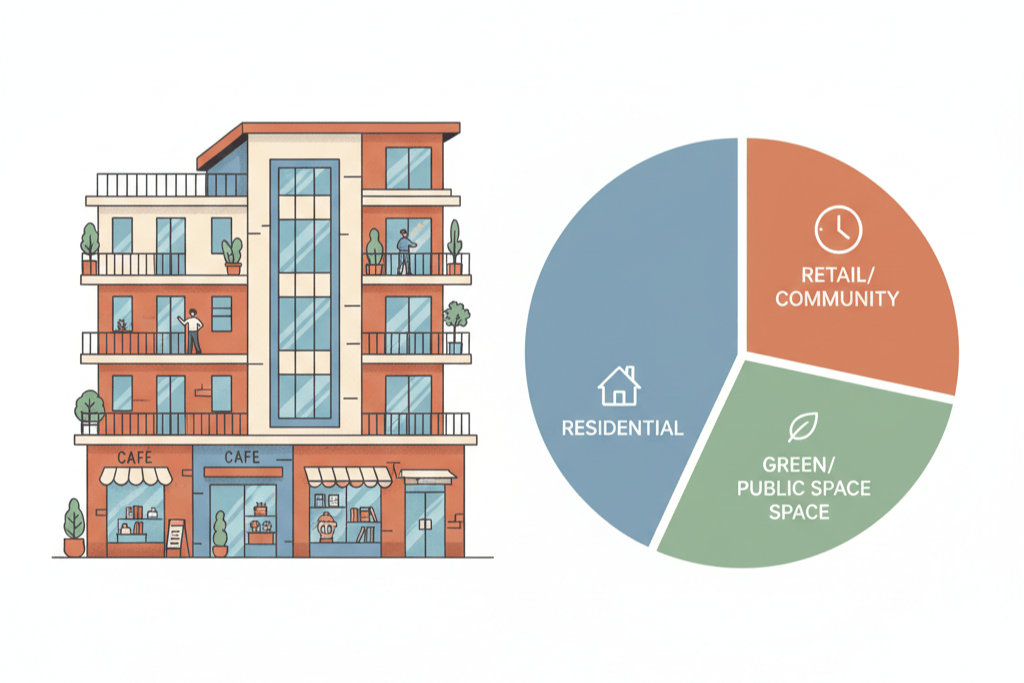
This is the classic mixed-use property: a building with commercial space on the ground floor and residential rental units above. Think of a two-story building in a downtown area with a restaurant lease on the first floor and three apartments on the second floor. The commercial and residential portions have different tenants, different lease structures, and potentially different depreciation schedules.
Rental/Personal Mix
A property used partly as a rental and partly for personal purposes. This is the vacation rental scenario covered extensively under Section 280A (discussed in our companion article on vacation rentals), but it also includes situations like a duplex where you live in one unit and rent the other, or a home with a rented accessory dwelling unit (ADU).
Rental/Business Mix
A property that serves both as a rental to third parties and as the location for the owner’s own business. An investor might own a small office building, lease most of it to tenants, and use one suite as their own real estate management office.
Agricultural/Rental Mix
A property with both farming operations and rental components — a farmstead with tenant-occupied buildings, or agricultural land with rental storage facilities.
Each of these scenarios requires a different analytical framework for REPS purposes.

Which Hours Count: The Activity-by-Activity Analysis
Under IRC Section 469(c)(7), REPS qualification requires more than 750 hours in real property trades or businesses. The key phrase is “real property trades or businesses,” which includes development, redevelopment, construction, acquisition, conversion, rental, operation, management, leasing, and brokerage activities.
For mixed-use properties, the question becomes whether specific hours spent on the property relate to a qualifying real property activity.
Hours on the Rental Portion
Time spent managing, maintaining, and operating the rental portion of a mixed-use property clearly counts toward REPS hours. This includes:
- Screening and communicating with tenants
- Collecting rent and handling bookkeeping for the rental units
- Coordinating repairs and maintenance for rental spaces
- Inspecting rental units and common areas
- Marketing vacant rental units
- Negotiating lease terms
- Handling tenant complaints and disputes
These hours are straightforward and should be logged with enough detail to identify that they relate to the rental activity.
Hours on the Commercial Portion
Commercial leasing and management are also qualifying real property activities. Hours spent on the commercial portion of a mixed-use building count toward REPS if they involve:
- Negotiating commercial leases
- Managing commercial tenant relationships
- Overseeing common area maintenance (CAM) obligations
- Coordinating build-outs for new commercial tenants
- Managing property-level accounting that serves both portions
In fact, the IRS draws no distinction between residential and commercial rental management for REPS hour counting purposes. Both are real property trades or businesses under the statute.
Hours on the Personal-Use Portion
This is where it gets complicated. If you live in one unit of a duplex, the time you spend maintaining your personal residence does not count toward REPS. Mowing the lawn, fixing your own kitchen faucet, or cleaning your own unit are personal activities, not real property trade or business activities.
However, hours spent on the rental unit in the same building do count. And hours spent on shared systems that serve both units — the roof, the furnace, the building’s exterior — need to be allocated. There is no bright-line rule for this allocation. Most practitioners use a reasonable method such as square footage, number of units, or time spent on each portion.
Hours on Your Own Business Space
If you use part of a rental property as your own real estate office, the hours you spend in that office working on real estate activities count toward REPS — but not because of the office space itself. They count because you are performing qualifying real property trade or business activities. The fact that you happen to do them in a building you also rent to others is incidental.
Be careful here: hours spent on non-real-estate business activities in that same office do not count toward REPS, even though they take place in a property you own. An investor who runs an e-commerce business from a suite in their own commercial building cannot count those e-commerce hours toward REPS.
Allocation Rules for Income and Expenses
Mixed-use properties require careful allocation of income and expenses between the different uses. The method of allocation can significantly impact your REPS deductions.
Square Footage Allocation
The most common method divides income and expenses based on the proportion of the building’s square footage dedicated to each use. If a 10,000-square-foot building has 6,000 square feet of rental space and 4,000 square feet of personal or business use, 60% of shared expenses are allocated to the rental activity.
Unit-Based Allocation
For properties with distinct, comparable units (like a duplex), allocating based on the number of units can be simpler and defensible. In a duplex where you live in one unit and rent the other, a 50/50 allocation of shared expenses is reasonable if the units are similar in size.
Time-Based Allocation
For properties where usage varies throughout the year — a home rented part-time via Airbnb, for example — allocation based on the number of days each use occurs is appropriate. This is the method prescribed by Section 280A for properties that cross the personal-use threshold.
Income Allocation
Rental income is reported only for the rental portion of the property. If you occupy one unit of a triplex and rent the other two, only the rent from the two tenant-occupied units is reported. You do not impute rental income to yourself for the unit you live in (though you also cannot claim rental deductions on that unit).
Depreciation Allocation
Depreciation is a critical component of REPS tax strategy, and mixed-use properties add complexity. Only the rental portion of a building can be depreciated as rental property. The personal-use portion is not depreciable. The business-use portion may be depreciable under different rules (Section 179, bonus depreciation) depending on the nature of the business.
Residential rental property is depreciated over 27.5 years. Commercial rental property is depreciated over 39 years. If your mixed-use building has both residential and commercial rental portions, each portion follows its own schedule.
The Grouping Election and Mixed-Use Properties
The grouping election under Treas. Reg. 1.469-9(g) allows REPS taxpayers to treat all rental activities as a single activity for material participation purposes. This election is particularly valuable for mixed-use property owners.
Consider an investor who owns three properties: a mixed-use building with apartments and retail space, a standalone residential rental, and a small commercial property. Without the grouping election, the investor must demonstrate material participation (more than 100 hours with no one else participating more, or more than 500 hours) in each property separately. With the election, all hours across all properties are combined.
However, the grouping election applies only to rental activities. If part of a mixed-use property is used in the owner’s non-rental business (say, you operate a restaurant on the ground floor of your own building), that business portion is not a rental activity and cannot be grouped with your rentals.
Material Participation and Spousal Hours
For material participation in each rental activity (or the grouped activity), spouses filing jointly can combine their hours under IRC Section 469(h)(5). If one spouse manages the residential tenants and the other handles the commercial leasing, their combined hours count toward material participation on the property.
This is distinct from REPS qualification itself, where each spouse must independently meet the 750-hour and more-than-half tests. Spousal hour combination applies only to the material participation requirement, not to REPS qualification.
Common Mixed-Use Scenarios and Their Tax Treatment
Scenario 1: House Hacking a Duplex
You buy a duplex, live in one unit, and rent the other. The rental unit generates income. Shared expenses (property taxes, insurance, roof repairs, landscaping) are allocated — typically 50/50 for similar-sized units. Your REPS hours include time spent managing, maintaining, and operating the rental unit. Time spent on your personal unit does not count. Depreciation is taken only on the rental unit’s allocated portion of the building’s basis.
If you move out and rent both units later, the entire property becomes a rental activity and all hours count toward REPS.
Scenario 2: Retail Below, Apartments Above
You own a three-story building: retail on the ground floor, two floors of apartments above. All three floors are rented to third parties. Every hour spent on this building — managing the retail tenant, screening residential applicants, handling maintenance, overseeing the property — counts toward REPS. The residential portion is depreciated over 27.5 years; the commercial portion over 39 years. Income and expenses are allocated by square footage or another reasonable method.
Scenario 3: Home Office in a Rental Building
You own a small office building with five suites. Four are rented to tenants. You use the fifth as your real estate management office. The four rented suites are rental activity. The fifth suite is not a rental — it is used in your real estate management business. Hours spent in your office on real estate activities count toward REPS (because they are real property trade or business hours), but the office suite’s income and expenses are reported separately from the rental activity.
Scenario 4: Short-Term Rental with Owner Use
You own a cabin that you rent on Airbnb 200 nights per year and use personally 25 days. The personal use exceeds the 14-day / 10% threshold (10% of 200 = 20 days), triggering Section 280A. REPS hours spent managing the STR still count toward your 750-hour threshold, but the property itself cannot generate a net deductible loss. This is a case where REPS qualification and Section 280A limitations pull in opposite directions.
Documentation Best Practices for Mixed-Use Properties
Mixed-use properties demand more granular documentation than single-use rentals. Here is what the IRS expects to see:
- Separate hour logs for each activity or use. If a property has a rental portion and a personal portion, your log should identify which portion each activity relates to.
- Allocation methodology documentation. Record the method you use (square footage, units, time) and the rationale for choosing it. This should be consistent from year to year.
- Floor plans or square footage measurements that support your allocation percentages.
- Expense receipts that identify the property area where work was performed. A plumber’s invoice for “apartment #2 bathroom” is far more useful than one that just says the property’s address.
- Clear separation of personal and rental activities on days when you do both at the same property.
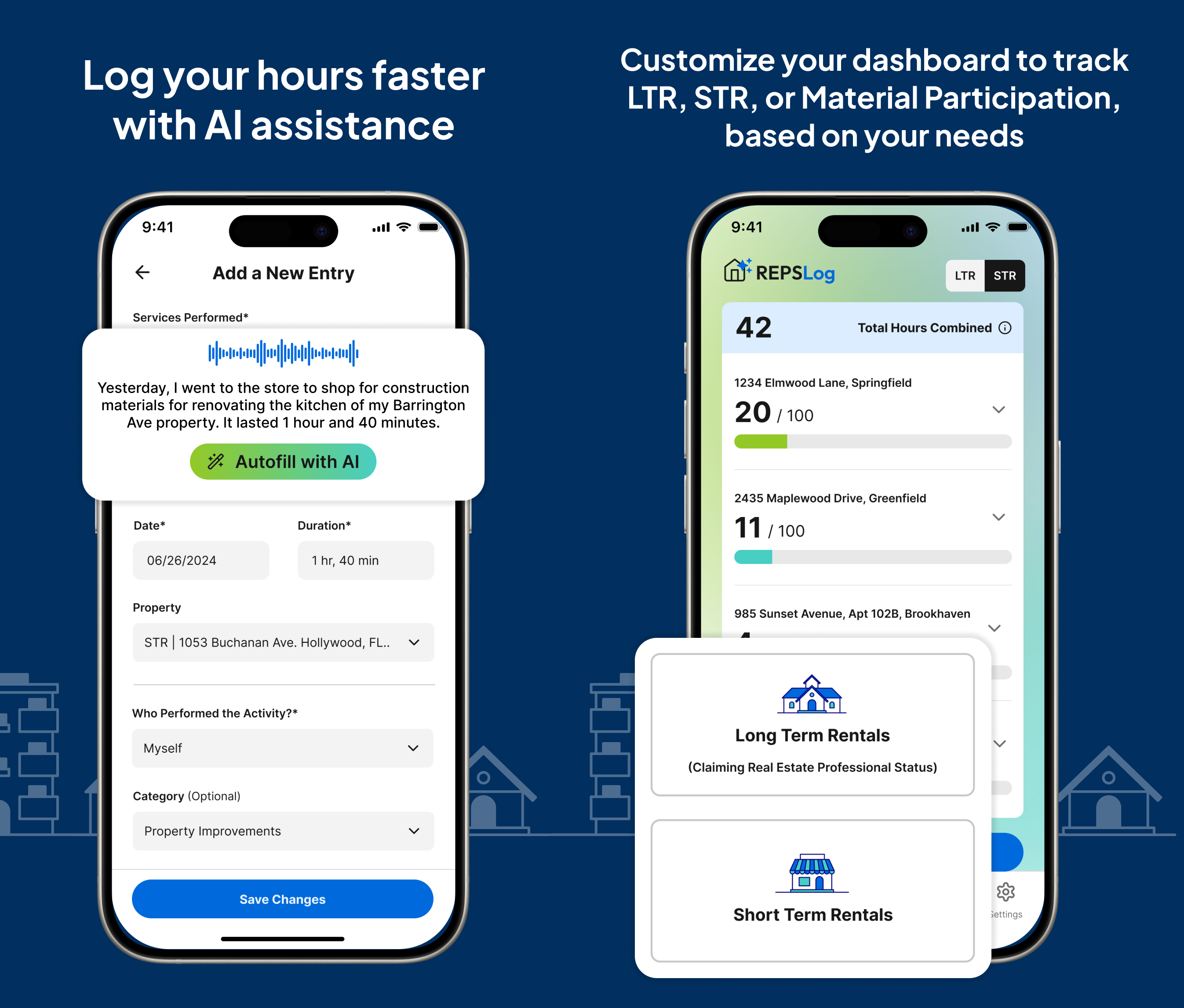
A tool like REPSLog helps maintain this level of detail by letting you tag activities by property and category, creating the contemporaneous log the IRS values most.
Key Takeaways
- All rental management hours count toward REPS regardless of whether the rental is residential or commercial. The statute covers both.
- Personal-use hours at a mixed-use property do not count toward REPS. Only time spent on qualifying real property trade or business activities qualifies.
- Allocation of expenses must follow a reasonable, consistent method — typically square footage, number of units, or days of use.
- Depreciation schedules differ between residential rental (27.5 years) and commercial rental (39 years) portions of the same building.
- The grouping election under Treas. Reg. 1.469-9(g) simplifies material participation across mixed-use and single-use properties combined.
- Section 280A still applies to any portion of a property used personally beyond the threshold, even if REPS is established.
- Documentation must be granular enough to distinguish hours and expenses by property use type.
Frequently Asked Questions
Do hours spent on the commercial portion of a mixed-use building count toward REPS?
Yes. Managing, leasing, and maintaining commercial rental space is a qualifying real property trade or business activity under IRC 469(c)(7). Hours spent on commercial and residential rental portions both count toward your 750-hour threshold and the more-than-half test.
How do I allocate expenses on a duplex where I live in one unit?
The most common approach is a 50/50 allocation for units of similar size. If the units differ significantly in square footage, use a proportional allocation based on actual square footage. Whichever method you choose, apply it consistently and document your rationale.
Can I group a mixed-use property with my other rentals under Treas. Reg. 1.469-9(g)?
Yes, the rental portions of a mixed-use property can be included in your grouping election. However, any portion of the property used in your own non-rental business or for personal purposes is not a rental activity and cannot be grouped.
If I operate my real estate business from a suite in my rental building, do those hours count toward REPS?
Yes, but not because of the property itself. The hours count because you are performing real property trade or business activities (management, acquisition analysis, etc.). Where you perform those activities is irrelevant for REPS hour counting. Just be sure to separate the business suite’s income and expenses from the rental activity.
Does a mixed-use property have one depreciation schedule or multiple?
Multiple. The residential rental portion is depreciated over 27.5 years, and the commercial rental portion is depreciated over 39 years. Personal-use portions are not depreciable as rental property. You need to determine the cost basis attributable to each portion and depreciate each accordingly.
Can I count time traveling to a mixed-use property toward REPS?
Travel time to a property for the purpose of performing qualifying real property activities generally counts toward REPS hours. If you are traveling to the property for both personal and rental purposes, you should allocate the travel time based on the primary purpose of the trip. If the primary purpose is rental management, the travel time counts. If the primary purpose is personal use, it does not.
How do I handle common area maintenance hours at a mixed-use property?
Common area maintenance benefits both the rental and personal-use (or business-use) portions of the property. Allocate the time in the same proportion you allocate expenses — typically by square footage. If you spend 4 hours repairing a shared stairway in a building where 75% of the square footage is rental, 3 hours count toward REPS and 1 hour does not.
Disclaimer: This article is for educational purposes only and does not constitute tax, legal, or financial advice. Tax laws are complex and subject to change. Consult a qualified tax professional before making any decisions related to Real Estate Professional Status or mixed-use property deductions.
Track Your Mixed-Use Property Hours with Confidence
Managing REPS hours across mixed-use properties requires granular tracking by property and activity type. REPSLog lets you categorize every hour by property, activity, and use type — giving you the detailed contemporaneous records the IRS expects.
Available on iOS | Android | Web