Owning a vacation rental property is one of the most appealing ways to combine real estate investing with lifestyle benefits. You spend a few weeks at the beach house each year, rent it out the rest of the time, and claim depreciation and expenses against the rental income. When Real Estate Professional Status (REPS) enters the picture, the tax savings potential multiplies — but so do the complications.
The intersection of REPS and personal-use vacation rentals creates one of the most complex areas in real estate taxation. Section 280A of the Internal Revenue Code imposes strict limits on deductions when a property is used personally, and these limits do not simply vanish because you qualify as a real estate professional. Understanding how these rules interact is essential for any REPS taxpayer who occasionally vacations at their own rental property.
How Section 280A Limits Vacation Rental Deductions
Section 280A is the IRS provision that governs deductions for dwelling units used as both a residence and a rental. Its purpose is straightforward: prevent taxpayers from disguising personal vacation expenses as business deductions. The rules apply to any dwelling unit — houses, condos, cabins, apartments, and even boats that qualify as residences.
Under Section 280A, a property is considered a personal residence if you use it for personal purposes for the greater of:
- 14 days during the tax year, or
- 10% of the number of days the property is rented at fair market value
Once a property crosses this threshold, Section 280A kicks in and limits the deductions you can take. Specifically, rental expenses can only offset rental income — you cannot generate a net rental loss from the property that flows through to reduce your other income.
This is where REPS investors run into trouble. The entire point of REPS is to use rental losses (primarily from depreciation) to offset active income. But Section 280A does not care about your REPS status. If personal use exceeds the threshold, losses are capped regardless of whether you materially participate in the property or qualify as a real estate professional.

The 14-Day Rule: Two Sides of the Same Coin
The 14-day rule under Section 280A actually works in two directions, and understanding both sides is critical.
Side 1: The Tax-Free Rental Rule. If you rent your property for fewer than 15 days during the year, you do not need to report any rental income at all. This is the well-known provision that lets homeowners rent their house during major events (the Super Bowl, a music festival) for a few days without tax consequences. This side of the rule is favorable but largely irrelevant to REPS investors, who by definition are renting properties as a trade or business.
Side 2: The Personal-Use Limitation. If you rent the property for 15 or more days AND use it personally for more than 14 days (or 10% of rental days, whichever is greater), the property is classified as a personal residence. At that point, expenses must be allocated between personal and rental use, and allocated rental expenses cannot exceed rental income. No net loss is allowed.
For a REPS investor who owns a beach condo rented 200 days per year, the 10% threshold means personal use must stay at or below 20 days. Exceed that, and Section 280A prevents the rental loss from flowing through to offset W-2 or business income — even with REPS qualification and material participation.
What Counts as Personal Use?
The definition of personal use is broader than many taxpayers realize. Under IRC Section 280A(d), personal use includes:
- Any day you or your family use the property for personal purposes. Family includes siblings, parents, grandparents, children, and their spouses.
- Any day the property is rented to a family member at below fair market value. Even if your brother pays you some rent, if it is below fair market value, those are personal-use days.
- Any day the property is used by anyone under a reciprocal arrangement. If you let a friend use your cabin in exchange for using their lake house, both properties are recording personal-use days.
- Any day another owner uses the property (in shared ownership arrangements).
Days you spend primarily performing repair and maintenance work on the property are generally excluded from personal-use days, provided you can demonstrate that the primary purpose of your visit was work, not recreation. This is a fact-intensive inquiry, and the IRS will look skeptically at a taxpayer who claims seven days of maintenance at a beachfront condo during July.
The Allocation Problem
When Section 280A applies, you must allocate expenses between personal and rental use. The method prescribed by the IRS (in Publication 527 and various court rulings) typically uses a ratio based on the number of rental days versus total days of use.
For example, if you rent a property 200 days and use it personally 30 days, the rental allocation would be 200/230, or approximately 87%. Only 87% of mortgage interest, property taxes, insurance, maintenance, utilities, and depreciation can be applied against rental income. The remaining 13% goes on Schedule A as personal deductions (subject to their own limitations).
Here is the critical constraint: the allocated rental expenses cannot create a net loss. If rental income is $40,000 and allocated expenses total $55,000, you can only deduct $40,000. The remaining $15,000 in excess expenses is carried forward to future years — it does not offset your W-2 income, even with REPS.
The ordering rules matter too. The Tax Court established in Bolton v. Commissioner that expenses must be deducted in a specific order: first, the rental portion of mortgage interest and taxes (which are deductible regardless); then operating expenses; and finally depreciation. Depreciation is last in line, meaning it is the deduction most likely to be limited when Section 280A applies.
How REPS Interacts with Section 280A
This is where the analysis gets nuanced. REPS reclassifies rental activity as non-passive, allowing rental losses to offset active income. But Section 280A is a separate limitation that operates independently of the passive activity rules.
Think of it as two gates your deductions must pass through:
- Gate 1 (REPS + Material Participation): Converts rental income/loss from passive to non-passive
- Gate 2 (Section 280A): Caps rental deductions at rental income if personal use exceeds the threshold
You can pass Gate 1 with flying colors — 1,200 hours of material participation, full REPS qualification, perfect contemporaneous logs — and still be blocked at Gate 2 if you spent 21 personal days at a property rented 200 days.
The practical takeaway is that REPS does not override Section 280A. These are parallel provisions in the tax code, each with its own requirements and limitations.
Strategies for REPS Investors Who Use Vacation Rentals Personally
Given these constraints, REPS investors who want to enjoy their vacation properties while preserving tax benefits should consider the following approaches.
Track Personal-Use Days Meticulously
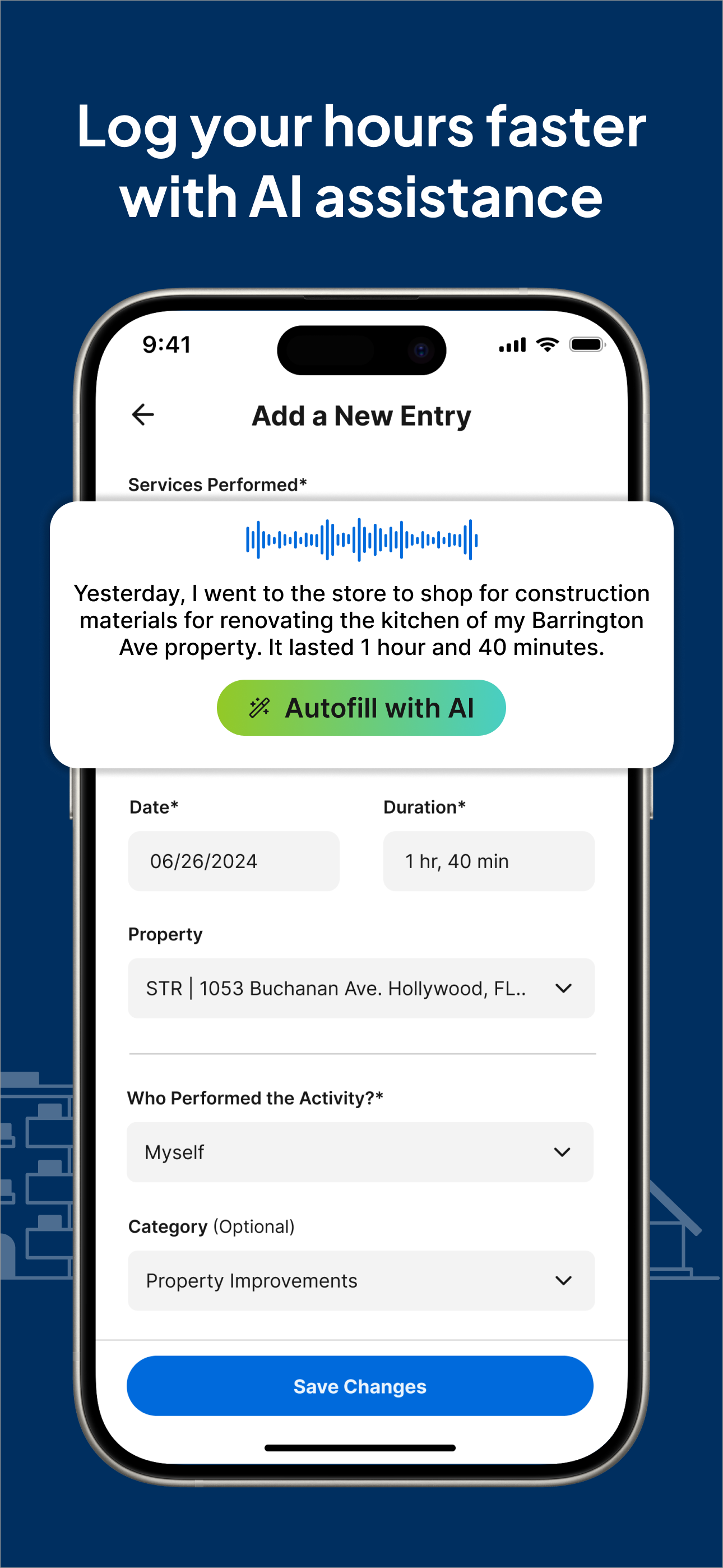
The single most important thing you can do is know exactly where you stand at all times. Track every day of personal use, every family member visit, and every reciprocal arrangement. An app like REPSLog can help you maintain this record alongside your REPS hours, giving you a real-time view of whether you are approaching the personal-use threshold.
Stay Under the Threshold
Structure your personal use to remain at or below the greater of 14 days or 10% of rental days. If you rent the property 300 days, you have 30 days of personal use available. If you rent it 100 days, you have 14 days. Plan your personal vacations accordingly.
Distinguish Maintenance Days from Vacation Days
Days spent primarily on repair and maintenance do not count as personal-use days under Section 280A(d)(2). But “primarily” is the operative word. If you fly to your condo, spend three hours replacing a faucet and coordinating with a cleaner, then spend the rest of the day at the pool, the IRS has grounds to classify it as a personal day. Document your work activities thoroughly — take photos, keep receipts, and log the hours worked.
Consider the Property’s Role in Your REPS Portfolio
If you have multiple rental properties and have made the grouping election under Treas. Reg. 1.469-9(g), the vacation property is grouped with your other rentals for material participation purposes. But Section 280A still applies on a property-by-property basis. The loss limitation cannot be grouped away.
For this reason, some investors separate their vacation rental from their REPS portfolio in their planning. They accept that the vacation property will not generate deductible losses, and they focus their REPS hours and loss generation on properties they do not use personally.
Evaluate Whether the Property Is Worth the REPS Complication
In some cases, the cleanest approach is to treat the vacation rental as a separate, income-focused investment rather than a loss-generating REPS property. If Section 280A will consistently limit your deductions, the hours you spend on that property might be better allocated to other properties where losses can actually flow through.
Short-Term Rentals and the Personal-Use Trap
Short-term rental (STR) investors face heightened risk with Section 280A because their rental calendars are often more fragmented. A property rented on Airbnb for 150 scattered days across the year might have 50 days where the owner uses it personally, 90 days sitting vacant, and 75 days of guest stays mixed in between.
The 10% threshold for 150 rental days is just 15 days. That means the owner in this example, using the property 50 personal days, is well over the limit and Section 280A fully applies.
STR investors should also be aware that days the property is listed but not booked are neither rental days nor personal-use days — they are vacant days. Only days the property is actually rented at fair market value count as rental days for the denominator of the 10% calculation. A property that is available 365 days but only rented 100 of them has a threshold of just 14 days.
The Audit Risk Factor
The IRS is well aware that vacation rentals are a common area of abuse. A 2024 Treasury Inspector General report identified vacation rental deductions as a priority for compliance enforcement. Properties in desirable vacation destinations — beach towns, ski resorts, lakefront communities — receive additional scrutiny.
For REPS taxpayers, the audit risk is compounded because REPS claims already draw heightened attention. An auditor examining your REPS qualification will inevitably review each property in your portfolio, and a vacation rental with personal use raises immediate red flags.
Strong documentation is your best defense:
- Maintain a calendar showing every day of personal use, rental use, and vacancy
- Log all maintenance visits separately, with detailed descriptions of work performed
- Keep guest records (booking confirmations, cleaning schedules) that corroborate your rental day count
- Track personal-use days for family members, not just yourself
Key Takeaways
- Section 280A limits vacation rental losses independently of REPS. Qualifying as a real estate professional does not override the personal-use limitation.
- The personal-use threshold is the greater of 14 days or 10% of rental days. Exceeding this threshold caps your rental deductions at rental income — no net loss is allowed.
- Personal use includes family members, below-market rentals, and reciprocal arrangements. The definition is broader than most taxpayers expect.
- Maintenance days are excluded from personal use only if the primary purpose of your presence is repair and maintenance work. Document thoroughly.
- REPS investors should track personal-use days as carefully as they track REPS hours. A dedicated tracking tool keeps you aware of your position year-round.
- Short-term rental properties are particularly vulnerable because the 10% threshold is calculated against actual rental days, not available days.
- Consider separating vacation properties from loss-generating REPS properties in your tax planning to avoid complications.
Frequently Asked Questions
Can REPS override the Section 280A personal-use limitation?
No. Section 280A operates independently of the passive activity rules under IRC 469. Even if you qualify as a real estate professional and materially participate in the property, the personal-use limitation still applies. If your personal use exceeds 14 days (or 10% of rental days), your rental deductions are capped at rental income.
Do days spent doing maintenance at my vacation rental count as personal-use days?
Days spent primarily on repair and maintenance are generally excluded from personal-use days under Section 280A(d)(2). However, you must be able to show that the principal purpose of your presence was work. Brief maintenance tasks sandwiched between recreational activities will not qualify. Log your work hours, take photos, and keep receipts.
How does the 14-day rule interact with the grouping election under Treas. Reg. 1.469-9(g)?
The grouping election under Treas. Reg. 1.469-9(g) allows you to treat all rental properties as a single activity for material participation purposes. However, Section 280A applies to each property individually. You cannot average personal use across grouped properties. Each property’s personal-use days are evaluated separately.
If I rent my vacation home for fewer than 15 days, do I need to report the income?
No. Under Section 280A(g), if you rent the property for fewer than 15 days during the tax year, the rental income is not reportable and the rental expenses are not deductible (beyond what you would normally claim as personal deductions). This is sometimes called the “Masters Rule” after Augusta, Georgia homeowners who rent during the golf tournament.
Can my spouse’s vacation days at the property count against the personal-use threshold?
Yes. Under Section 280A(d)(2), personal use includes any day the property is used by any member of your family, which includes your spouse, siblings, parents, grandparents, children, and their spouses. Your spouse vacationing at the property while you are at home still counts as a personal-use day.
What happens to disallowed expenses under Section 280A?
Disallowed expenses are generally carried forward to the next tax year under Section 280A(c)(5). They can be used in a future year when rental income exceeds expenses, but they never convert into losses that offset other income. The carry-forward is property-specific and follows the same ordering rules.
Should I separate my vacation rental from my other properties for REPS purposes?
This is a strategic decision that depends on your specific situation. If the vacation property consistently triggers Section 280A limitations, the hours you spend on it still count toward your 750-hour REPS threshold and the more-than-half test, but the property itself will not generate deductible losses. Some investors find it cleaner to acknowledge this and focus their loss-generation strategy on non-personal-use properties.
Disclaimer: This article is for educational purposes only and does not constitute tax, legal, or financial advice. Tax laws are complex and subject to change. Consult a qualified tax professional before making any decisions related to Real Estate Professional Status or vacation rental deductions.
Start Tracking Your REPS Hours and Personal-Use Days Today
Keeping accurate records of both your qualifying hours and your personal-use days is essential for vacation rental owners pursuing REPS. REPSLog makes it easy to log activities, track your progress toward the 750-hour threshold, and maintain the kind of contemporaneous documentation the IRS expects.
Available on iOS | Android | Web