Two of the most valuable tax provisions available to real estate investors — Real Estate Professional Status (REPS) under IRC Section 469(c)(7) and the Qualified Business Income (QBI) deduction under IRC Section 199A — exist in different parts of the tax code and serve different purposes. REPS reclassifies rental income and losses from passive to non-passive, allowing losses to offset active income. The QBI deduction provides up to a 20% deduction on qualified business income from pass-through entities and sole proprietorships.
The natural question every savvy real estate investor asks: can you use both? The short answer is yes, in many cases they do stack. But the interaction between these provisions is more complex than a simple yes or no, and understanding the mechanics can mean the difference between a well-optimized return and a missed opportunity.
Section 199A QBI Deduction: The Basics
The Tax Cuts and Jobs Act of 2017 created Section 199A, which allows eligible taxpayers to deduct up to 20% of their qualified business income from pass-through businesses. The deduction is currently scheduled to remain in effect through 2025, but Congressional action has extended it, and its availability in 2026 and beyond depends on the most recent legislation at the time of your filing.
The QBI deduction applies to income from:
- Sole proprietorships
- Partnerships
- S corporations
- Trusts and estates
It does not apply to C corporation income (which is taxed at the corporate level) or to W-2 wages.
The Three Components of the QBI Calculation
The Section 199A deduction is the lesser of:
- 20% of the taxpayer’s total QBI from all qualified trades or businesses, or
- 20% of the taxpayer’s taxable income minus net capital gains
For each individual trade or business, the deduction may also be limited by:
- The W-2 wage limitation: The greater of (a) 50% of W-2 wages paid by the business, or (b) 25% of W-2 wages plus 2.5% of the unadjusted basis of qualified property (UBIA) held by the business
- The taxable income threshold: For 2026, taxpayers below the income threshold ($191,950 single / $383,900 married filing jointly, adjusted for inflation) are not subject to the W-2 wage/UBIA limitation or the specified service trade or business (SSTB) exclusion
Does Rental Real Estate Qualify as a Trade or Business?
This is the threshold question for real estate investors seeking the QBI deduction. Section 199A requires that income come from a “qualified trade or business.” Rental real estate does not automatically qualify — the IRS requires that the activity rise to the level of a trade or business under Section 162.
In 2019, the IRS provided a safe harbor in Revenue Procedure 2019-38 that gives taxpayers a clear path to treating rental real estate as a qualified trade or business. To qualify for the safe harbor, you must:
- Maintain separate books and records for each rental enterprise (or group of similar properties)
- Perform at least 250 hours of rental services per year for the enterprise
- Maintain contemporaneous records of hours, activities, dates, and who performed the work
- Attach a statement to your tax return claiming the safe harbor
Rental services include advertising, negotiating leases, verifying tenant information, collecting rent, managing the property, purchasing materials, and supervising employees and contractors.
Properties rented to yourself, properties used under Section 280A (personal-use vacation rentals), and triple-net-lease properties are excluded from the safe harbor.
Where REPS and QBI Intersect
The intersection of REPS and the QBI deduction occurs at several points, and understanding each one is important for tax planning.
REPS Helps Establish Trade-or-Business Status
One of the biggest hurdles for rental real estate QBI is proving that the rental activity is a trade or business. REPS investors have a built-in advantage here. If you qualify as a real estate professional and materially participate in your rental activities, you have already demonstrated a level of involvement that strongly supports trade-or-business status under Section 162.
While REPS qualification alone does not automatically mean your rental is a Section 162 trade or business (these are separate legal standards), the overlap is substantial. An investor who spends more than 750 hours in real property trades or businesses, materially participates in their rentals, and maintains contemporaneous logs has compelling evidence that the rental activity is conducted with the regularity, continuity, and profit motive required for trade-or-business status.
In practice, most REPS-qualifying investors will also meet the 250-hour safe harbor for QBI purposes, since they are already logging well in excess of that amount across their portfolio.
REPS Losses Reduce QBI — Which Can Reduce the QBI Deduction
Here is where the stacking gets counterintuitive. REPS allows rental losses to offset active income. But those same losses reduce (or eliminate) your QBI from rental real estate. Since the QBI deduction is 20% of QBI, lower QBI means a smaller deduction.
Example: You have $200,000 in rental income before depreciation and $300,000 in depreciation expense, creating a $100,000 net rental loss. With REPS, this loss offsets $100,000 of your W-2 income. But your QBI from the rental activity is negative $100,000. There is no QBI deduction to take — the 20% deduction on negative QBI is zero.
This does not mean REPS is bad for you in this scenario. The $100,000 loss offsetting W-2 income at a marginal rate of 37% saves $37,000. The lost QBI deduction on a hypothetical $200,000 of positive QBI would have been worth $40,000 at 20% — but that $200,000 of positive QBI would have been taxable income. The REPS loss is almost always more valuable than the QBI deduction because it eliminates income entirely rather than reducing it by 20%.
The QBI Deduction Shines When REPS Creates Positive Non-Passive Income
The most powerful stacking occurs when a REPS investor has some properties generating losses (which offset W-2 or business income) and other properties generating positive income. The positive-income properties produce QBI that is eligible for the 20% deduction.
Consider an investor with:
- Properties A and B generating a combined $150,000 loss (after depreciation)
- Property C generating $80,000 of net income
With REPS and grouping, the aggregate rental result is a $70,000 loss that offsets W-2 income. But for QBI purposes, the computation may allow the $80,000 of positive QBI from Property C to support a $16,000 QBI deduction (20% of $80,000), depending on how the properties are grouped for QBI purposes and whether the aggregation rules apply.
The interplay is complex and depends on whether you aggregate your rental activities under the Section 199A aggregation rules (which are separate from the Section 469 grouping rules under Treas. Reg. 1.469-9(g)). Aggregation for QBI purposes is elective and has its own requirements, including common ownership and operational similarity.
Taxable Income Limitations
The QBI deduction is ultimately limited to 20% of your taxable income (before the QBI deduction) minus net capital gains. For REPS investors who use large rental losses to significantly reduce their taxable income, this cap can limit the available QBI deduction even when positive QBI exists.
If your taxable income after REPS losses is $100,000, the maximum QBI deduction is $20,000 (20% of $100,000), regardless of how much total QBI your properties generated.
The W-2 Wage and UBIA Limitation
Above the income threshold, the QBI deduction for each business is limited to the greater of:
- 50% of W-2 wages paid by the business, or
- 25% of W-2 wages plus 2.5% of the unadjusted basis immediately after acquisition (UBIA) of qualified property
For rental real estate investors, the UBIA component is often the saving grace. Even if you pay no W-2 wages (common for individual landlords who use 1099 contractors or self-manage), the 2.5% of UBIA can generate a meaningful QBI deduction limit. A $2 million rental property provides $50,000 of UBIA capacity (2.5% x $2,000,000), supporting a QBI deduction of up to $50,000 if QBI is sufficient.
REPS investors who own multiple properties often have significant UBIA, making this limitation less restrictive than it first appears.
Planning Strategies for Stacking REPS and QBI
Strategy 1: Use the Safe Harbor Even If You Qualify as REPS
The Revenue Procedure 2019-38 safe harbor is a clean, defensible way to establish trade-or-business status for QBI purposes. Even though your REPS qualification already provides strong evidence, claiming the safe harbor adds a layer of protection. Since you are already logging your hours for REPS (and likely exceeding 250 hours per rental enterprise), claiming the safe harbor is essentially free.
Strategy 2: Consider QBI Impact When Planning Cost Segregation Studies
Cost segregation accelerates depreciation, increasing current-year losses. For REPS investors, these losses offset active income. But they also reduce QBI. If your marginal tax rate is below the QBI deduction’s effective benefit, accelerating depreciation might not be optimal from a total tax perspective.
In practice, the immediate benefit of the accelerated depreciation deduction almost always exceeds the foregone QBI deduction, but run the numbers both ways with your CPA.
Strategy 3: Evaluate Section 199A Aggregation Separately from Section 469 Grouping
The grouping election under Treas. Reg. 1.469-9(g) (for passive activity purposes) and the aggregation election under Section 199A (for QBI purposes) are independent elections with different rules. You can group all rentals together for material participation purposes while keeping them separate for QBI calculations, or vice versa. Work with your tax advisor to determine the optimal combination.
Strategy 4: Track Hours at the Property Level
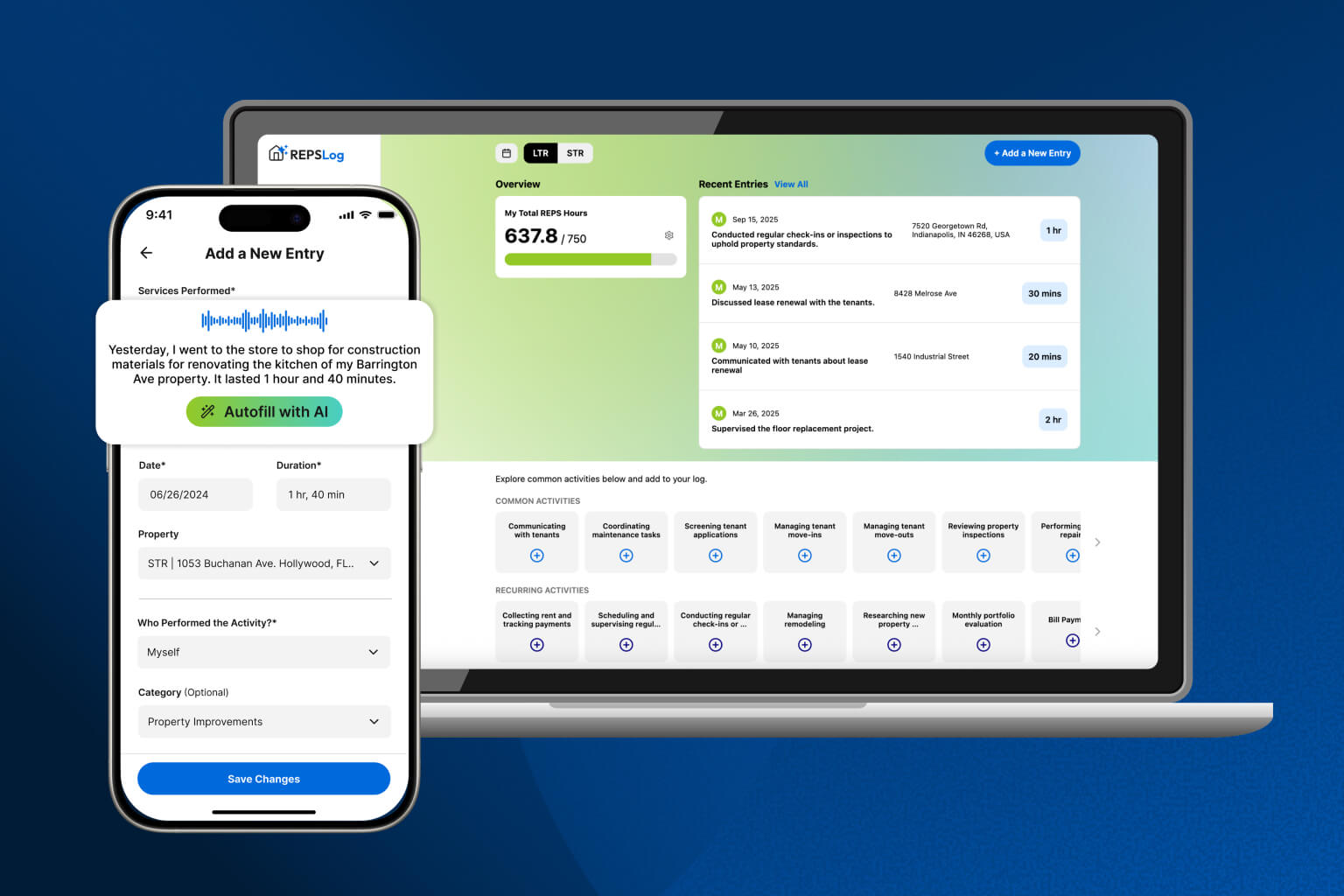
Even if you make a grouping election for material participation, tracking hours at the property level supports the safe harbor for each rental enterprise and allows flexibility in QBI aggregation decisions. REPSLog lets you log hours by property and category, maintaining the granular detail needed for both REPS and QBI compliance.

Key Takeaways
- REPS and the QBI deduction can stack, but the interaction is nuanced. REPS losses reduce QBI, which reduces the QBI deduction.
- REPS losses are typically more valuable than the QBI deduction because they eliminate income at your marginal rate rather than reducing it by 20%.
- The 250-hour safe harbor under Revenue Procedure 2019-38 provides a clean path to trade-or-business status for QBI purposes. Most REPS investors already exceed this threshold.
- Above the income threshold, the W-2 wage and UBIA limitation applies. The 2.5% UBIA component helps rental investors with substantial property basis.
- Section 199A aggregation and Section 469 grouping are separate elections with different rules. Optimize each independently.
- Track hours at the property level to support both the REPS material participation requirement and the QBI safe harbor.
Frequently Asked Questions
Can I claim both REPS and the QBI deduction in the same tax year?
Yes. REPS and the QBI deduction are separate provisions in different parts of the tax code. You can qualify as a real estate professional (allowing rental losses to offset active income) and also claim the 20% QBI deduction on any positive qualified business income from your rental activities.
Does REPS automatically qualify my rental income for the QBI deduction?
No. REPS reclassifies rental income/loss as non-passive under Section 469. The QBI deduction under Section 199A requires that the income come from a qualified trade or business under Section 162. While REPS qualification provides strong evidence of trade-or-business status, they are technically separate tests. The Revenue Procedure 2019-38 safe harbor is the cleanest way to confirm qualification.
If my rental activities generate a net loss after depreciation, is there any QBI deduction?
No. The QBI deduction is 20% of qualified business income. If your QBI is zero or negative, there is no deduction. However, the REPS-enabled loss itself is likely more valuable, since it offsets income at your marginal tax rate (potentially 32-37%) rather than providing a 20% deduction.
How does cost segregation affect the QBI deduction for REPS investors?
Cost segregation accelerates depreciation, increasing current-year rental losses. These larger losses reduce QBI, which reduces or eliminates the QBI deduction. However, the tax savings from the accelerated depreciation (at your full marginal rate) typically exceed the lost QBI deduction (at 20% of the incremental QBI reduction).
Is the Section 199A QBI deduction still available in 2026?
The QBI deduction was originally enacted by the Tax Cuts and Jobs Act of 2017 and was set to expire after 2025. Congressional action may extend, modify, or make permanent this provision. Check with your tax advisor for the current status as of your filing year.
Can I aggregate my rental properties for QBI purposes the same way I group them under Treas. Reg. 1.469-9(g)?
No. Section 199A aggregation and Section 469 grouping are separate elections with different rules. Section 199A aggregation requires common ownership and certain operational similarities. The Section 469 grouping election under Treas. Reg. 1.469-9(g) applies to all rental activities regardless of similarity. You can make different choices for each, and the optimal strategy may differ.
Do I need to meet the 250-hour safe harbor for each property or for my entire portfolio?
The safe harbor applies to each “rental real estate enterprise,” which can be an individual property or a group of similar properties. You can treat each property as its own enterprise or group similar properties together. If you group them, the 250-hour requirement applies to the group. Most REPS investors who make the grouping election can treat their entire portfolio as one enterprise and easily exceed 250 hours.
Disclaimer: This article is for educational purposes only and does not constitute tax, legal, or financial advice. Tax laws are complex and subject to change, and the availability of the Section 199A QBI deduction depends on current legislation. Consult a qualified tax professional before making any decisions related to REPS or the QBI deduction.
Track Every Hour for REPS and QBI Compliance
Meeting both the REPS hour requirements and the QBI safe harbor starts with detailed, contemporaneous record-keeping. REPSLog makes it simple to log your hours by property and category, ensuring you have the documentation for both provisions.
Available on iOS | Android | Web