If you own multiple rental properties and qualify as a Real Estate Professional, there is a single filing decision that can determine whether your rental losses offset your income or sit trapped on your return. It is called the grouping election, it lives in a Treasury Regulation most investors have never read, and getting it right — or getting it wrong — can have consequences that last for years.
This guide explains what the grouping election does, the regulation that authorizes it, when it helps, when it creates problems, how to file it, what the statement should say, and what to do if you missed the deadline.
The Problem the Grouping Election Solves
Qualifying as a Real Estate Professional under IRC Section 469(c)(7) is a major accomplishment. You have met the 750-hour test and the more-than-half test. Your rental activities are no longer automatically classified as passive. But there is a catch that trips up many investors: REPS qualification alone does not make all your rental losses non-passive.
After qualifying as a Real Estate Professional, you must still demonstrate material participation in each rental activity. And by default, the IRS treats each rental property as a separate activity. That means if you own five rental properties, you need to prove material participation five times, once for each property.
This is where the math gets uncomfortable. Suppose you logged 800 total hours across your portfolio. That is well above the 750-hour threshold. But the distribution looks like this:
- Property A: 300 hours
- Property B: 200 hours
- Property C: 150 hours
- Property D: 100 hours
- Property E: 50 hours
Using the 500-hour test (Test 1), only Property A qualifies. Using the 100-hour test (Test 3), Properties A through D might qualify (assuming no other individual logged more hours on any of them). But Property E, at 50 hours, fails every test. Its losses remain passive despite you being a qualifying Real Estate Professional.
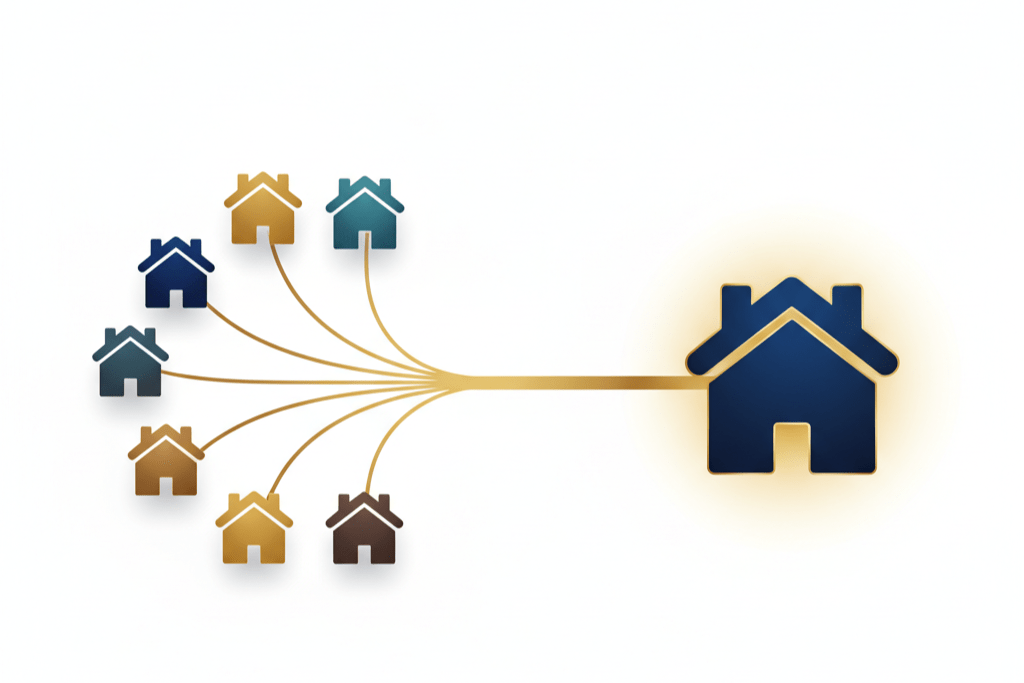
The grouping election eliminates this problem by letting you treat all your rental properties as a single activity for material participation purposes.

What Treas. Reg. Section 1.469-9(g) Actually Says
The grouping election is authorized by Treasury Regulation Section 1.469-9(g), which provides:
A qualifying taxpayer for whom this paragraph is applicable for the taxable year may make an election to treat all interests in rental real estate as a single rental real estate activity for purposes of applying the material participation tests of section 469(c)(1)(A) and any regulations thereunder.
Unpacking this:
“A qualifying taxpayer” means someone who meets the REPS requirements under IRC Section 469(c)(7)(B) for the tax year: more than 750 hours in real property trades or businesses and more than 50% of personal service time in those activities.
“All interests in rental real estate” means every rental property you own, without exception. You cannot cherry-pick. The election groups your entire rental real estate portfolio into one activity. You cannot elect to group Properties A and B while keeping Property C separate.
“A single rental real estate activity” means one combined activity. When you apply any of the seven material participation tests, you apply them to the combined hours across all properties. Your 800 total hours in the example above would easily satisfy the 500-hour test for the single grouped activity.
“For purposes of applying the material participation tests” is an important limitation. The grouping only affects how material participation is evaluated. It does not change the REPS qualification tests themselves (you still need 750 hours and the more-than-half test). And it does not change anything about how income and expenses are reported on Schedule E.
When Grouping Helps
Uneven Hour Distribution Across Properties
This is the primary use case. Most multi-property investors do not spend equal time on each property. A newly acquired fixer-upper might demand 400 hours while a stabilized property with a reliable tenant requires 40. Without grouping, the stabilized property’s losses could be passive even though you are a full-time real estate professional.
Grouping solves this by pooling your hours. As long as your combined total across all properties clears one of the material participation tests, every property’s losses are non-passive.
Portfolio Growth
As you acquire more properties, maintaining material participation in each one independently becomes harder. If you own two properties, hitting 100 or 500 hours on each is manageable. At ten properties, the math becomes very difficult without grouping.
The grouping election scales with your portfolio. One material participation test applies to the aggregate, regardless of how many properties you own.
Simplified Documentation
Without grouping, you need to produce a separate hours summary for each property, demonstrating that each one independently passes a material participation test. With grouping, you need one aggregate total. You should still track hours by property (more on that later), but the compliance burden is lighter because you only need to clear one threshold for the combined activity.
Properties with Property Management
If one of your properties is managed by a third party and you only spend 40 hours on it during the year, that property alone would fail the 100-hour test, and your property manager might log more hours than you, eliminating Test 3. Grouping prevents this from being a problem because the 40 hours are folded into your total.
When Grouping Hurts
The grouping election is not always the right choice. There are three scenarios where it can create significant problems.
Selling a Property
This is the most commonly cited downside, and it is the one that causes the most regret.
When you sell a grouped property at a gain, the gain is treated as income from the single grouped activity. If the grouped activity is non-passive (because you materially participate), the gain is non-passive income. That is usually fine.
But the issue arises with suspended passive losses. If you had passive losses from years before you made the grouping election, or from years when you did not qualify as a REPS, those suspended losses are tied to the grouped activity. When you sell one property out of the group, you cannot release all of the suspended losses from prior years, because the activity (the grouped whole) has not been fully disposed of. You sold one property, but the grouped activity continues.
Without grouping, each property is its own activity. When you sell a property, it is a complete disposition of that activity, and all suspended passive losses for that property are released at once (per IRC Section 469(g)). Grouping eliminates this release mechanism for individual properties because the sale of one property is not a disposition of the entire grouped activity.
This can lock up substantial losses indefinitely. If you plan to sell properties regularly, grouping may cost you more than it saves.
Losing REPS Status
The grouping election is only effective in years when you qualify as a Real Estate Professional. If you lose REPS status in a future year (perhaps because you take a more demanding W-2 job, or your spouse who qualified stops doing real estate work), the grouping election is dormant. Your rental activities revert to being separate, automatically passive activities for that year.
This is not catastrophic by itself, but it creates a planning complication. If you were relying on grouping to make material participation work, losing REPS status means each property is separately evaluated, and properties where you logged minimal hours will generate passive losses that year.
The election does not need to be re-filed when REPS status is regained. It reactivates automatically. But the gap year can produce unexpected passive loss limitations.
Properties with Different Character
If you own a mix of short-term rentals and long-term rentals, grouping them together can create complications. Short-term rentals that qualify for the STR loophole are excluded from the definition of “rental activity” under Treas. Reg. 1.469-1T(e)(3)(ii)(A), but exclusion from the rental classification alone does not make the activity’s losses non-passive — the owner must still demonstrate material participation in the STR activity for its losses to be treated as non-passive. Grouping is a mechanism for rental real estate activities. Mixing STR loophole properties into the group can blur the lines between different regulatory frameworks.
Additionally, if you own properties in different states, grouping all of them together as a single activity does not change the state tax treatment. Some states do not conform to the federal grouping election, and state-level material participation may still need to be evaluated property by property.
Consult your CPA before grouping dissimilar properties.
How to File the Grouping Election
The grouping election is made by attaching a written statement to your federal income tax return (Form 1040) for the first tax year you want the election to apply. There is no dedicated IRS form. The statement is a separate page attached to (or included as a PDF with) your return.
Timing
The election must be filed with the return for the first year it takes effect. If you want the election to apply starting with your 2026 tax year, you attach the statement to your 2026 Form 1040 (filed in 2027, or with an extension).
You cannot file the election retroactively for prior years through the normal process (but see the section on late filing relief below).
What the Statement Must Include
The regulation does not prescribe exact language, but Tax Court and IRS guidance make clear that the statement should contain these elements:
- A reference to the governing regulation: Treas. Reg. Section 1.469-9(g)
- A declaration that the taxpayer is a qualifying Real Estate Professional under IRC Section 469(c)(7)(B)
- A statement that the taxpayer elects to treat all interests in rental real estate as a single rental real estate activity
- The tax year the election takes effect
- The name and Social Security number of the qualifying taxpayer (and spouse, if filing jointly)
- A list of all rental real estate properties included in the election
E-Filing vs. Paper Filing
If you e-file, the election statement should be included as a PDF attachment. Most tax software has a function for attaching supplemental statements. If you paper-file, include the statement as a separate page with your return.
Duration
Once made, the election applies to every future year in which you qualify as a Real Estate Professional. You do not need to re-file it annually. If you have a year where you do not qualify for REPS, the election has no effect for that year, but it automatically reactivates if you re-qualify in a future year.
Revocation
The election is generally irrevocable. You can revoke it only if there is a material change in your facts and circumstances, such as selling most of your portfolio, fundamentally changing your level of involvement, or significantly altering the types of properties you own. Simply deciding that ungrouping would produce a better tax result is not grounds for revocation.
If you are considering revoking, talk to a tax attorney. The IRS may challenge the revocation if it appears motivated purely by tax optimization.
Template: Grouping Election Statement
Below is a template based on the regulatory requirements and common practice. Replace the bracketed items with your information.
Election to Treat All Interests in Rental Real Estate as a Single Rental Real Estate Activity
Pursuant to Treasury Regulation Section 1.469-9(g), the undersigned taxpayer hereby elects to treat all interests in rental real estate as a single rental real estate activity for the taxable year ending December 31, [YEAR], and all subsequent taxable years in which the taxpayer qualifies under Treasury Regulation Section 1.469-9(c).
Taxpayer Name: [Full Legal Name] SSN: [XXX-XX-XXXX]
Spouse Name (if filing jointly): [Spouse Full Legal Name] Spouse SSN: [XXX-XX-XXXX]
Qualifying Real Estate Professional: [Name of the spouse who meets the REPS requirements]
The qualifying taxpayer met the requirements of IRC Section 469(c)(7)(B) for the taxable year, performing more than 750 hours of services in real property trades or businesses in which the taxpayer materially participated, and performing more than 50% of all personal services in real property trades or businesses.
Rental Real Estate Interests Included in This Election:
- [Property Address] — [Property Type, e.g., Single Family Rental]
- [Property Address] — [Property Type]
- [Property Address] — [Property Type]
Signature: ________________ Date: ________________
Example Completed Statement
Election to Treat All Interests in Rental Real Estate as a Single Rental Real Estate Activity
Pursuant to Treasury Regulation Section 1.469-9(g), the undersigned taxpayer hereby elects to treat all interests in rental real estate as a single rental real estate activity for the taxable year ending December 31, 2026, and all subsequent taxable years in which the taxpayer qualifies under Treasury Regulation Section 1.469-9(c).
Taxpayer Name: David A. Chen SSN: 555-00-1234
Spouse Name: Sarah M. Chen Spouse SSN: 555-00-5678
Qualifying Real Estate Professional: Sarah M. Chen
The qualifying taxpayer met the requirements of IRC Section 469(c)(7)(B) for the taxable year, performing more than 750 hours of services in real property trades or businesses in which the taxpayer materially participated, and performing more than 50% of all personal services in real property trades or businesses.
Rental Real Estate Interests Included in This Election:
- 500 Birch Lane, Nashville, TN 37209 — Single Family Rental
- 1820 Harbor Drive, Unit A-B, Chattanooga, TN 37405 — Duplex
- 3400 Summit Ave, Nashville, TN 37215 — Short-Term Rental
- 912 Lakewood Blvd, Knoxville, TN 37920 — Single Family Rental
Signature: Sarah M. Chen Date: April 10, 2027
Properties Acquired After the Election
Any rental real estate interest you acquire after filing the grouping election is automatically included in the grouped activity. You do not need to amend the statement or re-file. The regulation groups “all interests in rental real estate,” and new acquisitions are interests in rental real estate.
That said, it is good practice to mention new properties when your CPA prepares your return, so the property list on file is current. If an audit occurs years later, a complete property list eliminates ambiguity about which properties were intended to be part of the group.
Late Filing Relief Under Rev. Proc. 2011-34
If you should have filed the grouping election in a prior year but did not attach the statement, Revenue Procedure 2011-34 may provide relief.
Who Qualifies for Late Filing Relief
You must meet all four conditions:
- You were a qualifying Real Estate Professional for each year the election should have been in place. You actually met the 750-hour and more-than-half tests.
- You filed your returns consistently as if the election existed. You treated all your rental real estate as a single activity and reported losses accordingly. If some years you treated certain properties as passive and others as non-passive without a grouping election, the consistency requirement is not met.
- You failed to attach the formal written statement. The only deficiency was the paperwork. You did the work, met the requirements, filed consistently, but forgot the statement.
- The IRS has not previously denied the election for any year in question. If an examiner specifically rejected your grouping election during an audit, Rev. Proc. 2011-34 generally does not give you a second attempt for that year.
How to File the Late Election
Prepare the standard grouping election statement (using the template above) and add the following header at the top:
FILED PURSUANT TO REV. PROC. 2011-34
Attach this statement to your next filed tax return. The late election is treated as if it had been in place for all prior years in which you met the four conditions.
You generally do not need to amend prior-year returns. The election applies retroactively based on your consistent filing history.
When Rev. Proc. 2011-34 Does Not Help
- You did not actually qualify for REPS in the prior years
- Your returns were not filed consistently with the election (mixed passive/non-passive treatment)
- You are learning about the grouping election for the first time and have no filing history to correct (in this case, simply attach the election to your next return going forward)
- An IRS examiner already denied the election on audit
Record-Keeping After the Election
Making the grouping election simplifies the material participation analysis, but it does not eliminate the need for detailed records. In fact, smart record-keeping becomes even more important after you group.
Track Hours by Property
Even though material participation is evaluated for the single grouped activity, you should still log your hours by individual property. There are two reasons:
Audit preparation. If the IRS questions your material participation, they may ask for a property-by-property breakdown. Having hours segregated by property shows thorough record-keeping and makes it easy to demonstrate how the aggregate total was reached.
Future flexibility. If you sell a property or revoke the election, you will need property-level data to evaluate material participation and suspended losses on a per-property basis. Hours that were only tracked in aggregate cannot be reliably split after the fact.
Track in Real Time
Grouped or not, the IRS expects contemporaneous records. A log maintained throughout the year is far more defensible than one assembled at tax time. The same principles apply whether you have one property or twenty.
Frequently Asked Questions
Can I group some properties and leave others ungrouped?
No. The regulation requires you to group all interests in rental real estate. It is all or nothing. You cannot selectively group certain properties while keeping others separate.
Does the grouping election affect my Schedule E?
No. You still report income and expenses for each property separately on Schedule E. The grouping election only changes how material participation is evaluated. Your tax preparer handles the material participation analysis separately from Schedule E reporting.
If I lose REPS status for one year, do I need to re-file the election when I re-qualify?
No. The election remains in effect and reactivates automatically in any future year that you qualify as a Real Estate Professional. There is no re-filing requirement.
My spouse qualifies for REPS. Does the grouping election apply to both of us?
Only the qualifying spouse (the one who meets the 750-hour and more-than-half tests) can make the election. However, on a joint return, the election benefits both spouses because losses from the grouped activity flow to the joint return. Both spouses’ hours can be combined when evaluating material participation for the grouped activity.
Can I use the grouping election with the STR loophole?
This requires careful analysis. The STR loophole applies to properties that are not “rental activities” under IRC Section 469 (because the average guest stay is seven days or fewer). The grouping election under Treas. Reg. Section 1.469-9(g) applies to “interests in rental real estate.” If a property qualifies for the STR loophole, it may already be outside the scope of the grouping election. Mixing the two strategies across different properties in the same portfolio is common, but the interaction requires coordination with your CPA.
What if I only own one property? Should I file the election?
The election has no practical effect with a single property because there is nothing to group. You might consider filing it proactively if you plan to acquire additional properties soon, but most CPAs advise filing it when you actually own multiple properties.
Does grouping affect depreciation recapture when I sell?
No. Depreciation recapture under IRC Section 1250 is calculated on a property-by-property basis regardless of whether the properties are grouped. Grouping affects the passive/non-passive characterization of gain or loss, not the depreciation recapture calculation itself.
Key Takeaways
- The grouping election under Treas. Reg. Section 1.469-9(g) lets qualifying Real Estate Professionals treat all rental properties as a single activity for material participation purposes.
- It solves the problem of uneven hour distribution across multiple properties and scales well as your portfolio grows.
- The election is made by attaching a written statement to your tax return for the first year it applies. No special IRS form is needed.
- Grouping is irrevocable except in cases of material changes in circumstances. Think carefully before filing.
- The biggest risk is on property sales: grouping can prevent the release of suspended passive losses when you sell an individual property.
- If you missed the filing deadline, Rev. Proc. 2011-34 provides late filing relief if you meet four conditions.
- Continue tracking hours by property even after grouping, for audit defense and future flexibility.
Organize Your Hours for the Grouping Election
Whether you are evaluating whether to group, filing the election for the first time, or defending it in an audit, the foundation is the same: clean, contemporaneous records of your hours by property and activity.
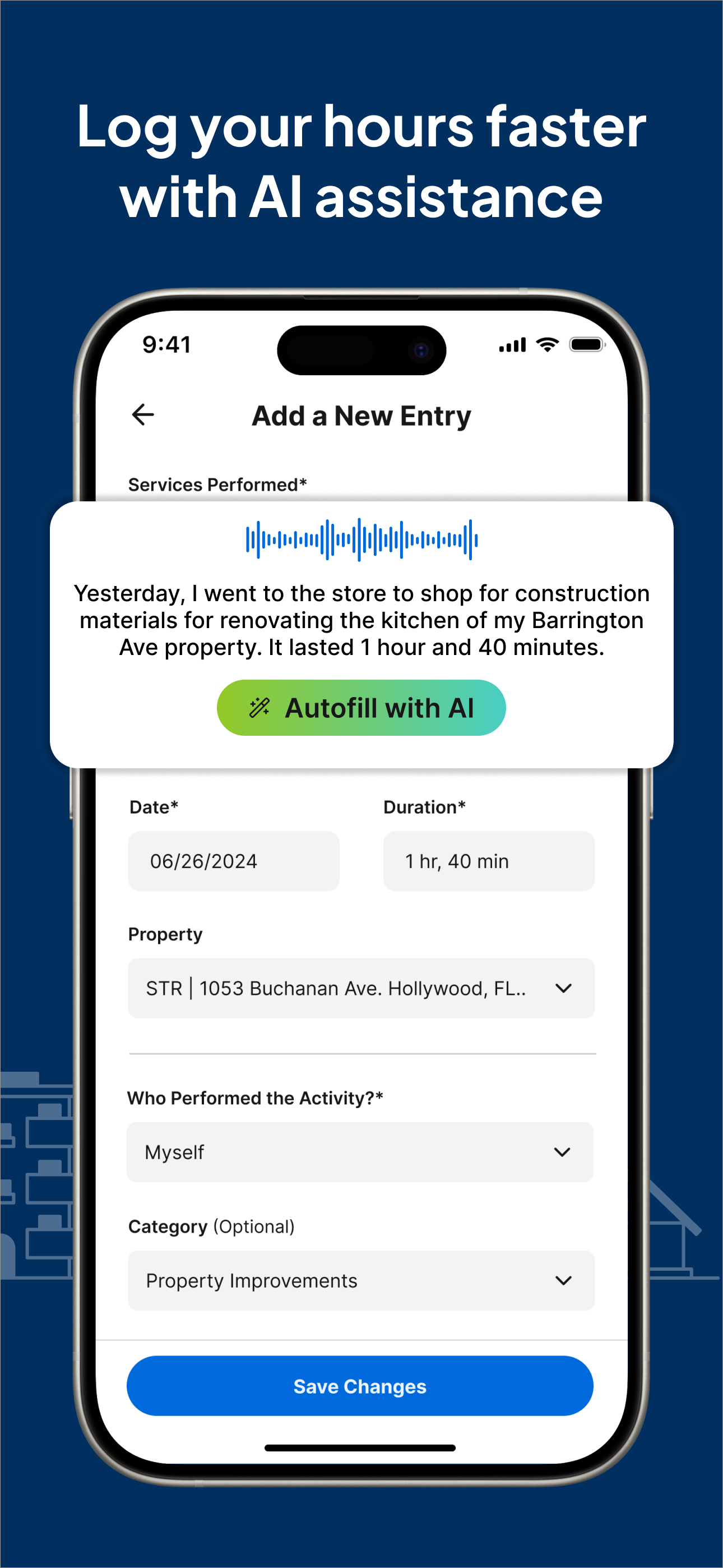
REPSLog tracks your material participation hours by property and category throughout the year. See your aggregate total for material participation testing, while keeping a property-level breakdown ready for any future need. Available on iOS and Android, or on the web at app.reps-log.com. Start tracking your hours free →.
This article is for educational purposes only and does not constitute tax or legal advice. Consult a qualified tax professional regarding your specific situation before making any election or filing decision.
Do this in REPSLog
- Multiple Properties: add each rental by address, mark it LTR or STR, see hours per property.
- Hours Dashboard and Stats: hours by property, category and year against your goal.
- CPA-ready Export (PDF and CSV): a tax year as PDF and CSV, split by LTR and STR, with receipts.
Step by step in the Help Center: how to use it. Try REPSLog free for 14 days on iPhone, Android or the web app.