Every year, thousands of real estate investors sit down with their CPA and ask the same question: “Can I get Real Estate Professional Status even though I have a day job?” The answer is nuanced, and most of the advice floating around online glosses over the part that actually matters. Let’s break it down with full transparency.
Understanding the Two-Hurdle System
The IRS doesn’t hand out Real Estate Professional Status (REPS) based on a single threshold. You need to clear two distinct hurdles in the same tax year, and both must be satisfied simultaneously:
Hurdle 1: The 750-Hour Minimum
You must spend more than 750 hours performing services in real property trades or businesses during the tax year. This is the number everyone fixates on, and honestly, it’s the easier of the two requirements for most active investors.
Hurdle 2: The More-Than-Half Requirement
Here is where full-time employees hit a wall. Your real estate hours must constitute more than 50% of all the personal services you perform during the year. “Personal services” encompasses essentially every hour you spend working in any trade or business, including your W-2 employment.
The critical insight is that the second hurdle, not the first, is what disqualifies most working professionals. You could log 1,500 hours of legitimate real estate work and still fail if your day job consumed 1,600 hours.

Running the Numbers on a 40-Hour Work Week
Let’s put concrete figures behind this. A standard full-time position runs roughly 2,080 hours annually (40 hours multiplied by 52 weeks). Even accounting for vacation, most W-2 employees clock between 1,800 and 2,000 hours per year.
To satisfy the more-than-half test, your real estate hours must exceed your total non-real-estate personal service hours. If your employer reports 2,000 hours of work:
- You would need at least 2,001 hours of qualifying real estate activity
- That’s approximately 38.5 hours per week of real estate work on top of your full-time position
- Combined, you’d be working roughly 78 hours every single week for the entire year
That schedule is unsustainable for virtually anyone. And the IRS knows it. An auditor reviewing a return where someone claims 4,000+ total personal service hours will scrutinize those records with extreme skepticism.
Why the 750-Hour Number Is Misleading in Isolation
The 750-hour threshold gets disproportionate attention because it sounds achievable. At roughly 14.5 hours per week, plenty of active landlords can reach that mark. But reaching 750 hours means absolutely nothing if you worked 1,500 hours at your regular job. You’d still fail the more-than-half test because 750 is not greater than 1,500.
This is the trap: investors celebrate hitting 750 hours in October, stop tracking diligently, and then discover at tax time that they never had a chance of qualifying. Their CPA has to deliver the bad news that REPS was mathematically impossible from the start.
If you hold a full-time position, you need to evaluate the more-than-half requirement first. Work backward from your anticipated W-2 hours before setting any real estate hour goals.
Realistic Paths Forward for W-2 Employees
If you’re employed full time and serious about unlocking REPS-level tax benefits, you have several legitimate options. None of them involve fabricating hours.
Option 1: Reduce Your Employment Hours
The most direct approach is to lower the denominator. If you transition to part-time employment at 1,000 hours per year, you’d only need 1,001 hours of real estate activity to satisfy the more-than-half requirement. That’s roughly 19 hours per week in real estate, which is achievable for investors managing multiple properties.
Some investors negotiate reduced schedules, job-share arrangements, or consulting contracts specifically to create this flexibility. The transition doesn’t have to be permanent. Even a single year at reduced hours can unlock substantial deductions if you have accumulated rental losses.
Option 2: Qualify Through Your Spouse
The tax code evaluates REPS at the individual level. Only one spouse needs to qualify for the couple to elect REPS treatment on their joint return. Critically, the qualifying spouse’s more-than-half test is measured against that spouse’s own personal service hours, not the household total.
Consider this scenario: one spouse works full time earning $200,000 at a W-2 job. The other spouse manages the couple’s rental portfolio, spending 800 hours on real estate activities and 400 hours on a part-time consulting gig. The second spouse qualifies for REPS because 800 exceeds 400 (more-than-half satisfied) and 800 exceeds 750 (minimum hour threshold satisfied).
The key limitation: only the qualifying spouse’s participation hours count toward REPS qualification. You cannot combine both spouses’ real estate hours. However, once one spouse qualifies, the couple can use the REPS election on their joint return to treat rental activities as non-passive. While spouses cannot combine hours for REPS qualification, they can combine hours for material participation on individual rental properties under IRC Section 469(h)(5).
Option 3: Use the STR Loophole Instead
If neither reducing your hours nor qualifying through a spouse is feasible, the short-term rental (STR) loophole may be your best alternative path.
Properties with an average guest stay of seven days or less are not classified as rental activities under IRC Section 469. Instead, they’re treated as regular trade or business activities. This classification eliminates both the 750-hour requirement and the more-than-half test entirely.
To deduct losses from an STR property, you need to demonstrate material participation on that specific property. The most commonly used test requires you to spend more than 100 hours on the activity during the year, with no other individual spending more hours than you on that same property.
For a W-2 employee, 100 hours on a single property is roughly two hours per week. That’s realistic even with a demanding day job. This is precisely why the STR loophole has become the preferred strategy for high-income earners who want real estate tax benefits without leaving their careers.
Option 4: The Sabbatical or Career Transition Year
Some investors time their REPS qualification around natural career breaks. A sabbatical, a gap between jobs, parental leave, or a transition to self-employment can all reduce your non-real-estate hours enough to make the math work.
If you know you’ll be between positions for several months, that’s the year to maximize your real estate activity and capture the REPS election. The tax savings from a single qualifying year (especially if you have large accumulated passive losses) can be substantial enough to justify planning your career moves around the opportunity.
Similarly, investors approaching retirement can qualify for REPS during their first year of reduced employment, even if they never qualified while working full time.
What Counts as “Personal Services” and What Doesn’t
The more-than-half test references “personal services performed in trades or businesses.” Understanding what falls inside and outside this definition is essential for your calculation.
Hours that count against you (non-real-estate personal services):
- W-2 employment hours (all of them, including overtime)
- Self-employment hours in non-real-estate businesses
- Hours in a trade or business where you’re a partner or S-corp shareholder
- Consulting or freelance work outside of real estate
Hours that do NOT count against you:
- Volunteer work (no trade or business involved)
- Personal investment management (stocks, crypto, passive fund monitoring)
- Household and family responsibilities
- Education not connected to a current trade or business
This distinction matters. If you spend 300 hours per year managing your stock portfolio, those hours don’t increase your personal service total. Only time spent in an active trade or business counts. An investor whose only “work” is a part-time W-2 job at 800 hours and real estate at 801 hours qualifies, regardless of how they spend the rest of their time.
Documentation Requirements When You Have W-2 Income
If you claim REPS while also receiving W-2 income, you should expect heightened IRS attention. An auditor’s first move will be to calculate your W-2 hours and compare them against your claimed real estate hours. Your documentation needs to be airtight.
For your W-2 hours: Keep records of your actual hours worked. If you’re salaried and don’t track time, request a statement from your employer or document your typical schedule. The IRS may default to 2,080 hours for a full-time employee unless you can prove otherwise. If you work 35 hours per week rather than 40, that difference of 260 hours could be the margin that makes your qualification viable.
For your real estate hours: Maintain a contemporaneous log, meaning entries created at or near the time you performed the work. Each entry should record the date, the duration, the specific activity performed, and which property it relates to. Vague descriptions like “property stuff” or blocks of identical 2.0-hour entries will not survive audit scrutiny.
Supporting evidence: Calendar appointments, email timestamps, travel records, contractor invoices, and property management correspondence all corroborate your log. The more independent documentation you can point to, the stronger your position.
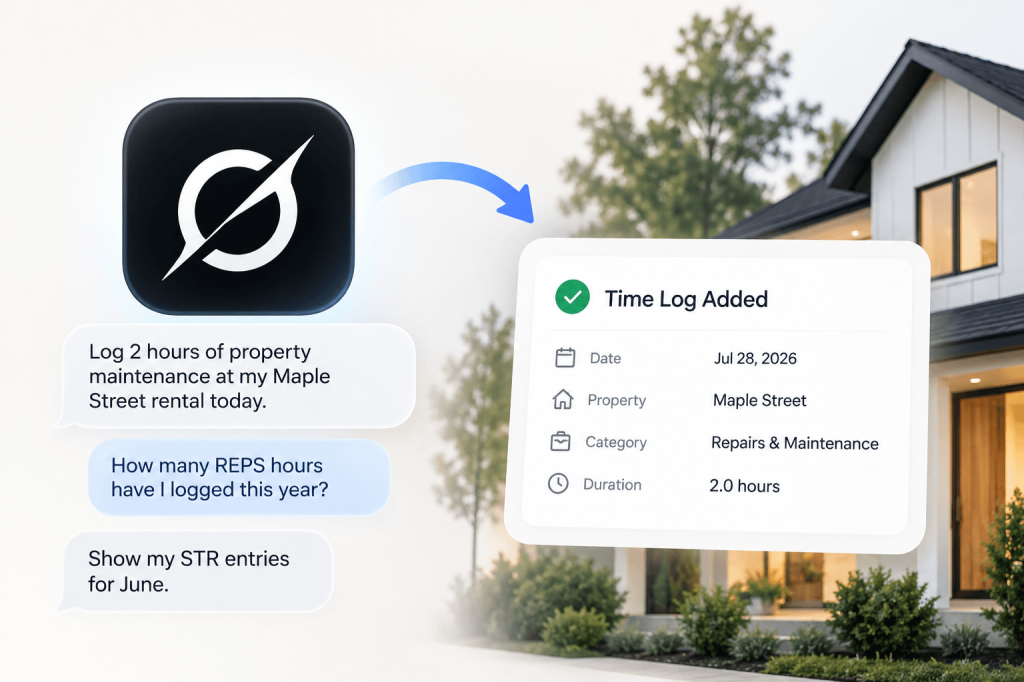
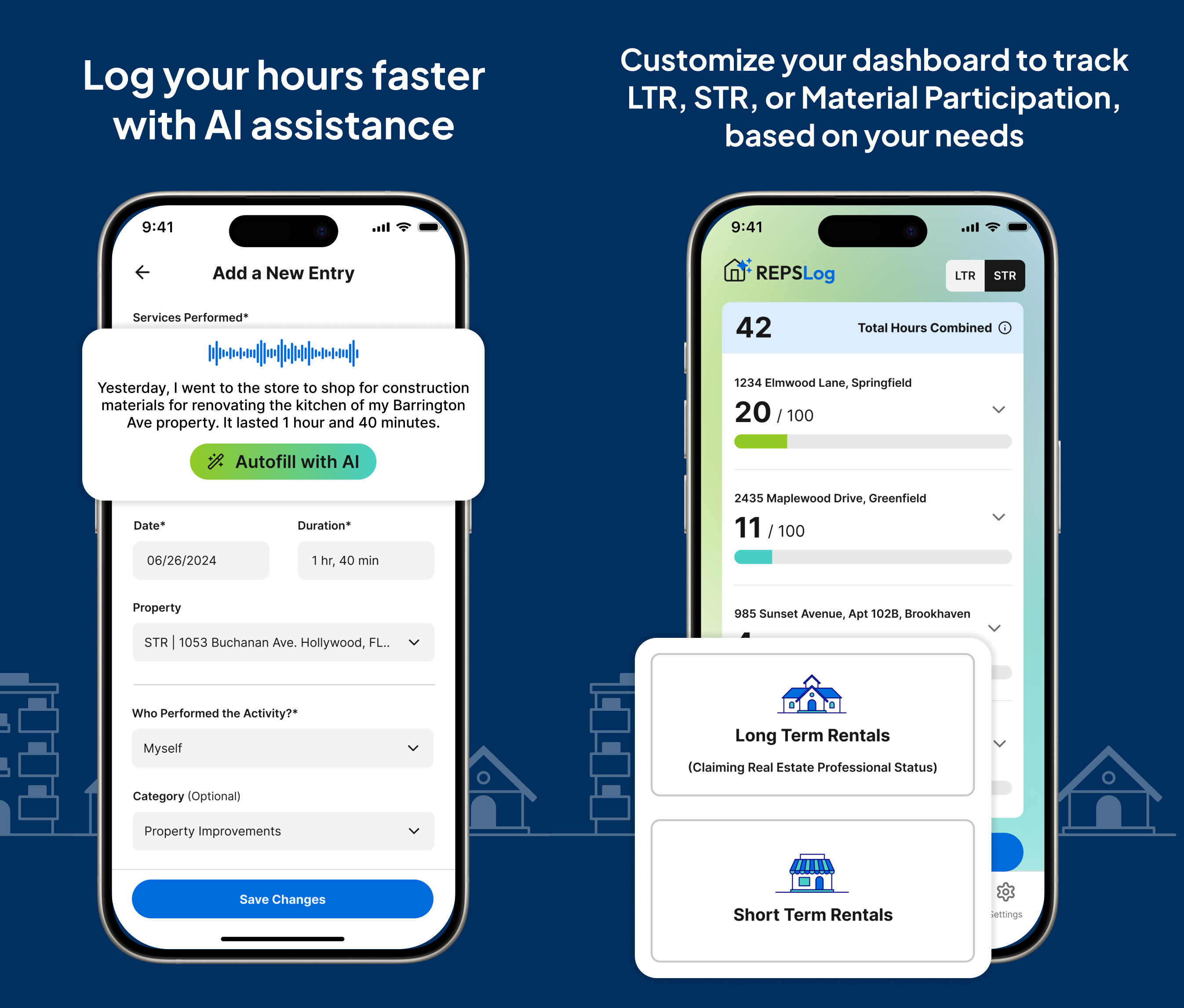
REPSLog is designed to make this documentation process seamless. You can log hours directly from your phone with timestamped entries, categorize activities by property, and generate comprehensive reports that satisfy IRS requirements. The app is available on iOS and Android, or on the web at app.reps-log.com. Start tracking your hours free →.
Frequently Asked Questions
Does the IRS check my W-2 hours against my REPS claim?
Yes. In an audit, the IRS will typically determine your W-2 hours by reviewing pay stubs, employer records, or applying standard full-time assumptions. They then compare this figure against your claimed real estate hours. If your real estate hours don’t exceed your employment hours, you fail the more-than-half test regardless of how many real estate hours you logged.
Can I count weekends and evenings toward REPS?
Absolutely. There’s no restriction on when you perform real estate activities. Many qualifying investors do the bulk of their real estate work during evenings, weekends, and early mornings. What matters is that the activities are legitimate, properly documented, and actually occurred.
What if I’m a real estate agent with a W-2 from my brokerage?
Real estate agent hours count as real property trade or business hours. If your W-2 comes from a real estate brokerage, those hours actually help you satisfy both the 750-hour minimum and the more-than-half test, because they are real estate personal services. This is one scenario where a W-2 job and REPS qualification work together rather than against each other.
My employer doesn’t track exact hours. What do I use?
If you’re salaried without time records, document your typical work schedule in writing. Note your standard arrival and departure times, lunch breaks, and any days off. Some taxpayers obtain a letter from their employer confirming their expected hours. The IRS may apply a standard 40-hour week if you can’t demonstrate otherwise, so it’s in your interest to document a lower actual figure if that’s the reality.
Can I combine real estate hours from multiple activities?
Yes, but with an important caveat. You can aggregate hours across all your real property trade or business activities for the 750-hour test and the more-than-half test. However, you must also separately demonstrate material participation in each rental activity (unless you make a grouping election under Treas. Reg. Section 1.469-9(g) to treat all your rentals as a single activity).
Is it worth pursuing REPS if I’m close to retirement?
Often, yes. The year you retire or significantly reduce your working hours can be an ideal year to qualify. If you’ve accumulated suspended passive losses over many years of rental investing, a single qualifying REPS year can unlock those losses against your other income. Planning your real estate activity levels around your retirement date can produce meaningful tax savings.
Key Takeaways
- The more-than-half test, not the 750-hour minimum, is the real barrier for anyone with full-time employment
- At a standard 40-hour work week, you would need over 2,000 hours of real estate activity to qualify, which is practically a second full-time job
- Reducing your employment to part-time (or less) dramatically lowers the threshold you need to clear
- The spouse qualification strategy lets one spouse’s real estate hours stand on their own, independent of the other spouse’s W-2 hours
- The STR loophole is often the most practical path for W-2 earners, requiring more than 100 hours per property with no more-than-half test
- Career transitions, sabbaticals, and retirement create natural windows for REPS qualification
- Documentation of both your W-2 hours and real estate hours must be thorough and contemporaneous
Start Building Your Documentation Today
Whether you’re working toward REPS qualification this year or laying the groundwork for a future qualifying year, consistent hour tracking is the foundation of every successful strategy. REPSLog helps you log real estate hours from your phone, organize activities by property and category, and generate the detailed reports you’ll need at tax time or in an audit. Available on iOS and Android, or on the web at app.reps-log.com. Start tracking your hours free →.
This article is for educational purposes only and does not constitute tax or legal advice. REPS qualification involves complex, fact-specific determinations under IRC Section 469. Consult a qualified tax professional for guidance tailored to your individual circumstances.
Do this in REPSLog
- REPS Hour Tracking Goals (750 / 500 / 100): pick the 750, 500 or 100-hour test and watch progress per year and per property.
- Hours Dashboard and Stats: hours by property, category and year against your goal.
- Built-in Timer with Live Activity: time an activity live and drop the minutes into an entry.
Step by step in the Help Center: how to use it. Try REPSLog free for 14 days on iPhone, Android or the web app.