You spent all year managing your rentals, logging hours, and pushing toward 750. Then your CPA ran the numbers and the verdict came back: you didn’t make it. Maybe you fell short on hours. Maybe the more-than-half test tripped you up. Either way, you’re not getting Real Estate Professional Status this year.
Before you panic, understand this: missing REPS is not a financial catastrophe. Your rental losses don’t vanish. You have multiple fallback options available right now, and you can position yourself to qualify next year. Here’s exactly what happens and what you can do about it.
The Default: Passive Activity Loss Rules Take Over
When you don’t hold Real Estate Professional Status, the IRS treats your rental real estate activities as passive by default under IRC Section 469. This classification has one major consequence: passive losses can only be used to offset passive income.
If your rental properties generated $40,000 in tax losses this year (after accounting for depreciation, mortgage interest, repairs, and operating expenses), those losses cannot offset your W-2 salary, business income, capital gains, or any other non-passive income. They’re effectively frozen.
This is the fundamental problem that REPS solves. With REPS, your rental activities become non-passive, and those losses can offset any type of income. Without it, Section 469 keeps those losses locked away until you have either passive income or a qualifying disposition event.
Your Losses Are Suspended, Not Destroyed
This is the most important thing to understand: suspended passive losses do not expire. They carry forward indefinitely under the passive activity loss (PAL) carryforward rules until one of two things happens.
Trigger 1: You generate passive income. If next year you have $15,000 in passive income from a different source (perhaps a K-1 from a passive partnership, or a rental property that produces net taxable income), your carried-forward losses can offset that passive income dollar for dollar. You don’t need REPS to use suspended losses against passive income.
Trigger 2: You dispose of the property in a fully taxable transaction. When you sell the property that generated the suspended losses, all accumulated passive losses from that specific activity are released and become deductible against any type of income, including W-2 wages and capital gains. This is codified in IRC Section 469(g).
This disposition rule is powerful. An investor who accumulated $200,000 in suspended losses over a decade of ownership can deduct the entire amount in the year of sale, creating a massive tax reduction. The losses were never lost; they were waiting.
Note that a 1031 exchange does not trigger this release, because it’s not a fully taxable disposition. The suspended losses carry over to the replacement property instead.
The $25,000 Active Participation Exception
Even without REPS, the tax code provides a partial escape valve for smaller landlords who are involved in managing their properties. Under IRC Section 469(i), you can deduct up to $25,000 in rental real estate losses against non-passive income if you meet two conditions:
Condition 1: Active participation. You must actively participate in the rental activity. This is a lower threshold than material participation. Active participation means you’re involved in management decisions in a meaningful and bona fide sense: approving tenants, setting rental terms, authorizing expenditures. You can use a property manager and still satisfy this standard, as long as you retain decision-making authority.
Condition 2: Income limits. Your modified adjusted gross income (MAGI) must be below $150,000. The full $25,000 allowance is available at MAGI of $100,000 or less. Between $100,000 and $150,000, the allowance phases out at a rate of $0.50 for every dollar of MAGI above $100,000. At $150,000 MAGI, the allowance disappears entirely.
The math on the phase-out:
| MAGI | Maximum Allowable Deduction |
|---|---|
| $100,000 or less | $25,000 |
| $110,000 | $20,000 |
| $120,000 | $15,000 |
| $130,000 | $10,000 |
| $140,000 | $5,000 |
| $150,000+ | $0 |
For many real estate investors, particularly high earners, the MAGI threshold renders this exception useless. If your household income exceeds $150,000, you won’t benefit from the $25,000 allowance at all. This is precisely the income range where REPS becomes most valuable and where the inability to qualify stings the most.
Plan B: The Short-Term Rental Loophole
Here’s where many investors discover their best alternative. If you own properties with an average guest stay of seven days or fewer, those properties may qualify for treatment under what’s commonly called the STR loophole.
Under Treasury Regulation 1.469-1T(e)(3)(ii)(A), a rental activity is excluded from the definition of “rental activity” if the average period of customer use is seven days or less. When a property falls outside the rental activity classification, it’s treated as a regular trade or business. This means the passive activity loss limitations that apply to rental activities don’t automatically apply.
To deduct losses from an STR property against your ordinary income, you still need to demonstrate material participation. But the tests are fundamentally different from REPS:
- No 750-hour annual minimum. The material participation tests under Section 469 focus on your involvement in each specific activity.
- No more-than-half test. Your W-2 hours are irrelevant to the STR loophole analysis.
- Most commonly used test: You spent more than 100 hours on the activity during the year, and no other individual (including property managers, co-hosts, and cleaners) spent more hours than you on that same activity.
For a W-2 employee who fell short of REPS, the STR loophole can salvage significant tax benefits. You might not be able to deduct losses on your long-term rentals, but your short-term rental properties could still generate non-passive deductions if you can demonstrate material participation.
If you own STRs and haven’t been tracking your hours against material participation tests, start now. Even mid-year tracking can establish a record for the current tax year.
Qualifying Through Your Spouse
REPS qualification is an individual test, but only one spouse needs to qualify for the election to apply on a joint return. If you didn’t qualify this year, consider whether your spouse could qualify instead.
The evaluation is straightforward: does your spouse spend more than 750 hours in real property trades or businesses, and do those hours constitute more than half of their total personal service hours? If your spouse works part-time or is not employed outside the home, their personal service hour total is lower, making the more-than-half threshold much easier to clear.
Even if it’s too late for this year, restructuring responsibilities so that one spouse handles the majority of real estate management duties can set you up for qualification next year. This might mean one spouse takes over tenant communications, property inspections, bookkeeping, and contractor coordination while the other focuses on their W-2 career.
The key requirement: the qualifying spouse must actually perform the work and be able to document their hours independently. The IRS has denied REPS claims where spouses attempted to attribute hours that were actually performed by the other spouse.
What Happens When You Eventually Sell
The disposition rule in Section 469(g) is the ultimate safety net for investors who never qualify for REPS. When you sell a property in a fully taxable transaction, every dollar of suspended passive loss from that activity becomes deductible in the year of sale.
Consider an investor who owned a rental property for 12 years without ever qualifying for REPS. Over that period, they accumulated $180,000 in suspended passive losses from depreciation and operating expenses. When they sell the property for a gain of $100,000:
- The $180,000 in suspended losses is released
- $100,000 offsets the gain on sale (reducing taxable gain to zero)
- The remaining $80,000 offsets other income (W-2, business income, capital gains from other sources)
- Total tax benefit in the year of sale could exceed $30,000 depending on the investor’s marginal rate
This is why your CPA will tell you to keep meticulous records of passive losses even in years you don’t qualify for REPS. Those accumulated losses represent real future tax value. If your records are incomplete, you may lose the ability to claim losses you’re legally entitled to deduct at disposition.
PAL Carryforward Mechanics You Should Understand
Passive activity losses carry forward on a per-activity basis. This means the IRS tracks which property generated which losses. Understanding a few mechanics will help you plan:
Annual recalculation: Each year, your passive income and losses are netted. If you have $10,000 in passive losses from Property A and $3,000 in passive income from Property B, only $7,000 is added to your suspended loss balance ($10,000 minus $3,000).
Multiple property tracking: If you own five rental properties, each property’s suspended losses are tracked separately. Selling one property releases only that property’s accumulated losses, not the losses from your entire portfolio.
Death of the taxpayer: Under current law, suspended passive losses are allowed as a deduction on the decedent’s final return, but only to the extent they exceed the step-up in basis that the heir receives. Depending on the property’s fair market value, a significant portion of accumulated losses may effectively disappear at death. This is an argument for strategic disposition planning while you’re alive.
Grouping elections: If you’ve made an election to group your rental activities as a single activity under Treas. Reg. Section 1.469-9(g), all grouped properties are treated as one activity for PAL purposes. You’d need to dispose of all properties in the group to trigger the full release. Think carefully before grouping if disposition planning is part of your strategy.
Planning for Next Year’s Qualification
Missing REPS this year is a data point, not a verdict. Use it to plan strategically for next year.
Audit your hour shortfall. Exactly how many hours did you fall short? If the gap was 50 hours, minor adjustments to your routine could bridge it. If the gap was 500 hours, you need a structural change in how you allocate your time.
Identify the binding constraint. Did you fail the 750-hour test, the more-than-half test, or both? The answer determines your strategy. If the more-than-half test was the problem, no amount of additional real estate hours will help unless you also reduce your W-2 hours.
Examine your activity categories. Were you performing activities that don’t count toward REPS? Time spent on investor-type activities (reviewing financial statements, attending investment seminars, passively monitoring property managers) doesn’t qualify. Redirect that time toward hands-on management activities that do count.
Start tracking on January 1. Not January 15. Not “when things pick up.” The first day of the year. Every hour counts, and the investors who qualify consistently are the ones who treat tracking as a year-round discipline rather than a year-end scramble.
Consider the grouping election. If you haven’t filed a grouping election to treat all your rental properties as a single activity, discuss it with your CPA. Grouping allows you to aggregate material participation hours across all properties, which can make the difference between qualifying and falling short.
Don’t Fabricate a Qualification You Didn’t Earn
The temptation exists. You’re sitting at 720 hours, you know what’s at stake financially, and nobody is watching you type 780 into your tax software. Don’t do it.
The IRS has seen this pattern thousands of times. REPS claims are among the most frequently audited positions on individual returns, particularly for taxpayers with substantial W-2 income and large rental loss deductions. The penalties for an inaccurate REPS claim include:
- Disallowance of all rental loss deductions claimed under REPS
- Interest on the resulting tax underpayment
- Accuracy-related penalties of 20% under Section 6662
- Potential fraud penalties of 75% in egregious cases
The suspended losses from a non-qualifying year will still be available to you in the future. The risk-adjusted value of a fraudulent REPS claim is deeply negative.
Frequently Asked Questions
Can I amend a prior year return to claim REPS if I later discover I qualified?
You can file an amended return within three years of the original filing date (or two years from the date of payment, whichever is later). However, you must have actually met all REPS requirements during that prior year and have documentation to prove it. Retroactive reconstruction of a contemporaneous log is risky and may not withstand audit scrutiny.
Do suspended passive losses offset capital gains?
Not directly. Suspended passive losses can only offset passive income during years you hold the property. However, at disposition, the released losses become fully deductible and can offset capital gains, ordinary income, or any other type of income on your return.
What if I qualified for REPS last year but not this year?
REPS is tested annually. Last year’s qualification has no bearing on this year. Your rental activities revert to passive classification for the current year. Any net rental losses this year become subject to the passive activity loss rules, though you can still use the $25,000 active participation allowance if your income qualifies.
Can I use suspended losses from one property to offset gains from selling a different property?
No. Suspended passive losses from one activity can only be released upon disposition of that specific activity (or used to offset passive income from any source). Selling Property A does not release suspended losses from Property B unless the properties were grouped as a single activity.
Is there a limit to how many years losses can be carried forward?
No. Under current federal tax law, suspended passive losses carry forward indefinitely. There is no expiration. However, state tax rules may differ, so confirm with your CPA regarding your specific state.

Key Takeaways
- Missing REPS does not eliminate your rental losses. They are suspended and carry forward indefinitely until you have passive income or sell the property.
- The $25,000 active participation allowance is available to investors with MAGI under $150,000 who actively manage their rentals, but phases out completely above that threshold.
- The STR loophole offers a viable alternative path for short-term rental owners, with no 750-hour minimum and no more-than-half test.
- At disposition, all suspended passive losses from the sold property are fully released against any income type.
- REPS is evaluated annually, so a missed year doesn’t affect future qualification.
- Never claim REPS if you didn’t actually qualify. The penalties significantly outweigh the benefit.
Track Every Hour, Regardless of Whether You Qualify
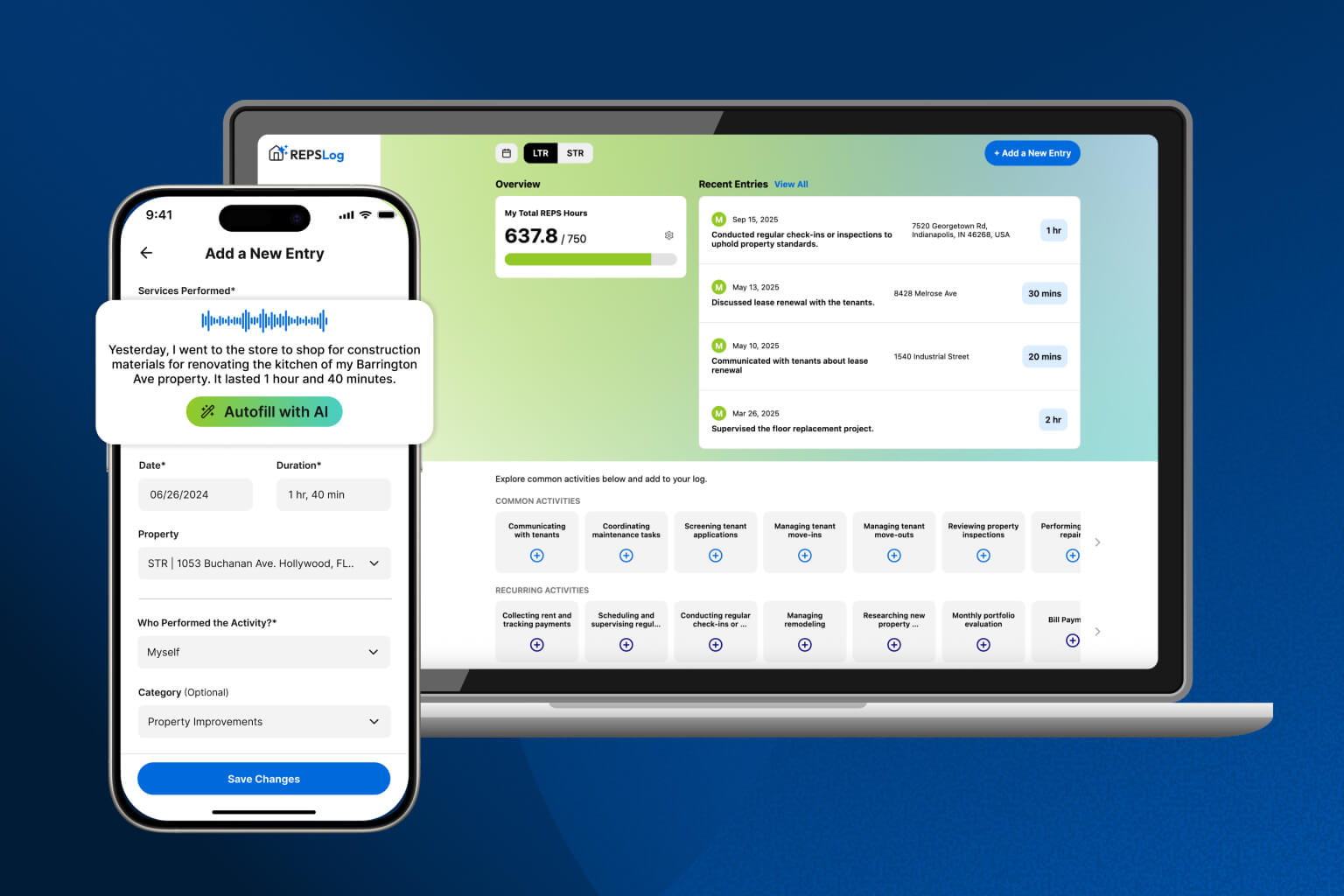
Even in years when REPS is out of reach, your tracked hours serve critical purposes: they support STR material participation claims, strengthen your credibility in future audits, and provide the data you need to plan next year’s qualification strategy. REPSLog lets you log hours from your phone in seconds, organize activities by property and category, and maintain the kind of contemporaneous record the IRS expects. Available on iOS and Android, or on the web at app.reps-log.com. Start tracking your hours free →.
This article is for educational purposes only and does not constitute tax or legal advice. Passive activity loss rules and REPS qualification involve complex, fact-specific analysis under IRC Section 469. Consult a qualified tax professional for guidance tailored to your situation.
Do this in REPSLog
- Hours Dashboard and Stats: hours by property, category and year against your goal.
- CPA-ready Export (PDF and CSV): a tax year as PDF and CSV, split by LTR and STR, with receipts.
- REPS Hour Tracking Goals (750 / 500 / 100): pick the 750, 500 or 100-hour test and watch progress per year and per property.
Step by step in the Help Center: how to use it. Try REPSLog free for 14 days on iPhone, Android or the web app.