Imagine meticulously logging 932 hours of real estate activity over the course of a year, only to have the Tax Court say it was not enough. That is exactly what happened in Hairston v. Commissioner (T.C. Memo 2019-104), a case that should concern every real estate professional who relies on REPS to deduct rental losses against ordinary income.
The Hairstons did not fail because they were lazy. They failed because of how they logged their hours, what activities they counted, and how they presented their case. Understanding why their claim collapsed reveals critical lessons about what the IRS and Tax Court actually look for in a REPS qualification.
The Facts of the Case
Mr. and Mrs. Hairston owned several rental properties and claimed Real Estate Professional Status on their tax return, using it to deduct substantial rental losses against their other income. When the IRS challenged their REPS claim, the case went to Tax Court.
Mr. Hairston presented a log showing 932 hours of real estate activity for the tax year. On its face, this exceeded the 750-hour threshold required under IRC Section 469(c)(7). He should have been in the clear.
But the Tax Court looked beyond the total number and examined the substance behind it. What they found undermined the entire claim.

Problem 1: The One-Hour Minimum Entries
One of the most damaging patterns in the Hairston log was the prevalence of entries rounded to exactly one hour. Day after day, activities were logged at precisely 60 minutes, regardless of what the activity was.
The court found this suspicious for good reason. Real work does not consistently take exactly one hour. Driving to a property might take 23 minutes one day and 35 minutes the next. A phone call with a contractor might be 12 minutes. Reviewing a lease might take 45 minutes. When every single entry lands on exactly one hour, it suggests the taxpayer was not actually measuring time but instead assigning a default value to each activity.
This pattern undermined the credibility of the entire log. The court could not determine which entries reflected actual time spent and which were inflated by the rounding, so it treated the whole log as unreliable.
The lesson: Log your actual time in real increments. If something took 22 minutes, write 22 minutes. Precision signals that you are actually tracking your work rather than filling in a template after the fact.
Problem 2: Watching Contractors Work
A significant portion of Mr. Hairston’s claimed hours involved watching contractors perform work on his properties. He would drive to a property where a contractor was doing repairs or improvements, observe the work being done, and log the time as real estate participation.
The Tax Court distinguished between active supervision of contractors and passive observation. Actively managing a construction project, making decisions about materials and methods, inspecting completed work, and directing the scope of a project all qualify as material participation. Simply being present while someone else works does not.
This distinction matters enormously for landlords who hire contractors. Showing up at a property where a plumber is fixing a pipe and sitting in the living room for three hours does not generate three hours of qualifying time. What generates qualifying time is the decision-making, coordination, and oversight that constitutes genuine management activity.
The lesson: When logging contractor-related hours, document what you actually did, not just that you were there. “Met with roofer to review scope of shingle replacement, inspected existing damage, discussed timeline and material options, approved final estimate” is participation. “Was at property while roofer worked” is not.
Problem 3: Snow Removal as Real Estate Activity
Another contested area in the Hairston case was time spent on snow removal. Mr. Hairston logged hours for removing snow from his rental properties, treating it as a qualifying real estate activity.
The Tax Court scrutinized whether routine maintenance tasks performed by the owner constitute the kind of real estate activity that counts toward REPS qualification. While property maintenance can certainly qualify, the court looked at whether the time claimed was proportionate to the actual work involved and whether the activity was being inflated to pad the hour count.
Snow removal for a single-family rental might reasonably take 30 to 60 minutes per snowfall event. If a taxpayer is logging four hours of snow removal for one property after a moderate snowfall, the numbers stop making sense, and the court notices.
The lesson: Routine maintenance hours must be realistic and proportionate. You can absolutely count time spent maintaining your properties, but the hours you claim must align with what the activity actually requires.
Problem 4: The Reconstructed Log Problem
The court also examined whether the Hairston log was truly contemporaneous or was assembled after the fact. Several indicators suggested the log was not maintained in real time.
The consistency of the formatting, the uniformity of the time entries, and the lack of the kind of corrections and variations you see in a genuinely maintained daily log all pointed toward after-the-fact creation. A real contemporaneous log has scratched-out entries, varying handwriting quality (or varying levels of detail in typed entries), and the natural inconsistency of records kept in real time.
A log that looks too clean, too uniform, and too perfect actually works against the taxpayer because it signals that it was produced for the audit rather than maintained during the year.
The lesson: Maintain your log throughout the year, and do not clean it up for presentation. The messiness of a real-time log is actually a feature because it proves the log is genuine.
What the Court Wanted to See
Reading between the lines of Hairston, the Tax Court laid out what a credible REPS log looks like.
Specific activity descriptions. Not “property management” but “called ABC Plumbing to schedule leak repair at 123 Main St, discussed scope of work, received verbal estimate of $450.”
Realistic and varied time entries. A mix of short and long entries that reflect the actual rhythm of real estate work. Some days are busy with four or five hours of activity. Other days involve a single 20-minute phone call.
Contemporaneous creation. Evidence that the log was maintained at or near the time the work was performed, not assembled weeks or months later.
Corroborating evidence. Receipts, emails, text messages, contractor invoices, and other records that independently confirm the activities logged.
Clear distinction between active participation and passive presence. The log should describe what the taxpayer did, not merely where the taxpayer was.
How This Applies to Your REPS Tracking
The Hairston case is a warning about quantity over quality in REPS documentation. It is not enough to hit 750 hours on paper. The hours you log must be credible, documented with specificity, and defensible under scrutiny.
Here is a practical checklist drawn from the Hairston lessons:
Vary your time entries. If you notice that most of your entries are exactly 30 minutes or exactly one hour, you are probably rounding. Use a timer or check the clock when you start and stop activities.
Describe your active role. For every entry, your log should answer: “What decision did I make, what action did I take, or what problem did I solve?” If the answer is “I watched someone else do something,” that entry is vulnerable.
Keep it real-time. The best log is one maintained daily. The second-best is one maintained weekly. Anything beyond that is reconstruction, and reconstruction carries risk.
Preserve supporting documents. Save emails, texts, invoices, receipts, and any other records that corroborate your logged activities. Digital records with timestamps are especially valuable.
Be conservative. It is far better to log 800 genuine, well-documented hours than 1,200 inflated, poorly documented hours. The Hairstons logged 932 hours and lost. A taxpayer who logs 780 defensible hours with strong supporting documentation is in a much stronger position.
The Broader Pattern in Tax Court Cases
Hairston is not an isolated case. The Tax Court has consistently rejected REPS claims where the taxpayer’s log showed patterns of inflation, rounding, or after-the-fact creation. Cases like Bailey v. Commissioner, Leyh v. Commissioner, and numerous other memorandum decisions follow similar patterns.
The common thread is that taxpayers who treat REPS logging as a box-checking exercise, something to be done at the end of the year to support a deduction they have already claimed, consistently lose in court. Taxpayers who treat REPS logging as an ongoing, genuine record of their real estate work consistently win.
The difference is not about sophistication or legal strategy. It is about honesty and discipline.

Key Takeaways
- Logging more than 750 hours is necessary but not sufficient. The quality, specificity, and credibility of your log matter as much as the total.
- Uniform one-hour entries are a red flag that signals estimation rather than actual tracking. Log your real time in real increments.
- Watching contractors work is not the same as actively supervising or managing a project. Document your decisions, not just your presence.
- Routine maintenance hours must be proportionate to the actual work. Four hours of snow removal on a single driveway is not credible.
- A contemporaneous log with natural imperfections is more credible than a polished log created after the fact.
- Conservative, well-documented hours beat inflated, poorly documented hours every time in Tax Court.
Frequently Asked Questions
Did the Hairstons fail because they did not have enough hours?
Not exactly. They logged 932 hours, which exceeds the 750-hour threshold. They failed because the Tax Court found their log unreliable. The court could not verify how many hours were genuine because the logging patterns (uniform time entries, passive observation, questionable proportionality) undermined the credibility of the entire document.
Does the IRS require a specific log format?
No. Treasury Regulation 1.469-5T(f)(4) requires “any reasonable means” of documenting participation, including a contemporaneous daily time report, log, or similar document. The IRS does not mandate a specific form or template. What matters is that the documentation is detailed, contemporaneous, and credible.
Can I count time spent driving to my properties?
Yes, travel time to and from properties for the purpose of performing real estate activities generally counts as participation. However, you should log the drive time separately from the activity time and be realistic about duration. A 20-minute drive logged as one hour is the same rounding problem that hurt the Hairstons.
How detailed do my activity descriptions need to be?
Detailed enough that an IRS examiner can understand what you did and how long it reasonably took. “Property management” is too vague. “Reviewed and responded to tenant maintenance request for leaking kitchen faucet at 456 Oak Ave, contacted ABC Plumbing for estimate, scheduled repair for Thursday” is appropriately specific.
What if I genuinely do the same task every day?
Even recurring tasks have variations. On Monday, maybe you checked on three tenants. On Tuesday, perhaps you only dealt with one but spent extra time on a lease renewal. Log the actual work each day rather than creating identical entries. Even if the activities are similar, the details and time spent will naturally vary.
Should I keep my log if I end up not claiming REPS?
Yes. If you are performing substantial real estate activities, keep your log regardless of whether you ultimately claim REPS. Circumstances change, and having a contemporaneous record for a year when you did not claim the status is far better than trying to reconstruct one later for a year when you decide you want to claim it.
How does Hairston affect my REPS strategy going forward?
Hairston reinforces that your documentation strategy must be built on quality, not just quantity. Focus on accurate, real-time tracking with specific descriptions and supporting evidence. If your current logging method produces uniform time blocks with generic descriptions, change your approach before it costs you.
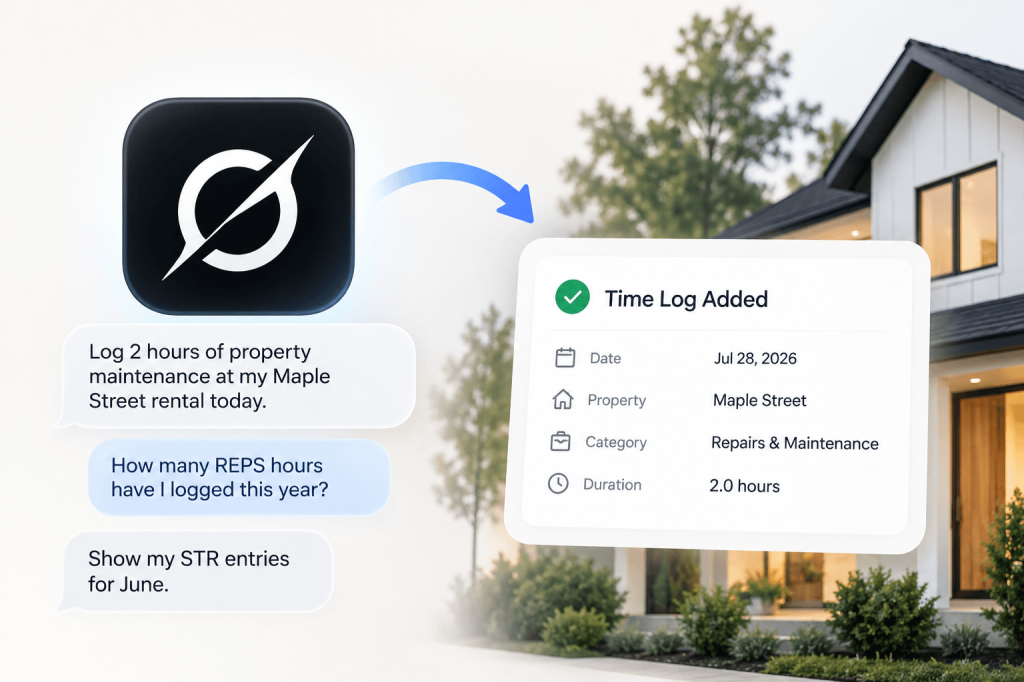
Building a REPS log that survives Tax Court scrutiny requires the right tools and the right habits. REPSLog is designed to help real estate professionals create the kind of detailed, contemporaneous records that courts expect. With activity categorization, real-time logging, and structured entries that encourage specificity over vague descriptions, REPSLog helps you build a defensible case from day one. Download it on iOS, Android, or use it on the Web.

This article is for educational purposes only and does not constitute tax or legal advice. Consult a qualified tax professional for guidance tailored to your situation.
Do this in REPSLog
- Evidence Attachments: attach receipts, invoices and photos to any entry.
- Backdate Entries: log past work on the date it happened, back to 2020.
- CPA-ready Export (PDF and CSV): a tax year as PDF and CSV, split by LTR and STR, with receipts.
Step by step in the Help Center: how to use it. Try REPSLog free for 14 days on iPhone, Android or the web app.