If you work part-time and own rental properties, Real Estate Professional Status might be more accessible than you think. The REPS qualification rules create a mathematical landscape where part-time workers have a genuine advantage over their full-time counterparts, provided they understand how the numbers work and commit to thorough documentation.
This article breaks down the exact math for various part-time schedules, identifies which types of part-time employment pair most naturally with REPS qualification, and explains the documentation strategy you need for both your real estate and non-real-estate hours.
Understanding the Two Tests Through a Part-Time Lens
REPS qualification requires passing two simultaneous tests each calendar year.
Test one: More than 750 hours. You must spend more than 750 hours during the tax year performing services in real property trades or businesses in which you materially participate.
Test two: More than half of your total working hours. Your real estate hours must constitute more than half of all the hours you spend working in any trade or business during the year. This is often called the “more-than-half” test.
For full-time employees working 2,080 hours annually (40 hours per week, 52 weeks), the more-than-half test demands more than 2,080 hours of real estate work. Combined with the 750-hour threshold, full-time workers effectively need more than 2,080 real estate hours, which is itself a full-time commitment. Very few people can sustain two full-time jobs.
Part-time workers face a fundamentally different equation. The fewer hours you spend on non-real-estate work, the lower the bar for the more-than-half test, and for many part-time schedules, the 750-hour threshold actually becomes the harder test to pass.

The Math at Various Weekly Hours
Here is how the numbers shake out at different part-time schedules, assuming 50 working weeks per year (allowing for two weeks of vacation or unpaid time off).
10 hours per week (500 annual hours). Your non-real-estate hours total roughly 500. To pass the more-than-half test, you need more than 500 real estate hours. Since 750 is already more than 500, the 750-hour test is your binding constraint. You need approximately 15 hours per week of real estate activity. This is very achievable for an active landlord managing several properties.
15 hours per week (750 annual hours). Your non-real-estate hours total roughly 750. The more-than-half test requires more than 750 real estate hours, which aligns almost exactly with the 750-hour threshold. You need roughly 15 to 16 hours per week of real estate work. Still very manageable.
20 hours per week (1,000 annual hours). Now the more-than-half test becomes the binding constraint. You need more than 1,000 real estate hours, which requires about 20 hours per week of real estate activity. This is essentially a second part-time job, but it is doable for someone actively managing multiple properties, doing renovation work, or combining property management with other real estate activities.
25 hours per week (1,250 annual hours). You need more than 1,250 real estate hours, or approximately 25 hours per week. This requires significant real estate involvement, think managing several properties plus development projects or a real estate brokerage practice, but it remains within reach.
30 hours per week (1,500 annual hours). You need more than 1,500 real estate hours, requiring approximately 30 hours per week of real estate work. This is approaching full-time real estate activity alongside a substantial part-time job. Feasible for someone whose real estate work is their primary occupation and who supplements it with part-time employment for benefits or supplemental income.
Which Part-Time Jobs Pair Well with REPS
Not all part-time work is created equal when it comes to REPS compatibility. The ideal part-time job for a REPS candidate has several characteristics.
Flexible scheduling. Jobs that let you control your hours make it easier to dedicate blocks of time to real estate work. Freelance consulting, contract work, and gig economy jobs all offer this flexibility.
Limited weekly hours. The fewer hours you work at your non-real-estate job, the easier the more-than-half test becomes. Jobs in the 10 to 20 hour range create the most favorable math.
No overlap with real estate activities. If your part-time job involves anything that could be classified as a real property trade or business, those hours might actually count toward your REPS total rather than against it. Real estate-adjacent roles like property photography, real estate website design, or construction consulting can sometimes blur this line, though the classification depends on the specific facts.
Predictable hours. Jobs with consistent schedules make it easier to plan and track your time allocation. If your part-time hours fluctuate wildly week to week, tracking becomes more complicated, though not impossible.
Common good pairings include: Part-time teaching or tutoring, freelance writing or graphic design, seasonal employment (giving you months of full-time real estate focus), remote customer service, part-time bookkeeping, weekend-only retail or hospitality, and consulting practices with controlled client loads.
Pairings that create challenges include: Part-time medical or legal practice (often 30+ hours), commissioned sales roles (hours can be unpredictable and high), management positions where “part-time” regularly exceeds the scheduled hours, and any role where you are expected to be on-call.
The Seasonal Worker Advantage
If your part-time employment is seasonal, you may have a built-in advantage. Consider someone who works a retail job 30 hours per week from October through December (roughly 13 weeks, or 390 hours) and dedicates the remaining nine months primarily to real estate.
With 390 non-real-estate hours, the more-than-half test requires more than 390 real estate hours. The 750-hour threshold is the binding constraint. With nine months of focused real estate time, hitting 750 hours requires about 19 hours per week during the active season. This is entirely manageable.
Seasonal workers should pay attention to which months are their real estate months. If your non-real-estate work consumes the summer and your rental properties are quiet in winter, the overlap might not work. But if you can dedicate spring through fall to real estate while working a seasonal non-real-estate job in winter, the arrangement can be ideal.
Documenting Your Non-Real-Estate Hours
Here is something many REPS candidates overlook: you need to track your non-real-estate hours too. The more-than-half test is a comparison, and you need data on both sides of the equation.
Pay stubs as evidence. Your pay stubs from a W-2 job provide strong evidence of hours worked. Keep every pay stub for the tax year, or download electronic records from your employer’s payroll system. If your pay stubs show hours worked per pay period, you have excellent documentation.
Employer records. Time clock records, schedule printouts, or HR confirmations of your work schedule all serve as corroborating evidence for your non-real-estate hours.
Self-employment records. If your non-real-estate work is self-employment (freelancing, consulting, gig work), you need to track those hours just as carefully as your real estate hours. Client logs, project time tracking software, invoices with hourly breakdowns, and calendar entries documenting client work all help establish your non-real-estate time.
Volunteer and hobby exclusions. The more-than-half test applies to hours in trades or businesses, not all waking hours. Volunteer work, hobbies, personal errands, and leisure activities do not count on either side of the equation. Only compensated work or work in a trade or business you own counts.
Common Mistakes Part-Time Workers Make
Miscounting W-2 hours. Some taxpayers use their scheduled hours rather than their actual hours worked. If you are scheduled for 20 hours but routinely work 25 due to overtime or staying late, your actual hours are what matter. Understating your non-real-estate hours to make the more-than-half test work is a dangerous game.
Forgetting to count all trades or businesses. The more-than-half test counts all non-real-estate trades or businesses, not just your primary job. If you drive for a rideshare company on weekends in addition to your part-time job, those hours count against you. Side hustles, consulting gigs, and freelance projects all factor into the calculation.
Ignoring the material participation requirement. Meeting the 750-hour and more-than-half tests gets you REPS status, but you still need to materially participate in each rental activity (or in a grouped rental activity) to deduct the losses. Part-time workers sometimes focus so heavily on the REPS qualification that they overlook this separate requirement.
Not tracking at all because “the math obviously works.” Even if your schedule clearly supports REPS qualification (say, 10 hours per week W-2 and 25 hours per week real estate), you still need documentation. The IRS does not take your word for it. A detailed log with supporting evidence is required regardless of how favorable the math appears on paper.
The Retirement Transition
One scenario where part-time work and REPS intersect perfectly is the transition from full-time employment to retirement. Many real estate investors gradually reduce their W-2 hours as they approach retirement, shifting more time to property management and real estate activities.
If you are contemplating this transition, the year you drop from full-time to part-time is often the first year REPS becomes achievable. A worker who reduces from 40 hours per week to 20 hours per week immediately halves the more-than-half threshold, potentially opening the door to REPS qualification for the first time.
Planning this transition with a tax professional is critical because the timing of your hour reduction within the calendar year affects the math significantly. Dropping to part-time in January is very different from dropping to part-time in September.
Key Takeaways
- Part-time workers have a mathematical advantage for REPS qualification because the more-than-half test threshold drops proportionally with non-real-estate hours.
- At 10 to 15 weekly hours of non-real-estate work, the 750-hour threshold is your binding constraint, requiring roughly 15 hours per week of real estate activity.
- At 20+ weekly hours, the more-than-half test becomes the harder hurdle, requiring real estate hours to exceed your total W-2 or other business hours.
- Seasonal employment is especially advantageous because concentrated non-real-estate work leaves extended periods for full-time real estate focus.
- You must document both your real estate hours and your non-real-estate hours. Pay stubs, employer records, and time tracking for self-employment are all necessary.
- All non-real-estate trades and businesses count for the comparison, including side hustles, freelance work, and gig economy activities.
Frequently Asked Questions
Does the IRS actually verify my part-time hours?
Yes. In an audit, the IRS will request documentation of both your real estate hours and your non-real-estate working hours. Pay stubs, W-2 forms showing wages (which can be back-calculated to hours at a known hourly rate), employer verification letters, and your own records all come into play.
What if my part-time hours vary significantly from week to week?
Variable hours are fine for REPS purposes, but they increase the documentation burden. You cannot simply multiply your average weekly hours by 52. You need actual records showing your real hours for each pay period or week. Your payroll records should provide this data for W-2 employment.
Can I reduce my hours at my job specifically to qualify for REPS?
You can, and there is nothing inherently wrong with adjusting your work schedule for tax planning purposes. However, the IRS may scrutinize the transition, especially if you claim the same total income despite fewer hours (which might suggest you are understating your actual hours). The arrangement must be genuine.
Do unemployment benefits count as hours in a trade or business?
No. Receiving unemployment benefits does not constitute working in a trade or business. If you are laid off and collecting unemployment while managing your rental properties, the unemployment period does not generate hours on the non-real-estate side of the equation. This can actually create a favorable window for REPS qualification.
What if my spouse works full-time but I work part-time?
On a joint return, only one spouse needs to qualify as a real estate professional. If you work part-time and meet both the 750-hour test and the more-than-half test, your spouse’s full-time W-2 job does not affect your REPS qualification. However, note that your spouse’s hours in real estate cannot be combined with yours for the REPS qualification tests, though they can count toward material participation in your rental activities under IRC 469(h)(5).
Are retirement plan contributions or passive income considered “hours”?
No. Investment management time for stocks, bonds, or retirement accounts does not count as hours in a trade or business unless you are a professional trader. Only active work in an operating trade or business generates hours for the more-than-half test. Collecting dividends, rental income, or interest is not “working.”
Can I count real estate education hours toward the 750-hour threshold?
Formal real estate education, such as courses for license renewal, continuing education, or specialized real estate certifications, can count toward REPS hours if it is directly related to a real property trade or business in which you materially participate. Casual reading or browsing real estate websites generally does not qualify.
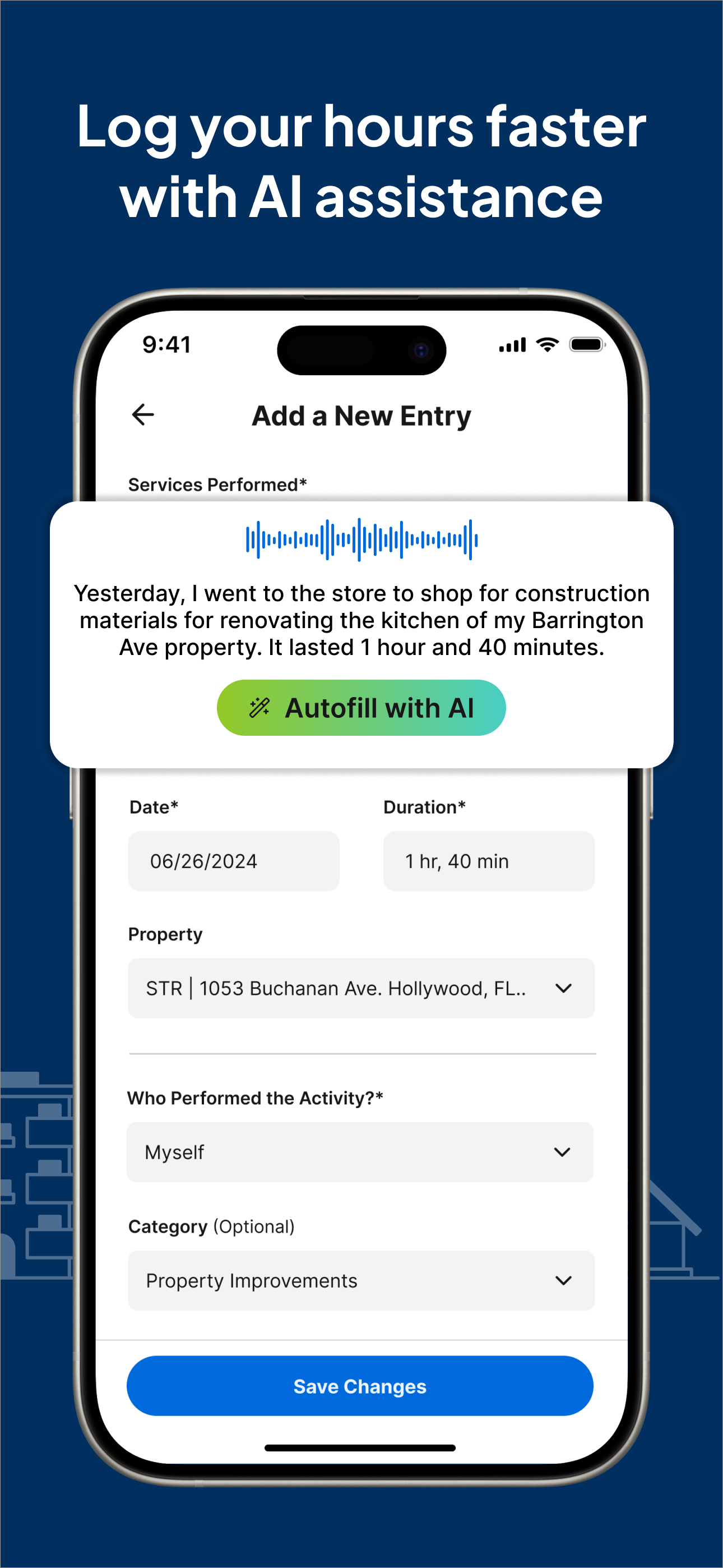
Part-time workers are often in the best position to leverage REPS, but only if they track and document every hour on both sides of the equation. REPSLog makes it simple to log your real estate activities with the specificity the IRS requires, while keeping your total hours organized for the more-than-half comparison. Start tracking today on iOS, Android, or Web.
This article is for educational purposes only and does not constitute tax or legal advice. Consult a qualified tax professional for guidance tailored to your situation.
Do this in REPSLog
- REPS Hour Tracking Goals (750 / 500 / 100): pick the 750, 500 or 100-hour test and watch progress per year and per property.
- Hours Dashboard and Stats: hours by property, category and year against your goal.
- Built-in Timer with Live Activity: time an activity live and drop the minutes into an entry.
Step by step in the Help Center: how to use it. Try REPSLog free for 14 days on iPhone, Android or the web app.