“I am a licensed real estate agent. I am already a real estate professional for tax purposes, right?”
This is one of the most common and most dangerous misconceptions in real estate taxation. Having a real estate license does not make you a Real Estate Professional under IRC Section 469(c)(7). Being employed by a brokerage does not make you a Real Estate Professional. Even closing millions of dollars in transactions does not make you a Real Estate Professional for REPS purposes unless you can document that you meet the specific hour-based tests.
This article explains why the misconception exists, how agent and brokerage hours actually apply to REPS, and why tracking remains essential even for full-time agents.
The License Is Not the Status
The confusion between “real estate professional” as a job description and “Real Estate Professional” as a tax designation is understandable. They sound identical. But they are entirely different concepts.
A real estate license is issued by your state licensing authority and authorizes you to assist in real estate transactions. It says nothing about your tax status.
Real Estate Professional Status under IRC 469(c)(7) is a tax classification that allows qualifying taxpayers to treat rental real estate losses as non-passive, making them deductible against ordinary income. It is determined annually based on hours worked, not on licenses held.
You could be a licensed agent who sells one house per year while working 50 hours per week at a non-real-estate job, and you would not be a REPS-qualifying Real Estate Professional despite holding a license. Conversely, a full-time property developer who has never held a real estate license could qualify for REPS if the hour tests are met.
The license is irrelevant to the tax determination. The hours are everything.

How Agent and Brokerage Hours Count
The good news for full-time real estate agents is that brokerage work is explicitly listed as a qualifying real property trade or business under IRC 469(c)(7)(C). This means your hours spent performing brokerage activities count toward the 750-hour threshold and the more-than-half test.
Qualifying brokerage hours include time spent on listing presentations, market analysis, showing properties, negotiating offers, drafting contracts, attending closings, prospecting for clients, marketing listings, open houses, continuing education, broker meetings, MLS research, and all other activities directly related to your real estate brokerage business.
For a full-time agent working 40 or more hours per week, the 750-hour test is easily met. In fact, it is almost impossible to work full-time as an agent and not exceed 750 hours. The question for most agents is not whether they have enough hours, but whether they can prove it.
Why Tracking Still Matters
If a full-time agent clearly exceeds 750 hours, why bother tracking? Because “clearly exceeding” the threshold and “proving you exceeded it under IRS examination” are two very different things.
The IRS does not accept job titles as evidence. When you claim REPS on your tax return, the IRS can ask you to substantiate the claim. “I am a full-time real estate agent” is not substantiation. Treasury Regulation 1.469-5T(f)(4) requires documentation of services performed and time spent.
Commission income does not prove hours. Earning $300,000 in real estate commissions proves you are a productive agent. It does not prove you spent more than 750 hours doing it. A highly efficient agent working 20 hours per week could earn substantial commissions through a few large transactions, while a less productive agent working 50 hours per week might earn less.
W-2 income from a brokerage does not prove hours. Even if you receive a W-2 from your brokerage, the W-2 shows compensation, not hours worked. Unless your brokerage tracks your hours through a time clock or similar system (which most do not), your W-2 is weak evidence of time spent.
Independent contractor status creates additional complexity. Most real estate agents are classified as independent contractors rather than employees. As an independent contractor, there is no employer tracking your hours, no time clock, and no payroll records showing hours worked per pay period. Your REPS documentation depends entirely on your own records.
Tax Court cases have denied agents who did not track. There are Tax Court decisions where licensed real estate agents lost their REPS claims because they could not substantiate their hours. The court acknowledged they were agents but held that without adequate documentation, the statutory tests were not proven.
The More-Than-Half Test for Agents with Side Income
The 750-hour test is rarely the issue for full-time agents. The more-than-half test is where complications arise, particularly for agents who have income from other activities.
Consider an agent who also has a part-time consulting business, teaches evening classes, or runs a side business. The hours spent on those non-real-estate activities count against the agent in the more-than-half calculation.
Even activities that seem adjacent to real estate can be problematic. If you run a property inspection business, a home staging company, or a mortgage brokerage, the IRS may classify those hours separately from your real estate brokerage hours depending on the specific facts. Property inspection is not a “real property trade or business” as defined by the statute. Home staging might or might not qualify depending on how it is structured.
For agents with side income sources, tracking becomes essential not just for the REPS qualification but for establishing the correct allocation between real estate and non-real-estate hours.
Part-Time Agents Face Bigger Challenges
Part-time agents have a genuinely difficult path to REPS. If you hold your license and sell a few houses per year while working another part-time or full-time job, your real estate hours may not reach 750, and even if they do, they may not exceed your non-real-estate hours.
A part-time agent who sells five to ten houses per year might spend 300 to 500 hours on brokerage activities. That is below the 750-hour threshold on brokerage hours alone. However, if the agent also owns rental properties, the rental management hours combine with brokerage hours toward the 750-hour total.
Part-time agents who own rental properties are in a particularly strong position if they track everything carefully. Their brokerage hours provide a significant head start, and their property management hours close the gap.
Team Leaders and Broker-Owners
If you are a team leader or broker-owner who spends significant time on business operations (recruiting, training, compliance, office management), the classification of those hours requires careful analysis.
Hours that qualify: Activities directly related to real estate brokerage, including training agents on transaction procedures, reviewing contracts for compliance, managing listing inventory, and handling client escalations.
Hours that may not qualify: Pure business administration that is not specific to real estate brokerage, such as general HR functions, accounting for the brokerage business, IT management, and office lease negotiations. While these activities support your real estate business, they may not constitute participation in a “real property trade or business” as defined by the statute.
The distinction is not always clear, and the IRS has latitude in how it draws these lines. The safest approach is to track all activities with sufficient detail that a tax professional can evaluate each category and make defensible classifications.
What Good Agent Hour Tracking Looks Like
Effective hour tracking for a real estate agent does not need to be burdensome. Here is a practical approach.
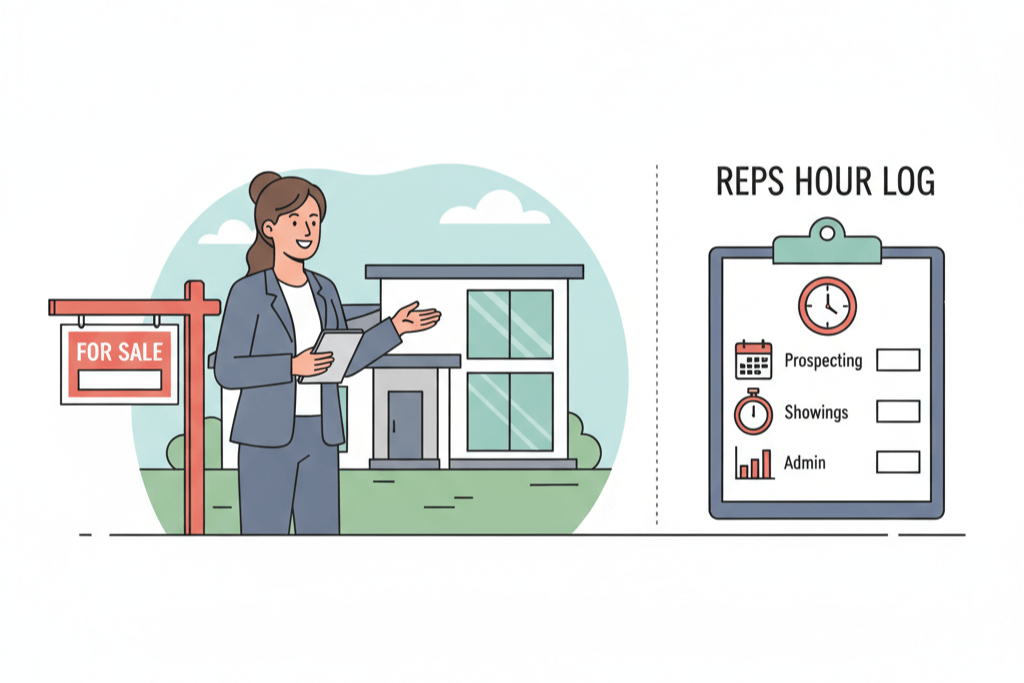
Daily time entries. At the end of each day, record your major activities and time blocks. “9:00-11:00 AM: Showed three properties to buyer client (Johnson), 11:30 AM-12:30 PM: Prepared CMA for listing presentation at 456 Oak Street, 1:00-3:00 PM: Open house at 789 Elm Ave, 3:30-5:00 PM: Drafted and submitted offer for Smith buyer.”
Categorize your activities. Group your activities into categories like buyer representation, listing management, prospecting, marketing, education, and property management (for your own rentals). This categorization helps at tax time and during any audit.
Log non-real-estate hours too. If you have any side business or employment income, track those hours separately. You need both numbers for the more-than-half test.
Maintain supporting records. Showing schedules, closing statements, MLS activity logs, CRM records, marketing invoices, and continuing education certificates all corroborate your logged hours.
Do not estimate at year-end. A December estimate of “I worked about 45 hours per week for 50 weeks” is not documentation. It is a guess presented as fact. Track throughout the year.
Key Takeaways
- A real estate license does not confer REPS tax status. The license is a professional credential; REPS is a tax classification based entirely on documented hours.
- Real estate brokerage is a qualifying activity, so agent hours count toward the 750-hour test. Full-time agents generally exceed 750 hours easily.
- Commission income and W-2 income from a brokerage do not prove hours worked. The IRS requires documentation of specific activities and time spent.
- Independent contractor status means there are no employer records to rely on. Your documentation depends entirely on your own tracking.
- Part-time agents can combine brokerage hours with rental management hours to reach the 750-hour threshold.
- The more-than-half test is the more common failure point for agents, especially those with side businesses or other income sources.
- Track daily activities throughout the year rather than estimating at tax time.
Frequently Asked Questions
If I am a full-time agent at a major brokerage, do I still need to keep a log?
Yes. Being full-time makes it likely you exceed 750 hours, but the IRS requires you to prove it with documentation, not with a claim about your work schedule. Tax Court has denied REPS claims from full-time agents who could not substantiate their hours.
Do continuing education hours count toward REPS?
Yes. Continuing education related to your real estate brokerage business, such as license renewal courses, designation courses (CRS, ABR, etc.), and real estate-specific seminars, counts as qualifying hours.
Can I use my MLS activity log to prove my hours?
MLS activity logs can serve as supporting evidence, showing when you logged in, viewed listings, updated statuses, and performed searches. However, MLS logs do not capture all of your brokerage activities (phone calls, showings, negotiations, etc.) and typically do not record duration. They are a supplement to your time log, not a replacement.
What if I am an agent and a landlord? How do I categorize my hours?
Keep separate but combined records. Your brokerage hours and your rental management hours are both qualifying real estate activities. Log them with clear descriptions so it is apparent which hours relate to brokerage and which to property management. Both count toward REPS qualification.
Does time spent at the office count if I am not actively working on transactions?
Time at the office counts if you are performing real estate brokerage activities such as research, marketing, client communication, training, or administrative work related to transactions. Simply sitting at your desk reading non-real-estate material does not count.
I am a licensed agent but I mostly do property management. Does that change anything?
Property management is a separate qualifying real estate activity. If you spend most of your time managing properties rather than brokering transactions, your property management hours count just as much as brokerage hours. Track both types and combine them for REPS qualification.
Can my broker verify my hours for the IRS?
Your broker can provide supporting documentation such as transaction records, office attendance logs, and production reports. However, unless your broker specifically tracks your working hours, they cannot verify the specific number of hours you worked. Your own contemporaneous log remains the primary documentation.
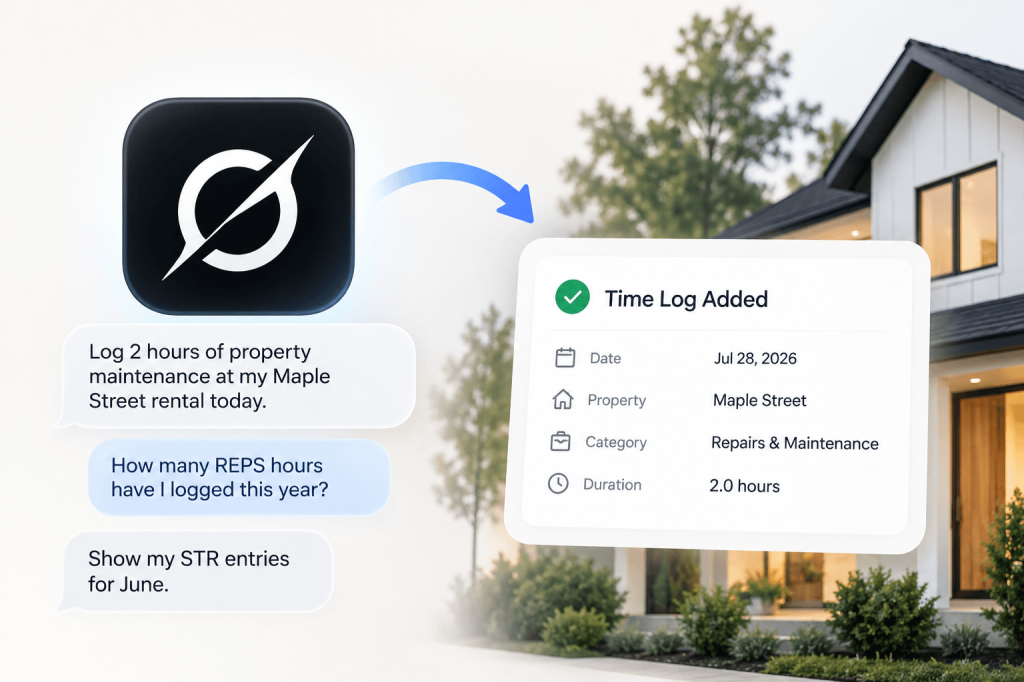
Being a real estate agent gives you a head start on REPS qualification, but without proper documentation, that head start is meaningless. REPSLog makes it simple to log your brokerage and property management hours together, categorized and organized for both REPS qualification and audit defense. Start tracking on iOS, Android, or Web.
This article is for educational purposes only and does not constitute tax or legal advice. Consult a qualified tax professional for guidance tailored to your situation.
Do this in REPSLog
- REPS Hour Tracking Goals (750 / 500 / 100): pick the 750, 500 or 100-hour test and watch progress per year and per property.
- Hours Dashboard and Stats: hours by property, category and year against your goal.
- Built-in Timer with Live Activity: time an activity live and drop the minutes into an entry.
Step by step in the Help Center: how to use it. Try REPSLog free for 14 days on iPhone, Android or the web app.