The passive activity loss rules under IRC Section 469 are the single most important tax concept for real estate investors to understand. These rules determine whether your rental losses can offset your salary, business income, or investment gains, or whether they sit trapped on your return, unusable until you sell the property. Every investor encounters these rules eventually. This article explains how they work, what exceptions apply, and how to plan around them.
What Are the Passive Activity Loss Rules?
Congress enacted the passive activity loss rules in the Tax Reform Act of 1986 to prevent high-income taxpayers from using paper losses from tax shelters to eliminate their tax liability on wages and active business income. The rules achieve this by creating two buckets of income and loss:
Passive income and loss: Income or loss from activities in which the taxpayer does not materially participate, including most rental activities.
Non-passive income and loss: Income or loss from activities in which the taxpayer materially participates (active businesses), plus wages, salaries, and portfolio income (interest, dividends, capital gains).
The core rule: passive losses can only offset passive income. They cannot offset wages, salaries, active business income, or portfolio income. If your passive losses exceed your passive income, the excess is suspended and carried forward to future years.
Rental Activities Are Presumed Passive
Under IRC Section 469(c)(2), rental activities are treated as passive regardless of the taxpayer’s level of participation. Even if you spend 2,000 hours managing your rental properties, the activity is still passive by default.
This is a critical distinction from other business activities, where material participation converts the activity from passive to non-passive. For rentals, material participation alone is not enough. You need an additional exception to escape passive treatment.
The three primary exceptions are:
- Real Estate Professional Status (REPS) under IRC Section 469(c)(7): If you qualify as a real estate professional and materially participate in the rental activity, the activity is treated as non-passive.
- The $25,000 Special Allowance under IRC Section 469(i): A limited exception allowing up to $25,000 in rental losses to offset non-passive income for certain taxpayers.
- The Short-Term Rental Exception: Under Treas. Reg. 1.469-1T(e)(3)(ii)(A), rental activities with an average period of customer use of seven days or less are not treated as rental activities at all, removing them from the rental-specific passive presumption.
Understanding Passive vs. Non-Passive Income
Passive Income Sources
- Rental income from properties where you do not qualify as a REPS or materially participate
- Income from limited partnerships
- Income from businesses in which you do not materially participate
- Income from certain trusts and estates
Non-Passive Income Sources
- Wages and salaries (W-2 income)
- Self-employment income from businesses where you materially participate
- Portfolio income: interest, dividends, capital gains from stocks and bonds
- Guaranteed payments from partnerships for services
Why This Matters
If you have $40,000 in passive rental losses and $200,000 in W-2 income but no passive income, you cannot use the rental losses to reduce your W-2 tax bill (except to the extent the $25,000 allowance applies). The $40,000 in losses is suspended and carried forward.
If, however, you also have $30,000 in passive income from another source (such as a profitable rental property or a business in which you do not participate), you can use $30,000 of the $40,000 in losses against that passive income. The remaining $10,000 is suspended.
The $25,000 Special Allowance
IRC Section 469(i) provides a limited exception for individual taxpayers who actively participate in rental real estate activities:
- You may deduct up to $25,000 in rental real estate losses against non-passive income
- “Active participation” is a lower standard than “material participation.” It requires owning at least 10% of the property and being involved in management decisions (approving tenants, setting rental terms, approving expenditures)
- The $25,000 allowance phases out by $1 for every $2 of adjusted gross income above $100,000
- The allowance is completely eliminated at $150,000 AGI
Phase-out example: At an AGI of $130,000, the allowance is reduced by ($130,000 – $100,000) / 2 = $15,000. Your available allowance is $25,000 – $15,000 = $10,000.
For high-income investors (AGI above $150,000), this allowance provides zero benefit. It is primarily useful for moderate-income investors and investors early in their careers before income scales up.
Suspended Losses: How They Work
When passive losses exceed passive income and the $25,000 allowance, the excess losses are suspended. These suspended losses are not lost; they are carried forward indefinitely and can be used in two ways:
Against future passive income: In any year where you have net passive income, your suspended passive losses from prior years offset that income. The losses are applied automatically.
Upon disposition of the activity: When you sell or otherwise completely dispose of the entire interest in the passive activity in a taxable transaction, all suspended losses attributable to that activity are released. They become non-passive losses that can offset any type of income: wages, business income, portfolio income, or the gain from the sale itself.
Disposition Release: The Exit Strategy
The disposition rule under IRC Section 469(g) is critical for long-term planning. If you hold a property for years, accumulating suspended losses each year, those losses are released in full when you sell the property in a taxable transaction.
Example: You own a rental property for ten years, generating $15,000 per year in suspended passive losses. At sale, you have $150,000 in accumulated suspended losses. You sell the property for a $200,000 gain. The $150,000 in suspended losses offsets the gain, and you pay tax on only $50,000.
Important qualifications:
- The disposition must be a complete disposition of your entire interest in the activity
- The transaction must be taxable (a 1031 exchange defers the gain and does not release suspended losses)
- Sales to related parties do not trigger the release
- If you use the grouping election under Treas. Reg. 1.469-9(g) and sell one property within the group, it may not qualify as a complete disposition of the grouped activity
Material Participation Tests
When you need to demonstrate material participation (for REPS qualification, for the STR loophole, or for non-rental business activities), there are seven tests under Treas. Reg. 1.469-5T(a). You need to satisfy only one:
- More than 500 hours of participation in the activity during the year
- Substantially all of the participation in the activity is by the taxpayer
- More than 100 hours of participation and no less than any other individual’s participation (the comparative test)
- The activity is a significant participation activity (more than 100 hours) and the taxpayer’s total hours in all significant participation activities exceed 500
- Material participation in any five of the prior ten years
- The activity is a personal service activity and the taxpayer participated in any three prior years
- Based on all facts and circumstances, the taxpayer participates on a regular, continuous, and substantial basis
For most real estate investors, Tests 1 and 3 are the most relevant. Test 1 is the clearest (more than 500 hours), while Test 3 is commonly used for the STR loophole (more than 100 hours and more than anyone else, including contractors and property managers).
Spousal Hours and the Passive Activity Rules
Under IRC Section 469(h)(5), the participation of a taxpayer’s spouse is treated as participation by the taxpayer when testing material participation. This means:
- If you spend 200 hours and your spouse spends 350 hours on a rental activity, you are treated as having 550 hours for material participation purposes (satisfying Test 1).
However: Spousal hours do not combine for REPS qualification. Each spouse must independently meet the more than 750 hours and more-than-half tests to qualify as a real estate professional. This is a distinction that frequently causes confusion.
The Interaction Between REPS and Passive Activity Rules
REPS changes the default treatment of rental activities. Without REPS, rental activities are automatically passive. With REPS:
- Rental activities in which you materially participate are treated as non-passive
- Rental activities in which you do not materially participate remain passive even with REPS
- You can elect to group all rental activities into one activity under Treas. Reg. 1.469-9(g) to simplify the material participation test
This interaction is why REPS is so valuable for high-income investors: it removes the default passive classification from rental activities, allowing depreciation and other losses to offset W-2 and active business income.
Planning Around the Passive Activity Rules
Strategy 1: Pursue REPS Qualification
If you or your spouse can dedicate more than 750 hours to real property trades or businesses and meet the more-than-half test, REPS qualification converts rental losses from passive to non-passive. This is the most powerful strategy for high-income investors.
Strategy 2: Generate Passive Income
If you cannot qualify as a REPS, you can still use passive losses by generating passive income from other sources. Strategies include:
- Investing in profitable passive businesses (silent ownership)
- Owning profitable rental properties alongside loss-generating ones
- Passive income from syndications or limited partnerships
Strategy 3: Time Your Dispositions
If you have accumulated suspended losses, a strategic sale releases those losses. Plan dispositions in years when the released losses can offset the greatest amount of income. Avoid 1031 exchanges if your primary goal is to release suspended losses (exchanges defer both gains and losses).
Strategy 4: Use the STR Loophole
Short-term rental properties with average stays of seven days or less escape the rental activity classification. With material participation, STR losses are non-passive without REPS.
Strategy 5: Maximize the $25,000 Allowance
For investors with AGI under $150,000, actively participating in rental activities allows up to $25,000 in losses against non-passive income. This is most useful in early career stages or for moderate-income investors.
Frequently Asked Questions
Can passive losses offset capital gains from stock sales?
No. Capital gains from stocks are portfolio income, not passive income. Passive losses can only offset passive income. However, if you have suspended passive losses and completely dispose of the activity, the released losses can offset any type of income, including capital gains.
What happens to suspended losses if I die?
Suspended passive losses are allowed as a deduction on the decedent’s final return, but only to the extent they exceed the step-up in basis the heir receives. In many cases, the step-up in basis absorbs some or all of the suspended losses, effectively eliminating them.
Can I carry passive losses back to prior years?
No. Under current law, passive losses can only be carried forward, not back. They carry forward indefinitely until used against passive income or released upon disposition.
Do the passive activity rules apply to S corporations and partnerships?
The passive activity rules apply at the individual partner or shareholder level, not at the entity level. Each partner or S corporation shareholder determines whether their share of the entity’s income or loss is passive or non-passive based on their own participation.
What is the difference between active participation and material participation?
Active participation is a lower standard used only for the $25,000 special allowance. It requires owning at least 10% and being involved in management decisions. Material participation is a higher standard requiring one of the seven tests under Treas. Reg. 1.469-5T(a), typically involving significant hours of direct participation.
Can I use passive losses from one rental to offset passive income from another rental?
Yes. Passive income and losses from all passive activities are netted together. A loss from Property A can offset income from Property B, as long as both are passive activities.
What if I convert a rental property to my primary residence?
Converting a rental property to a personal residence is not a taxable disposition and does not release suspended passive losses. The losses remain suspended until a qualifying disposition occurs.

Key Takeaways
- Passive losses can only offset passive income under IRC Section 469; they cannot offset wages, active business income, or portfolio income
- Rental activities are automatically classified as passive regardless of your participation level, unless an exception applies
- REPS qualification plus material participation converts rental losses to non-passive, allowing them to offset any income
- The $25,000 special allowance phases out completely at $150,000 AGI and provides no benefit to high-income investors
- Suspended losses carry forward indefinitely and are released upon a complete taxable disposition of the activity
- Spousal hours combine for material participation under 469(h)(5) but not for REPS qualification
- The STR loophole removes properties with seven-day-or-less average stays from rental activity classification entirely
- Strategic portfolio planning around passive income generation and disposition timing can maximize the value of your losses
Track Your Hours for REPS and Material Participation
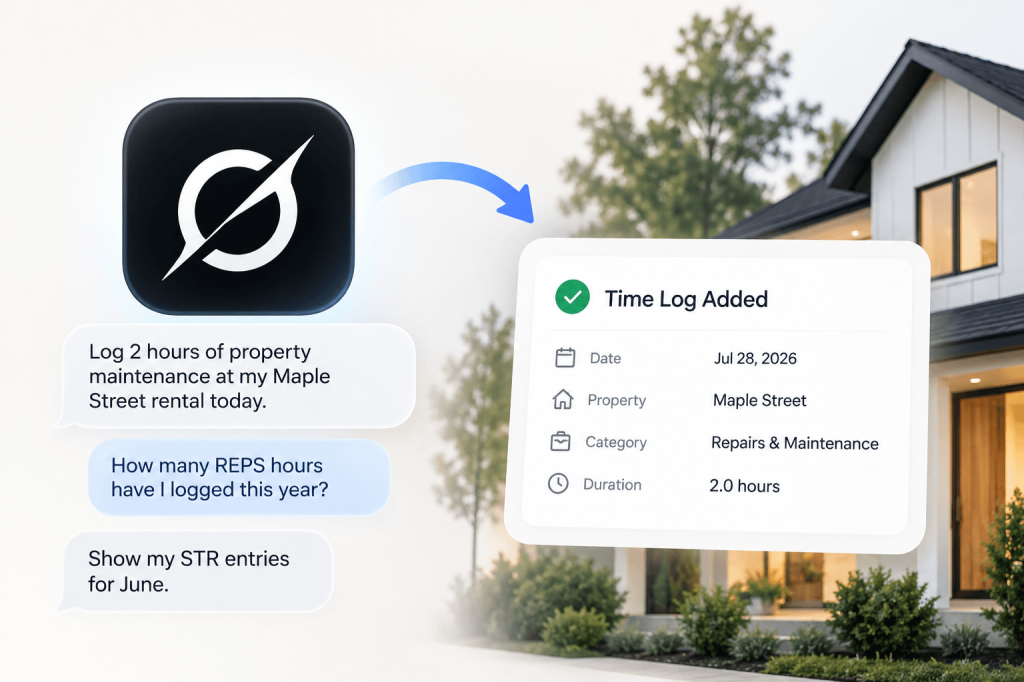
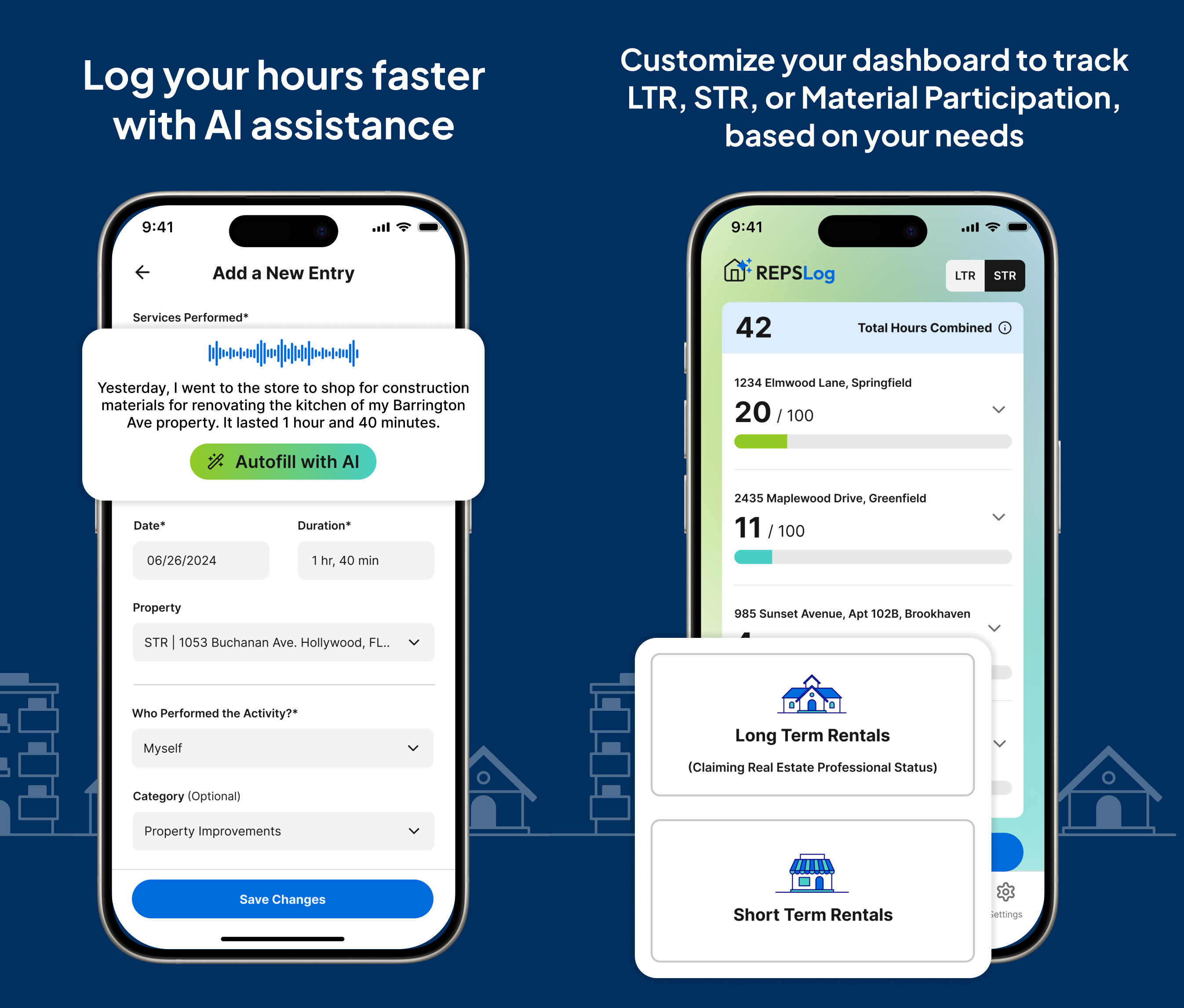
Whether you are pursuing REPS qualification or demonstrating material participation for the STR loophole, accurate hour tracking is your foundation. REPSLog makes it simple to log every activity by property, category, and participant.
Available on iOS | Android | Web
This article is for educational purposes only and does not constitute tax or legal advice. Consult a qualified tax professional for guidance tailored to your situation.
Do this in REPSLog
- REPS Hour Tracking Goals (750 / 500 / 100): pick the 750, 500 or 100-hour test and watch progress per year and per property.
- Hours Dashboard and Stats: hours by property, category and year against your goal.
- Built-in Timer with Live Activity: time an activity live and drop the minutes into an entry.
Step by step in the Help Center: how to use it. Try REPSLog free for 14 days on iPhone, Android or the web app.