Short-term rental investors pursuing the STR loophole need to prove material participation in their rental activity. The two most common paths are Test 1, requiring more than 500 hours, and Test 3, requiring more than 100 hours with a comparative element. Choosing the wrong test can mean unnecessary work, failed qualification, or audit vulnerability. This article breaks down when each test makes sense, how the comparative element in Test 3 changes the calculus, and why the simplicity of Test 1 is sometimes worth the extra hours.
Part of our STR loophole series: the loophole as a whole is in our STR loophole guide, and the test itself in the 100-hour material participation test.
The Two Tests at a Glance
Under Treas. Reg. 1.469-5T(a), the IRS provides seven tests for material participation. For STR investors, two dominate the conversation:
Test 1 (The 500-Hour Test): You participate in the activity for more than 500 hours during the tax year. No comparative requirement. If you exceed 500 hours, you materially participate, regardless of how many hours any contractor or property manager logs.
Test 3 (The 100-Hour Comparative Test): You participate in the activity for more than 100 hours during the tax year, AND your participation is not less than any other individual’s participation in the activity during the year.
Both tests achieve the same result: material participation status, which makes income and losses from the activity non-passive when combined with the seven-day average stay rule.
The Simplicity Advantage of Test 1
Test 1 is a single threshold: more than 500 hours. There is nothing to compare, no contractor tracking required (for this specific test), and no risk that someone else’s hours will disqualify you.
Why Simplicity Matters
Audit resilience. When the IRS audits a REPS or STR claim, they typically examine two things: (1) whether you actually spent the claimed hours, and (2) whether you met the legal requirements of the test. With Test 1, the legal analysis is binary: did you exceed 500 hours? Yes or no. There is no room for the IRS to argue that a contractor’s uncounted hours exceeded yours.
No contractor tracking burden. Under Test 1, it does not matter if your property manager logged 800 hours on your property. Your 501 hours are sufficient. This eliminates an entire category of documentation risk.
Straightforward documentation. Your hour log needs to show dates, descriptions, durations, and properties. That is it. No comparative worksheets, no contractor hour summaries, no estimation methodologies for third-party work.
The Tradeoff
The tradeoff is time. More than 500 hours per year is approximately 10 hours per week. For a single STR property, this is significant. For a W-2 earner managing an STR on the side, 10 hours per week dedicated to one rental property is a substantial commitment.
Is 500 hours realistic for one STR? It depends on the property’s booking volume and your management approach:
- A high-volume urban STR with 80 to 100 turnovers per year, self-managed, can generate 500+ hours from guest communication, turnover management, pricing optimization, maintenance, and financial tracking.
- A low-volume seasonal cabin with 20 to 30 bookings per year will struggle to generate 500 hours of legitimate management activity.
If your property naturally generates 500+ hours of work, Test 1 is the obvious choice. If it does not, you are either inflating hours (dangerous) or spending time on marginal activities (inefficient).
When Test 3 Makes More Sense
Test 3 exists because Congress recognized that some business owners participate meaningfully in activities without spending 500 hours. The 100-hour threshold is achievable for almost any STR owner who is actively involved in management.
The Ideal Test 3 Candidate
You have a full-time W-2 job and limited time for STR management. Logging 150 to 200 hours per year is realistic; logging 500 is not.
You self-manage core functions (guest communication, pricing, listing management) while hiring out turnover cleaning and maintenance. Your personal hours range from 120 to 250 per year.
You do not use a single individual who dominates the work. Your cleaners rotate, your maintenance contractors are called as needed, and no single person outpaces your involvement.
You have one or two STR properties. The comparative element is manageable with a small number of properties and service providers to track.
The Comparative Element: Risks and Realities
The comparative element is what makes Test 3 both more accessible and more complicated than Test 1. You need to demonstrate that no single individual participated more than you did.
Risk scenario 1: The dedicated cleaner. If one cleaner handles all your turnovers, they could easily exceed your hours. A property with 60 turnovers at three hours each gives the cleaner 180 hours. If your total is 150 hours, you fail Test 3.
Risk scenario 2: The full-service property manager. A property manager who handles everything from guest communication to maintenance coordination can log 200 to 400 hours on an actively booked property. If you are logging 130 hours, the property manager disqualifies you.
Risk scenario 3: The co-host. An Airbnb co-host who handles guest messaging, pricing, and review management could log more hours than you, especially if they are managing your property as a significant part of their business.
Risk scenario 4: The renovation contractor. If your property undergoes a major renovation during the year, the contractor might log hundreds of hours, far exceeding your participation. This is typically a one-year issue, but it can disqualify you in the renovation year.
Decision Framework: Choosing Your Test
Choose Test 1 (500 Hours) When:
- Your STR is high-volume and self-managed, naturally generating 500+ hours of work
- You use a full-service property manager or a single individual who dominates the work
- You want the simplest audit defense with no comparative tracking
- You manage STR operations as your primary activity (not a side project)
- You have multiple STRs and can aggregate hours through Test 4 instead (discussed below)
Choose Test 3 (100 Hours + Comparative) When:
- You have a full-time W-2 job and limited time for STR management
- You self-manage core functions and use multiple rotating contractors
- No single individual working on your property exceeds your hours
- You are diligent about tracking both your hours and contractor hours
- Your property is lower-volume (20 to 40 bookings per year) and does not generate 500 hours of work
Consider Test 4 (Significant Participation Activities) When:
- You own multiple STR properties, each generating more than 100 hours of your participation
- Your total hours across all significant participation activities exceed 500
- Individual properties do not generate enough hours for Test 1, and Test 3 is risky due to contractor hours
Test 4 allows you to aggregate hours across multiple activities. If you have three STR properties and spend 180 hours on each (540 total), you satisfy Test 4 even though no single property hits 500 hours. Each property must be a “significant participation activity” (your participation exceeds 100 hours), and the aggregate must exceed 500.
Practical Scenarios
Scenario A: The Weekend Warrior
Profile: Full-time software engineer, owns one beach condo STR with 45 bookings per year. Self-manages guest communication, pricing, and listing. Hires a cleaning company (rotating team of three cleaners) and a local handyman for repairs.
Your annual hours: 160 (guest communication: 60, pricing and listings: 30, inspections and supplies: 25, financial management: 20, travel and miscellaneous: 25)
Highest individual contractor: Cleaner A handles 18 turnovers at 2.5 hours = 45 hours. Cleaner B handles 15 turnovers = 37.5 hours. Cleaner C handles 12 turnovers = 30 hours. Handyman: 20 hours.
Result: Test 3 works. Your 160 hours exceed the highest individual (Cleaner A at 45 hours). No need for Test 1.
Scenario B: The Remote Investor
Profile: Corporate executive, owns one mountain cabin STR with 50 bookings per year. Uses a local co-host who handles guest communication, turnover coordination, and pricing. You handle financial management and strategic decisions.
Your annual hours: 110 (financial management: 40, strategic planning: 25, travel to property: 20, inspections: 15, miscellaneous: 10)
Highest individual contractor: Co-host: 300 hours.
Result: Test 3 fails. The co-host’s 300 hours far exceed your 110 hours. You need Test 1 (but you only have 110 hours, so Test 1 fails too). This investor needs to restructure management to reclaim hours from the co-host, or pursue a different material participation test.
Scenario C: The Multi-Property STR Operator
Profile: Physician’s spouse, manages three STR properties full-time. Self-manages all guest communication and operations. Uses different cleaning services for each property.
Your annual hours per property: Property A: 250, Property B: 200, Property C: 180. Total: 630.
Highest individual contractors: Property A cleaner: 120. Property B cleaner: 90. Property C cleaner: 100.
Result: Test 1 works for Property A (250 > 500? No). Test 3 works for all three (your hours exceed each property’s highest individual). Test 4 also works (630 total across three significant participation activities). This investor has multiple paths to qualification.
Combining Tests Across Properties
You are not required to use the same test for every property. You can use Test 1 for one STR, Test 3 for another, and Test 4 across all of them (as long as the conditions are met for each).
This flexibility means you should evaluate each property individually:
- Which test is easiest to satisfy for this specific property?
- What is the documentation burden for each test?
- Which test provides the strongest audit defense?
Frequently Asked Questions
Can I switch between tests from year to year?
Yes. Material participation is tested annually. You can use Test 3 one year and Test 1 the next. There is no requirement to consistently use the same test.
If I use Test 1, do I still need to track contractor hours?
Not for purposes of the material participation test itself. However, contractor hour tracking is good practice for other reasons, including supporting the business nature of the activity and defending against IRS challenges to the overall STR classification.
Does my spouse’s hours count toward my total for both tests?
Yes. Under IRC Section 469(h)(5), your spouse’s participation is treated as your participation. If you log 300 hours and your spouse logs 250 hours, you are treated as having 550 hours for Test 1 or for the comparative element of Test 3. However, spousal hours do not count toward REPS qualification tests.
What if my contractor hours change significantly mid-year?
Monitor the situation throughout the year. If a contractor’s hours are trending higher than expected (perhaps due to a renovation or increased booking volume), adjust your involvement accordingly. Quarterly check-ins on your comparative position can prevent year-end surprises.
Is Test 3 riskier in an audit than Test 1?
Test 3 introduces the additional element of the comparative analysis, which gives the IRS more to examine. If your contractor hour records are incomplete or your estimates are aggressive, the IRS can challenge the comparative element. Test 1 has no such vulnerability. From a pure audit-risk perspective, Test 1 is safer.
Can I count hours from acquisition activities toward material participation?
Time spent on acquisition research, due diligence, and closing activities for a property you ultimately purchase generally counts toward your participation in that activity. For the STR loophole, these hours apply once the property is operational and classified as a non-rental activity under the seven-day rule.
What about Test 7, the facts-and-circumstances test?
Test 7 requires participation on a “regular, continuous, and substantial basis” and explicitly excludes its use for rental activities. Since STR properties qualifying under the seven-day rule are not rental activities, Test 7 may technically be available. However, it requires more than 100 hours and is inherently subjective, making it the weakest test in an audit. Most practitioners recommend relying on the more objective tests.
Key Takeaways
- Test 1 (more than 500 hours) is simpler, has no comparative element, and provides the strongest audit defense, but requires significantly more time
- Test 3 (more than 100 hours + comparative) is accessible for W-2 earners but requires tracking contractor hours and ensuring no individual exceeds your participation
- The comparative element in Test 3 is per individual, not per combined total of all contractors
- Test 4 allows aggregation across multiple significant participation activities, providing a middle path for multi-property investors
- You can use different tests for different properties and switch tests year to year
- Choose Test 1 when you have the hours and want simplicity; choose Test 3 when time is limited and your contractor structure supports it
- Spousal hours count toward your total under IRC Section 469(h)(5) for both tests
- Monitor your position quarterly to avoid year-end qualification failures
Track Your STR Hours with REPSLog
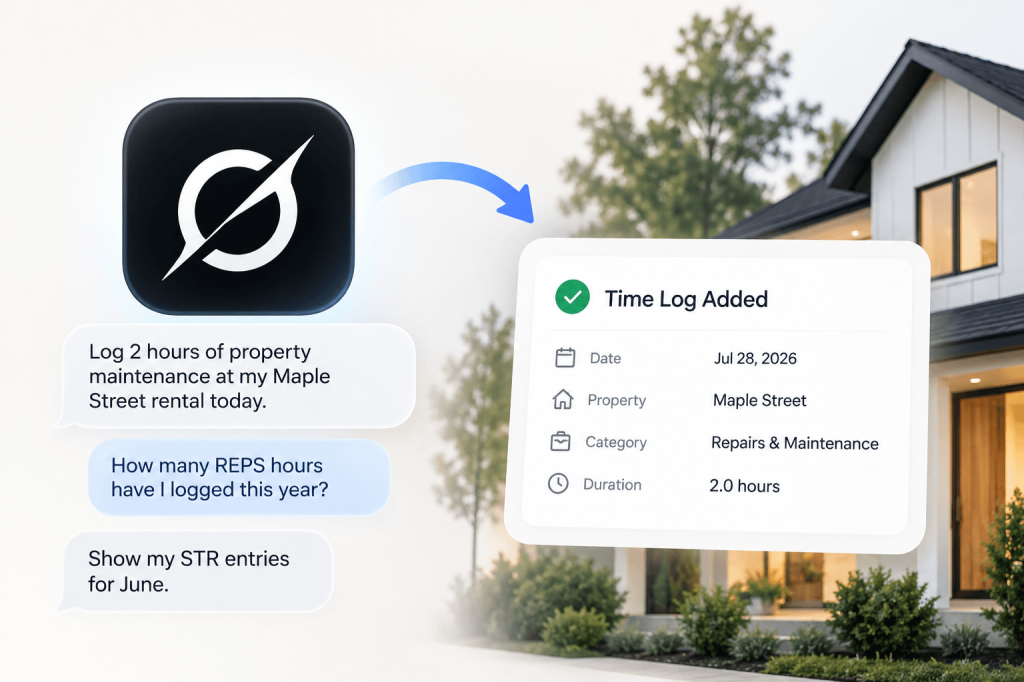
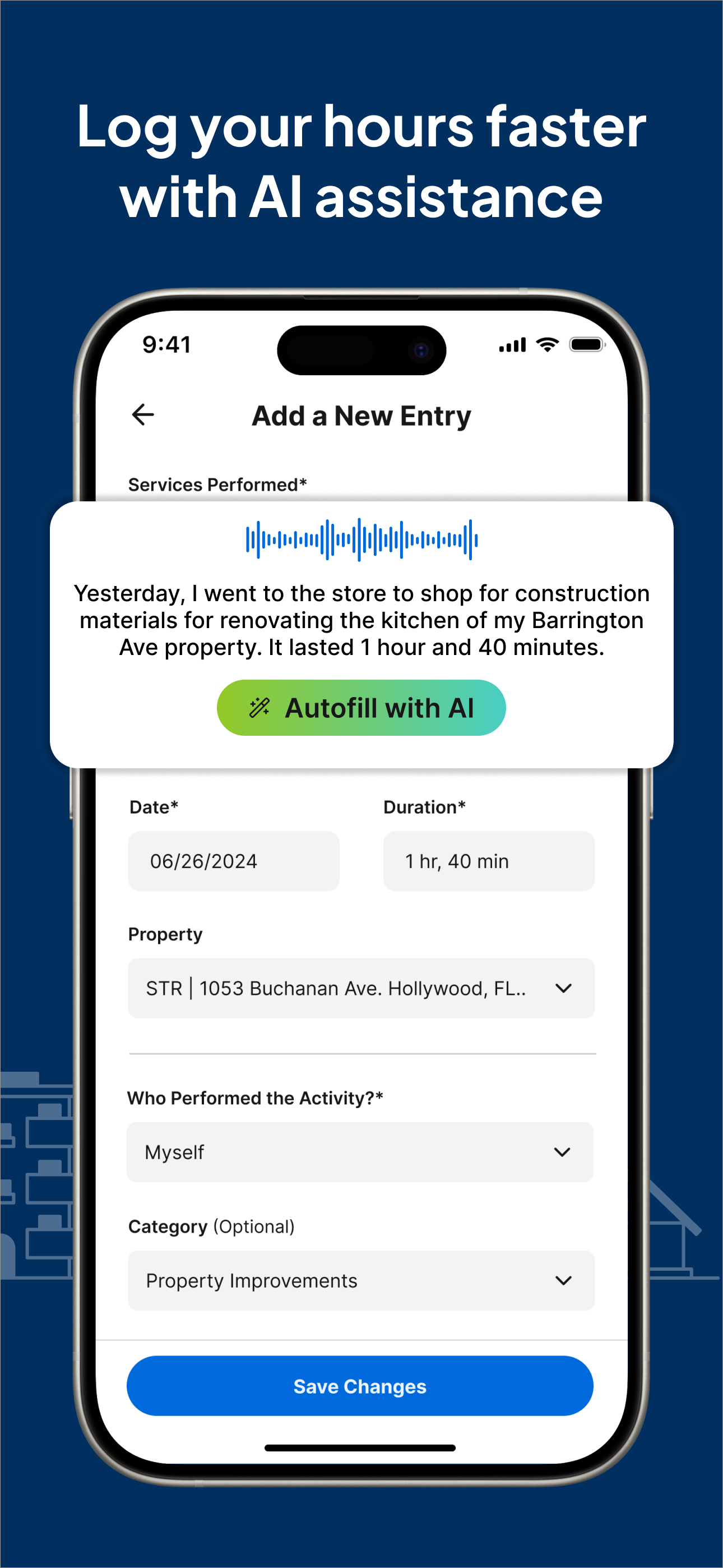
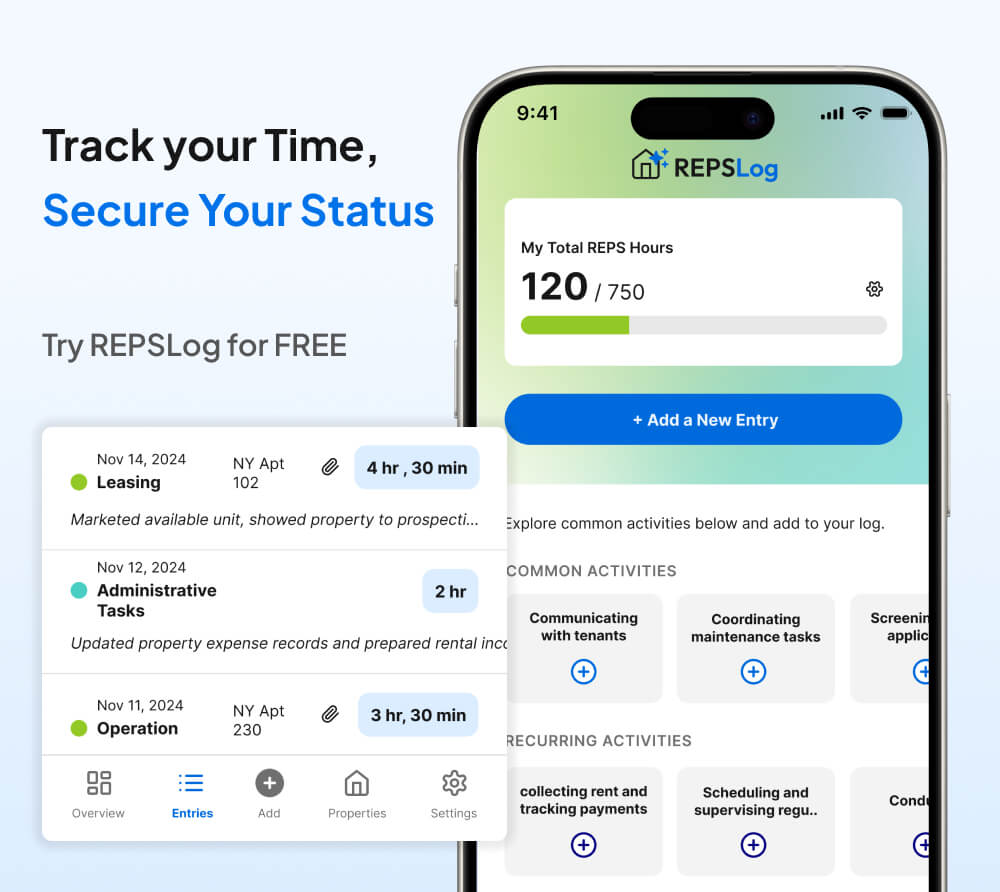
Whether you are targeting 100 hours or 500 hours, REPSLog keeps your hour log organized by property, category, and participant. See your running total at any time, and generate year-end reports that support whichever material participation test applies to your situation.
Available on iOS | Android | Web
This article is for educational purposes only and does not constitute tax or legal advice. Consult a qualified tax professional for guidance tailored to your situation.
Do this in REPSLog
- Participants: log who did each activity, so spouse hours count where allowed and contractor hours stay separate.
- STR Loophole Tracking: a 100 or 500-hour counter per short-term rental, with hours by participant.
- Booking Calendar Sync (Airbnb, Vrbo and any iCal): pull every Airbnb, Vrbo or other booking into your log and get an entry suggested per stay.
Step by step in the Help Center: how to use it. Try REPSLog free for 14 days on iPhone, Android or the web app.