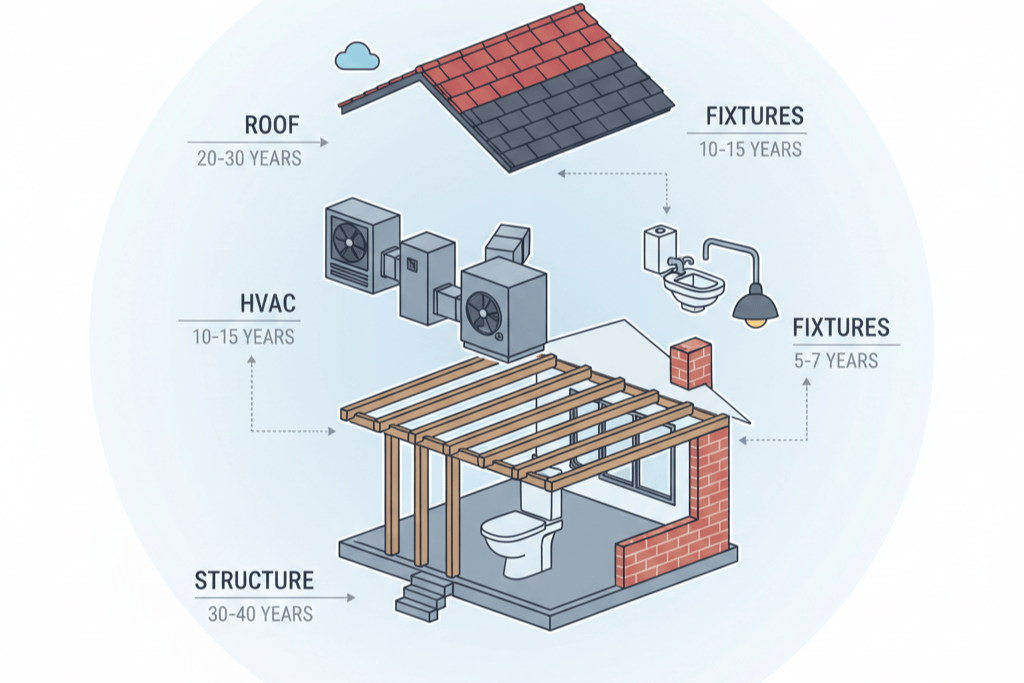
If you qualify as a real estate professional under IRC Section 469(c)(7), you already hold the key to unlocking rental losses against your active income. But the size of those losses — and therefore the size of your tax savings — depends almost entirely on how much depreciation your properties generate. That is where cost segregation comes in.
A cost segregation study is the single most effective tool for accelerating depreciation on a rental property, and when combined with Real Estate Professional Status (REPS), the results can be transformative. Investors who pair REPS with cost segregation routinely save six figures in federal taxes in a single year.
This guide explains how cost segregation works, why it matters so much for REPS-qualifying investors, when to order a study, and how to evaluate whether the investment makes sense for your portfolio.
Run your own numbers on the cost segregation calculator to see what a study would save you this year, after its cost.
What Is Cost Segregation?
When you purchase a residential rental property, the IRS requires you to depreciate the building over 27.5 years using the straight-line method. Commercial properties use a 39-year schedule. Land is not depreciable at all. Under default depreciation, a $1 million residential building would generate roughly $36,364 in annual depreciation deductions.
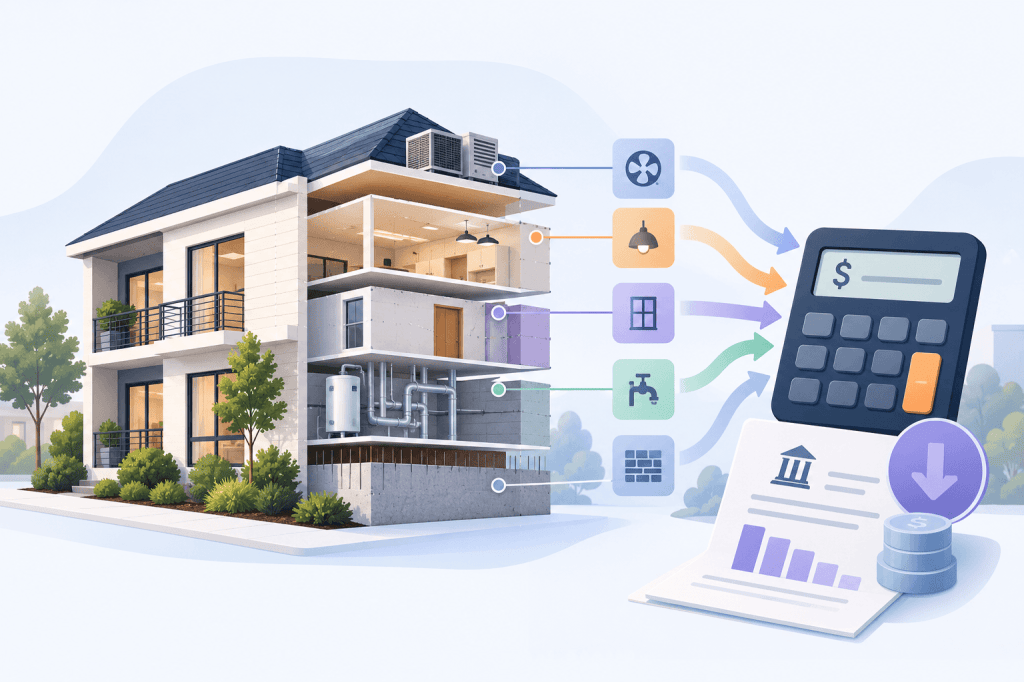
Cost segregation is an engineering-based study that reclassifies components of your property into shorter depreciation categories. Instead of treating the entire building as a single 27.5-year asset, a cost segregation study identifies components that qualify for 5-year, 7-year, or 15-year depreciation schedules.
What Gets Reclassified
A qualified cost segregation firm employs engineers who physically inspect (or review blueprints of) your property and identify components that fall into shorter-lived asset classes. Common reclassifications include:
5-Year Property (Personal Property)
- Appliances (refrigerators, washers, dryers, dishwashers)
- Carpeting and specialty flooring
- Decorative lighting fixtures
- Window treatments (blinds, shutters)
- Cabinetry (when not permanently attached structural components)
- Certain electrical outlets and circuits dedicated to equipment
- Security systems
- Signage
7-Year Property
- Furniture and fixtures
- Office equipment in property management offices
- Certain specialized assets
15-Year Property (Land Improvements)
- Parking lots and driveways
- Sidewalks and pathways
- Landscaping
- Fencing and retaining walls
- Swimming pools and outdoor amenities
- Drainage and irrigation systems
- Outdoor lighting
Everything that remains after reclassification stays in the 27.5-year (or 39-year) category. Typically, a cost segregation study reclassifies 20-40% of a property’s depreciable basis into these shorter-lived categories.
How Cost Segregation Creates Larger Paper Losses
Consider a residential rental property purchased for $800,000, with $600,000 allocated to the building (the remaining $200,000 is land). Under standard depreciation:
- Annual depreciation: $600,000 / 27.5 = $21,818 per year
Now assume a cost segregation study reclassifies 30% of the building into shorter-lived categories:
- $90,000 in 5-year property
- $30,000 in 7-year property
- $60,000 in 15-year property
- $420,000 remaining in 27.5-year property
In Year 1, the accelerated depreciation from the reclassified components — plus any applicable bonus depreciation on those components — could generate $80,000 or more in total depreciation, compared to the $21,818 you would get under the standard schedule.
That extra $58,000+ in depreciation is a paper loss. The property may be cash-flow positive, generating rental income that exceeds your mortgage, taxes, insurance, and operating expenses. But on your tax return, the accelerated depreciation creates a net loss from the rental activity.
Why REPS Makes Cost Segregation So Valuable
Here is the critical connection: without REPS, those paper losses are passive. They can only offset passive income. If you do not have enough passive income to absorb them, they are suspended and carried forward.
With REPS and material participation in your rental activity, those losses become non-passive. They flow through your tax return and offset your W-2 wages, business income, capital gains — everything. The larger the depreciation deduction, the larger the offset.
This is why cost segregation and REPS are a multiplicative combination:
- REPS without cost segregation: You can deduct rental losses, but standard depreciation limits the size of those losses to roughly $21,818 per property per year (for an $800,000 residential property)
- Cost segregation without REPS: You generate enormous first-year depreciation, but the resulting losses are passive and probably get suspended
- REPS plus cost segregation: You generate enormous first-year depreciation AND you can use those losses immediately against all income sources
For an investor in the 37% federal bracket, an additional $60,000 in accelerated depreciation means $22,200 in immediate federal tax savings — plus state tax savings where applicable. Across a portfolio of multiple properties, the numbers become very significant.
When to Order a Cost Segregation Study
Newly Acquired Properties
The ideal time to conduct a cost segregation study is the year you purchase a property. This allows you to take the accelerated depreciation from the start, maximizing your first-year deductions.
Existing Properties (Look-Back Studies)
If you already own properties and have been depreciating them on the standard schedule, you can still benefit. A look-back cost segregation study reclassifies components as of the original placed-in-service date, and you claim the “catch-up” depreciation in the current year using a Form 3115 (Change of Accounting Method). This requires no amended returns — you take the cumulative adjustment in a single year.
For REPS investors, this catch-up amount can be enormous, sometimes creating six-figure deductions in a single tax year.
Renovated Properties
Major renovations create additional depreciable basis that can be segregated. If you have completed a significant rehab or improvement project, a cost segregation study on the renovation costs alone can generate meaningful accelerated depreciation.
Properties Above the Cost Threshold
Cost segregation studies typically cost between $5,000 and $15,000, depending on the property’s complexity and size. As a general rule of thumb:
- Properties with a depreciable basis of $500,000 or more are almost always worth studying
- Properties in the $250,000 to $500,000 range may be worth it, especially for REPS-qualifying investors
- Below $250,000, the study cost may not be justified unless you have multiple similar properties that can be studied together
Your CPA and cost segregation firm can provide a preliminary estimate of the expected tax benefit before you commit.
Choosing a Cost Segregation Firm
Not all cost segregation studies are created equal. The IRS has published an Audit Techniques Guide for cost segregation that outlines what constitutes a quality study. Key factors to evaluate:
Engineering-Based Methodology: The study should be conducted by or supervised by a licensed engineer or architect. Desktop-only studies (sometimes marketed as low-cost alternatives) carry higher audit risk because they lack the detail and specificity the IRS expects.
Detailed Asset-by-Asset Breakdown: The report should identify each reclassified component with specificity — not just “electrical” but “dedicated 20-amp circuits for kitchen appliances in Unit 3.”
Compliance with IRS Guidelines: The firm should follow the IRS Cost Segregation Audit Techniques Guide and be prepared to defend the study in the event of an audit.
Experience with Your Property Type: Different property types (multifamily, single-family, commercial, STR) have different reclassification opportunities. Choose a firm with relevant experience.
Audit Support: Reputable firms stand behind their work and will assist in defending the study if the IRS questions it.
Cost Segregation and Bonus Depreciation in 2026
Bonus depreciation allows you to deduct a percentage of the cost of qualifying assets in the first year, rather than spreading it over the asset’s full recovery period. Under the Tax Cuts and Jobs Act of 2017, bonus depreciation was 100% through 2022 and has been phasing down:
- 2023: 80%
- 2024: 60%
- 2025: 40%
- 2026: 20%
- 2027 and beyond: 0% (unless Congress acts)
In 2026, you can still apply 20% bonus depreciation to the 5-year, 7-year, and 15-year property identified in a cost segregation study. While 20% is less dramatic than the 100% that was available previously, the combination with accelerated depreciation schedules still creates significant front-loaded deductions.
Legislative developments may change this timeline. The One Big Beautiful Bill Act (OBBBA) and other proposals have included provisions to restore higher bonus depreciation rates, so investors should monitor developments closely and consult with their tax advisors about the current rules at the time they file.
Common Misconceptions About Cost Segregation
“Cost segregation is only for large commercial properties.” False. Residential rentals, single-family homes, duplexes, and short-term rentals all benefit. The threshold is the depreciable basis, not the property type.
“Accelerated depreciation just creates a problem later through depreciation recapture.” Partially true, but often overstated. When you sell a property, depreciation taken on personal property (5-year and 7-year assets) is recaptured at your ordinary income tax rate (up to 37%), while depreciation on real property is recaptured at 25% under Section 1250. However, the time value of money matters enormously. Taking large deductions today and deferring recapture to a future sale — especially if structured via a 1031 exchange — creates significant financial benefit.
“My CPA can do cost segregation.” Most CPAs do not have the engineering expertise to conduct a proper study. They work with cost segregation firms and incorporate the results into your tax return. The study itself requires engineering analysis.
“I missed my window because I bought the property years ago.” Look-back studies solve this problem entirely. You can claim the catch-up depreciation in the current year via Form 3115.
Typical Savings Examples
These examples illustrate the combined impact of REPS plus cost segregation for investors in the 37% federal tax bracket:
Single-Family Rental ($500,000 building basis)
- Standard depreciation: ~$18,182/year
- After cost seg (30% reclassified): ~$45,000 in Year 1 depreciation
- Additional Year 1 tax savings from cost seg: ~$9,900 federal
4-Unit Multifamily ($1.2 million building basis)
- Standard depreciation: ~$43,636/year
- After cost seg (35% reclassified): ~$120,000 in Year 1 depreciation
- Additional Year 1 tax savings from cost seg: ~$28,200 federal
Short-Term Rental ($800,000 building basis)
- Standard depreciation: ~$29,091/year
- After cost seg (40% reclassified, STR properties often have more personal property): ~$95,000 in Year 1 depreciation
- Additional Year 1 tax savings from cost seg: ~$24,400 federal
These figures are illustrative and depend on many factors including the specific property, the cost segregation results, the applicable bonus depreciation rate, and the investor’s overall tax situation. Always work with your CPA to model the actual impact.
Frequently Asked Questions
Can I do cost segregation on a property I have owned for several years?
Yes. A look-back cost segregation study reclassifies components as of the original purchase date and allows you to take the cumulative catch-up depreciation in the current tax year via Form 3115. No amended returns are needed.
Does cost segregation trigger an audit?
Cost segregation itself does not trigger an audit. However, large depreciation deductions combined with significant W-2 income can draw IRS attention, which is why having a properly conducted engineering-based study and solid REPS documentation is essential.
Is cost segregation worth it for a $300,000 property?
It depends on your tax bracket and the property’s characteristics. For a REPS-qualifying investor in the 37% bracket, a $300,000 property with a $225,000 building basis might generate $15,000-$25,000 in additional first-year depreciation. If the study costs $5,000-$7,000, the ROI is still strongly positive.
What happens to cost segregation benefits if I sell the property?
You will face depreciation recapture on the accelerated depreciation you claimed. However, if you execute a 1031 exchange, recapture is deferred. Even without an exchange, the time value of taking large deductions now versus paying recapture later typically favors cost segregation.
Can I combine cost segregation with the STR loophole?
Absolutely. Short-term rental properties that qualify for non-passive treatment under the average-stay-of-7-days-or-less rule benefit from cost segregation just as much as REPS-qualifying long-term rentals. STR properties often have a higher percentage of reclassifiable components due to furnishings and amenities.
Do I need REPS to benefit from cost segregation?
Not necessarily. Cost segregation accelerates depreciation regardless of your REPS status. However, without REPS (or the STR loophole), the resulting losses are passive and may be suspended if you lack sufficient passive income. REPS is what unlocks the ability to use those losses against active income.
How long does a cost segregation study take?
Most studies are completed within 4-8 weeks, depending on the property’s complexity and the firm’s workload. For newly acquired properties, you should ideally initiate the study in the year of purchase to ensure it is completed before tax filing.
Key Takeaways
- Cost segregation reclassifies building components into 5-year, 7-year, and 15-year depreciation schedules, dramatically accelerating deductions
- REPS plus cost segregation is a multiplier, because REPS converts the accelerated depreciation from passive losses into deductions against all income
- Look-back studies are available for properties you already own — you can claim cumulative catch-up depreciation in a single year
- Bonus depreciation at 20% in 2026 still enhances the first-year deduction on reclassified components
- Properties above $250,000 in building basis are generally worth studying, especially for REPS investors
- Choose an engineering-based firm that follows IRS guidelines and will support you in an audit
- Always coordinate with your CPA to model the tax impact before and after cost segregation
How REPSLog Keeps You Audit-Ready Alongside Cost Segregation
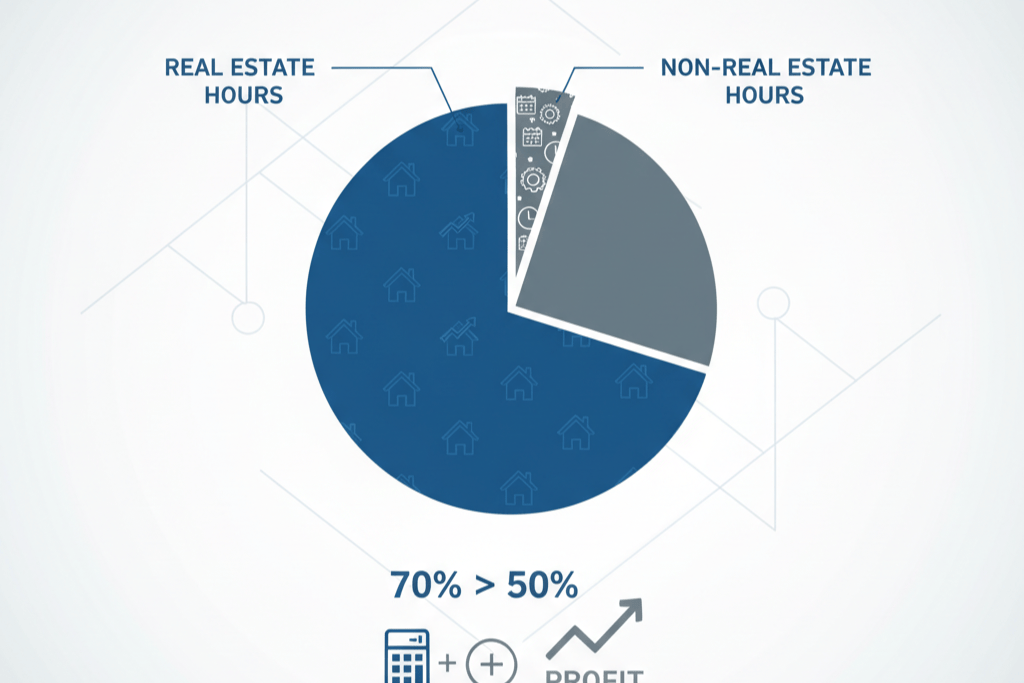
Cost segregation generates the large depreciation deductions. REPS unlocks those deductions against your active income. But the entire strategy falls apart if you cannot prove you qualified as a real estate professional. That means documenting more than 750 hours in real property trades or businesses, passing the more-than-half test, and demonstrating material participation.
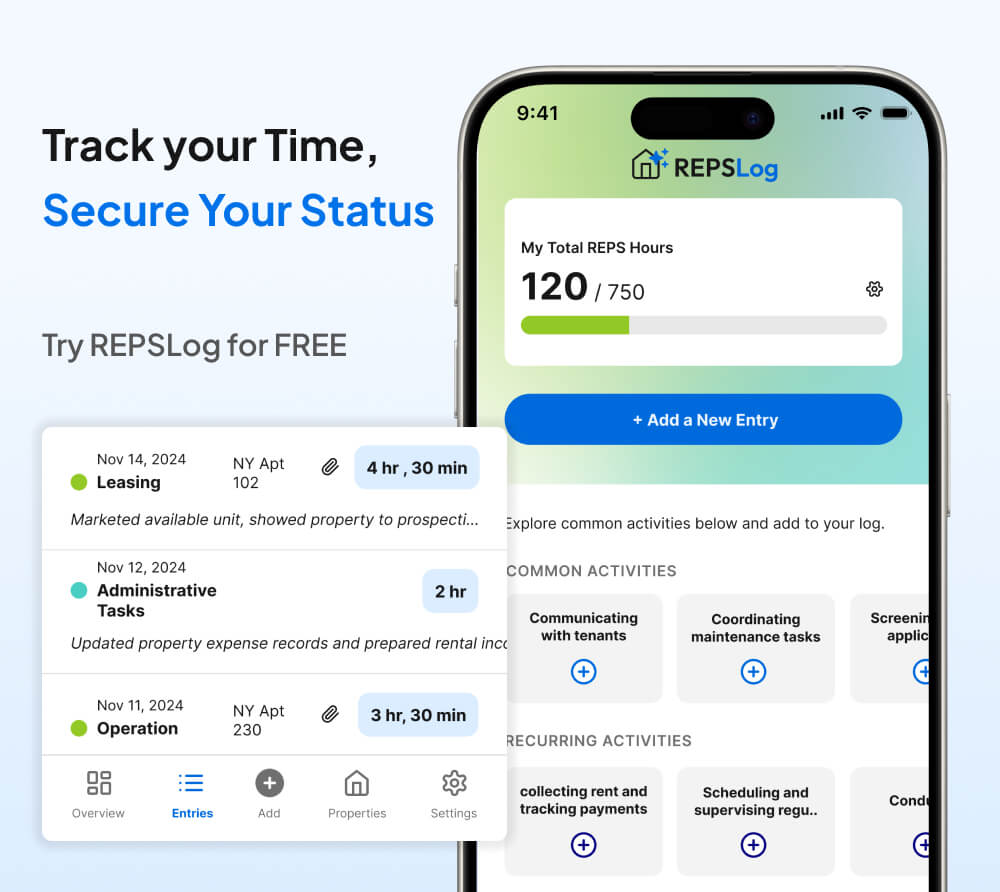
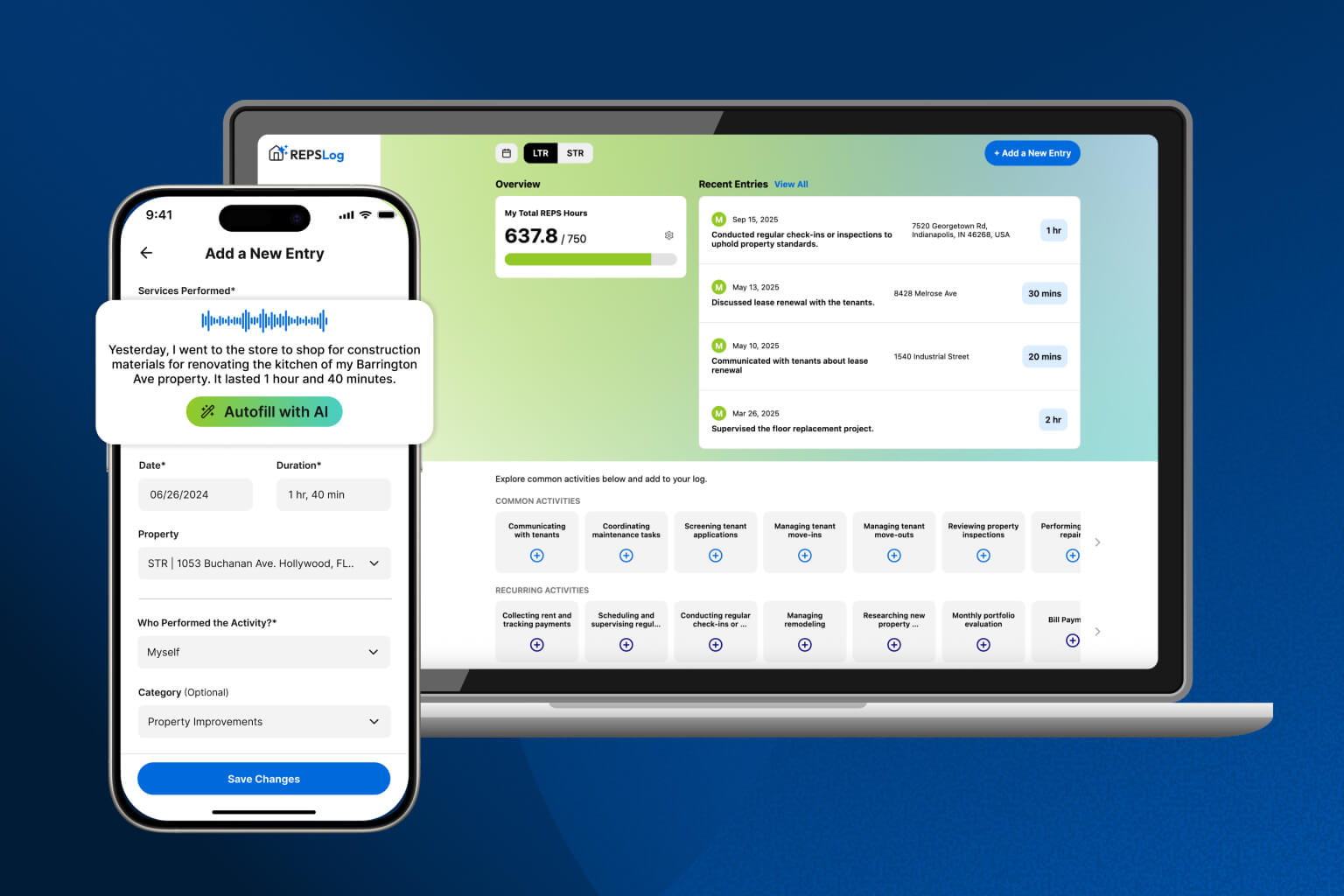
REPSLog is built specifically for this documentation challenge. Log your real estate activities in seconds, track your progress toward the 750-hour threshold in real time, categorize entries by property and activity type, and export audit-ready reports for your CPA. When the IRS questions your REPS claim — and with large cost segregation deductions, the scrutiny increases — your REPSLog records provide the contemporaneous, detailed evidence you need.
Available on iOS and Android, or on the web at app.reps-log.com. Start tracking your hours free →
This article is for educational purposes only and does not constitute tax or legal advice. Consult a qualified tax professional for guidance tailored to your situation.
Do this in REPSLog
- REPS Hour Tracking Goals (750 / 500 / 100): pick the 750, 500 or 100-hour test and watch progress per year and per property.
- Entry logging: what, when, how long, which property, with evidence, in one form.
- CPA-ready Export (PDF and CSV): a tax year as PDF and CSV, split by LTR and STR, with receipts.
Step by step in the Help Center: how to use it. Try REPSLog free for 14 days on iPhone, Android or the web app.