Real estate remains one of the most tax-advantaged asset classes available to individual investors. But the advantage does not appear automatically. It requires understanding and actively implementing specific strategies within the tax code. This article provides an overview of the six most impactful tax strategies for real estate investors in 2026: Real Estate Professional Status, the STR loophole, cost segregation, 1031 exchanges, the QBI deduction, and entity structuring. Each section explains what the strategy does, who benefits most, and the key requirements to get it right.
Strategy 1: Real Estate Professional Status (REPS)
What It Does
Under IRC Section 469(c)(7), qualifying as a real estate professional removes the default passive classification from your rental activities. When combined with material participation, your rental income and losses become non-passive, meaning rental losses can offset your W-2, business, and other active income.
Without REPS, rental losses are passive and can only offset passive income (or up to $25,000 of non-passive income under the special allowance, which phases out between $100,000 and $150,000 MAGI). For high-income investors, the passive limitation effectively locks away their rental losses.
Who Benefits Most
- Households where one spouse manages rental properties full-time while the other earns a high W-2 salary
- Full-time real estate investors and agents
- Investors with significant depreciation deductions from cost segregation studies
- Anyone with AGI above $150,000 who wants to use rental losses against active income
Key Requirements
- More than 750 hours spent in real property trades or businesses in which you materially participate
- More than half of all personal services performed during the year in real property trades or businesses
- Material participation in each rental activity (or in the grouped activity under Treas. Reg. 1.469-9(g))
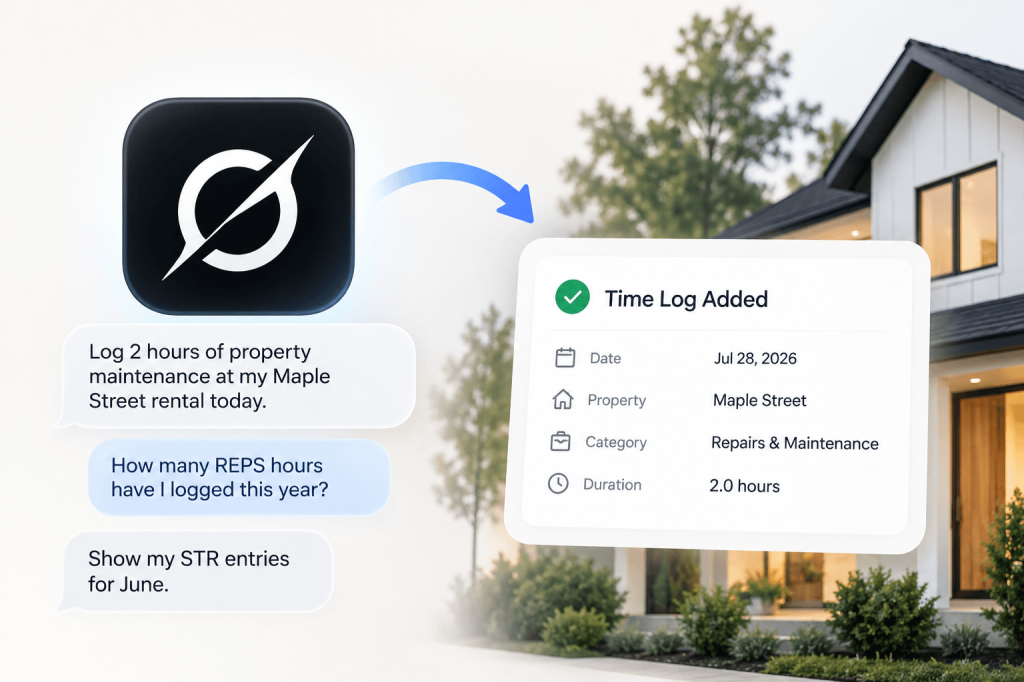
- Contemporaneous hour logs documenting activities by date, description, duration, and property
Both the 750-hour and more-than-half tests must be met individually. Under IRC Section 469(h)(5), spousal hours may be combined for material participation testing, but not for REPS qualification.

Strategy 2: The Short-Term Rental (STR) Loophole
What It Does
Under Treas. Reg. 1.469-1T(e)(3)(ii)(A), a rental activity with an average period of customer use of seven days or less is not treated as a rental activity. This removes the automatic passive classification without needing REPS. If you materially participate in the STR activity, the income and losses are non-passive.
This strategy is particularly valuable for W-2 earners who cannot meet the REPS more-than-half test because of their full-time job.
Who Benefits Most
- W-2 earners with short-term rental properties (Airbnb, Vrbo, vacation rentals)
- Investors who self-manage their STR properties
- Anyone who cannot qualify as a REPS but wants non-passive rental losses
Key Requirements
- Average guest stay of seven days or less during the tax year (calculated per property)
- Material participation in the STR activity. Most commonly satisfied through:
- Test 1: More than 500 hours of participation
- Test 3: More than 100 hours and more than any other individual (the comparative test)
- Documentation of average stay calculation and material participation hours
The comparative element in Test 3 means you must also track contractor and property manager hours to prove no single individual exceeds your participation.
Strategy 3: Cost Segregation
What It Does
Cost segregation is an engineering-based study that reclassifies components of a building into shorter depreciation categories. Standard residential rental property depreciates over 27.5 years. Cost segregation identifies components that qualify for 5-year, 7-year, or 15-year depreciation, accelerating the deductions into the early years of ownership.
Components reclassified typically include personal property (appliances, carpeting, decorative fixtures), land improvements (landscaping, parking, sidewalks), and certain building systems.
Who Benefits Most
- Investors who qualify as REPS or use the STR loophole (so they can actually use the accelerated deductions)
- Owners of properties with improvement values of $200,000 or more
- Investors who recently acquired properties (the study is most valuable in the first year of ownership)
- Short-term rental investors with furnished properties (more personal property to reclassify)
Key Requirements
- Hire a qualified cost segregation firm. The study must be engineering-based and defensible. Costs typically range from $5,000 to $15,000 depending on property complexity.
- Understand bonus depreciation. The bonus depreciation percentage has been phasing down. For 2026, consult current legislation for the applicable percentage. 5-year, 7-year, and 15-year property may be eligible.
- Ensure you can use the deductions. A cost segregation study that generates $200,000 in year-one depreciation is worthless if the losses are suspended as passive. Pair cost segregation with REPS or the STR loophole.
- Be aware of depreciation recapture. When you sell the property, accelerated depreciation is recaptured at ordinary income rates (up to 25% for real property). This is a deferral strategy, not an elimination strategy.
The Math
A $400,000 residential property (excluding land) depreciating straight-line over 27.5 years generates approximately $14,545 in annual depreciation. A cost segregation study might reclassify $120,000 into 5-year and 15-year property, generating $80,000 or more in first-year depreciation (depending on bonus depreciation rates). At a 35% marginal rate, that is an additional $23,000 in year-one tax savings compared to straight-line depreciation.
Strategy 4: 1031 Exchanges
What It Does
IRC Section 1031 allows investors to defer capital gains taxes when selling one investment property and acquiring another “like-kind” property. The gain from the sale is not recognized as long as the proceeds are reinvested into qualifying replacement property within the statutory timeframes.
This deferral can be repeated indefinitely, allowing investors to grow their portfolios without paying capital gains tax until a final taxable disposition. Some investors hold until death, at which point the stepped-up basis eliminates the deferred gain entirely.
Who Benefits Most
- Investors selling appreciated properties who want to reinvest in larger or better properties
- Portfolio rebalancers moving from one market to another
- Investors upgrading from lower-performing to higher-performing assets
- Long-term investors building generational wealth
Key Requirements
- Like-kind property. Both the relinquished and replacement properties must be held for investment or use in a trade or business. Personal residences do not qualify.
- 45-day identification period. You must identify potential replacement properties within 45 days of selling the relinquished property.
- 180-day exchange period. The replacement property must be acquired within 180 days of the sale.
- Qualified intermediary. You cannot touch the sale proceeds. They must be held by a qualified intermediary who facilitates the exchange.
- Equal or greater value. To defer all gain, the replacement property must be of equal or greater value than the relinquished property, and you must reinvest all net proceeds.
Important Consideration for REPS Investors
A 1031 exchange defers the gain, but it also keeps suspended passive losses locked up. If you have accumulated significant suspended losses on a property, a taxable sale (not a 1031 exchange) might be more beneficial because the disposition releases those suspended losses. This is a case where the best strategy depends on your specific facts, and you should model both scenarios with your tax advisor.
Strategy 5: The Qualified Business Income (QBI) Deduction
What It Does
Under IRC Section 199A, eligible taxpayers can deduct up to 20% of qualified business income from pass-through entities and sole proprietorships. For real estate investors, rental income may qualify as QBI if the rental activity rises to the level of a trade or business.
The QBI deduction effectively reduces the tax rate on qualifying rental income by 20%. On $100,000 of qualifying rental income, the deduction would be $20,000, saving approximately $7,000 at a 35% marginal rate.
Who Benefits Most
- Real estate investors with net rental income (not just losses)
- Investors who actively manage their properties
- Pass-through entity owners (LLCs, S corps, partnerships)
- Investors with rental income below the taxable income threshold for the deduction phase-out (or who satisfy the W-2 wage and property basis tests above the threshold)
Key Requirements
- Trade or business standard. The rental activity must constitute a trade or business. The IRS provided a safe harbor in Revenue Procedure 2019-38 requiring 250 hours of rental services per year, separate books, and contemporaneous records. Alternatively, you can argue trade-or-business status based on all facts and circumstances.
- Taxable income limitations. Above certain taxable income thresholds, the deduction may be limited by W-2 wages paid and/or the unadjusted basis of qualified property.
- Specified service trade or business (SSTB) exclusion. Certain professional service businesses are excluded from the deduction above income thresholds. Real estate operations are generally not SSTBs.
- Filing requirements. The deduction is calculated on the individual return, not the entity return.
QBI and REPS Interaction
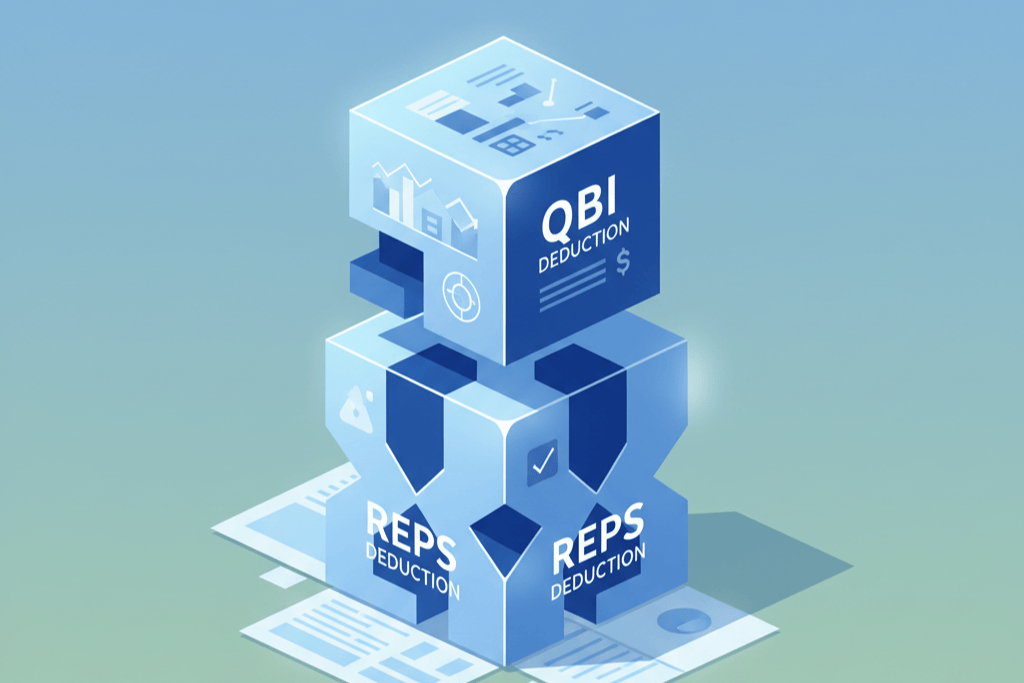
REPS qualification and the QBI deduction address different issues. REPS converts losses from passive to non-passive. The QBI deduction reduces the tax rate on income. If your rental activities generate net income (perhaps from properties without significant depreciation), the QBI deduction can reduce your effective tax rate on that income by up to 20%.
Strategy 6: Entity Structuring
What It Does
The legal structure you use to hold rental properties affects liability protection, tax treatment, and operational flexibility. Common structures include sole proprietorship, single-member LLC, multi-member LLC, S corporation, and C corporation. Each has different implications for REPS, the STR loophole, the QBI deduction, and day-to-day operations.
Who Benefits Most
- All real estate investors benefit from appropriate entity structuring
- Multi-property investors who need liability isolation between properties
- Investors in states with favorable LLC laws
- Investors employing family members in the business
Key Considerations
Single-member LLC (disregarded entity): The most common structure for individual real estate investors. Provides liability protection without changing the tax treatment. The LLC is disregarded for federal tax purposes, and all income and expenses flow through to Schedule E. FICA exemption for children under 18 employed by a parent applies.
Multi-member LLC (partnership): Used when multiple investors co-own a property. Taxed as a partnership by default. Each member’s share of income and losses flows through to their individual return. Material participation is tested at the individual level.
S corporation: Can provide self-employment tax savings on active business income. However, rental income is generally not subject to self-employment tax anyway, limiting the benefit for pure rental operations. The FICA exemption for employing your children does not apply when the employer is a corporation.
Series LLC: Available in some states, allowing multiple “series” within one LLC, each with separate liability protection. Can simplify multi-property portfolios while maintaining asset isolation.
C corporation: Rarely used for rental properties due to double taxation (corporate tax on income, then shareholder tax on distributions). The FICA exemption for children does not apply.
Structuring for Tax Strategies
Your entity choice can enhance or limit your tax strategies:
- REPS compatibility: All pass-through structures (sole proprietorship, LLC, partnership, S corp) are compatible with REPS. Your hours managing properties within these entities count toward your REPS qualification.
- STR loophole compatibility: Same as REPS. The seven-day test and material participation are tested at the individual level regardless of entity.
- Cost segregation: Available for properties held in any entity type.
- 1031 exchanges: The same taxpayer must sell and acquire. Properties held in an LLC (disregarded or multi-member) can be exchanged, but entity changes during the exchange process can create complications.
- QBI deduction: Available for income from pass-through entities. C corporation income does not qualify.
- Employing children: The FICA exemption applies only to sole proprietorships and disregarded-entity LLCs owned by the parent. Corporations and multi-member LLCs with non-parent members are excluded.
Putting It All Together
The most effective approach combines multiple strategies:
Example: Physician household with spouse managing five rentals
- Entity: Each property in a single-member LLC for liability protection. LLCs are disregarded entities, so all income flows to the joint return.
- REPS: Spouse qualifies as a real estate professional (more than 750 hours, more-than-half test).
- Grouping election: Filed under Treas. Reg. 1.469-9(g) to treat all five properties as one activity for material participation.
- Cost segregation: Studies performed on each property at acquisition, generating accelerated depreciation.
- Result: Large rental losses from depreciation flow through as non-passive deductions against the physician’s W-2 income.
- Future: When selling a property, evaluate whether a 1031 exchange or taxable sale is more beneficial based on suspended loss position.
Example: W-2 earner with two STR properties
- Entity: Each STR in a single-member LLC.
- STR loophole: Both properties have average stays under seven days, qualifying under Treas. Reg. 1.469-1T(e)(3)(ii)(A).
- Material participation: Self-manages both properties, logging more than 150 hours each, with no individual contractor exceeding those hours (Test 3).
- Cost segregation: Performed on both furnished STR properties (high personal property content for reclassification).
- Result: STR losses offset W-2 income without REPS qualification.
- QBI: Net rental income from future profitable years qualifies for the 20% QBI deduction.
Frequently Asked Questions
Can I use all six strategies simultaneously?
Yes, to the extent each one applies to your situation. REPS, cost segregation, and entity structuring work together routinely. The STR loophole applies to specific properties. 1031 exchanges apply at the time of disposition. The QBI deduction applies when you have net qualifying income.
Which strategy should I implement first?
Start with entity structuring (protect your assets) and hour tracking (build your REPS or material participation documentation). These are foundational. Cost segregation is most impactful in the first year of property ownership. 1031 exchanges and QBI planning can be layered on as your portfolio matures.
Do I need a CPA for all of these strategies?
Strongly recommended. While you can understand the concepts yourself, the implementation details and interactions between strategies require professional expertise. A CPA experienced with real estate investors is essential.
How much can these strategies save in total?
For a household with $400,000 in W-2 income and $1 million in rental property, the combination of REPS qualification and cost segregation can save $50,000 to $100,000 or more in federal taxes in the first year of ownership. The QBI deduction, 1031 exchanges, and entity structuring add incremental benefits over time.
Are these strategies legal?
Yes. Every strategy discussed here is explicitly provided for in the Internal Revenue Code or Treasury Regulations. They are tax planning, not tax avoidance. However, each strategy must be properly implemented with genuine compliance, not just paperwork.
What is the biggest mistake investors make with these strategies?
Failing to document. REPS without hour logs, cost segregation without a proper study, 1031 exchanges without a qualified intermediary, and entity structuring without proper legal formation all create audit risk. The strategies work; the documentation is what proves they apply to you.
How do these strategies interact with state taxes?
State treatment varies significantly. Some states fully follow federal provisions, others partially follow, and some have their own rules entirely. California, for example, does not conform to the federal bonus depreciation rules. Check each strategy’s state-level treatment with your advisor.

Key Takeaways
- REPS converts rental losses from passive to non-passive, allowing them to offset W-2 and active business income
- The STR loophole achieves a similar result for short-term rentals without requiring REPS qualification
- Cost segregation accelerates depreciation into the early years of ownership, dramatically increasing year-one deductions
- 1031 exchanges defer capital gains taxes when reinvesting in like-kind replacement property
- The QBI deduction reduces the effective tax rate on qualifying rental income by up to 20%
- Entity structuring affects liability protection, tax treatment, and eligibility for specific strategies like the FICA exemption for children
- The most effective approach combines multiple strategies tailored to your specific portfolio and income profile
- Documentation is the common thread: every strategy requires proper records to withstand IRS scrutiny
Start Building Your Tax Documentation Today
REPSLog is the foundation of your real estate tax strategy. Track your REPS hours, document material participation for the STR loophole, and build the contemporaneous records that support every strategy in your toolkit.
Available on iOS | Android | Web
This article is for educational purposes only and does not constitute tax or legal advice. Consult a qualified tax professional for guidance tailored to your situation.
Do this in REPSLog
- REPS Hour Tracking Goals (750 / 500 / 100): pick the 750, 500 or 100-hour test and watch progress per year and per property.
- Entry logging: what, when, how long, which property, with evidence, in one form.
- CPA-ready Export (PDF and CSV): a tax year as PDF and CSV, split by LTR and STR, with receipts.
Step by step in the Help Center: how to use it. Try REPSLog free for 14 days on iPhone, Android or the web app.