If you are relying on the short-term rental loophole to deduct rental losses against your W-2 income, you probably know you need to track your own hours. What many investors overlook is equally important: you must also track the hours of every contractor, cleaner, property manager, and service provider who works on your property. The reason comes down to Test 3 under Treas. Reg. 1.469-5T(a)(3), the material participation test that most STR investors use to qualify for the loophole. Fail to track contractor hours, and you may not be able to prove your participation exceeds theirs. This article explains which contractors count, how to document their hours, and how to structure your operations to stay on the right side of the test.
Part of our STR loophole series: the loophole as a whole is in our STR loophole guide, and the test itself in the 100-hour material participation test.
Why Contractor Hours Matter
The STR loophole works in two steps. First, your property must have an average period of customer use of seven days or less under Treas. Reg. 1.469-1T(e)(3)(ii)(A), which reclassifies it as a non-rental activity. Second, you must materially participate in the activity for the losses to be non-passive.
Most STR investors who work a W-2 job rely on Test 3 for material participation: more than 100 hours of your own participation, and your participation must be no less than any other individual’s participation.
That “no less than any other individual” requirement is the comparative element. It does not compare you to the combined hours of all service providers. It compares you to each individual separately. But to prove you pass the test, you need to know how many hours each individual worked on your property.
Without contractor hour records, you have a critical gap in your documentation. In an audit, the IRS can argue that you cannot demonstrate the comparative element because you do not know whether a contractor exceeded your hours. That gap alone can disqualify your material participation claim.
Which Contractors Count?
Every individual who performs services for your STR activity counts in the comparison. The test looks at “participation of any other individual,” which is interpreted broadly.
Cleaning Personnel
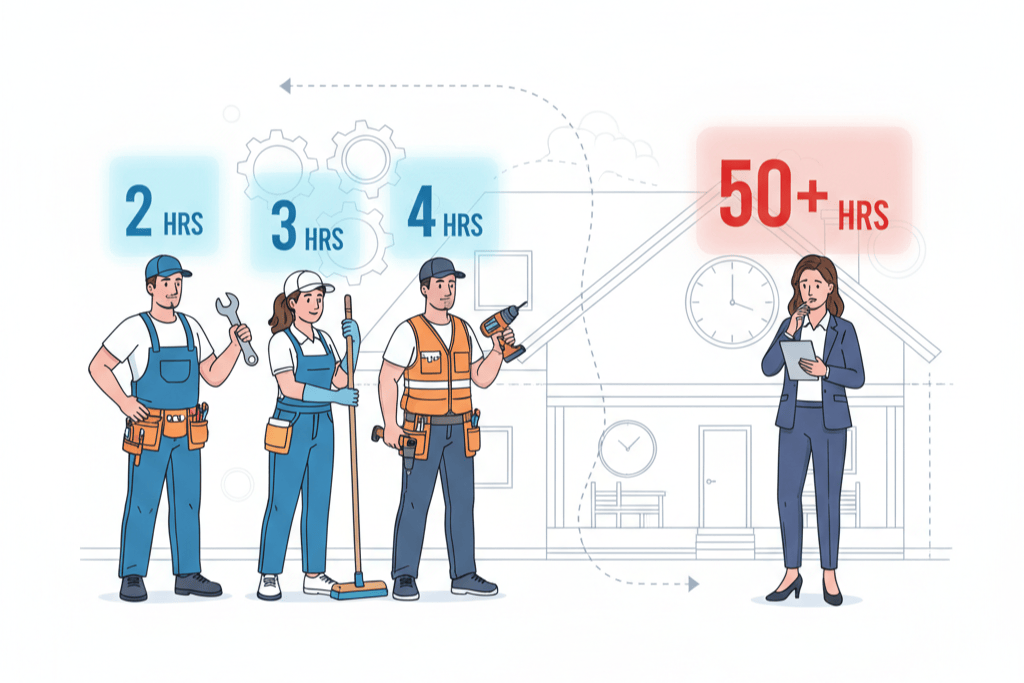
Cleaning is typically the most hour-intensive contractor service for STRs. If you have 60 turnovers per year and each turnover takes three hours to clean, that is 180 hours of cleaning. If one cleaner handles all 60 turnovers, that single individual has 180 hours attributed to your property.
Key question: Is it one person or a team? If a cleaning company sends a rotating team of three cleaners, each cleaner handles roughly 20 turnovers (60 hours each). No single individual reaches 180. But if one dedicated cleaner handles every turnover, that one person has 180 hours.
This distinction can determine whether you pass or fail Test 3.
Property Managers
A full-service property manager who handles guest communications, pricing, turnover coordination, and maintenance may log significant hours on your property. If one individual manages your STR as part of their portfolio, their hours on your property specifically need to be tracked.
For management companies with multiple staff members, track hours by individual, not by company. The front desk person who handles guest calls has their own hours. The maintenance coordinator has theirs. The manager who oversees operations has theirs.
Maintenance and Repair Contractors
Plumbers, electricians, HVAC technicians, handymen, and other repair contractors typically work on your property sporadically. Their hours tend to be low (a few hours per visit, a few visits per year), but they still need to be tracked.
A handyman who visits monthly for four hours has 48 annual hours. That is well below most investors’ personal hours. But a contractor performing a multi-week renovation could accumulate hundreds of hours.
Landscaping and Exterior Maintenance
Landscapers, pool maintenance workers, snow removal contractors, and similar exterior service providers log regular hours. A weekly lawn service at one hour per visit is 52 hours per year.
Virtual Assistants and Co-Hosts
If you use a virtual assistant for guest communications or an Airbnb co-host who manages bookings, their hours count. A VA who spends five hours per week on your property’s guest messages logs 260 hours per year, which would exceed most investors’ personal hours.
Anyone Else
The test is broad. If an individual performs services related to your STR activity, their hours are part of the comparison. When in doubt, track it.
How to Document Contractor Hours
Method 1: Request Time Records Directly
The most reliable method is asking your contractors to provide time records for work performed on your property. Many contractors already track time for billing purposes.
For cleaning services: Ask for a log of each cleaning, including date, start time, end time, and the name of the individual cleaner. If the company invoices per cleaning, request confirmation of the typical time per cleaning.
For property managers: Request a quarterly or annual summary of hours spent on your property, broken down by individual staff member and activity type.
For maintenance contractors: Invoices typically show the date of service and hours billed. Save every invoice and compile an annual summary.
Method 2: Estimate From Invoices
When direct time records are unavailable, estimate hours from invoices and service records:
- A cleaning invoice for $150 at an estimated rate of $30/hour suggests five hours of work
- A plumbing invoice showing “3 hours labor” explicitly states the time
- A monthly lawn service invoice typically represents a known duration (ask the provider)
Document your estimation methodology and the source data used. The IRS accepts reasonable estimates when exact records are unavailable, but you need a defensible basis for each estimate.
Method 3: On-Site Observation
For contractors who work on-site, note their arrival and departure times when you are present. Even occasional observations help establish a pattern:
“Cleaning team arrives at 10:00 AM and departs at 1:00 PM each turnover. Based on 50 turnovers per year, estimated 150 hours per year.” If you observed this timing on five occasions, that observation supports the estimate for the full year.
Method 4: Contractual Terms
Service agreements often specify expected hours or visit durations. A pool maintenance contract for “weekly 45-minute visits” translates to roughly 39 hours per year. Reference the contract in your documentation.
Structuring Your Operations for Test 3 Success
Once you understand the comparative element, you can structure your STR operations to support your qualification:
Spread Work Across Multiple Providers
The comparative test is per individual. Using multiple service providers distributes hours so no single person accumulates more than you:
- Instead of one cleaner handling all turnovers, use a cleaning service that rotates team members
- Instead of one handyman for all maintenance, use specialists (plumber, electrician, general handyman) for different tasks
- Instead of a full-service property manager, self-manage core functions and outsource specific tasks
Self-Manage the Most Time-Intensive Functions
Guest communication and booking management are among the most hour-intensive STR activities. By self-managing these functions, you capture those hours in your own total:
- Answer guest inquiries and messages personally
- Handle check-in coordination yourself
- Manage pricing and listing optimization directly
- Review and respond to guest reviews yourself
Monitor Your Comparative Position Throughout the Year
Do not wait until December to discover that your cleaner logged more hours than you. Track the comparison quarterly:
| Q1 | Your Hours | Highest Individual Contractor |
|---|---|---|
| 45 | Cleaner A: 38 |
| Q2 | Your Hours | Highest Individual Contractor |
|---|---|---|
| 42 | Cleaner A: 42 |
At Q2, the gap has closed. You need to either increase your involvement or find ways to distribute the cleaner’s hours (perhaps by handling some turnovers yourself or rotating cleaners).
Consider a Co-Management Approach
If you currently use a full-service property manager, consider switching to a co-management model where you handle guest communication and the property manager handles only maintenance and cleaning coordination. This splits the management hours and keeps you as the dominant participant.
What to Do If You Cannot Pass Test 3
If a contractor’s hours will inevitably exceed yours (for example, a dedicated property manager handling everything for a remote property), you have alternatives:
Test 1: More than 500 hours. If you can dedicate more than 500 hours to the STR activity, the comparative element is irrelevant. You qualify regardless of how many hours any contractor logs.
Test 4: Significant participation activities. If you have more than 100 hours in this STR and your total hours across all significant participation activities (multiple STRs, other businesses) exceed 500, you qualify.
Restructure your management. Reduce the property manager’s role and take on more functions personally.
Consider REPS qualification. If you or your spouse can meet the more than 750 hours and more-than-half tests, REPS qualification provides an alternative path that does not depend on the comparative test.
Record-Keeping Systems
Create a simple system for tracking both your hours and contractor hours:
Your Hour Log
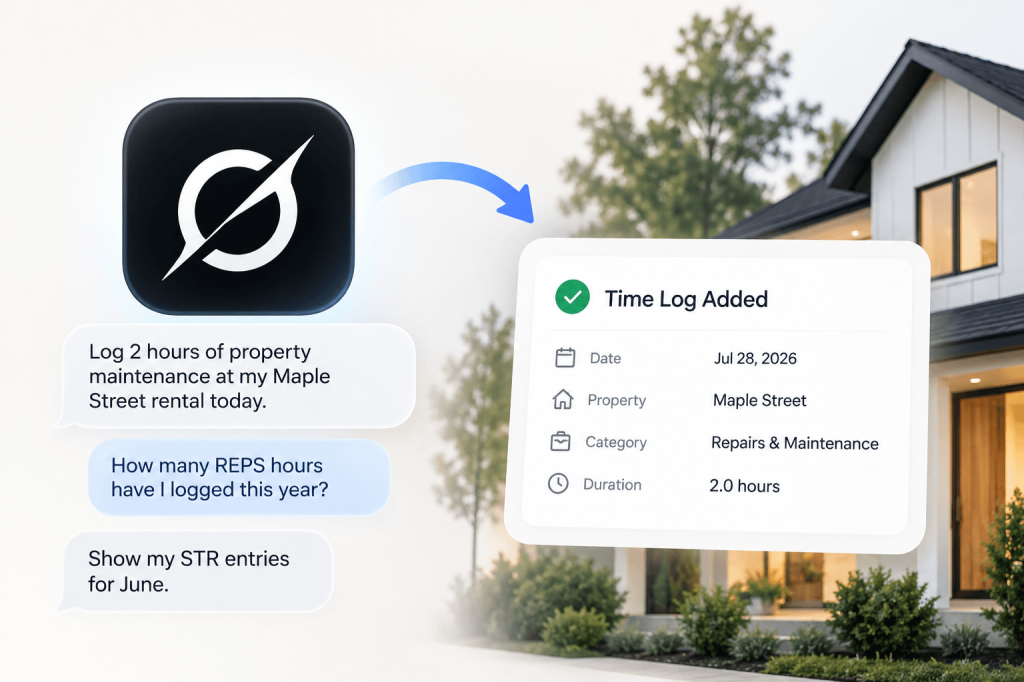
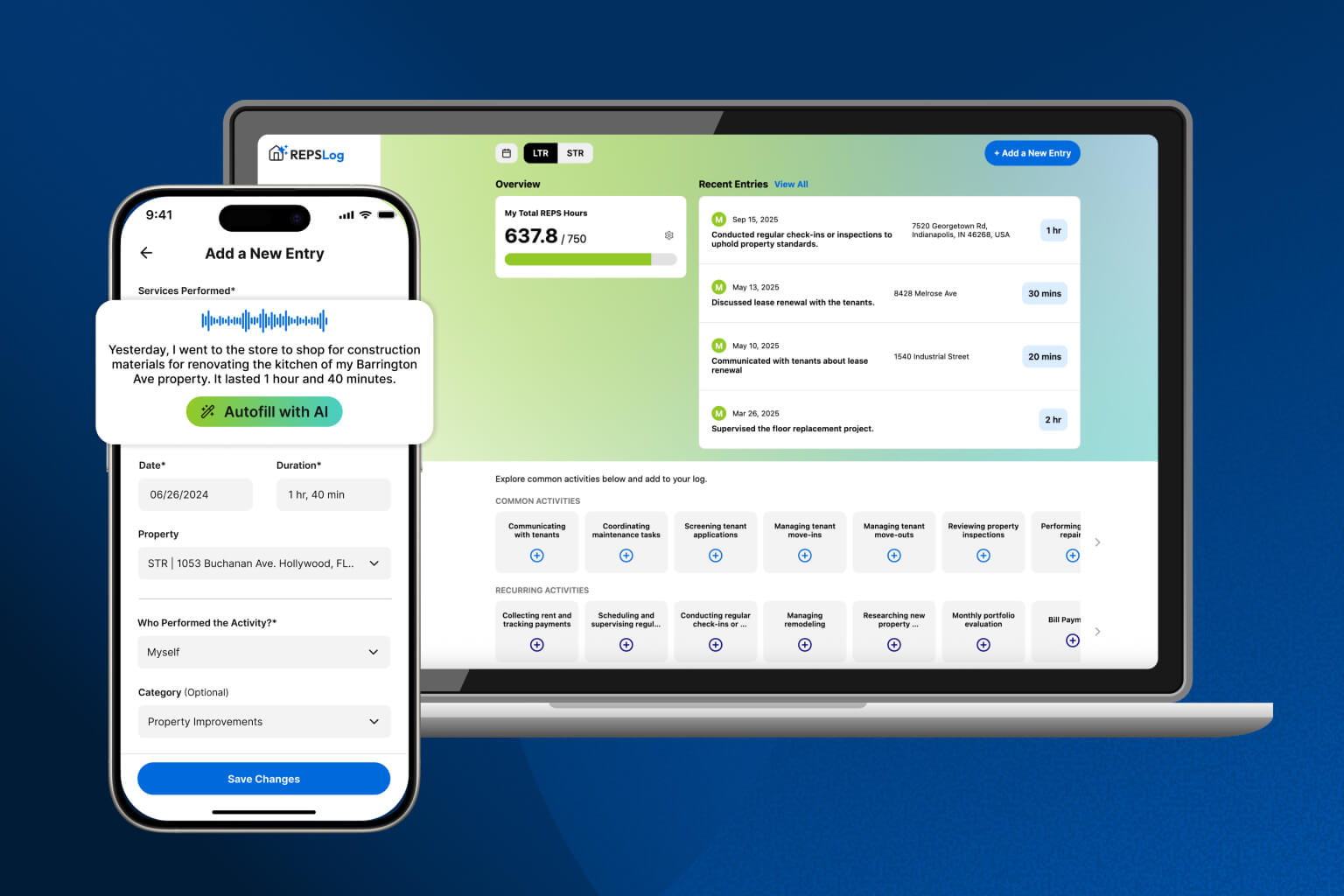
Use a dedicated tracking tool like REPSLog to log your daily activities. Each entry should include:
- Date
- Activity description
- Duration
- Property
Contractor Hour File
Maintain a file (physical or digital) for each property containing:
- All contractor invoices
- Time records received from contractors
- Your estimates and supporting calculations
- Annual summary by individual
Year-End Comparison Document
Prepare an annual summary showing:
- Your total hours per property
- Each individual contractor’s total hours per property
- A clear demonstration that your hours equal or exceed each individual’s hours
- Source references for all hour figures
Frequently Asked Questions
What if a contractor refuses to provide time records?
Use your best estimate based on invoices, scope of work, and any observations. Document your estimation methodology. A reasonable, good-faith estimate is better than no records at all.
Do I need to track hours for contractors who only worked on my property once?
Yes, though the tracking burden is minimal. A one-time contractor visit is typically documented by the invoice showing the date and hours worked. A plumber who spent two hours on a repair is two hours. This will not affect your comparative position.
If I use an Airbnb cleaning service that assigns random cleaners, how do I track individual hours?
Request information from the cleaning company about which individuals cleaned your property and how many times each person was assigned. If the company cannot provide this level of detail, document the total hours and the number of team members in the rotation to estimate per-individual hours.
Does my spouse’s cleaning or maintenance work count as contractor hours?
No. Under IRC Section 469(h)(5), your spouse’s participation is treated as your participation for material participation testing. Your spouse’s hours are added to yours, not compared against yours. This is an advantage, not a risk.
What if I hire my child to clean the STR?
Your child’s hours are treated as a separate individual’s hours for the comparative test. If your child cleans the property for 150 hours and you only manage it for 120 hours, you fail Test 3. However, if your child is your minor child and you count your spouse’s hours with yours, the combined total might still exceed your child’s hours.
How detailed do contractor hour records need to be?
They should be detailed enough to support your per-individual annual totals. Exact start and end times for every visit are ideal but not always practical. Date, approximate duration, and individual name are the minimum. The standard is reasonable documentation, not forensic precision.

Key Takeaways
- Test 3 under Treas. Reg. 1.469-5T(a)(3) compares your hours to each individual contractor’s hours, not to the combined total
- You must track contractor hours to prove no single individual exceeds your participation
- Cleaning services are typically the highest-risk category because of the volume of turnover hours
- Using rotating staff, distributing work across multiple providers, and self-managing key functions all help maintain your comparative position
- Request time records from contractors, estimate from invoices when records are unavailable, and document your methodology
- Monitor your comparative position quarterly to catch problems before year-end
- If Test 3 is not achievable, consider Test 1 (more than 500 hours), Test 4 (aggregate significant participation), or restructuring your management approach
- Spousal hours count as your hours under 469(h)(5), which is an advantage for the comparative test
Track Both Your Hours and Contractor Data with REPSLog
REPSLog helps STR investors track the hours that matter for material participation. Log your activities by property, category, and participant, and always know where you stand against the comparative threshold.
Available on iOS | Android | Web
This article is for educational purposes only and does not constitute tax or legal advice. Consult a qualified tax professional for guidance tailored to your situation.
Do this in REPSLog
- Participants: log who did each activity, so spouse hours count where allowed and contractor hours stay separate.
- STR Loophole Tracking: a 100 or 500-hour counter per short-term rental, with hours by participant.
- Booking Calendar Sync (Airbnb, Vrbo and any iCal): pull every Airbnb, Vrbo or other booking into your log and get an entry suggested per stay.
Step by step in the Help Center: how to use it. Try REPSLog free for 14 days on iPhone, Android or the web app.