One of the most frequently debated questions among real estate investors pursuing REPS qualification is whether travel time to and from properties counts toward the more than 750 hours requirement. The answer is nuanced: some travel time counts, some does not, and the distinction can add or subtract dozens of hours from your annual total. This article examines what Tax Court cases have established, the commuting vs. business travel distinction, and how to document travel time properly.
The General Rule: Business Travel Counts, Commuting Does Not
The IRS treats travel time similarly across most contexts. The general framework is:
Business travel is travel between work locations or travel from one business activity to another. This travel is performed for a business purpose and the time spent traveling is considered part of the business activity.
Commuting is travel from your home to your regular place of business. Commuting time is a personal expense and does not count as work time.
For REPS purposes, the question is whether travel to a rental property is business travel (countable) or commuting (not countable). The answer depends on your specific facts and circumstances.

What Tax Court Cases Tell Us
Several Tax Court cases have addressed the treatment of travel time in the context of REPS qualification and material participation. While no single case provides a universal rule, the case law establishes useful patterns.
Travel Between Properties Counts
When an investor travels from one property to another during a workday, that travel is business travel. If you inspect Property A in the morning and drive 30 minutes to Property B for an afternoon inspection, the 30-minute drive counts toward your REPS hours.
This is consistent with general tax principles: travel between two work locations during the course of business is deductible and countable as work time.
Travel From Home to a Property: It Depends
The treatment of travel from your home to a rental property depends on whether the property constitutes your regular place of business or an alternative work location:
If your home is your principal place of business for your real estate activities (you do not have a separate office), travel from your home to any rental property is generally treated as business travel, not commuting. The logic is that your commute is from your home office to a work site, which is business travel.
If you have a separate office that serves as your regular place of business, travel from your home to that office is commuting (not countable). Travel from the office to properties is business travel (countable). Travel directly from home to a property may also be business travel if the property is not your regular place of business.
The Home Office Advantage
Establishing a home office for your real estate management activities provides a significant advantage for REPS hour counting. When your home is your principal place of business:
- Travel from home to any property is business travel, not commuting
- Travel from home to meet contractors, attend closings, or visit hardware stores for property supplies is business travel
- The first and last trips of each workday count, not just trips between locations
Many Tax Court cases have examined whether a taxpayer’s home qualifies as their principal place of business. The factors include whether you spend substantial time at home performing management activities, whether you have a dedicated office space, and whether there is no other fixed location where you conduct the administrative aspects of your business.
Long-Distance Travel to Out-of-State Properties
If you own properties in another state or a significant distance from your home, travel to those properties is business travel when the trip has a legitimate business purpose (inspection, meeting contractors, handling tenant issues, acquisition research).
However, the IRS may scrutinize extended travel periods. If you fly to your vacation rental property and spend a week there, the countable travel time is limited to the actual travel hours (flights, driving), not the entire trip duration. Time spent at the destination counts only if you are performing real estate activities, not vacationing.
What Specifically Counts
Based on the case law and IRS guidance, the following travel-related time generally counts toward REPS hours:
Countable Travel Time
- Driving from your home office to a rental property for inspections, maintenance oversight, or tenant meetings
- Driving between properties during a workday
- Travel to meet contractors, vendors, or service providers at a property or at a supply store for property-related purchases
- Travel to attend closings, appraisals, or inspections for properties you are acquiring or managing
- Travel to attend real estate education events such as investor meetups, conferences, or courses directly related to your property management activities
- Travel to your CPA, attorney, or insurance agent for meetings related to your real estate activities
- Air travel to out-of-state properties for legitimate management purposes
- Travel to view potential acquisition targets as part of your property sourcing activities
Non-Countable Travel Time
- Commuting from home to a separate real estate office that is your regular place of business
- Personal travel that happens to pass by a property (driving past your rental on the way to the grocery store does not count)
- Vacation travel to a location where you also own rental property unless the primary purpose of the trip is business
- Travel time during a trip where no real estate activity is performed at the destination
Documentation Best Practices
Travel time is one of the most audited components of REPS hour logs. The IRS looks for specificity and credibility. Here is how to document travel time effectively:
Record Each Trip
For every trip you count toward REPS hours, log:
- Date of travel
- Starting location (home office, Property A, etc.)
- Destination (Property B, contractor meeting at property, etc.)
- Purpose of the trip (quarterly inspection, meet plumber for water heater replacement, show unit to prospective tenant)
- Travel time (driving time, not including stops for personal errands)
- Miles driven (supports mileage deduction and corroborates travel time)
Use Supporting Evidence
Strengthen your travel log with:
- Mileage tracking apps that record your routes automatically
- Calendar entries showing appointments at properties
- Receipts from locations visited (hardware stores, properties)
- Contractor communications confirming meetings at properties
- Gas receipts or toll records that corroborate travel patterns
Be Consistent and Reasonable
If your property is 15 minutes from your home, logging 15 minutes of travel time each way is credible. Logging 45 minutes for the same trip is not. Be honest and consistent. The IRS can check distances and typical drive times.
Similarly, if you log travel to a property five days per week, the IRS will expect to see substantial activity at the property on each visit. Driving to a property just to “check on it” for five minutes does not justify counting 30 minutes of round-trip travel time as a business activity.
The Round Trip Question
A common question: do you count the drive back home as well?
Generally, yes. If your home is your principal place of business and you drive to a property and back, both legs of the trip are business travel. The return trip from a work location to your home office is not commuting; it is a return trip to your principal place of business.
However, if you stop for personal errands on the way home (grocery store, kids’ school pickup, gym), the return trip is split. Count only the portion of the drive that represents direct travel from the property to your home, not the extended route including personal stops.
Travel Time in the Context of Total Hours
Travel time can be a meaningful contributor to your total REPS hours, but it should not be the dominant category. An hour log where 300 of 800 hours are travel time may raise audit flags, even if each individual trip is legitimate.
A balanced log might show travel time representing 10% to 20% of total hours. If you have four properties averaging 20 minutes from your home and you visit each one weekly, that is roughly:
- 4 properties x 40 minutes round trip x 52 weeks = approximately 138 hours of travel per year
- As a percentage of 800 total hours: 17%
This is a reasonable proportion. If travel time creeps above 25% to 30% of total hours, scrutinize whether you are logging excessive or inflated travel time.
Out-of-State Property Travel
Investors who own properties in other states face additional complexity:
Occasional trips are clearly business travel. Flying to your out-of-state rental for a quarterly inspection, meeting with a property manager, or overseeing a renovation is legitimate business travel. Count the actual travel time (flights, airport time, driving at the destination).
Extended stays require allocation. If you spend a week at your out-of-state property, count only the hours you spend on real estate activities, plus reasonable travel time. A seven-day trip where you perform 20 hours of property management generates 20 hours of activity time plus travel time, not 168 hours.
Mixed-purpose trips require careful separation. If you combine a property inspection with a family vacation, only the business portion counts. The IRS may allocate travel days between business and personal based on the primary purpose of each day. Document the business purpose of each day clearly.
The Home Office Deduction Connection
If you claim a home office deduction for your real estate management activities, you strengthen the argument that your home is your principal place of business. This reinforces the treatment of travel from home to properties as business travel.
To claim the home office deduction, you generally need:
- A dedicated space used regularly and exclusively for business
- The space must be your principal place of business (where you perform substantial administrative or management activities)
Having a home office is not required to count travel time, but it creates a more defensible position.
Frequently Asked Questions
Can I count travel time to a property I am considering purchasing but have not yet bought?
Yes. Acquisition research is a real property trade or business activity. Travel to view potential properties, attend open houses, or meet with sellers counts toward your REPS hours.
Does travel to a hardware store for property supplies count?
Yes, if the trip is for supplies specifically for your rental properties. Document the purpose (e.g., “Drove to Home Depot for replacement faucet for Unit 2 at 456 Oak Ave”). Keep the receipt showing the property-related purchase.
Can I count time spent driving while on the phone with a tenant or contractor?
The driving time counts as travel to or between properties (if applicable). The phone call is a separate real estate activity occurring during the drive. You should not double-count the same time period. Log it as travel time with a note that you also handled a tenant call during the drive.
How do I handle travel time when I visit multiple properties in one trip?
Count the total travel time for the entire trip. If you leave home, visit Property A, drive to Property B, then return home, the total driving time across the entire route is countable (assuming your home is your principal place of business).
Does Uber or taxi time to a property count?
Yes. The mode of transportation does not affect whether travel time is countable. Whether you drive, take a taxi, use rideshare, or take public transit, the travel time is countable if the trip is for a business purpose.
What if I work from a co-working space, not my home?
If the co-working space is your regular place of business, travel from home to the co-working space is commuting (not countable). Travel from the co-working space to properties is business travel (countable). Consider whether establishing your home as your principal place of business would be more advantageous for REPS hour counting.
Can I count the time it takes to park and walk to a property?
Reasonable parking and walking time is generally included as part of the travel to the property. You do not need to separately itemize parking time, but do not inflate travel time by adding excessive walking or parking estimates.
Key Takeaways
- Business travel to rental properties generally counts toward REPS hours; commuting to a regular office does not
- Establishing your home as your principal place of business makes travel from home to all properties countable as business travel
- Travel between properties during the workday is clearly countable business travel
- Out-of-state travel counts but requires careful documentation of the business purpose and allocation between business and personal days
- Round-trip travel counts when your home is your principal place of business
- Travel time should represent a reasonable proportion (typically 10% to 20%) of your total REPS hours
- Document every trip with date, origin, destination, purpose, time, and mileage
- Supporting evidence (mileage apps, receipts, calendar entries) strengthens your position in an audit
Log Travel and Property Activities with REPSLog
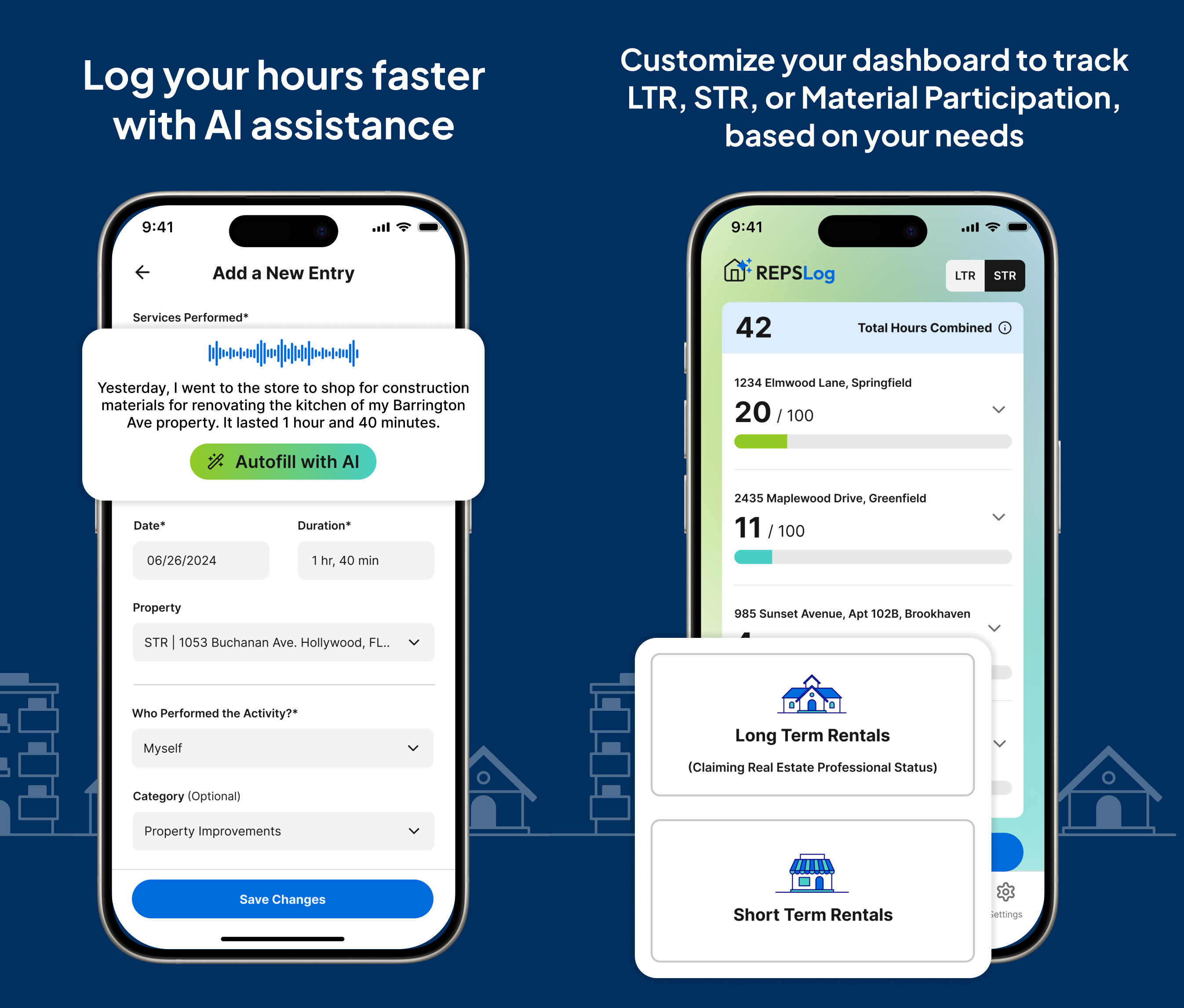
REPSLog makes it easy to log travel time alongside property management activities. Track each trip by property, note the purpose, and build a complete hour log that demonstrates your REPS qualification with precision.
Available on iOS | Android | Web
This article is for educational purposes only and does not constitute tax or legal advice. Consult a qualified tax professional for guidance tailored to your situation.
Do this in REPSLog
- Built-in Timer with Live Activity: time an activity live and drop the minutes into an entry.
- Evidence Attachments: attach receipts, invoices and photos to any entry.
- REPS Hour Tracking Goals (750 / 500 / 100): pick the 750, 500 or 100-hour test and watch progress per year and per property.
Step by step in the Help Center: how to use it. Try REPSLog free for 14 days on iPhone, Android or the web app.