Paying your children for legitimate work in your real estate business is one of the most straightforward and underutilized tax strategies available to rental property investors. When structured properly, you can shift income from your high tax bracket to your child’s low or zero bracket, create legitimate business deductions, and even fund tax-advantaged retirement accounts for your kids. This guide covers the age requirements, tasks children can realistically perform, compensation standards, and the documentation that keeps this strategy audit-proof.
Why This Strategy Works
The core tax benefit is simple: income shifting. When you pay your child for work, the payment is a deductible business expense for your LLC (reducing your taxable income at your marginal rate) and taxable income to your child (typically at a much lower rate or not at all).
For the 2026 tax year, a child with only earned income can earn up to the standard deduction amount without owing any federal income tax. This means thousands of dollars in compensation can be completely tax-free to your child while providing a dollar-for-dollar deduction against your rental income.
Additionally, if your real estate business is structured as a sole proprietorship or a single-member LLC (treated as a disregarded entity) and your child is under 18, their wages are exempt from Social Security and Medicare taxes (FICA) under IRC Section 3121(b)(3)(A). This exemption does not apply if the business is structured as a corporation or a multi-member LLC taxed as a partnership (unless the partnership’s only members are the child’s parents).

Age Requirements and Practical Considerations
There is no specific minimum age set by the IRS for employing your child. The standard is that the child must be capable of performing the work they are paid for, and the work must be legitimate. Practically, here is how age ranges typically work:
Ages 7 to 12: Appropriate for simple tasks such as cleaning common areas, organizing supplies, basic yard work, sorting paperwork, shredding documents, and similar duties. Compensation should reflect the simplicity of the tasks and the local market rate for such work.
Ages 13 to 15: Capable of more substantial work: cleaning rental units during turnover, painting, assisting with landscaping, data entry, organizing maintenance records, photography for listings, and basic bookkeeping assistance.
Ages 16 to 17: Can perform most tasks an adult worker would handle: property showings (with supervision), maintenance coordination, supply runs, tenant communication assistance, social media management for listings, and more complex administrative work.
Ages 18 and older: Treated as adult employees. The FICA exemption under IRC Section 3121(b)(3)(A) no longer applies (though it extends to age 21 for FUTA purposes). Compensation should match market rates for equivalent adult work.
The key at every age is that the child must actually perform the work. Paying your seven-year-old $500 per month for “consulting” is not going to withstand scrutiny. Paying your seven-year-old $12 per hour for four hours of cleaning rental units during Saturday turnover is legitimate.
Tasks Kids Can Realistically Perform
Here is a practical list of tasks organized by category, along with reasonable time estimates and compensation considerations:
Property Maintenance and Cleaning
- Cleaning rental units between tenants (vacuuming, mopping, wiping surfaces)
- Yard maintenance (mowing, raking, weeding, watering)
- Pressure washing driveways, walkways, and decks
- Painting interior walls and trim
- Minor repair assistance (holding tools, carrying materials, cleanup after repairs)
- Snow removal from walkways and driveways
- Stocking supplies (paper towels, cleaning products, light bulbs)
Administrative Tasks
- Filing paperwork and organizing documents
- Data entry (entering expenses into spreadsheets or accounting software)
- Scanning and digitizing documents
- Answering routine calls and taking messages
- Mailing letters and notices
- Organizing receipts and invoices
Marketing and Technology
- Taking photographs of properties for listings
- Updating listing descriptions on rental platforms
- Managing social media accounts for rental properties
- Creating simple flyers or marketing materials
- Researching rental comparables online
- Reviewing and responding to guest reviews (with supervision)
STR-Specific Tasks
- Turnover cleaning and preparation between guests
- Restocking consumables (toiletries, coffee, snacks)
- Laundering and folding linens
- Assembling welcome materials
- Inspecting properties after guest checkout
Determining Reasonable Compensation
The IRS requires that compensation paid to your children be “reasonable.” This means the amount paid should be comparable to what you would pay an unrelated person for the same work in your local market.
Factors to consider:
- Local minimum wage: Your child’s hourly rate should be at least minimum wage and should not dramatically exceed what you would pay a non-family member for the same task.
- Market rates for the work: If a cleaning service charges $20 per hour in your area, paying your 14-year-old $20 per hour for cleaning is reasonable. Paying them $75 per hour is not.
- The child’s age and capability: Younger children may reasonably be paid at or near minimum wage, while older teenagers with developed skills might earn more.
- Consistency with non-family workers: If you pay a contractor $15 per hour for yard work, paying your child $15 per hour for the same work is defensible.
What is NOT reasonable:
- Paying a child $50,000 per year for part-time, unskilled work
- Paying wages that far exceed the local market rate for comparable tasks
- Paying for work that was not actually performed
- Paying amounts that are clearly designed to maximize the deduction rather than reflect fair compensation
Documentation Requirements
Documentation is what separates a legitimate employment arrangement from an impermissible scheme. Treat your child’s employment with the same formality you would apply to any employee:
Employment Records
- Written job description listing the tasks the child will perform
- Employment agreement or offer letter specifying hourly rate, expected hours, and responsibilities
- W-4 form completed by the child (the parent may complete it on behalf of a minor)
- Time records showing dates worked, hours per day, and tasks performed
- Payroll records documenting each payment, including date, amount, and pay period
Payment Methods
- Pay by check or bank transfer. Never pay in cash without documentation. A paper trail is essential.
- Maintain a separate bank account in the child’s name (custodial account) where payments are deposited
- Issue a W-2 at year-end if applicable, or a 1099-NEC if the child is treated as an independent contractor (W-2 is generally preferable for the FICA exemption)
Work Product Documentation
- Before-and-after photos of cleaning or maintenance work
- Logs of tasks completed with dates and descriptions
- Screenshots or records of administrative work (data entry files, filed documents)
- Communication records showing the child’s involvement in property management tasks
Tax Benefits Breakdown
Here is a concrete example of the tax benefit:
Scenario: You are in the 32% federal tax bracket. You pay your 15-year-old child $12,000 per year for legitimate property maintenance work through your sole proprietorship or single-member LLC.
Your deduction: $12,000 deducted against your rental income, saving you $3,840 in federal taxes (32% x $12,000).
Your child’s tax: If the child has no other income, the $12,000 is below the standard deduction. Federal income tax owed: $0.
FICA savings: If the business is a sole proprietorship or disregarded-entity LLC and the child is under 18, no Social Security or Medicare taxes are due on either side.
Net tax savings: $3,840 in federal taxes, plus any applicable state tax savings, plus FICA savings. The money stays in the family.
Additional Opportunity: Roth IRA for Your Child
Once your child has earned income, they can contribute to a Roth IRA. A child earning $12,000 from your real estate business can contribute up to the annual Roth IRA limit (or their total earned income, whichever is less) to a Roth IRA.
The power of this move is extraordinary. Contributions made in a child’s teenage years have decades of tax-free growth ahead of them. A $6,000 annual contribution starting at age 14, growing at 8% annually, would be worth approximately $550,000 by age 55 without any additional contributions.
Structuring the Arrangement
Entity Structure Matters
The FICA exemption under IRC Section 3121(b)(3)(A) applies when a child under 18 is employed by:
- A parent’s sole proprietorship
- A single-member LLC owned by a parent (treated as a disregarded entity)
- A partnership where the only partners are the child’s parents
The FICA exemption does not apply when the employer is:
- A corporation (C corp or S corp)
- A multi-member LLC that includes non-parent members
- A partnership that includes non-parent partners
If your real estate business is held in a corporation or a multi-member LLC, you lose the FICA benefit. This does not disqualify you from paying your child, but the FICA savings disappear, reducing the overall tax benefit.
Frequency and Consistency
Pay your child on a regular schedule (weekly, biweekly, or monthly) rather than in a lump sum. Regular payments look like a real employment arrangement. A single $12,000 check in December looks like a tax scheme.
Hours Must Be Realistic
A child attending school full-time can realistically work 5 to 15 hours per week during the school year and 15 to 30 hours per week during summer. Your payment amounts and time records should reflect realistic work patterns, not year-round 40-hour weeks.
Common Pitfalls
Pitfall 1: No actual work performed. The most dangerous mistake. If your child did not actually do the work, the payments are not deductible and could trigger penalties. The IRS can reclassify the payments as gifts.
Pitfall 2: Excessive compensation. Paying above-market rates inflates the deduction beyond what is defensible. Keep rates consistent with what you would pay an unrelated person.
Pitfall 3: Poor documentation. Without time records, work product evidence, and proper payroll documentation, the arrangement is vulnerable in an audit.
Pitfall 4: Wrong entity structure. If you expect the FICA exemption but operate through a corporation, you will owe payroll taxes you did not budget for.
Pitfall 5: Not filing required forms. Depending on compensation levels and entity structure, you may need to file W-2s, payroll tax returns, and state-specific employment forms. Consult your CPA.
Pitfall 6: State labor law violations. Many states have restrictions on child labor, including minimum ages, maximum hours, and types of permitted work. Comply with your state’s labor laws in addition to federal tax requirements.
Frequently Asked Questions
Can I pay my child if my properties are managed by a property manager?
Yes, if there is legitimate work for the child to perform. Even with a property manager, tasks like cleaning between tenants, yard work, data entry, and administrative support may be performed by your child. The child’s work does not need to overlap with the property manager’s responsibilities.
Do I need workers’ compensation insurance for my child?
This depends on your state’s laws. Some states exempt family members from workers’ compensation requirements, while others do not. Check your state’s requirements before assuming an exemption applies.
Can both parents employ the same child through different entities?
Yes, if each parent has a separate business and the child performs legitimate work for each. Each business claims a deduction for the wages it pays, and the child reports total earned income from all sources.
What if my child is a college student over 18?
The FICA exemption for children under 18 no longer applies, but you can still employ your child and claim a deduction for reasonable compensation. The standard deduction still shelters a significant portion of the child’s income from tax.
Can I pay my grandchildren?
The FICA exemption under IRC Section 3121(b)(3)(A) applies specifically to a child employed by a parent. Grandchildren employed by grandparents do not qualify for the FICA exemption. However, you can still employ and deduct compensation paid to grandchildren if the work is legitimate and compensation is reasonable.
How does this interact with my REPS qualification?
Paying your child for property management work does not affect your own REPS qualification. Your child’s hours are their hours, not yours. You cannot count your child’s work hours toward your more than 750 hours requirement or your material participation tests (unless your child is your spouse, per 469(h)(5)).
Does paying my child count toward the 100-hour test for the STR loophole?
Your child’s hours count as their hours, which could potentially count against you under the comparative test (Test 3). If your child works more than 100 hours on a property and you work fewer hours than your child, your child’s hours would prevent you from satisfying Test 3. Carefully track both your hours and your child’s hours to avoid this issue.

Key Takeaways
- Paying your children for legitimate work in your real estate business shifts income from your high bracket to their low or zero bracket
- Children under 18 employed by a parent’s sole proprietorship or single-member LLC are exempt from Social Security and Medicare taxes
- Tasks must be legitimate, age-appropriate, and compensated at reasonable market rates
- Documentation is essential: job descriptions, time records, payment records, and work product evidence
- The standard deduction can shelter your child’s entire earned income from federal tax
- Roth IRA contributions using earned income create decades of tax-free growth
- Entity structure matters: the FICA exemption does not apply to corporations or multi-member LLCs with non-parent members
- Comply with state labor laws regarding minimum ages and permitted work types
Log Your Property Management Activities with REPSLog
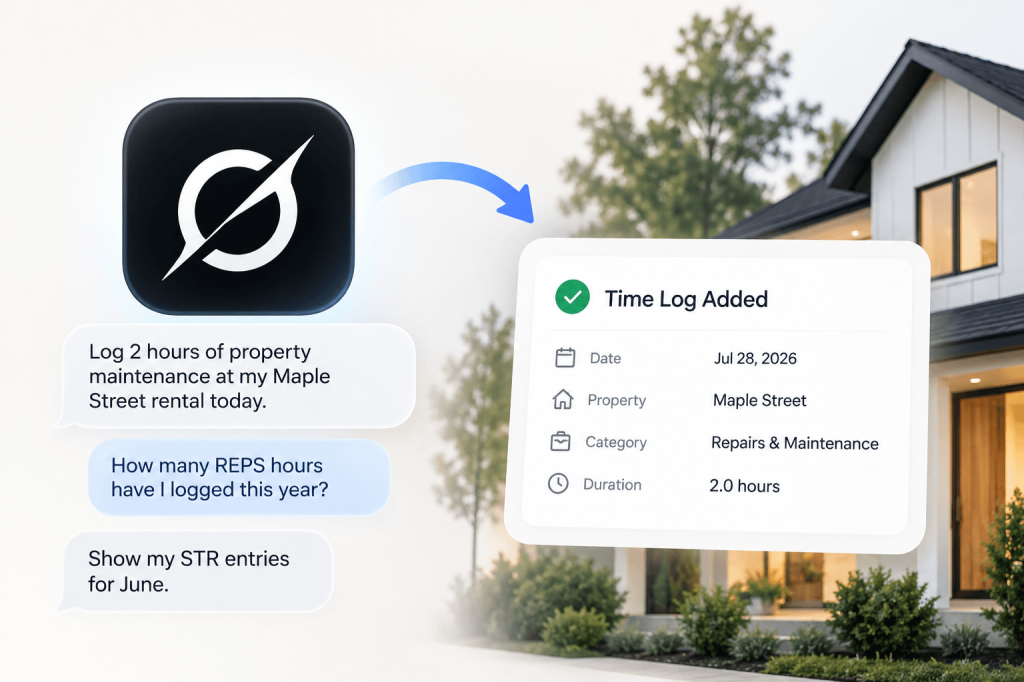
Whether you are tracking your own REPS hours or documenting tasks performed by family members helping with your properties, REPSLog keeps everything organized by property, category, and participant.
Available on iOS | Android | Web
This article is for educational purposes only and does not constitute tax or legal advice. Consult a qualified tax professional for guidance tailored to your situation.
Do this in REPSLog
- Participants: log who did each activity, so spouse hours count where allowed and contractor hours stay separate.
- Multiple Properties: add each rental by address, mark it LTR or STR, see hours per property.
- CPA-ready Export (PDF and CSV): a tax year as PDF and CSV, split by LTR and STR, with receipts.
Step by step in the Help Center: how to use it. Try REPSLog free for 14 days on iPhone, Android or the web app.